News 15-09-2026
British Columbia: A Turn East
British Columbians are traveling to the United States less often, the housing market is recovering slowly, and municipal leaders are discussing scooters and Indigenous rights.
British Columbia Turns Its Summer Routes Away from the U.S.
This summer, Metro Vancouver residents are traveling to the United States less often—both by land and by air. Data from several sources confirms a persistent trend that began well before the current vacation season and, apparently, shows no sign of reversing. Passenger traffic between Vancouver International Airport (YVR) and U.S. cities has fallen for 19 consecutive months, while southbound traffic at the Lower Mainland’s four border crossings continues to lose vehicles. Overall travel, however, is not declining—people are simply choosing different destinations.
According to data from the Vancouver Airport Authority (VAA), transborder flights—in other words, flights between YVR and all destinations in the United States—fell 2.8 percent year over year in July, to 667,118 passengers. During the first seven months of the year, the figure declined by a cumulative 4.3 percent, to 3,534,616 passengers. Airline representatives told Business in Vancouver that they began reducing the number of U.S. routes and flight frequencies as early as 2025, redirecting capacity to domestic Canadian routes as well as Mexico and the Asia-Pacific region.
It is important to understand that this does not mean people have stopped flying. On the contrary, Vancouver International Airport is becoming increasingly busy. Total passenger traffic through YVR rose 2.6 percent in July, to 2,732,171 passengers, and reached 16,105,221 passengers during the first seven months of 2026—3.7 percent more than during the same period a year earlier. Domestic traffic increased 4.2 percent in July, to 1,360,642 passengers, and was up 5.1 percent over the first seven months, to 7,918,865. But the most impressive growth came from the Asia-Pacific region: up 10.6 percent in July, to 431,472 passengers, and up 14 percent over seven months, to 2,936,885. In other words, U.S. flights are losing market share while Asian routes are actively gaining it.
The picture is even clearer on the ground. According to the Cascade Gateway Border Data Warehouse and the Whatcom Council of Governments, which track the Lower Mainland’s four border crossings—Peace Arch, Pacific Highway, Lynden and Sumas—southbound traffic for all vehicles fell nine percent year over year in August, to 252,256 vehicles. Compared with August 2024, the decline reached 33 percent. When all vehicles other than passenger cars with British Columbia licence plates are excluded from the data, the August decline is again nine percent, to 135,720 vehicles. In other words, the trend cannot be explained by through-traffic from other regions: local residents themselves have stopped traveling south.
In July, as Business in Vancouver previously reported, southbound traffic involving vehicles with British Columbia licence plates at these crossings fell 11 percent compared with July 2025 and 36 percent compared with July 2024. Because of technical problems with the platform used by data collectors, some days were not recorded at all from March through June. The publication therefore decided not to release statistics for those months in order to avoid distorting the picture. The last “clean” month before the problems was February, when southbound traffic by B.C.-plated vehicles fell 16.6 percent, marking the 13th consecutive month of decline.
Several factors are driving this shift, and they overlap. The first is economic. The Canadian dollar was slightly weaker in August than a year earlier—about 1.39 Canadian dollars per U.S. dollar, compared with roughly 1.38 a year earlier, according to X-Rates. For the average traveler, the difference is small, but combined with overall inflation, it makes a trip to the United States noticeably more expensive. The second factor is political. On Aug. 21, trade talks between the United States and Canada broke down, and Washington imposed 50 percent tariffs on a broad range of goods the following day. Although the tariffs do not directly affect tourists, they have intensified the general cooling in bilateral relations and, the publication notes, may have further discouraged travel to the United States.
The term “transborder” requires some explanation. In aviation statistics, it refers to flights crossing the Canada-U.S. border that operate under special customs procedures. When the number of such flights declines for 19 consecutive months, it is a signal not only to travelers but also to airlines, airports and border businesses—from hotels in Seattle to duty-free shops. It is also significant that growth in domestic and Asian traffic is fully offsetting losses on U.S. routes: overall passenger traffic at YVR is increasing, meaning Vancouver residents are not staying home but redirecting their travel to Toronto, Calgary, Tokyo, Seoul or Mexico City.
The key conclusion for businesses and policymakers is clear: the United States is becoming less attractive to British Columbia residents, and this is no longer a seasonal fluctuation but a structural shift, reinforced by 19 months of declining air traffic and a multiyear drop in land travel. Airlines adapted first, shifting capacity to Asia and within Canada—and, judging by the July figures, they made the right decision. Border communities in Washington State, by contrast, will have to accept that the flow of Canadian shoppers and tourists on which they relied for decades continues to dry up.
British Columbia Housing Market: Slow Recovery Amid Tariffs and Higher Rates
British Columbia’s real estate market continues to send mixed signals. On the one hand, home sales in August were again lower than a year earlier and remained well below historical norms. On the other, experts insist that a recovery is underway, albeit at a glacial pace. That is the contradictory picture described by the British Columbia Real Estate Association (BCREA), which released fresh August data.
According to the report, the total value of homes sold in the province during the month was $5.2 billion. That was 4.8 percent lower than in August 2025 and 25.4 percent below the 10-year average for the month. In other words, this August was one of the weakest in the long history of available records, even after seasonal factors are taken into account. BCREA chief economist Brendon Ogmundson sought to combine cautious optimism with a realistic assessment of the risks in comments to CityNews Vancouver: “Home sales in the province remain well below long-term averages, but have been steadily improving over the past year. We expect the gradual recovery in sales to continue, although new tariffs and the recent jump in long-term interest rates add a layer of risk to this outlook.”
The figures confirm that “improvement” is a relative term. The average price of a home listed for sale across the province was $924,826, approximately one percent below last year’s level. The number of transactions fell 5.5 percent compared with August 2025, with a total of 46,069 properties changing hands. At the same time, trends varied across the largest metropolitan areas. In Greater Vancouver, the average price was $1,213,418, down 1.3 percent year over year, while sales fell 3.6 percent, to 1,869 units. In the Fraser Valley, the average price declined to $949,354, a drop of 4.7 percent, while in Chilliwack it rose 1.5 percent, to $746,289. This divergence shows that the market is not uniform: in some places, prices are still supported by limited supply, while elsewhere buyers have finally seen the long-awaited correction.
The cumulative total for the year is also disappointing. Since the beginning of 2026, transactions worth $43.26 billion have been completed in the province, 6.5 percent less than during the same period last year. For those less familiar with macroeconomics, two key terms in the report deserve explanation. “Long-term interest rates” refers to government bond yields and rates on long-term mortgages; when they rise, monthly mortgage payments increase and buyers become more cautious. “Tariffs” in this context are trade duties that can hurt employment and household incomes and, in turn, people’s willingness to take on large loans.
The key takeaway from the BCREA report is this: the market is not collapsing, but neither is it recovering with confidence. It is balancing between buyers’ gradual return and pressure from external factors—trade policy and borrowing costs. If rates continue to rise and tariff threats materialize, the “gradual recovery” could be delayed indefinitely. If long-term rates stabilize and the province’s economy withstands tariff pressure, the current low sales figures could prove to be the bottom from which a more substantial upswing begins. For now, buyers and sellers continue to proceed cautiously, waiting for clearer signals.
From Scooters to Indigenous Rights: What Worries B.C. Municipal Leaders
The annual Union of B.C. Municipalities conference, which brought nearly 2,000 delegates to Vancouver, would seem to be focused on serious issues—housing affordability, crime and the future of the Indigenous rights law. But when New Westminster Mayor Patrick Johnstone was asked about the main concern among older residents in his city, the answer was unexpected: seniors are afraid of electric scooters on sidewalks. The detail, raised amid sweeping political debates, illustrates how local governments are forced to juggle issues ranging from the deeply everyday to the constitutional.
Speaking to reporters outside the convention centre, Johnstone called e-scooters a “relatively new threat” compared with cars, but emphasized that the provincial government has been testing their use in individual communities for seven years and still has not introduced uniform safety rules. In his view, the province should establish regulations that apply across all municipalities while investing in education and active-transportation infrastructure. The problem is genuinely growing: e-scooter collisions have already prompted British Columbia police to issue warnings, and several school districts have restricted their use. It is telling that this seemingly local issue appeared on the same agenda as much weightier subjects—this is how municipal politics works, where a specific retiree’s fear for their safety on a sidewalk carries no less weight than the fate of a foundational law.
The conference’s main political event, however, is expected to be the future of British Columbia’s Declaration on the Rights of Indigenous Peoples Act, known as DRIPA. Deputy Premier Niki Sharma will take part in an expanded plenary session on the legislation Tuesday. The context is tense: in April, Premier David Eby backed away from a plan to suspend or amend the law after strong opposition from many Indigenous leaders, while members of the provincial Conservatives are calling for the law to be scrapped altogether. Eby and Conservative Opposition Leader Trevor Halford will both speak at the convention later this week—their speeches will likely indicate how intense the standoff over DRIPA remains.
Several points are worth clarifying to understand what is happening. DRIPA is a provincial law requiring the British Columbia government to bring all its laws into alignment with the United Nations Declaration on the Rights of Indigenous Peoples. In practice, this means coordinating decisions affecting the lands and rights of Indigenous communities, which has drawn opposition from those who see it as a threat to investment and resource projects. E-scooters, meanwhile, belong to the category known as micromobility—light electric devices that have fallen into a legal gray area in most Canadian provinces because they were created under rules for cars and bicycles, not for a new class of transportation. This vacuum creates a paradox: devices intended to reduce pressure on roads have become a source of concern for the most vulnerable pedestrians.
The story’s central value is that it exposes the real hierarchy of local problems and the gap between provincial and municipal agendas. Mayor Johnstone effectively issued a criticism of the province: seven years of testing without uniform rules is an example of regional government shifting risks onto municipalities without giving them the necessary tools. At the same time, the DRIPA case shows how fragile the compromise remains between Indigenous rights and right-wing political pressure. Eby’s retreat in April was seen as a concession, but it did not satisfy Conservative demands for the law’s complete repeal. The conference is therefore becoming a forum where local leaders are asking the province for concrete decisions—whether traffic rules for scooters or clarity on DRIPA’s constitutional status—rather than yet another delay. The way Eby and Halford’s speeches unfold later this week will show whether the province is prepared to respond to those demands or prefers to continue leaving difficult questions to municipalities.




News 13-09-2026
Vancouver: Weekend Childcare, Events Guide and Flood Risk
Vancouver is launching its first licensed weekend childcare programs for working parents; an events guide for September 14–20; and a Statistics Canada report shows that Canadian cities continue to build homes in flood-prone areas.
Vancouver Launches First Licensed Weekend Childcare Programs: A Shift for Working Parents
In today’s world, where working hours have long ceased to follow the standard “nine to five,” finding affordable childcare on weekends has become a genuine headache for millions of families. Vancouver, one of Canada’s most dynamic cities, has taken an important step toward addressing the problem by opening the first licensed extended-day programs for school-age children operating on Saturdays and Sundays. The development, reported by CBC News, marks not merely the arrival of a new service but the beginning of a significant cultural shift in the social-support system.
From 8 a.m. to 6 p.m. Pacific time, children aged five to 12 can now attend the Champlain Heights community centre. The initiative did not emerge out of nowhere: Robert Baxter, president of the community-centre association and a parent himself, noticed that the building sat largely unused on weekends while many families were desperately looking for someone to care for their children. “We realized our childcare centre was underused on weekends,” the publication quoted him as saying. The program’s main feature is flexibility. Parents can register their child for a single day or for several weekends, which is crucial for people working rotating schedules. The service costs $65 per day. However, Baxter notes that, unlike private babysitters or unlicensed sitters, the program allows parents to access the provincial fee-reduction program for childcare, making expenses more predictable.
Vancouver city councillor Sean Orr emphasizes that affordability and access to childcare are issues that concern most city residents. “Not everyone works nine to five,” he said. “It’s really important to be able to access childcare during non-standard hours.” Orr also added that weekend services could be especially valuable for newly arrived immigrants, who often lack the support of extended family members able to help with grandchildren or nieces and nephews. The observation highlights the project’s social role: it not only makes working life easier but also supports integration.
Perhaps the most important comment, however, came from Sharon Gregson of the Coalition of Child Care Advocates of British Columbia. She calls the arrival of weekend programs “a major cultural shift” and points out that such a service has long been needed. According to her, about 75 percent of children in the province do not have access to licensed childcare, and one of the main reasons is the lack of flexible operating hours. Doctors, nurses, emergency-service workers, hotel and restaurant employees, and real-estate agents often work precisely when traditional childcare centres are closed. “This is a really great start,” Gregson concludes.
To understand the significance of the change, several points should be clarified. Licensed childcare means that a facility meets government standards for safety, hygiene and staff qualifications, giving parents legal protections and access to subsidies. Unlicensed care, such as babysitting, may be cheaper or more convenient, but it is not regulated by the government and does not qualify for tax deductions or provincial support programs. That is why moving from “hourly babysitting” to a structured solution based at a community centre represents a qualitative leap. Rotating schedules, mentioned in the article, are common in service and healthcare industries, where employees work shifts and their days off may fall in the middle of the week—or on Saturday and Sunday—making standard childcare centres impractical.
Baxter said he hopes their example will inspire other community centres to follow suit. “We hope this becomes an example that really moves the needle and fills this gap,” he said. For now, it is only a first step, but it demonstrates the willingness of city authorities and community organizations to adapt to the realities of the modern labour market. If the Champlain Heights experiment proves successful, it could become a model for the entire province, where a shortage of childcare spaces remains one of the most urgent social problems.
Things to Do in Vancouver from September 14 to 20: A Guide to the Last Week of Summer
The last official week of summer in Vancouver always feels like a brief pause before the rainy season, and the city seems determined to get as much as possible out of the warm weather. These seven days feature several major music events, theatre premieres, food festivals and street celebrations spanning almost every part of Metro Vancouver—from Granville Island to Whistler and Richmond. In its article “20 fantastic things to do in Vancouver this week: Sept. 14 to 20,” Daily Hive compiled 20 reasons not to stay home. The list is worth examining more closely because behind its entertainment-focused format lies a fairly precise snapshot of what drives the city: a mix of nostalgia for 1990s rock, Indigenous art, sustainable fishing and local food culture.
The week’s main musical attraction is Keanu Reeves, who is coming to Vancouver not to film a movie but with his band Dogstar as part of the All In Now tour. The concert takes place on Wednesday, September 16, at 7:30 p.m. at the Vogue Theatre. The event is interesting from two perspectives: Reeves is both a Canadian and Hollywood icon and a four-time MTV Movie Award winner, while his band remains the same 1990s grunge group that released a new album only this spring. That same evening, at 8 p.m. at the Queen Elizabeth Theatre, Beck, an eight-time Grammy winner, will perform as part of his Ride Lonesome tour. Live-music fans will therefore have to choose between two venues on the same night.
The musical week’s climax will be, with a note about the future, the announcement of Foo Fighters. The band will bring its Take Cover stadium tour to BC Place on September 20, 2026, marking its first stadium tour in years. Queens of the Stone Age will join the Canadian dates—a band whose heavy, hypnotic style is perfectly suited to the stadium format. For Vancouver, this is more than just a concert: it confirms the city’s status as a mandatory stop for artists of “15 Grammy” calibre.
The cultural program is just as packed. The Vancouver Fringe Festival, running from September 10 to 20, turns Granville Island and other city venues into a laboratory for experimental theatre, with more than 80 productions, two days of free children’s events and the return of the free Fringe Patio music series. Duran Cruickshank deserves special mention: at Little Mountain Gallery, he performs a 35-minute solo version of Home Alone, playing 33 characters across 29 scenes, with 11 pizzas, 10 traps and two burglars. It is exactly the kind of format in which festival aesthetics meet pop-culture nostalgia and push the performer’s endurance to its limits. BBC Culture has repeatedly noted that such one-person shows often become festivals’ biggest discoveries—and this is precisely such a case.
A major thematic highlight of the week is the ʔəm̓i ce:p xwiwəl (Come Toward the Fire) festival, presented by the Chan Centre for the Performing Arts in partnership with the Musqueam people from September 18 to 20. Artists, musicians, speakers and dance groups from Musqueam and other Indigenous nations of Turtle Island—as North America is known in Indigenous tradition—will share one stage. This is fundamentally different from an ordinary city festival: culture is not being put on display but presented as a living practice. Some events are free, while others require tickets. The Still Moon Arts Society’s full-moon festival, held with the Renfrew Park Community Association, is similar in spirit. This year’s theme is “Tiny Life,” featuring origami, lanterns and performances, with events continuing through September 26.
Theatrical classics are represented by Bard on the Beach, one of Canada’s largest not-for-profit Shakespeare festivals, running through September 19 at Vanier Park on the waterfront. This season’s productions include The Merry Wives of Windsor, Macbeth, Goblin:Oedipus and Antigone. The context matters: the festival has existed since 1990 and has long been part of Vancouver’s cultural identity, while its waterfront tents are among the city’s most recognizable visual symbols.
For those who prefer movement to the stage, Bike the Night takes place on Friday, September 18. The free nighttime bike ride along the Seawall features music, lighting and prizes and is designed for all ages and skill levels. The evening begins with a festival at David Lam Park from 5 to 10 p.m., featuring live music, food trucks, registration with Project 529—a bicycle-registration service that helps recover stolen bikes—and bike tuneups from MEC. The first wave starts at 6:30 p.m. and is intended for younger riders; the second begins at 7:45 p.m.
The food section of the list reflects how Vancouver is rethinking local resources. In Richmond, the Divers’ Catch Festival, organized by the BC Dive Fisheries Society, returns for a second year on September 19. It celebrates sustainably harvested seafood, with geoduck, sea urchin (uni) and sea cucumber—hand-harvested in British Columbia waters—as the main attractions. Admission is $138.88 per person, with sessions from 5:30 to 7 p.m. and 7:30 to 9 p.m. at the Gulf of Georgia Cannery. The price may seem high, but it reflects not only the food but also the festival’s educational mission: showing that sustainable hand-harvesting represents a distinct economy and culture rather than an exotic novelty. By comparison, the Richmond Night Market, which is taking place for the final time this year on Fridays, Saturdays, Sundays and holiday Mondays through September 20, charges only $7 admission and offers more than 500 food items, the world’s first night-market zipline and a Trading Card zone. This year’s theme is “Little Wonder World,” complete with a giant soccer installation. Children under seven and adults aged 60 and over enter free, while a Zoom Pass costs $40.
Local food culture is also expanding in North Vancouver. Ignite Pizzeria has opened its first North Shore location in the historic 1904 Beasley Block building at 101 Lonsdale Ave. The dough is fermented for five days and baked on stone at 800 degrees Fahrenheit. The location also offers an expanded menu, cocktails, a wine list, a south-facing patio and a daily happy hour. Hours are 11 a.m. to 7 p.m. Sunday through Thursday and until 11 p.m. on Friday and Saturday.
Another important thread this week is visual art. At Pendulum Gallery, 885 W. Georgia St., the Splash 2026 Art Collection exhibition runs through October 1, featuring about 100 works donated by Canadian and international artists. The artists include Andrew Dadson, a multidisciplinary artist working at the intersection of painting, photography and installation; Edward Burtynsky, one of the world’s best-known contemporary photographers, whose industrial landscapes have long become part of the visual canon of the Anthropocene; and Marie Khouri, a sculptor with studios in Paris and Vancouver. The gallery is open from 9 a.m. to 6 p.m. Monday through Wednesday, until 9 p.m. Thursday and Friday, and until 5 p.m. Saturday. Admission is free, and no appointment is required.
Historical walks and sports occupy their own niches. On September 19 at 1 p.m., Forbidden Vancouver Walking Tours presents the Death and Life of Granville Street Walking Tour, led by historian and writer Aaron Chapman and Forbidden Vancouver founder Will Woods. Over six blocks, the tour explores a century of change, including vaudeville stages, movie palaces and urban-planning experiments. Tickets cost $35, with participants meeting at Vancouver City Centre station. That same day at 2 p.m., Vancouver Rise faces Montreal Roses in the Northern Super League at Swangard Stadium in Burnaby. Tickets start at $20 plus fees.
Finally, the 13th Whistler Village Beer Festival, running from September 16 to 20, turns the village into a craft-beer capital, with Oktoberfest, a craft brunch, “bandoke”—karaoke with a live band—and the main event on September 19 from noon to 5 p.m. at Whistler Olympic Plaza, where visitors can sample dozens of ciders and beers.
Canadian Cities Continue Building Homes in Flood-Prone Areas
A new Statistics Canada report published earlier this month has raised concerns among urban-planning specialists and climatologists: a significant share of homes in Winnipeg, Vancouver, Chatham-Kent, Ontario, and Chilliwack, British Columbia, is located in areas at high risk of flooding. The report’s authors also note that in Manitoba, Saskatchewan and British Columbia, the share of recently built housing in such hazardous areas is increasing. This is happening amid an acute housing crisis and government programs aimed at increasing construction. In other words, the effort to address housing affordability quickly may unintentionally expose more Canadians to flood-related risks, which are expected to become more frequent and intense as a result of climate change.
The most striking situation is in Winnipeg. More than 112,000 properties—45 percent of all dwellings in the metropolitan area—are located in high-risk flood zones. Statistics Canada defines these areas as locations where at least 80 percent of the land falls within the boundaries of so-called 100-year floodplains: areas with a one-percent chance of flooding in any given year. At the same time, the share of homes built in these zones is increasing. One important caveat is that the report does not account for protective infrastructure such as dikes and diversion channels, which Winnipeg uses in particular. However, the authors stress that the data still provide a useful indication of which areas could be affected if those protective systems fail.
In Metro Vancouver, more than 85,000 homes—slightly more than 10 percent of the housing stock—are located in high-risk areas vulnerable both to spring flooding on the Fraser River and to coastal storm surges. However, as Samuel McIntyre, a senior analyst with the Canadian Housing Statistics Program, points out, these figures are understated because they do not include high- and low-rise multi-unit buildings. Vancouver presents a somewhat unexpected picture compared with the rest of the country: the average assessed value of properties in flood zones was 4.5 percent higher than in areas not exposed to flooding, while the incomes of people living in those homes were 17 percent lower. In addition, Metro Vancouver’s flood-zone population includes a disproportionately high share of people over 55. McIntyre explains that many of them are likely retirees with modest incomes who nevertheless own relatively expensive property. This contrasts with the rest of the province, where high-risk areas generally have lower assessed property values.
One reason for this paradox, according to Hadi Mohammad Nahiduzzaman, a professor of engineering at the University of British Columbia’s Okanagan campus, is that land in river floodplains is usually cheaper for developers. “When they acquire this land for construction, the overall cost goes down, and then these retirees can easily afford such homes. But that is a misconception,” he says. In his view, more effective government regulation is needed to ensure that vulnerable groups are not disproportionately exposed to flood risk.
Statistics Canada’s report does not provide geographic data more detailed than the metropolitan-area level. However, the Fraser Basin Council has already prepared flood maps for Metro Vancouver and the Fraser Valley that account for protective infrastructure and model several scenarios, including snowmelt flooding and coastal storms. Steve Litke, the council’s director of water programs, believes the region’s protective infrastructure would mostly withstand a 100-year storm. In Metro Vancouver, flooding would most likely be limited to areas along the river, but in Chilliwack, which is also mentioned in the report, flooding could extend beyond the dikes, particularly around the Vedder Canal. “In British Columbia, we are more concerned about 200-year floods or record floods,” Litke says. “We should be very concerned about our exposure to events of that magnitude. Early signs indicate that we are going to see larger and more frequent floods. What used to be a 100-year flood could become a 50-year flood.” Under a Fraser River flood scenario involving a half-metre rise in sea level by 2050, significant parts of Metro Vancouver and the Fraser Valley would be submerged, including large areas of Chilliwack, Abbotsford and Agassiz, as well as parts of Pitt Meadows, Maple Ridge and Port Coquitlam.
Litke emphasizes that such scenarios demonstrate the importance not only of building protective infrastructure but also of maintaining and upgrading it as the climate changes. “This is very expensive infrastructure to build, maintain and especially upgrade. Staying ahead of climate projections, considering raising and widening dikes, accounting for a one-metre rise in sea level and dealing with coastal dikes—that is a major challenge,” he says.
The Statistics Canada report does not include data for Quebec, Newfoundland and Labrador, the Northwest Territories or Nunavut, nor does it cover Indigenous reserves, non-residential properties or vacant land. Nevertheless, it makes one point clear: Canada continues to expand housing construction in areas that are highly likely to face flood threats. Without coordinated regulation and climate-adaptation measures, this trend could have serious humanitarian and financial consequences.


News 12-09-2026
Technology, Culture and Growth: How British Columbia Is Changing
A story about how the theft of tokens at a rib festival led to the creation of digital fraud protection, while a Vancouver artist brought local landscapes into Marvel's Wolverine. Meanwhile, North Vancouver opened its first new elementary school in 35 years at a cost of $61 million, symbolizing the region’s rapid growth.
Digital Tokens Against Fraud: How a Theft at a British Columbia Rib Festival Led to a Technological Solution
A story that began with an ordinary theft at a food festival turned into an unexpected example of how a local problem can inspire innovation. Organizers of Esquimalt Ribfest, a popular barbecue festival in British Columbia, faced a sophisticated scam: criminals 3D-printed counterfeit tokens used to purchase beer and exchanged them for real drinks, causing financial losses and undermining confidence in the payment system used at large events. The incident, which occurred in 2025, prompted a local resident to consider how similar events could be protected against digital and physical counterfeiting. The result was the development of so-called “digital scam-resistant beer tokens”—a solution that combines the simplicity of traditional tokens with the security of modern technology. CTV News details the story.
The problem faced by Ribfest organizers lies in the vulnerability of anonymous physical tokens. Visitors typically buy tokens with cash and then exchange them for beer at serving stations. With a 3D printer, fraudsters can create copies that are nearly indistinguishable from the originals, particularly when the token design lacks sophisticated security features. At Esquimalt Ribfest, the criminals exploited precisely this weakness: volunteers accepted the printed tokens because they could not quickly verify the authenticity of each one. The damage was twofold—financial losses for the organizers and a loss of confidence in a system intended to be fast and convenient in crowded conditions.
The response was a solution developed by a local resident whose name was not identified in the report, but whose initiative deserves attention. The idea is to create a digital equivalent of the token that cannot be counterfeited through 3D printing. Presumably, the system links each token to a unique digital code or QR tag verified through a secure mobile app or terminal. This approach prevents mass duplication because each token is unique and can be used only once for a transaction. In addition, the digital format allows organizers to track circulation, identify anomalies and instantly block suspicious transactions.
The new system’s key advantage is its resistance to scams without compromising service speed. At festivals, where beer lines can be long and volunteers may not have technical training, verification must take only seconds. Digital tokens would likely be scanned with a smartphone or dedicated device, reducing the risk of human error. The digital format also creates opportunities to integrate cashless payments, reducing the amount of cash on-site and further lowering the risk of theft.
However, implementing such solutions comes with challenges. Not all festivalgoers are willing to use apps or smartphones to buy beer—particularly older people or those who prefer anonymity. Infrastructure is another concern: Would additional scanning stations be needed, and how could organizers ensure reliable network service in densely built areas with large numbers of users? Nevertheless, the Esquimalt Ribfest case shows that even a local incident can lead to technology that could eventually become standard at all kinds of mass events, from music festivals to sporting matches.
It is telling that the problem emerged not in the high-tech sector but at an ordinary food festival. This is a reminder that digital security is no longer limited to banks and corporations—it is becoming part of everyday life, including seemingly harmless objects such as a beer token. The development described in the CTV News report is not merely a technical fix but a signal that any system for exchanging value, however simple, needs protection against counterfeiting. If the 3D printer becomes a tool for fraudsters, digital technology may provide the response that restores trust in offline events.
Ultimately, the token theft at Esquimalt Ribfest became an example of how a local vulnerability can drive innovation. Scam-resistant digital tokens are not only a way to protect festival revenue but also a step toward a more transparent and secure economy for mass events. It remains to be seen how widely these solutions will spread in the coming summer seasons and whether they will become the new standard for the events industry.
Vancouver Artist Brings British Columbia to Marvel's Wolverine
The release of Sony PlayStation’s Marvel's Wolverine has become one of the most anticipated events for gamers around the world. It is now known that the game’s virtual world will feature landscapes from British Columbia. Much of the credit goes to Vancouver artist Gavin Goulden, who serves as senior art director at Insomniac Games. For Goulden, it was essential that the iconic hero not merely appear in Canada, but that Vancouver be allowed to play itself rather than serve as a stand-in for another city. “It’s often a filming location, but it’s depicted as another city,” the developer told Daily Hive. “So having the opportunity to showcase the Vancouver area itself and offer a unique take while still being authentic to the real place is a huge honour and something that was personally important to me.”
The game’s story, scheduled for release on Tuesday, September 15, is an original adventure that travels to different parts of the world, from Japan to the fictional island nation of Madripoor and, of course, Canada. Although it has not been explicitly stated, the opening sequence takes place in North Vancouver, featuring an epic scene at the famous sulphur pile—a mound of petroleum-refining byproduct that has become an unofficial symbol of the region’s industrial landscape. The cutscene also offers glimpses of the sails of Canada Place, the Vancouver Lookout at Harbour Centre and the Lions Gate Bridge. Goulden says the location was chosen not only for its visual impact but also for gameplay reasons: the sulphur pile creates an ideal arena for Wolverine’s fierce combat style while standing out as a unique place that locals will recognize instantly and everyone else will start Googling.
In the game’s first trailer, released last fall, Wolverine rides a motorcycle, while a road sign pointing to Squamish appears in the background. Notably, the sign prominently features the language of the Squamish people, an Indigenous nation whose traditional territory extends along the coast north of Vancouver. For Goulden, a lifelong comics fan, this was more than a formality: “It was incredibly important to me that the Squamish Nation language be clearly visible on our signs. It may seem like a small detail to some people, but for many of us who live in this area, it’s an important detail. When you recreate a real place—even if you take artistic liberties to fit it into the project’s vision—the goal is always authenticity and respect for the communities that live there.”
Goulden, who enjoys walking his dogs at Kits Beach and wandering through Stanley Park, says he is proud of his team’s work. “I couldn’t be prouder. I feel like we’ve created something truly special that honours a character with such a rich history while telling a unique story that takes Wolverine to different parts of the world—including Canada—with high-octane action, brutal combat true to Wolverine’s spirit and realistic graphics on PlayStation 5. I hope everyone gets to try it.” The wait is nearly over: players will be able to take control of Weapon X on PS5 on September 15.
What to understand in this article. A “sulphur pile” is a real mound of sulphide ore or sulfur left over from industrial activity on the shore of Burrard Inlet in North Vancouver. It has long been a local landmark and even a subject of environmental debate. The Squamish Nation language is one of the Indigenous languages of the region and belongs to the Salish language family. Its presence on road signs in the game is not merely decorative but an act of cultural recognition, something rarely seen in the video game industry. Finally, Madripoor is a fictional island nation in Marvel, known as a refuge for mutants and criminals, which first appeared in X-Men comics.
Key takeaways. Marvel's Wolverine will be a rare example of an AAA project in which a Canadian location does not disguise itself as an American city but plays itself. Including the Squamish language and recognizable Vancouver landmarks is not only a marketing move aimed at local audiences but also a statement about the value of regional identity in a global product. For Insomniac Games, already known for Spider-Man and its detailed depiction of New York, this continues the strategy of treating the city as a character—but now with an emphasis on respect for Indigenous peoples and their lands. The PS5 release on September 15 will show how well this approach resonates with players around the world, who may see North Vancouver for the first time not as a backdrop but as a fully realized setting.
North Vancouver Opens Its First New Elementary School in 35 Years
North Vancouver, one of Greater Vancouver’s oldest and fastest-growing suburbs, has received a long-awaited addition to its educational infrastructure. After a 35-year hiatus, the area has opened its first entirely new elementary school, Cloverley Elementary. Although the event may initially seem local, it reflects much broader trends: rapid population growth, a chronic shortage of school and child-care spaces, and an effort by British Columbia’s government to address social needs while advancing its climate agenda.
The $61 million project is more than just another school building. It has room for 585 students and includes an additional 92 child-care spaces for children under five. Combining educational and early-childhood infrastructure in one complex is becoming increasingly common in Canadian cities, where young families face a dual problem: a shortage of schools and a lack of affordable daycare spaces. Antje Wilson, chair of the North Vancouver School Board, said the community is growing and families need schools that grow with them. Cloverley Elementary, she said, responds to that demand by offering not only classroom space but also a modern educational environment designed for the future.
The project places particular emphasis on sustainability. The school was built using mass timber, a technology actively promoted in British Columbia as a way to reduce construction’s carbon footprint. Mass timber is an engineered material made from layers of wood bonded together. It can rival concrete and steel in strength, while requiring significantly less energy to produce and storing carbon within the structure rather than releasing it into the atmosphere. Combined with energy-efficient features, this approach is expected to reduce greenhouse-gas emissions and the building’s overall environmental footprint.
For Bowinn Ma, the provincial minister responsible for infrastructure, the project has personal significance. She emphasized that among the hundreds of major capital projects her ministry is delivering across the province, the new Cloverley school holds a special place in her heart because it is located in her home community. The minister also thanked the parents, school district and local residents who, she said, never stopped advocating for the school’s construction. It is an investment that will serve community families for generations, she said.
The opening of Cloverley Elementary illustrates how demographic pressure is changing government spending priorities. North Vancouver, traditionally viewed as a quiet bedroom community, has experienced a housing boom and an influx of young families in recent years. This, in turn, has intensified the problem of overcrowded classrooms and temporary modular buildings, which have been used for years as stopgap measures. The new school should ease some of that pressure, although experts note that a single facility will not be enough to meet growing demand.
It is also significant that the project was completed as part of a broader provincial strategy to build and modernize schools. In recent years, British Columbia has increased capital investment in education in an effort to catch up after decades of underinvestment. Critics, however, say construction is still lagging behind population growth, particularly in rapidly expanding municipalities such as North Vancouver, Surrey and Langley.
Another important aspect is the integration of child-care spaces into school complexes. The 92 spaces for children under five at Cloverley Elementary are not merely an add-on but part of a deliberate policy aimed at supporting working parents. In Canada, the shortage of affordable daycare remains one of the biggest challenges facing young families. Combining educational and early-childhood services in one building allows infrastructure and land resources to be used more efficiently.
The opening of Cloverley Elementary, then, is more than a local story about a new school. It is a symptom of deeper changes: suburban growth, a rethinking of construction technology with an emphasis on sustainability, and an attempt by governments to catch up with demographic reality. The only question is whether authorities will build enough schools before today’s first-graders become parents themselves.



News 11-09-2026
Road Rage, Rent Prices and Survival in British Columbia’s Wilderness
This new digest features three stories from British Columbia. Photographer Robin Nuber rescued a stabbing victim during a road-rage incident in Surrey: a man with multiple injuries clung to his Tesla while the attacker pursued them with a knife. The attacker was arrested and charged with assault with a weapon, criminal harassment and uttering threats. The second story is liv.rent’s report on rental prices in Metro Vancouver in September 2026: unfurnished one-bedroom apartments fell to $2,085, but four of Canada’s five most expensive cities for renters are still located here, and the gap between West Vancouver and Surrey exceeds $700 per month. The third story concerns British Columbia resident Stanislav Volo, who spent six days alone in the forests near Squamish and survived by remaining calm, minimizing movement and using natural resources, according to the operations manager of a local search-and-rescue service.
Road Rage in British Columbia: How a Photographer Saved a Stabbing Victim
On Monday evening in Surrey, a Vancouver suburb, an incident unfolded that local photographer Robin Nuber compared to a scene from an action movie. Returning home from Los Angeles, he found himself at the center of a road-rage confrontation that nearly ended in tragedy. According to Surrey police, a 37-year-old man has been charged with assault with a weapon, criminal harassment and uttering threats. He remains in custody and was scheduled to appear at Surrey Provincial Court on Thursday to set a date for his next hearing. The case not only highlights the growing danger of road rage, but also demonstrates how a bystander can become a key figure in saving someone’s life.
The incident unfolded rapidly. Nuber was heading to a photo shoot at Redwood Park in Surrey when he noticed that a pickup truck and a Jeep had collided and that the airbags in both vehicles had deployed. He slowed down and began recording the scene on his phone, assuming it was a road-rage incident. Soon, he began to question his own safety after hearing someone shout, “He has a knife!” A barefoot man ran toward his Tesla, pleading for help. As Nuber later told CBC, he felt as though he were on the set of Universal Studios, but this was a brutal reality. According to Nuber, the victim had multiple injuries: a split lip, a cut above his right eye and lacerations on his arm. Video recorded by the Tesla’s dashcam shows the knife-wielding attacker pursuing the vehicle as Nuber reverses, while the injured man clings to the open rear door. Nuber shouts, “Hold on,” and only after reaching a safe distance does he stop to let the man inside. “The guy was essentially hanging onto my car and being dragged beneath the door for about 100 feet. I was pulling him away from the pursuer,” the photographer recalled. Eventually, the attacker abandoned the chase, walked toward a wooded area and threw the knife into the brush. Police arrived within minutes and arrested the suspect without incident. According to officers, the victim was attempting to leave in his Ford pickup when the suspect, driving a Jeep Wrangler, rammed it. The victim then fled the vehicle, and the knife-wielding attacker chased him.
The case raises several important questions. First, road rage in British Columbia, as in many parts of North America, is becoming increasingly dangerous. Surrey police said the call came in at 4:44 p.m., and officers arrived at the scene quickly. However, it was Nuber’s civilian intervention—remaining calm and using his vehicle as shelter—that prevented more serious consequences. Second, the incident shows how quickly an everyday conflict on the road can escalate into an armed attack. The suspect faces charges of assault with a weapon, criminal harassment and uttering threats—serious offences that could result in a lengthy prison sentence. Third, Nuber’s actions illustrate the psychology of survival: “If you ever find yourself in a situation like that, you might surprise yourself and what your instincts do,” he said. His words echo the familiar truth that, in a crisis, people often act faster than they can think. For context, “road rage” refers to aggressive driving behaviour caused by stress, haste or personal conflicts, and can include pursuit, threats and physical violence. In this case, the collision between two vehicles triggered the escalation. It is also worth noting that Nuber’s Tesla likely had cameras that recorded the incident, helping police gather evidence. Nuber is a photographer, and his professional habit of documenting everything around him may have helped him remain composed. The case is a reminder that even in Vancouver’s peaceful suburbs, the unpredictable can happen—and that helping a stranger may require considerable effort, but can save a life.
Renting a One-Bedroom Apartment in Vancouver in September 2026: Prices Fell Slightly, but It’s Too Early to Celebrate
Metro Vancouver’s rental market delivered renters a small but welcome surprise in September 2026: the average rent for an unfurnished one-bedroom apartment fell to C$2,085, down $13 from August’s figure of $2,098. Year over year, the decline was more significant—3.95 percent, or $86. The figures come from liv.rent’s latest report, covered by Vancouver Is Awesome. However, the overall decline conceals a highly uneven picture: four of Canada’s five most expensive cities for renters are located in Metro Vancouver, and the gap between affordable and premium locations remains enormous.
West Vancouver once again ranked first for the cost of a one-bedroom apartment, although its lead over North Vancouver was minimal this month. Prices there fell by $68, from $2,533 in August to $2,465 in September. At the same time, the cost of two- and three-bedroom apartments in West Vancouver rose significantly, reaching $3,509 and $5,131, respectively. This suggests that falling prices for one-bedroom apartments are not a universal trend even within a single area: larger homes continue to become more expensive, possibly because of limited supply of family-sized units and sustained demand from affluent renters.
North Vancouver ranked just behind West Vancouver, but its trend was the opposite: one-bedroom rents rose by $62, from $2,384 to $2,446. North Vancouver also ranked second for two- and three-bedroom apartments, at $3,389 and $4,563. Vancouver rounded out the top three most expensive locations: one-bedroom apartments rose from $2,289 to $2,328, while two- and three-bedroom units cost $3,092 and $3,629, respectively. Burnaby retained fourth place in Metro Vancouver and fifth place in Canada, a position it took from Richmond in August. One-bedroom apartments there rent for an average of $2,101—just $1 less than in Burlington, Ontario, which rounds out the country’s four most expensive cities. Richmond completed Metro Vancouver’s top five, with an average one-bedroom rent of $1,996.
For those looking for more affordable housing, the best options are concentrated in Surrey and Langley. In Surrey, one-bedroom apartments cost an average of $1,736, while two-bedroom units cost $2,112. However, three-bedroom apartments are no longer the cheapest there: their average price is $2,944, slightly higher than in Langley. Langley offers one-bedroom apartments for $1,817 and two-bedroom units for $2,227, while remaining the best option for renting a three-bedroom home, with an average price of $2,895. Thus, the price divide between central and peripheral areas of the metropolitan region remains enormous: the difference in the cost of a one-bedroom apartment between West Vancouver and Surrey exceeds $700 per month, amounting to more than $8,400 over a year.
The furnished-housing segment also deserves attention. In September, average prices for both furnished and unfurnished one-bedroom apartments declined across Metro Vancouver. The report’s authors noted that furnished one- and two-bedroom apartments became cheaper simultaneously in Burnaby, Richmond, Coquitlam and New Westminster, while prices rose simultaneously in North Vancouver and Langley. West Vancouver was a special case, with the furnished and unfurnished markets moving in opposite directions: rent for furnished one-bedroom apartments rose by 2.93 percent, while rent for unfurnished units fell by 2.69 percent. This divergence may be explained by the fact that furnished housing serves a different audience—temporary workers, expatriates and people relocating for short periods—who are less price-sensitive and willing to pay for move-in readiness.
The report’s key takeaway is that a small decline in average neighbourhood rents does not mean housing has become broadly more affordable. Four of Canada’s five most expensive cities for renters are located in Metro Vancouver, meaning competition for housing remains among the fiercest in the country. Lower one-bedroom rents may be the result of seasonal factors—more listings enter the market in September after the summer lull—as well as increased new construction in certain areas. However, rising prices for two- and three-bedroom apartments in premium locations indicate that the structural shortage of family housing has not disappeared. For renters, this means negotiating for a one-bedroom apartment may have become slightly easier, but finding affordable housing for a family remains extremely difficult. Sustained price declines are unlikely in the long term without a substantial increase in supply and changes to immigration policy that currently supports strong rental demand in the region.
Six Days on the Edge: How a British Columbian Survived in the Wilderness Through Resourcefulness and Composure
The story of Stanislav Volo is not merely a lucky escape, but a clear example of how knowledge of the terrain, psychological resilience and sound decisions in a critical moment can save a life. The man spent six days alone in the forests of British Columbia before rescuers found him. Tyler Duncan, operations manager of the Squamish search-and-rescue service, described how events unfolded and what helped him survive in an interview with Your Morning Vancouver. The video report was published on the CTV News Vancouver website.
Squamish is a small town north of Vancouver, located in a scenic but challenging mountainous region. It is popular with hikers and outdoor enthusiasts, but its forests and ridges can become deadly for an unprepared person. It was in this area that the incident occurred—one that could easily have ended in tragedy. Stanislav Volo went hiking but, for some reason, failed to return by the expected time. Once it became clear that he was missing, rescuers began searching for him. Finding someone in dense forest and rugged terrain, however, is no easy task, especially if the person has not left a clear route plan.
Six days is a critical length of time to spend in the wilderness without food and water. A person can survive without water for roughly three days and without food for several weeks, but only if they have access to clean water and protection from hypothermia. In the mountains of British Columbia, nights can be cold even during the warmer months, while rain and wind can quickly cause heat loss. As a result, Stanislav’s greatest threats were not hunger but dehydration and hypothermia.
According to Tyler Duncan, Volo survived thanks to several factors. First, he did not panic and either remained in place or moved very little, allowing rescuers to narrow the search area. Second, he used natural resources—he likely drank water from streams and built a shelter from branches and leaves. Third, he sent signals that were eventually spotted from the air or ground. Although the brief report did not reveal the precise details, the fact that the search-and-rescue service’s operations manager chose to share the story speaks to its instructive value.
For search-and-rescue professionals, every such operation is a combination of expertise and luck. Squamish SAR (Search and Rescue) is one of the busiest teams in the region, as popular hiking routes—including the Garibaldi Lake trail and the area around Mount Garibaldi—fall within its jurisdiction. Dozens of incidents involving people becoming lost, injuries and weather conditions are recorded here each year. In this case, rescuers acted quickly, but the success of the operation depended to a considerable extent on the missing man himself.
The story is a reminder that the wilderness does not forgive mistakes, but neither does it require superhuman abilities. Basic skills are enough: knowing how to start a fire, find water, build a shelter and remain calm. Stanislav Volo proved that even six days alone in the forests of British Columbia is an ordeal that can be overcome if one acts sensibly. His experience will likely be used by rescuers in their public information work with hikers, while he himself will probably remember the adventure for a long time as the most difficult—and most valuable—lesson of his life.


News 10-09-2026
Canada: Ferries, a Substation and Protests Against AI
British Columbia is looking for domestic resources to protect its economy from U.S. tariffs, Vancouver is debating the placement of a substation beneath a park, and thousands of residents are preparing to protest artificial intelligence.
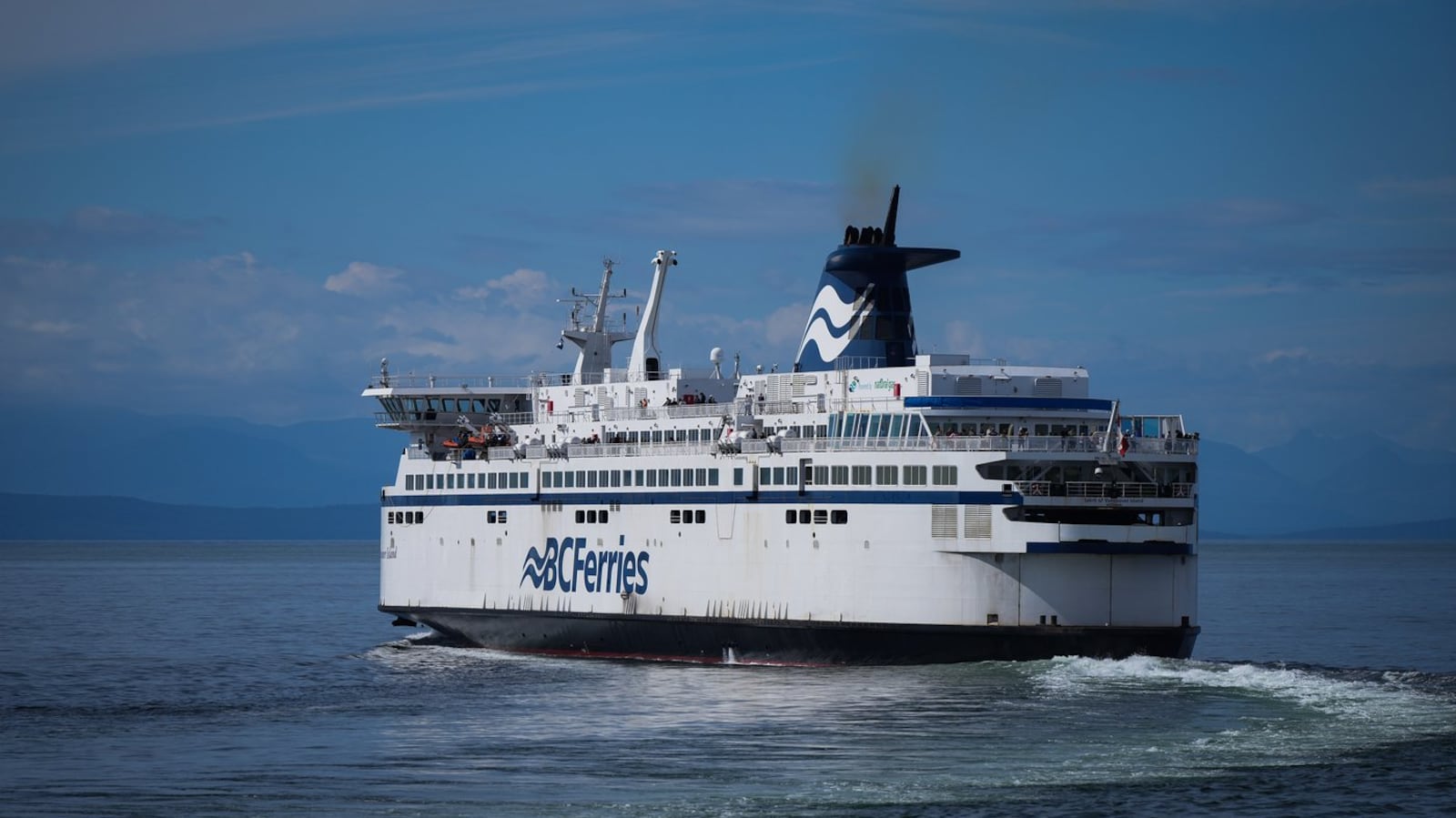
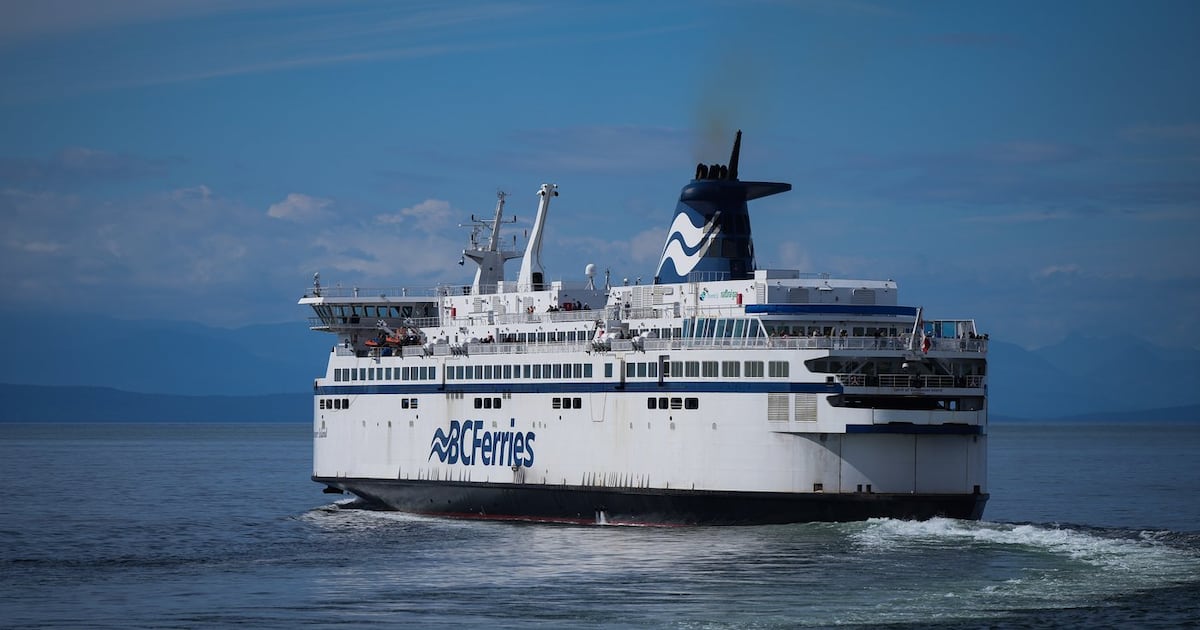
Building Ferries in British Columbia as an Economic Shield in the Trade War with the U.S.
As trade pressure from the United States intensifies, with tariffs on Canadian goods becoming not merely an economic tool but also a political lever, British Columbia is being forced to look for domestic resources to protect its economy. At first glance, ferry construction may seem like a narrowly specialized issue concerning only transportation infrastructure on Canada’s West Coast. However, a new report being discussed in Canadian business and political circles highlights a much broader problem: dependence on foreign suppliers and missed opportunities for domestic industry. The issue is not simply about ships, but about the region’s strategic autonomy in an era of protectionism.
According to information cited in a CTV News report, building ferries directly in British Columbia could become an effective response to U.S. tariffs. The report’s authors argue that the province has traditionally purchased ferries abroad, including from Europe and Asia, but that under current geopolitical conditions such supply chains are becoming vulnerable. More importantly, they do not create jobs or a tax base within the region. If vessels were built at local shipyards, every dollar invested in such a project would remain in British Columbia’s economy, generating a multiplier effect. This is not merely an abstract theory: hundreds of millions of dollars in contracts currently go to foreign shipbuilders but could instead support Canadian families and small businesses.
The report’s central idea is that U.S. tariffs imposed—or threatened—against Canadian products hit export-oriented industries hardest. However, the domestic market, including government procurement, remains largely outside the scope of American tariffs. British Columbia’s ferry fleet is precisely the kind of sector in which the provincial government and BC Ferries are the primary customers. If those orders were redirected to local shipyards, the provincial economy would receive contracts independent of external trade conditions. Moreover, ferry construction requires metalworking, engineering, electronics and logistics—in other words, an entire cluster of related industries that would also be affected by tariff wars.
The report emphasizes that modern ferries are complex engineering structures, and their production could become a catalyst for reviving Canada’s shipbuilding industry, which has declined significantly over the past several decades. The authors point to examples from other countries where government ship procurement has driven technological modernization. In particular, they note that even amid globalization, many developed countries protect their shipyards through domestic procurement mechanisms. For British Columbia, this would mean not only economic security but also energy security: ferries are critical infrastructure linking Vancouver Island with the mainland, and their timely replacement should not depend on decisions made in Washington or logistical disruptions in other parts of the world.
Several concepts may require clarification. In economics, the multiplier effect describes a situation in which one dollar of government spending produces more than one dollar in additional overall demand because recipients spend that money domestically, creating new jobs and income. The tariffs discussed here are import taxes imposed by the United States on Canadian goods, making them more expensive for American consumers and reducing the competitiveness of Canadian producers. BC Ferries is a provincial Crown corporation—a government-owned company that operates ferry services. Its procurement is governed by provincial law and can be directed toward local suppliers under a “buy Canadian” policy.
The report’s key conclusion is that building ferries in British Columbia is not merely an industry project, but also a tool of economic diplomacy and domestic resilience. At a time when the United States is using tariffs as a weapon, Canada has the option of responding asymmetrically: rather than imposing mirror tariffs, it can strengthen its own domestic market. This would require political will and a willingness to reconsider long-term contracts with foreign shipyards in favor of local ones, even if the initial cost is higher. Over the long term, such investments pay off through tax revenue, employment and technological sovereignty.
Vancouver’s New Substation Debate: Between Power and Parkland
A conflict is unfolding in downtown Vancouver that is familiar to many modern cities: how to upgrade critical infrastructure when there is virtually no open space left. B.C. Hydro plans to replace the aging Dal Grauer substation, which has supplied electricity to approximately 50,000 homes and businesses in the city center for more than 70 years. However, the proposed location for the new substation—beneath Lord Roberts Annex elementary school beside Nelson Park—has met strong opposition from local residents. The story, reported by CBC, goes far beyond a simple construction dispute.
The problem is that the Dal Grauer substation, along with another nearby facility, is nearing the end of its service life. According to Energy Minister Adrian Dix, without a new substation, downtown Vancouver will be unable to receive the clean electricity needed by everyone who lives and works there. B.C. Hydro and government representatives insist that the selected option is the least harmful of all those available. Locating the substation underground beneath the school would supposedly preserve valuable urban land at the surface, while the school itself would be demolished and replaced with a new one. Under a 2018 agreement between B.C. Hydro and the Vancouver school board, the utility must pay the school district at least $73 million to build a new elementary school with kindergarten spaces and a playground. Earlier this year, the school board submitted an application for a three-storey school serving more than 500 students, with play areas, a basketball court and an athletic field.
Activists from the Friends of Nelson Park group, however, see the situation differently. Carol Reardon, one of the campaigners, emphasizes that the substation is necessary, but says placing it beneath the only local park serving 20,000 people within a 10-minute walk would amount to a “massive industrial project” in the heart of a residential neighborhood. If the project proceeds, the school will be demolished, the playground eliminated and 85 trees—including magnificent mature canopies that are among the park’s main attractions—cut down.
Even experts acknowledge the complexity of the situation. Werner Antweiler, an economics professor at the University of British Columbia, explains that replacing energy infrastructure in a city center always involves logistical constraints. The substation must be located at a specific hub where all the lines can be brought together, making it extremely difficult to move it elsewhere. This explains why B.C. Hydro is insisting on its chosen site. For local residents, however, the issue is not only technical but also about quality of life: a park with century-old trees is not simply green space, but a neighborhood social center that would disappear for years during construction—and perhaps never return in its previous form.
The final decision now rests with the British Columbia Utilities Commission, which is assessing whether the project serves the public interest. A decision is expected in the coming months, and B.C. Hydro will not begin construction until it is issued. This gives both sides time, but no compromise is yet in sight. On one side is the need to maintain the power system serving Vancouver’s rapidly growing downtown; on the other is residents’ right to preserve the only park in a densely populated neighborhood. The Dal Grauer substation dispute is a striking example of how technological requirements collide with the human dimensions of a city. How the conflict is resolved will affect not only the future of Vancouver’s West End, but also the model for developing urban infrastructure in an era of limited land.
Vancouver on the Brink of a Digital Revolt: Why Thousands Are Protesting AI
In recent months, Vancouver has become one of North America’s leading centers of resistance to artificial intelligence. What began as scattered concerns voiced by parents and activists has grown into a mass movement preparing to hold two major protests in the coming weeks. Against a backdrop of petitions bearing thousands of signatures and announcements of new marches, the city is becoming an arena for a clash between corporate technological optimism and local communities’ fears about the future of their children and urban environment.
The first protest is scheduled for Thursday, September 10, beginning at 9:30 a.m. outside the AI Data Centre at 720 Beatty Street. It is being organized by the Coalition of Progressive Electors (COPE), a political force that appears intent on making opposition to the uncontrolled deployment of AI a central part of its platform. According to a press release, the party plans not only to protest but also to present its own platform for preventing irresponsible uses of artificial intelligence in city government and protecting residents from the negative effects of data-center construction. COPE also plans to sign a pledge opposing the introduction of AI in Vancouver schools. Speakers are expected to include COPE city councillor Sean Orr, who previously introduced a motion to regulate the use of AI at City Hall, as well as outspoken AI critic and party candidate Solomon Yi-Kieran. They will be joined by current school trustee Susie Ma. Protesters, including members of the No AI Vancouver movement, plan to display banners opposing the construction of new data centers and paint an anti-AI banner before the speeches begin.
However, that will only be a prelude. A larger event is scheduled for October 3, designated as an International Day of Protest. Organizers from @no.ai.vancouver, a group founded by 18-year-old Torin Laroche, are urging people to “mark their calendars.” The Instagram account currently has more than 11,000 followers, while a previous march on May 23 drew between 500 and 700 people, who walked through the city carrying anti-AI slogans. Organizers expect the October protest to surpass the May event in size. Activists traditionally begin with speeches before marching through the city. At the same time, they are urging people to sign petitions opposing the introduction of AI in Vancouver and across Canada. One key petition calls for a two-year moratorium on the use of AI in British Columbia classrooms. It has collected more than 2,100 signatures so far. Activists cite research indicating that generative tools such as ChatGPT are associated with poorer learning outcomes, while frequent AI use correlates with declining critical-thinking skills.
Telus, which is developing two new data centers in Vancouver, has become a central focus of the dispute. One is in Mount Pleasant and is expected to open in late 2026; the second, at 150 West Georgia Street, is scheduled to begin operating in 2029. Telus is also expanding its existing facility in Kamloops. According to a press release, the cluster’s combined capacity will exceed 150 megawatts by 2032. The company maintains that its data centers will be among the most sustainable in the world: 98% of their power will come from renewable energy, and they will support the decarbonization of more than 50 million square feet of real estate. Telus says its closed-loop liquid-cooling system will reduce cooling energy consumption by 80% compared with traditional data centers, while also allowing electricity to be reused as carbon-free thermal energy for heating the equivalent of 150,000 homes. Water consumption will be 90% lower than at conventional facilities, with plans to use reclaimed water from BC Place. The company also promises to create numerous jobs, which would benefit the local economy.
Critics, however, remain deeply skeptical of Telus’s sustainability rhetoric. Opponents point out that even the most efficient data centers consume enormous amounts of energy and water and add to the strain on urban infrastructure. The scale of AI deployment in schools is also raising concerns: parents and educators fear that content-generating technologies will replace personal instruction and foster children’s dependence on algorithms. The political dimension of the conflict is intensifying as COPE seeks to convert protest energy into electoral support by proposing specific regulatory mechanisms. While some see AI as inevitable progress, others are calling for at least a pause and greater public oversight. Vancouver is thus becoming a laboratory testing whether local communities can resist global technological trends. The events of September 10 and October 3 will show how broad and organized this wave of opposition has become—and how far residents are prepared to go to defend their vision of the future.


News 09-09-2026
Vancouver: Ranking Leaders, New Horizons and a $10 Million Lot
In this roundup, Vancouver has been named one of the world’s most relaxing cities, Fresh St. Market has announced plans to open a large store in Hastings-Sunrise, and a unique forested property in North Vancouver has been listed for $10 million.
Vancouver Named One of the World’s Most Relaxing Cities: What’s Behind the Ranking
Vancouver has once again proven that it can combine urban living with nature in a way that draws attention not only from locals but also from experts. According to a recent study conducted by Holafly in partnership with respected publication Condé Nast Traveller, this city on Canada’s west coast ranked fourth among the world’s top destinations for a relaxing holiday in 2026. For anyone who has visited Vancouver, the result is unlikely to come as a surprise: on one hand, there is a modern metropolis with well-developed infrastructure; on the other, breathtaking views are just a short drive away.
The ranking’s authors took a comprehensive approach, analyzing not only traditional tourist attractions but also specific, measurable indicators. The assessment considered population density, the number of natural areas and parks, the availability of spas and wellness facilities, air quality, hours of sunshine, traffic conditions and even the so-called happiness index of local residents. This approach makes it possible to assess not just the beauty of the scenery, but also how easy it is to breathe, get around and relax in a city. By these criteria, Vancouver genuinely stands out. Its biggest advantage is the remarkable accessibility of nature: more than 250 parks, including the famous 405-hectare Stanley Park and 860-hectare Pacific Spirit Provincial Park; 10 official oceanfront beaches; and a 22-kilometre seawall that is ideal for walking, running or cycling. And for those who miss the mountains, Grouse, Seymour and Cypress are always nearby, offering hiking in summer and skiing in winter.
Air quality also deserves special mention. Yes, last summer’s wildfires made their presence felt, but Vancouver is traditionally considered one of the large cities with the cleanest air in the world—a fact supported by data from Swiss company IQAir. In addition, the city enjoys long daylight hours during the summer, when the sun does not set until around 9 p.m., which also contributes to a greater sense of calm.
Vancouver also has a strong culture of self-care, with a reputation for spas and wellness centres. Visitors can choose from luxury options such as the Wedgewood Hotel Spa or Absolute Spa at the Fairmont, as well as more modern establishments inspired by Scandinavian contrast treatments. For example, just 20 minutes away by SeaBus is Tality Wellness in North Vancouver, where guests can enjoy saunas, cold plunges and a terrace overlooking the mountains. For a more unconventional experience, there is even the floating Hot Voyage sauna—a cedar cabin on the water from which guests can dive straight into the ocean in their bathing suits while enjoying panoramic views of the surrounding landscape.
Significantly, Vancouver was the only Canadian city on the list. First place went to Copenhagen, the capital of Denmark, which is recognized for its hospitality as well as its status as one of the happiest cities on the planet. Energetic Barcelona took second place while still managing to maintain a carefree atmosphere, and Vienna rounded out the top three, praised for its leisurely pace of life and abundance of greenery. Oslo, Miami, Munich, Singapore, Rome and Amsterdam ranked just below them. As noted in a report by Canada.com, the study reflects more than subjective impressions and is based on concrete statistical data, making it especially valuable for travellers planning future holidays.
It is important to understand that the concept of a “relaxing city” is much more complex than it may initially seem. It is not simply about palm trees and sandy beaches, although those are certainly pleasant. Rather, it is a combination of factors, from the amount of greenery and ease of getting around to whether residents themselves feel comfortable. The happiness index used in such studies is not an abstract philosophical idea but a practical indicator that directly affects how tourists experience an unfamiliar environment. If local residents are satisfied with their lives and are not under constant stress, that atmosphere inevitably reaches visitors as well. In other words, spending time in a city with a high standard of living and well-developed infrastructure is not merely a change of scenery—it is an investment in one’s own emotional well-being.
Ultimately, Vancouver’s recognition as one of the most peaceful places on the planet is not a marketing gimmick, but well-deserved acknowledgment of the city’s rare balance between urbanization and wilderness. For modern travellers increasingly tired of noisy megacities and searching for zen in the most remote corners of the planet, Vancouver may be the perfect compromise. There is no need to sacrifice comfort for beautiful views, because both are literally within reach. And that may be the main ingredient of a truly relaxing holiday: not having to make any effort to feel calm and happy.
Fresh St. Market to Open New Large Store in Vancouver: What It Means for Hastings-Sunrise
British Columbia continues to delight residents with news about growth in the food sector, and the latest announcement from local chain Fresh St. Market is no exception. The company, which has already become a public favourite thanks to its focus on fresh and local products, has confirmed plans to open its 11th store. The new location will be at 2585 Hastings St. in the lively Hastings-Sunrise neighbourhood, known for its unique atmosphere and strong sense of community. This will be more than just another supermarket: it will be the chain’s third Vancouver location and an important step in the company’s expansion strategy, which clearly emphasizes strengthening ties with local communities and producers.
According to Palle Knudsen, vice-president of retail operations and marketing at Fresh St. Market, it is extremely important that the new store become not merely a place to shop but a genuine gathering place for neighbourhood residents. He said Hastings-Sunrise has a deep sense of community and a love of fresh, farm-grown food—qualities that align perfectly with the brand’s philosophy. The opening is planned for fall 2027, but it is already clear that this will be a substantial project. The new store will cover 21,452 square feet, making it one of the key tenants in the Alba development, which will also house well-known pharmacy and retail giant London Drugs. The proximity of the two businesses is expected to create a powerful synergy, turning the site into a major shopping hub for the entire neighbourhood.
For shoppers, the new Fresh St. Market will offer the full grocery experience that has already become the chain’s trademark. Customers will find a wide selection of local products, including fruits and vegetables from British Columbia farmers, Certified Angus Beef and an extensive range of fresh seafood. Prepared foods will receive special attention, with an in-house bakery, a deli offering premium cold cuts and chef-prepared dishes, freshly made sushi and the hugely popular doughnuts from local brand Peak Donuts. The latter are known for their unusual savoury cheddar-and-onion variety, which has created considerable excitement among food lovers. The chain also plans to offer cookies baked on-site, a burrito bar and a carving station where customers can order slices of roasted meat. For those looking for a quick and filling meal, there will be an expanded hot-food section with seating, making the store an ideal place for lunch or dinner after work.
It is important to note that Fresh St. Market is not limited to commercial activities and is also actively involved in social programs. The new store will continue the chain’s partnership with FoodMesh, an organization that redistributes surplus food. Through this collaboration, the chain has already helped redirect the equivalent of nearly three million meals to charities and people in need across the province. This underscores the company’s responsible approach to food security and food waste—an increasingly important issue in modern society. According to Knudsen, the team is looking forward to becoming part of everyday life in Hastings-Sunrise by offering not only quality products but also friendly service that reflects the character of the community itself.
This is not the only ambitious project in Fresh St. Market’s portfolio. The company is in an active phase of expansion: next year, a 26,000-square-foot store is expected to open at CF Richmond Centre, while a new Kitsilano location opened in late 2025. This rapid growth demonstrates the company’s confidence in market stability and strong demand for premium products with a local focus. For Vancouver residents, this is welcome news, as the arrival of another major competitor should increase competition and ultimately have a positive effect on prices and service quality. More details about the new store and its product selection can be found in the original Daily Hive report. Without a doubt, the 2027 opening will be a significant event for the neighbourhood. In the meantime, residents can follow the chain’s social media channels to keep up with further announcements and project details.
Rare Opportunity or Land Paradox: Undeveloped $10 Million Lot in North Vancouver
On a map of North Vancouver, this property looks more like a tiny patch of forest surrounded by typical suburban development than a luxury real estate asset. Yet this completely forested piece of land, with no buildings on it, has been listed for $10 million. Realtors are calling it a “once-in-a-generation opportunity,” emphasizing its uniqueness and scale. Lot 17 Riverside Drive consists of 15.1 acres of pristine nature located right in the middle of a residential neighbourhood—an anomaly in the North Shore, where land is worth its weight in gold. The listing describes it as the largest residential land offering on the entire North Shore, promising potential buyers not merely a home but a private empire complete with a helipad, vehicle facilities, a swimming pool, a spa, a soccer field and tennis, pickleball and basketball courts.
The impression is enhanced not only by drone footage showing dense forest with spectacular views of the ocean and mountains, but also by AI-generated images of the proposed estate, called “Riverside Manor.” Although the property is legally zoned for residential development, its actual building potential appears fairly modest compared with the marketing promises. Documents indicate that the site could accommodate one main home of approximately 10,000 square feet and two accessory buildings. But the main issue that has held back the sale for years is the lack of an approved access road. Without official permission from the District of North Vancouver to build a road, the entire property remained essentially an isolated piece of wilderness that could not be reached by car.
Real estate agent Pete Shpak, who is handling the sale, explains that the property was previously listed, but the road-access issue was the sticking point. Local authorities were reluctant for a long time to approve development of the land, making it unattractive to investors. The situation has now changed, however. District representative Justin Beddall confirmed that the administration is reviewing an application for a building permit covering not only a home with a garage but also the access road itself. According to Shpak, the approval process is nearly complete, and he is optimistic about the future: “Based on what I’m seeing from the work of the officials and architects, we’re at the final stage of getting approval for access.”
Interestingly, the current owner has already completed considerable work, including an environmental assessment and slope management—mandatory requirements for construction in this hilly area. Renowned specialist Robert Blaney has been brought in to develop the concept design for the future home, adding credibility to the project in the eyes of potential buyers. Nevertheless, at first glance it may seem strange that for $10 million, a buyer receives nothing more than a bare forested lot, albeit one with an extraordinary view. For true connoisseurs of privacy and exclusivity, however, it could be ideal: an opportunity to build a home from scratch without being constrained by existing structures, while remaining close to all of North Vancouver’s amenities.
Properties like this rarely appear on the market, since most land on the North Shore has long been developed and undeveloped parcels of this size are virtually nonexistent. If the sale goes through, it will be one of the region’s most significant land transactions in recent years. The only question is whether a buyer will be willing to pay such a substantial sum for the chance to create a private “nature reserve” overlooking the ocean, or whether this forested area will remain an untouched corner of nature within the city, waiting for its moment. As the listing itself says, this is truly a rare opportunity—one that may never come again. More details about this unique property can be found in the Vancouver Is Awesome report, which includes all the details of this unusual sale.

News 08-09-2026
Vancouver Ahead of the Election: Opposition Unites, New Training Places and Cultural Heritage...
Ahead of the municipal election, William Azaroff is withdrawing his candidacy in favor of Pete Fry to prevent Mayor Ken Sim from being re-elected. Meanwhile, British Columbia is investing $241 million to expand skilled-trades programs at Vancouver Community College, and UBC’s Museum of Anthropology is returning a unique woolly dog pelt after 160 years—a symbol of the revival of Indigenous traditions.
William Azaroff Drops Out of Vancouver Mayoral Race in Bid to Unite Opposition Against Ken Sim
Ahead of Vancouver’s municipal election, the political landscape has undergone a major change. William Azaroff, the OneCity mayoral candidate, has announced that he is withdrawing from the race. His decision is driven by strategic considerations: consolidating progressive voters behind a single candidate to prevent incumbent Mayor Ken Sim from winning. In a statement to the media, Azaroff said he had heard residents’ concerns about ABC, Ken Sim’s party, potentially remaining in power and saw only one way to change the situation—creating the conditions for a single strong opponent from the progressive camp.
Azaroff decided to support Pete Fry of the Vancouver Greens. He explained that progressive parties had agreed on the need to join forces so that voters’ support would not be divided. The news, reported by CBC, signals the beginning of a more active phase of the election campaign, with the main divide running between union-backed and environmentally focused movements on one side and Sim’s centre-right coalition on the other.
To understand the situation, it is important to note that Ken Sim, leader of ABC (A Better City), won a decisive victory in the 2022 election, and his party secured a majority on city council. His governing style and a number of his initiatives have drawn strong criticism from left-wing and centrist forces, which fear that a repeat of that result would create an even greater imbalance in city politics. That concern became the catalyst for Azaroff’s decision.
The development highlights the opposition’s fragmentation. Despite repeated calls for unity, it had long been unable to agree on a single candidate. Now, with Azaroff leaving the race and supporting Fry, the question is whether the Green Party can attract enough electoral support to pose a genuine challenge to the governing party. Internal polling suggested that Azaroff, Fry and other potential left-leaning candidates—such as COPE representatives or independents—were unlikely to overcome the threshold on their own. If they unite, however, they could make the race competitive.
Notably, Azaroff did not simply withdraw; he also identified his main motivation: fear of another Sim term and ABC’s total dominance of council. He stated directly: “To remove Ken Sim, we need to unite behind a single progressive candidate.” The statement is more than a political formality—it is a clear message to voters about the need for strategic voting.
It remains an open question whether other progressive politicians will follow Azaroff’s example. If they do not, and several left-leaning candidates remain on the ballot, the vote will once again be divided, inevitably benefiting the incumbent mayor. The race promises to be tense, and the final weeks before the election will be decisive in consolidating the anti-incumbent vote.
Expanding Opportunities for Skilled-Trades Education in British Columbia
The government of British Columbia continues to invest actively in training skilled workers for the economy’s growing sectors. This time, attention is focused on Vancouver Community College, which will receive significant funding to expand its skilled-trades programs. The investment will add 224 new training seats, allowing the college to increase the total number of trades seats to more than 1,770 during the current academic year. The decision is part of the province’s broader “Look West” strategy, which aims to create 5,000 new skilled-trades training seats across British Columbia by the 2026–27 academic year.
The provincial government is providing $241 million over three years to prepare British Columbians for in-demand occupations. Labour Minister Jennifer Whiteside said such investments allow more people to find good jobs and contribute to the region’s economic development. She emphasized that the “Look West” strategy relies on the province’s greatest resource—its people—creating opportunities for families and businesses throughout the community. Meanwhile, Minister of Post-Secondary Education and Future Skills Jessie Sunner explained that industry leaders had repeatedly reported a shortage of skilled workers needed to deliver major projects. Expanding college training programs is therefore a direct response to labour-market demand.
The new seats at Vancouver Community College will help reduce waitlists for in-demand apprenticeship programs, introduce more young people to the trades and increase training capacity in fields such as automotive service technician, electrician, heavy-duty mechanic and refrigeration and air-conditioning mechanic. These occupations are particularly important as the province advances major projects in construction, clean energy, mining, transportation and advanced technology. Demand for skilled workers is especially high in the Lower Mainland, and expanding VCC’s programs should support economic growth throughout the region.
Local politicians have expressed unanimous support for the decision. Sunita Dhir, MLA for Vancouver-Langara, said the growing need for skilled professionals creates new employment opportunities for young people, allowing them to build their futures in their home province. George Chow, MLA for Vancouver-Fraserview, added that many young people want excellent jobs with room for advancement while remaining in the city they love, and the new training seats will help make that possible. Mabel Elmore of Vancouver-Kensington emphasized that investments of this kind strengthen not only the economy but also post-secondary institutions, benefiting families and future generations.
The college’s leadership also praised the province’s support. VCC President and CEO Ajay Patel expressed gratitude for continued investments in education, saying they would allow more students to build successful careers and contribute to the development of their communities. Student Mi Kimura, who has already completed the automotive service technician program, offered a particularly compelling perspective. She highlighted the value of hands-on training and said she was confident that expanding the program would help more students develop in-demand skills and take the first step toward future careers.
For context, Canada’s apprenticeship system combines paid workplace employment with classroom instruction. Apprentices gain practical experience under the supervision of an experienced mentor while completing theoretical courses, usually in several levels. After completing the program and passing the required exams, they receive a certificate as a qualified tradesperson recognized across the country. Vancouver Community College’s new seats are intended for precisely these kinds of programs. The “Look West” strategy, meanwhile, is a comprehensive economic plan aimed at creating jobs, expanding trade links and attracting investment to the region. More information about the programs and opportunities can be found on the official Vancouver Community College website or the provincial government portal. These measures demonstrate a systematic approach to addressing labour shortages in key sectors, which should support sustainable economic development across British Columbia over the long term.
Sacred Artifact Returns: World’s Only Woolly Dog Pelt Comes Back to B.C. After 160 Years
An event of immense importance to Canada’s Indigenous peoples has taken place at the University of British Columbia’s Museum of Anthropology in Vancouver. The only woolly dog pelt known to science—belonging to a breed raised for centuries by the Coast Salish and Interior Salish—has finally returned to its homeland after more than a century and a half away. The artifact survived colonization, epidemics and cultural assimilation and has now become a symbol of cultural revival and hope for the restoration of lost heritage.
Woolly dogs were not simply pets for the Salish peoples; they occupied a unique place in their economy and culture. These small but sturdy dogs produced exceptionally soft and warm wool, which Salish women spun and wove into famous blankets valued throughout the Pacific Northwest. With the arrival of European colonizers and the spread of inexpensive factory-made textiles, however, the tradition of breeding the dogs declined, and by the beginning of the 20th century the breed had disappeared entirely. The pelt in question was taken from the region in the 1860s and remained in overseas collections until it was finally returned to Canadian museums.
The return is deeply significant to the descendants of those who once lived alongside these animals. For Athaea Picha, a Kwantlen weaver and one of the first people to see the relic, it is not merely a scientific exhibit but a living connection to her ancestors. In her conversation with The Canadian Press, she said that stroking the wool felt like touching her people’s history—the time when dogs were full members of the community, given names, loved and cared for as relatives. For her and other craftspeople, the artifact will be an inexhaustible source of inspiration and knowledge about what the famous Salish wool looked like and felt like.
The journey of this pelt reflects the broader history of cultural repatriation, which is gaining momentum around the world. For many years, museums and private collectors kept Indigenous artifacts, often without considering their sacred significance or how they had been acquired. In recent decades, however, attitudes have begun to change. More institutions recognize a moral obligation to return heritage taken or removed during the colonial era to its rightful owners. The return of the woolly dog pelt is a striking example of modern museum policy moving toward greater justice.
For those unfamiliar with the region’s history, the Salish are a group of Indigenous peoples whose territories encompass parts of present-day British Columbia and the U.S. states of Washington and Oregon. Woolly dogs formed part of a complex ecosystem in which people and animals coexisted symbiotically. The dogs were fed a special diet, primarily fish, which made their wool especially high-quality and distinct from the hair of wild animals. Blankets made from the wool were not merely household items; they were valuable gifts used in ceremonies, weddings and the establishment of intertribal alliances. The loss of the dogs became a symbol of the loss of an entire layer of cultural identity.
The UBC Museum of Anthropology, where the relic will now be kept, plans not only to display it publicly but also to use it in educational programs. Scientists intend to conduct genetic analysis to better understand the breed’s origins and its relationship to modern dogs in the region. This could help reconstruct the historical record and potentially support efforts to recreate the breed—an extraordinary achievement for Indigenous peoples. For young Salish people who have never seen a living woolly dog, the artifact could become a starting point for new traditions in which ancient knowledge intersects with modern technology.
It is worth noting that the return of the pelt is only one of many steps on the path toward reconciliation. The event is a reminder that Indigenous history is not limited to tragic chapters; it is also rich in skill, wisdom and a profound connection with nature. Although the living breed of dogs has been lost forever, the return of their last physical trace makes it possible to say that the spirit of these animals and the culture that raised them continue to live on. For now, there is only hope that this gesture of goodwill will serve as an example for other museums around the world that still hold priceless artifacts belonging to Indigenous peoples in Canada and elsewhere.




News 07-09-2026
A Week in Vancouver: Events, Forgotten Disasters and Education
The city is preparing for a packed week from September 7 to 13, featuring everything from baseball games and a Weezer concert to a pickle festival. At the same time, the areas around Vancouver hold traces of forgotten disasters—from sunken ships to fighter jets that veered off course. And the opening of a private Dyslexia Centre highlights problems in the public education system: parents are being forced to pay for help that schools should provide free of charge.
A Week in Vancouver: From Baseball to a Pickle Festival
This week in Vancouver looks set to be so packed that it may make your head spin. From September 7 to 13, there will be something extraordinary for every taste. If you thought September was when the city slows down in anticipation of the rainy fall, you would be very much mistaken. The city’s parks, stadiums and cultural venues are turning into arenas for all kinds of events: from high-energy baseball games to intimate theatre productions, from farmers’ festivals to concerts by legendary rock bands. Local organizers clearly decided that summer should end with a bang, putting together a program capable of satisfying even the most demanding entertainment enthusiasts. It is especially welcome that many of these events are either free or reasonably priced, allowing nearly every resident and visitor to enjoy the festive atmosphere.
Without a doubt, the central event of the week will be the performance by the iconic American band Weezer, who will bring not only their timeless hits to Rogers Arena, but also such renowned guests as The Shins and Silversun Pickups. The concert, titled “Weezer: The Gathering,” promises to be a real treat for fans of ’90s and 2000s alternative rock. For those who prefer more active recreation, organizers have come up with something completely unique: the so-called Hoagie Half, which combines a half-marathon relay with a culinary tour of the city’s best sandwich shops. Participants will run a total of 21 kilometres, but not simply from start to finish. They will stop at independent sandwich shops, where each runner must pick up a sandwich and deliver it to base. It is part sport, part entertainment and part opportunity to support local small businesses.
The annual Vancouver Fringe Festival, which begins September 10 on Granville Island, will surely appeal to fans of theatre and live performance. This year’s festival promises to be especially large, with more than 80 different shows, ranging from experimental productions to classic comedy. One of the most unusual performances will be “That Show (time) of the Month,” in which male comedians will attempt stand-up while connected to a menstrual-cramp simulator. This bold and provocative concept is intended not only to entertain audiences, but also to draw attention to the challenges women face every day. The festival will also offer more traditional entertainment, including a free music terrace, children’s activities and many other surprises throughout its 10-day run.
This week will also offer opportunities to immerse yourself in the traditions of different peoples. Langley will host its fifth annual powwow, where more than 500 Indigenous dancers will showcase their vibrant regalia and captivating dances. It is a unique opportunity to experience a living culture that is an integral part of Canadian identity, and organizers emphasize that the event is open to people of all ages and backgrounds. Meanwhile, Surrey will host a Filipino festival, allowing visitors either to reconnect with their roots or to discover the island nation’s cuisine, music and customs for the first time. On the North Shore, a Polish festival will feature traditional treats and a marketplace where visitors can sample authentic Polish delicacies. The Richmond Night Market occupies a special place in this cultural mosaic. This year, it is offering visitors not only more than 500 kinds of street food, but also the world’s first zipline over a night market—something sure to become a hit with thrill-seekers.
Organizers have clearly taken care of sports fans and those who enjoy active family outings. Several major games will take place this weekend: the Vancouver Canadians will face the Eugene Emeralds in the Northwest League championship, while Vancouver Whitecaps FC will take on LA Galaxy and Austin FC at BC Place. For those who prefer spending time outdoors, the enormous Maan Farms pumpkin farm in Abbotsford is opening with a corn maze, a petting zoo and even a zipline. Richmond will host an agricultural festival featuring a farmers’ market and cooking workshops led by a renowned chef. Animal lovers can take part in the VOKRA charity run, with proceeds going toward rescuing homeless cats and kittens. In addition, the miniature railway in Burnaby and tours of the historic Orpheum Theatre will continue to operate, likely attracting architecture and history enthusiasts.
Perhaps the most unusual and entertaining event of the week, however, will be Picklefest, which promises to become a true kingdom of fermented cucumbers. Visitors will be able to try pickles in every form imaginable: in jars, on sticks and even as ingredients in various drinks. They can also enter a homemade pickle competition, where the best makers will receive prizes and widespread recognition. It is a celebration for those who appreciate culinary experimentation and unusual flavour combinations. Judging by the variety of events, this week in Vancouver really can satisfy every interest—from the desire to enjoy high art to the simple human wish to have fun and eat well. The Daily Hive events guide can help you navigate this kaleidoscope of experiences.
Five Forgotten Disasters: What the Vancouver Area Conceals
When people think of Vancouver, most picture mountains, the ocean and well-kept parks. Yet the areas around this Canadian city contain remarkable and sometimes tragic traces of the past that few people talk about. From sunken ships to military aircraft that crashed into mountainsides, these sites have become silent witnesses to history, even if they do not always appear in tourist guides. If you decide to search for these relics, remember that British Columbia’s Heritage Conservation Act strictly prohibits damaging or removing any fragments, as each of these objects is already several decades old.
One of the most intriguing sites is the so-called “Sun Island” on Westham Island. Despite its misleading name, it is not an island at all, but an old vessel abandoned at the edge of a marshy area. The 84-foot ship, built in 1929 by Japanese immigrant Jirokichi Arimoto, was used to transport fish. Its fate, however, is shrouded in darkness: the boat was likely abandoned when the Canadian government confiscated the property of Japanese people sent to internment camps during the Second World War. Today, the ship—nearly a century old—quietly rusts in Ewen Slough, overgrown with brush and becoming part of a landscape that few people recognize as a monument to an entire community’s tragedy.
Grouse Mountain, popular with tourists and skiers, holds an unexpected discovery for those who enjoy long walks. Right beside the Skyline Trail lies the engine of an F-86 Sabre fighter jet. In 1954, American pilot Lieutenant Lamar Barlow was flying at near-sonic speed when his compass failed. As they tried to help the pilot, controllers on the ground saw what is known as a “ghost” on their radar—a false return they mistook for Barlow’s aircraft. Believing he was over Tacoma, they gave the pilot incorrect coordinates, even though he was actually over Vancouver. Because of heavy cloud cover, Barlow did not see the approaching mountain and crashed into its slope. The wreckage, including the engine, can still be seen near the trail, while a small memorial recalls how an error on a radar screen can prove fatal.
For diving enthusiasts, Porteau Cove is considered a true mecca. Several vessels were deliberately sunk there to create an artificial reef. They include the schooner Granthall and the vessel Centurion III, as well as a reef made from old tires. The site is accessible to divers of all experience levels and is home to more than 100 marine species, from octopuses to longhorn sculpins. Unlike the grim stories of air disasters, this underwater museum was created intentionally and demonstrates how old ships can be given a second life as homes for ocean wildlife.
The story of the steamer JD McCormack, which now rests on the banks of the Fraser River, is no less fascinating. Built in 1921, it travelled the waters of Greater Vancouver for decades before being converted into a barge. About 80 years ago, the vessel ended up on the north bank of the river in the Coquitlam area, near the Port Mann Bridge, where it remains today. This forgotten steamer is a silent witness to an era when rivers were the region’s main transportation routes.
Mount Strachan holds a particularly sorrowful place in this collection. In 1963, a Canadian military T-33 training aircraft crashed there. Both pilots—Lieutenant Norman Ogden and Lieutenant Donald Clark—died after bad weather played a fatal role in the disaster. The aircraft’s wreckage is scattered across the slope, accessible by a difficult trail, while a memorial at the crash site pays tribute to the courageous airmen whose service ended in tragedy.
Each of these stories is more than just a fact about abandoned equipment. They are reminders of the fragility of human life, of mistakes that can come at an unbearable cost, and of how time transforms wreckage into objects of historical significance. Today, as modern technology makes accidents increasingly rare, it is difficult to imagine that real dramas once unfolded in these picturesque places. But if you find yourself in Vancouver and want to connect with the past, remember: every rusting hull and every memorial on a mountainside preserves the memory of those who were here long before us—and of the mistakes we must not repeat. More information about these stories can be found in this Vancouver Is Awesome article, which brings together archival records and eyewitness accounts.
Vancouver Dyslexia Centre: A Lifeline for the Few or a Warning to the System?
A specialized Dyslexia Centre is preparing to open in Vancouver and is expected to begin operating next fall. The news may seem encouraging for families dealing with this learning disorder, but it has exposed a longstanding and painful problem in British Columbia’s education system. The emergence of a private initiative intended to fill gaps in the public sector has prompted experts and advocates to express concern rather than optimism: why is this support not available in ordinary schools, forcing parents to seek it elsewhere—often at considerable cost? The situation appears especially paradoxical given statistics suggesting that a class of 30 students may include as many as six children showing signs of dyslexia.
Kathy McMillan, founder of Dyslexia B.C., whose own children have the diagnosis, speaks from bitter experience. Her younger daughter, who has severe dyslexia, would not have been able to complete public school without enormous additional spending on private specialists. “It was very, very expensive,” McMillan recalls. “It was absolutely impossible for her to remain in the public system all the way through.” The girl eventually graduated from university with honours, but only thanks to her family’s tremendous efforts and financial investment. McMillan’s older child remained in public school, but even there, tutors and paid lessons were necessary. In McMillan’s view, the creation of the Dyslexia Centre is not a solution to the problem, but rather striking evidence that the problem exists. “It shines a light on the gap,” she says, “and on how low a priority serving children with dyslexia is for the system.” She is calling on the government to “get serious” and develop a comprehensive plan that would include dyslexic students in the new literacy policy rather than shifting the burden onto parents.
The academic community appears to agree with this assessment. Linda Siegel, professor emerita at the University of British Columbia (UBC) and author of a book on dyslexia, supports the centre’s creation with one qualification: “...only because it isn’t happening in schools.” She stresses that children and their parents suffer from the lack of systemic support. Siegel points out that education faculties generally devote very little attention to recognizing dyslexia and determining how to address it. Psychoeducational assessments used to identify learning disabilities are also so time-consuming that they are effectively inaccessible to many families. Sterett Mercer, an associate professor of special education at UBC, shares her concerns: the effects of dyslexia do not disappear with age. They can “spill over” into adulthood, interfering with careers and everyday tasks. The centre’s creation, he says, is a step forward, but it must not replace a public support system that is supposed to serve everyone.
What will the new centre offer? Its director, Neil Johnston, explains that its main focus will be free screening for early signs of dyslexia and educational support. However, the paid support services will cost roughly the same as tutoring sessions, while the weekly training program for educators will cost more than $1,000. The centre is also prepared to work directly with schools and districts to develop individualized education plans. This financial aspect has prompted criticism, since ideally such expertise should be built into every school and district rather than sold to parents who are already under stress. In effect, access to quality assistance may once again become a privilege reserved for those who can afford it.
In response to a request from CBC News, the provincial Ministry of Education and Child Care said it is taking action of its own. Beginning this year, mandatory early-reading-skills screening will be introduced from kindergarten through Grade 3, and the investment will also include professional development for teachers. The ministry also noted that school-based support should be provided regardless of whether a child has an official diagnosis, and that a new “Community of Practice for Literacy Support” will begin operating in the fall. Nevertheless, as the experiences of Kathy McMillan and other parents demonstrate, declarations do not always match reality. The private centre scheduled to open next year remains, for many families, the only real light at the end of the tunnel—even if it lies outside the public system.


News 06-09-2026
Canada: Police Trial, Byelection and Soccer Derby
The digest features three notable stories from Canada: in Vancouver, a police officer will stand trial on an assault charge; in British Columbia, a battle is unfolding for the Abbotsford-Mission riding in a byelection; and the Vancouver Whitecaps are seeking a historic fifth consecutive title in a match against Montréal.
Vancouver Police Officer to Stand Trial on Assault Charge
Another scandal involving law enforcement officers is brewing in Canada. According to CBC, Vancouver constable Jason Grewal has been formally charged with assault. The incident that led to the criminal proceedings occurred on September 9, 2025, but the British Columbia Prosecution Service has only now approved the charge. Grewal has already been removed from operational duties and transferred to a desk position, which is standard practice in such cases.
Interestingly, the justice system’s response in this case illustrates how Canada’s system is intended to work. When information about the incident reached the Vancouver Police Department’s professional standards section, its leadership immediately transferred the investigation to the independent New Westminster Police Department. This was done to avoid a conflict of interest—after all, colleagues might not investigate a case involving one of their own with the necessary impartiality. The administrative proceedings under the Police Act have now been suspended until the criminal case is concluded. This approach—allowing the court process to come first, followed by an internal review—helps avoid putting pressure on witnesses and preserves objectivity.
VPD representatives have declined to comment on the details, citing the fact that the case is before the court. The first hearing is scheduled for October 1, when at least the basic circumstances of the incident are expected to become known. For now, it is possible only to speculate about what happened that September day. It is important to understand that, under Canadian law, the term “assault” covers a broad range of conduct—from threats and attempts to use force to actual physical contact without the victim’s consent. For a police officer, such charges are especially damaging to one’s reputation, since the job is directly connected with the use of force and any abuse of authority is subject to particularly intense public scrutiny.
This case fits into the broader context of growing public oversight of police conduct in North America. In recent years, Canadian provinces have increasingly referred investigations of such incidents to independent bodies in an effort to restore public confidence in law enforcement. Statistics nevertheless show that only a small number of cases reach court; many are closed during the preliminary investigation stage. The fact that prosecutors approved the charge indicates that there is sufficiently substantial evidence. It is hoped that the proceedings will be transparent and shed light on all the circumstances of the case, while serving as a reminder that the law applies equally to everyone—regardless of whether they wear a badge and uniform.
Battle for Abbotsford-Mission: What British Columbia’s Byelection Is About
In Canada, and particularly in British Columbia, byelections are always moments of truth for political parties. The Abbotsford-Mission riding, located in the picturesque Fraser Valley, has drawn attention after the final list of candidates for the provincial legislature was announced. The event is notable not only for its local importance but also because it reflects deep tectonic shifts in the province’s political landscape.
The main intrigue lies in the confrontation between two political heavyweights. Representing the British Columbia New Democratic Party (BC NDP) is Pamela Alexis, a woman with an impressive record of public service. She has already represented the riding, winning the 2020 election, and previously served as the province’s minister of agriculture and food and as mayor of Mission. Her deep roots in the local community, reinforced by memberships in the Chamber of Commerce and Rotary Club, make her a classic establishment candidate, relying on continuity and experience.
Her main opponent, however, is Conservative Party of British Columbia leader Karin Kirkpatrick, a figure with a federal profile. Kirkpatrick is a former member of Parliament who represented several ridings in the province and, notably, was the first woman in the history of Canada’s federal Conservatives to serve as opposition whip under Pierre Poilievre. Her move into provincial politics is a strong signal that the Conservatives are pursuing major expansion and attempting to bring the federal agenda to the provincial level.
But the most interesting aspect lies in the broader context. Kirkpatrick’s candidacy comes amid a serious internal crisis within the provincial Conservatives. Since she became leader, nine members of the Legislative Assembly have left the party, joining either the ranks of independents or a new political force. This fragmentation points to a deep split: some party members reject the new leader’s direction, raising questions about her ability to unite the right even in the face of such an important election. In effect, Kirkpatrick must fight not only opponents on the left but also an internal opposition that could undermine her campaign from within.
The other candidates are also revealing. The riding reflects the full diversity of the province’s political spectrum. The Greens have nominated Stephen Fowler, a local high-school teacher who is running on his party’s traditional left-wing platform: affordable social housing, expanded free public transit and investment in community health centres. His candidacy highlights the fact that even in a relatively conservative agricultural region, there is demand for progressive solutions.
The CentreBC candidate, Lakhwinder Judge, also deserves attention. Her political biography is unique: she has previously run for both the NDP and the federal Liberal Party. The party presents this ability to “change political jerseys” as an advantage—a willingness to work beyond traditional party lines. The strategy is an attempt to occupy the political centre and attract voters tired of polarization between the left and right. Skeptics, however, may see opportunism rather than principle.
Finally, the race includes Libertarian candidate Jeff Mondes, who has run in various elections several times before. His participation is a reminder that Canada always has room for ideological “maximalists” who advocate minimal government intervention.
In essence, this byelection will be a litmus test for several trends. For the NDP, it will test the party’s ability to retain power amid growing dissatisfaction with the economic situation. For the Conservatives, it will test the viability of their new leader and strategy. Observers note that the result in Abbotsford-Mission could indicate voter sentiment ahead of the next provincial general election. This is a contest in which local issues—agriculture, transportation and health care—are closely intertwined with big politics, while federal trends overlap with provincial realities. Will the riding become a launching pad for a Conservative breakthrough or a stronghold of stability for the NDP? We will find out soon. More details about the candidates and the campaign are available in the CityNews Vancouver report.
Whitecaps vs. Montréal: A Battle for History and a Fifth Straight Trophy
The semifinal round of the TELUS Canadian Championship is getting underway in Vancouver, promising to be a highlight of the Canadian soccer season. The local Vancouver Whitecaps will host their fierce rivals CF Montréal. The first match of the two-leg series will take place at BC Place on Wednesday, September 2, with the return leg scheduled for two weeks later, on September 16, at Stade Saputo in Montréal. The matches are particularly important for the home side: the Whitecaps are close to writing their names into Canadian soccer history.
The Whitecaps are on the verge of a unique achievement—a fifth consecutive Voyageurs Cup, the trophy awarded to the winner of the national championship. No team has ever accomplished this in the tournament’s history, while Vancouver have already won the trophy in 2015, 2022, 2023, 2024 and 2025. They now want to extend their dominance to six trophies, which would automatically secure them a place in the 2027 Concacaf Champions Cup. Standing in their way is their longtime rival from Montréal, with whom Vancouver share one of the country’s oldest professional soccer rivalries. The matchup dates back to 1993, when Vancouver played as the 86ers and Montréal were known as the Impact. Since then, the teams have met 80 times, with Montréal holding a slight edge: 37 wins to Vancouver’s 28, along with 15 draws. In the TELUS Canadian Championship specifically, however, the Whitecaps have the advantage, with seven wins, four losses and six draws.
Both teams faced difficult paths to the semifinals. Vancouver comfortably defeated Cavalry of the Canadian Premier League, winning 5–2 on aggregate over the two matches. Montréal, meanwhile, overcame another CPL team—Vancouver FC from the same city—by a 4–2 aggregate score. The winner of this two-leg series will earn the right to host the Cup final, scheduled for Wednesday, October 21. This became possible because an official draw determined in advance that the winner of this matchup would host the decisive game.
The format remains traditional for a cup competition of this kind. The teams play two matches, one at home and one away, and the winner is determined by the aggregate number of goals scored across both games. If the score is level after two matches, the series will be decided in extra time, followed, if necessary, by a penalty shootout. Fans planning to attend the match at BC Place should note that tickets are already included for Whitecaps season-ticket holders. Tickets for the general public will go on sale Monday, August 10, at 10 a.m. Pacific time through the official Ticketmaster website. Information about group tickets and premium packages is available on the club’s website.
One notable innovation is the introduction of so-called Football Video Support in the tournament’s semifinals and final. The system, which replaces traditional video review, will assist referees in making decisions during the competition’s five final matches. It is also worth noting that referees have used the new IFAB rules in effect since the 2026–27 season from the start of the tournament. In the broader picture, the TELUS Canadian Championship is Canada’s key domestic competition, effectively serving as the country’s national cup. It determines the nation’s strongest club and provides a route to international competition. The tournament is particularly important for MLS teams, as it gives them access to the championship for clubs from North and Central America. For fans, it is always a major occasion—a fierce derby between western and eastern Canadian soccer, where emotions run high and every touch of the ball could prove decisive in the fight for a historic trophy. More details about the match can be found in the announcement on the official portal.

News 05-09-2026
Tourist rescued, official resigns, and new support centre: Top B.C. stories
Today’s digest covers key incidents and developments in British Columbia: the remarkable rescue of a hiker after a week in the wilderness, the resignation of Metro Vancouver’s top official amid a scandal involving a vastly inflated budget, and the opening of Canada’s first support centre for people with dyslexia.
Missing B.C. hiker found alive after nearly a week of searches
A story that could have ended in tragedy has turned into a remarkable rescue in the Canadian province of British Columbia. A man who disappeared in rugged terrain near Squamish was found alive nearly a week after he was last seen. Rescuers, who had begun to lose hope because of the harsh conditions and difficult terrain, received word that the hiker had not only survived but also waited for help, demonstrating extraordinary resilience.
The report, published on the CTV News website, initially seems brief. However, behind the short announcement were days of work by dozens of volunteers, dog teams and helicopter crews. The area around Squamish is known for its natural beauty, but it is also one of the most dangerous places for hikers in Canada. Dense forests alternate with steep rocky slopes, while the weather can change within hours, turning an easy walk into a life-threatening challenge. The fact that the man spent nearly seven days in such conditions is an achievement in itself, since without food, warm clothing and reliable shelter, the chances of surviving in the wilderness decline rapidly with each passing day.
Search-and-rescue experts explain that in cases like this, psychological state is just as important as physical preparedness. Once hikers realize they are lost, panic becomes their greatest enemy, prompting irrational decisions—running deeper into the forest, wasting energy on pointless attempts to find a route or, conversely, becoming apathetic. Judging by the limited details available, the man appears to have kept a clear head and likely chose to remain in one place, which made the rescuers’ job considerably easier. It is also significant that he was apparently prepared enough to have communication equipment or water with him, although the exact contents of his gear have not yet been disclosed.
For local residents and the hiking community, the story is an important reminder that even experienced travellers can become trapped by the wilderness. British Columbia authorities routinely warn people to register their routes before setting out, carry satellite trackers and tell relatives when they expect to return. In this case, however, the incident ended happily, and the main task now is to help the survivor recover from several days of stress and dehydration. Rescuers say his discovery was the result of close cooperation among all the services involved, and they hope the case will encourage others to plan more responsibly when hiking in Canada’s challenging wilderness.
Metro Vancouver chief’s resignation: a turning point for regional government
Jerry Dobrovolny’s resignation as chief administrative officer of Metro Vancouver was more than a personnel change. It symbolized a deep crisis of confidence facing a governance structure unique in Canada. The decision was announced Friday, and board chair and Burnaby Mayor Mike Hurley said it was made “in advance of the municipal elections and the ongoing governance reform.” This was not an impulsive dismissal, but rather a forced step intended to “reset” an organization that in recent years has been at the centre of scandals involving opaque spending and the catastrophic growth of an infrastructure project’s budget.
The main reason for the resignation, as openly reported by the media, was the North Shore wastewater treatment plant project. Initially estimated at $700 million, its projected cost has now ballooned to an astonishing $3.86 billion. Dobrovolny was personally named in a lawsuit related to the project, making him particularly vulnerable to criticism. Although Metro Vancouver’s official statement praised him for helping the organization “navigate the impacts of the COVID-19 pandemic,” it is clear that the financial and reputational losses became too great. Against this backdrop, consulting firm Deloitte issued recommendations for reform in May 2025, and the board has already voted to reduce the number of elected municipal representatives from 45 to 34—one of the central elements of the planned changes.
Dobrovolny’s compensation also deserves attention. His base salary in 2023 was nearly $452,000, while his total compensation reached $592,000 in 2024. Those figures, splashed across newspaper headlines, fuelled public anger and led to a subsequent audit. After the board changed its policy, his compensation was reduced to $567,000 in 2025, but the damage to public confidence had already been done. For comparison, that is considerably more than the salary of British Columbia’s premier, raising questions about whether the compensation was proportionate to the responsibility. It is worth noting, however, that Dobrovolny is not an ordinary bureaucrat. He has a distinctive background: he previously played in the Canadian Football League for the Calgary Stampeders and served as Vancouver’s general manager of engineering services.
Heather McNell has been appointed acting chief administrative officer, and the statement emphasizes that essential services for residents will continue without interruption. However, the questions of who will take the job permanently and whether a new leader can restore public trust remain open. According to CBC, a special personnel meeting was already held behind closed doors on July 28, reinforcing the impression that the process was difficult. This resignation is not the end of the story, but another turn in it. Elections and reform lie ahead, with the goal of making governance more accountable. For now, however, residents of the Lower Mainland are asking whether the new structure can avoid repeating the mistakes of the past—or whether they will see only cosmetic changes that fail to address the underlying systemic problem.
To understand the situation, it is important to explain that Metro Vancouver is not a municipality in the conventional sense. It is a regional body that coordinates services for 21 cities and municipalities, including water supply, sewage treatment and regional planning. Residents do not directly elect its leadership, which has fuelled criticism that the organization is “unaccountable.” The North Shore plant is a vivid example of how a major infrastructure project can spiral out of control. Its construction was originally intended to address outdated wastewater treatment, but because of poor management, changes in contractors and, according to the plaintiffs, negligence, the cost increased five and a half times. The damage has already been done, and the new leadership will have to deal not only with the consequences but also restore the reputation of an organization that provides water and sewer services every day to 2.5 million people.
Canada opens first dyslexia support centre: why it matters to every family
Vancouver is now home to Canada’s first specialized centre devoted entirely to supporting people with dyslexia. The development may seem local, but it affects millions of families across the country. According to statistics cited by the organization’s leadership, about 20 percent of the population lives with this learning disorder. Most concerning is that 80 percent of them do not even know they have it. Imagine that one in every five children in a classroom may struggle with reading and writing, yet instead of receiving help, be labelled “lazy” or “incapable.” That is the injustice the new centre aims to address.
As Neil Johnston, CEO of the Dyslexia Centre, explained in an interview with Global News, dyslexia is not simply a problem with letters and words. It is a difference in how the brain processes information, affecting not only reading and writing but also mathematical skills and executive functions—in other words, the ability to plan, organize and control one’s actions. For a child who is not diagnosed in time, the school years can become a nightmare. Children experience constant stress, feel helpless and cannot understand why the education system created for them is unable to help. They watch their peers complete assignments with ease while they struggle even with simple texts—and this daily battle leaves deep emotional scars.
The new Vancouver centre will have two main roles. First, it will be a place where families can seek direct help: it will provide assessments, offer support programs and advise parents. Second—and perhaps even more importantly—the organization plans to work actively with teachers and school districts to change the education system itself. Johnston emphasizes that Canadian teachers are excellent professionals who, nevertheless, have not been adequately prepared to work with children with dyslexia. They simply have not been taught how to recognize the signs of the disorder or use effective teaching methods. The centre has already begun working with schools in British Columbia, offering both in-person and virtual programs. Eventually, it hopes to help schools develop their own capacity to support these students.
Early identification of difficulties is central to the centre’s strategy. Johnston points to the science of reading, which clearly shows that from kindergarten through Grade 3, children learn to read, while from Grade 4 onward they use reading to continue learning. If this critical period is missed, children lose the ability to absorb knowledge through text, automatically falling behind in every subject. That is why it is so important to identify problems as early as possible. The difficulty, however, is that formal assessment is a lengthy and expensive process. Not every family can afford to wait months or pay substantial fees for a specialist evaluation. Screening offers an alternative: quick tests that identify children struggling with reading and determine what support they need without a lengthy bureaucratic process.
Johnston has also responded positively to recent changes in British Columbia: the provincial government has finally officially recognized dyslexia, creating more opportunities for students to receive support in schools. But this progress is only the first step on a long road. The system is still not equipped to work with these children on a large scale, and the new centre is an attempt to fill that gap. For parents who see their child falling behind at school, crying over homework or beginning to hate learning, the main advice is simple: do not ignore the warning signs. As Johnston says, it is heartbreaking to watch your child suffer, but help is now available. The centre is open and ready to welcome families, offering not only professional support but also hope that children with dyslexia will not lose their school years. Investing in early identification and teacher training is not merely a way to help individual students; it is a strategic step toward creating a genuinely inclusive education system in Canada.


News 04-09-2026
First Fall Storm, Fine for Feeding Wildlife, and Punishment for Financial Fraud: Digest...
An autumn storm will hit the province’s coast, bringing rain and strong winds. A West Vancouver resident has been fined $27,000 for baiting bears and coyotes—a direct ban and a warning to everyone. The final blow for a market manipulator: Canada’s regulator is imposing a lifetime ban on securities trading on a British Columbia resident.
$27,000 Fine for Feeding Bears and Coyotes: One Wildlife Violation in British Columbia
A British Columbia resident has received a substantial fine of C$27,000 for deliberately luring dangerous wildlife in West Vancouver in the spring of 2022. This is not merely another penalty for breaking the rules, but a striking example of how one person’s irresponsible actions can pose a real threat to both animals and people. The province’s Conservation Officer Service reported that Kenneth Amaral placed food bait at several locations along Keith Road between April 26 and May 8, 2022, doing so in close proximity to homes and a pedestrian trail.
The investigation found that both bears and coyotes came to feed at the sites over several days. According to inspectors, what was particularly troubling was Amaral’s admission that he had deliberately put out the food despite knowing it was prohibited—even after a local resident publicly shamed him for doing so. Such behaviour borders on outright contempt for the law and common sense. Conservation officials stress that actions like these endanger the animals themselves: wild creatures that learn to associate people with food quickly lose their fear and begin acting aggressively, entering residential neighbourhoods where they inevitably face a tragic end—either being shot or euthanized.
Conservation Officer Sergeant Chris Doyle said in a video statement that the sentence should serve as a warning to everyone: feeding dangerous wildlife is a serious offence that puts both people and animals at risk. Significantly, C$20,000 of the fine will go to the Habitat Conservation Trust Foundation, creating a certain symmetry: money that was supposed to buy treats for wild animals will now be used to protect them. Inspector Simon Gravel added that bears and coyotes that begin associating human presence with food are far more likely to enter populated areas, creating conflict situations.
The case raises an important question about how seriously some people take the rules governing coexistence with wildlife. The provincial Wildlife Act explicitly prohibits feeding dangerous animals, and a $27,000 fine is not the harshest measure that may follow. Repeat violations can result not only in financial penalties but also in prison time. Local authorities urge residents to keep their distance from wildlife, dispose of garbage properly—open waste containers are among the most common reasons bears visit—and report suspicious incidents to the Report All Poachers and Polluters hotline.
It is worth noting that incidents like this are not uncommon in British Columbia, where wilderness exists virtually alongside urban development. However, as experts rightly point out, the source of the problem is often not the animals themselves but human foolishness and misplaced compassion. People who feed wildlife out of good intentions rarely consider the consequences. A bear that receives food outside someone’s home will remember the experience and start returning, losing its natural fear of humans. Ultimately, an animal that was merely following its instincts may have to be destroyed. That is precisely why conservation officers act so firmly. As CBC News reports, Amaral did not dispute his guilt, and his case became a clear example that caring for wildlife must not turn into creating a deadly danger for it.
A Ban That Flew from Boston to Vancouver: How a Canadian Penny-Stock Manipulator Was Caught by His Home Jurisdiction
Sometimes justice moves slowly but relentlessly, especially when cross-border financial crimes are involved. The story of Steve Marko Bajic, a 56-year-old British Columbia resident with Canadian and Croatian citizenship, is a classic example of how the globalization of financial markets forces law-enforcement systems in different countries to work together. Nearly three years ago, Bajic pleaded guilty in a U.S. court to conspiracy to manipulate securities markets, received what amounted to a symbolic sentence of one day in prison, and returned to his normal life in Vancouver. Now, however, his past has caught up with him in his home country of Canada, where regulators intend to impose mirror sanctions, effectively cutting him off from lawful activity in the securities market for life.
The case, scheduled to be heard by the British Columbia Securities Commission on September 8, concerns the so-called reciprocal recognition of sanctions. Because Bajic’s offence in the United States also violates Canada’s Securities Act, the provincial regulator has the authority to impose the same restrictions that were imposed by U.S. authorities. Those restrictions are severe: a permanent lifetime ban on trading securities, a ban on serving as a director or officer of companies, and a ban on promoting, managing, or advising securities issuers. For someone whose career was built on shadowy stock transactions, this amounts to professional death in the legitimate financial sector.
What did he do? Bajic was part of an international group that spent decades refining a “pump-and-dump” scheme—artificially inflating the price of cheap shares and then selling them at an inflated price. To conceal his tracks, he used a network of foreign shell companies through which he held shares in dozens of U.S. penny stocks—extremely cheap speculative securities traded over the counter. These structures allowed him to circumvent the U.S. Securities and Exchange Commission’s disclosure requirements for large shareholdings. Then, while remaining in the shadows, Bajic secretly organized aggressive promotional campaigns, creating artificial demand among naïve retail investors who believed the companies had strong potential. Once the price soared, he sold the shares through banks and brokers whom he misled about the securities’ true owner. The total proceeds from the schemes amounted to tens of millions of dollars, although according to U.S. prosecutors, Bajic personally earned approximately $837,000, which was ultimately confiscated.
A particularly notable figure in this story is Fred Sharp, a former West Vancouver lawyer who prosecutors say was the mastermind behind the entire criminal empire. Beginning in 2021, U.S. regulators named Sharp in numerous civil and criminal cases as the “architect” of multiple schemes he coordinated directly from his Vancouver office. Bajic is identified in those documents as one of Sharp’s clients. Significantly, in the case of Zhiin Yvonne Gazarch, another alleged Sharp associate who became the subject of a civil SEC lawsuit, Bajic is mentioned as the person who contacted Gazarch—known within Sharp’s operation by the code name “Wires”—to distribute proceeds from stock sales. Sharp himself has already been found liable for civil fraud, although his criminal charges remain unproven, and the SEC is now attempting to recover $52.9 million from him through the British Columbia courts.
A statement by Doug Muir, the commission’s director of enforcement, sheds light on the motivation behind the Canadian authorities’ actions. He emphasized that market manipulation and fraud are, by their nature, based on deception. Given the growing integration of capital markets across North America and the fact that Canadian investors can purchase securities offered in the United States, damage to the reputation of U.S. markets can seriously undermine Canadians’ confidence in the integrity of capital markets as a whole. The statement reflects a new reality: cross-border financial crimes require equally cross-border enforcement. Notably, the commission is considering at least three other similar reciprocal-ban applications involving British Columbians allegedly connected to Sharp, including Jack Friesen, Avatar Singh Dhillon, and the aforementioned Gazarch.
For the average reader, it is important to understand what a “penny stock” is and why these securities are so attractive to fraudsters. Penny stocks are shares of small companies that trade for less than one dollar per share and generally do not meet the listing requirements of major exchanges such as the NYSE or NASDAQ. Because they are subject to limited reporting requirements and have low liquidity, they receive little oversight, making them ideal targets for manipulators. Organizers buy large quantities of such shares through front companies, then circulate false or misleading news through spam emails, forums, or fabricated analyst reports, driving up the price. When the price peaks, they immediately sell their holdings, leaving ordinary investors with devalued shares. This was precisely the mechanism used by Sharp’s and Bajic’s group, adapted to modern conditions through complex offshore structures.
It is worth noting that Bajic’s punishment in the United States was surprisingly lenient—one day in prison, which he has already served, and the forfeiture of his illegal profits. U.S. prosecutors declined to seek restitution for victims, citing the enormous number of victims and the difficulty of calculating their losses. That decision may seem unfair to those who lost their savings, but it reflects the practical difficulty of such cases, in which victims are scattered around the world and the exact amount of damage is difficult to establish. Now, however, with the Canadian regulator taking action, Bajic will have to face consequences that may prove more tangible than his U.S. sentence. A ban on working in Canada’s securities industry effectively deprives him of the ability to earn a legal livelihood in the country where he lives—and is perhaps the harshest possible punishment for someone who made financial manipulation his profession. The situation itself serves as a warning to anyone who believes they can commit crimes in one jurisdiction with impunity and then live comfortably in another. Modern regulators have learned to share information and coordinate their actions, making international financial markets a place where it is increasingly difficult to evade justice.
First Fall Storm to Hit British Columbia’s Coast: What Residents Can Expect
The Canadian province of British Columbia is preparing for the first genuinely autumnal storm of the season, which forecasters say will bring heavy rain and strong winds to much of the Pacific coast. Environment Canada has already issued a special weather statement covering the province’s north and central coasts, as well as the west coast of Vancouver Island. The affected communities include Prince Rupert, Kitimat, and Bella Bella, along with the coastal area stretching from Zeballos in the north to Sooke, near Victoria.
According to meteorologists, the main phase of the bad weather will occur on Tuesday, when significant rainfall is expected, potentially causing localized flooding and increasing the risk of landslides in foothill and hilly areas. The peak wind load is forecast for Tuesday night into Wednesday morning. Forecasters are paying particular attention to the fact that, after the dry conditions experienced across southern British Columbia for much of the summer, the ground may be unable to absorb the sudden influx of water. This increases the likelihood of standing water on roads and localized flooding in low-lying areas, even in places where such problems are unusual.
Interestingly, Environment Canada has already classified the weather system as a fall storm, even though astronomical fall will not officially begin in British Columbia until September 22. Nature, it seems, has decided not to wait for the formal date and is reminding coastal residents that the seasons are changing. The provincial wildfire service, meanwhile, says the region is moving toward more “fall-like” weather, with higher humidity and temperatures close to seasonal norms. However, emergency officials warn that despite the arrival of rain, dry conditions persist in the southern Interior and southeastern parts of the province, so it is too early to relax.
For those unfamiliar with the region’s geography, British Columbia is Canada’s westernmost province, bordered by the Pacific Ocean. Its coastline is rugged, with numerous fjords and islands, and its climate is shaped by oceanic air masses. That is why fall storms are a familiar occurrence here, although they still require heightened attention from authorities and residents. Vancouver Island, which is included in the warning, is the largest island off the west coast of North America and is separated from the mainland by the Strait of Georgia.
As for practical advice, residents and visitors in coastal areas should remain alert: avoid travel during the storm whenever possible, especially in the evening and at night; monitor local warnings; and avoid parking vehicles near trees or power lines that may not withstand strong gusts. Tourists planning mountain hikes or coastal walks should postpone those activities until calmer days. It is also important to remember that even after the rain stops, the ground remains saturated and the risk of landslides continues for some time. As usual in such situations, local authorities are on heightened alert and will respond quickly to weather-related emergencies. More information about developments can be found in the original Global News article.



News 03-09-2026
A Fine for Kindness and Other Stories: B.C. News Digest
A look at the latest events in British Columbia: a harsh penalty for feeding wildlife, the lifting of a campfire ban in coastal areas, and a new development in the search for a missing backcountry hiker.
$27,000 Fine: Why “Kindness” Toward Wildlife Led to a Penalty
An incident in Metro Vancouver raises questions about the limits of human kindness toward wildlife. A local resident was fined a substantial $27,000 for systematically feeding bears and coyotes near a popular hiking trail. At first glance, it may seem that the man simply wanted to help the animals through difficult times. Wildlife officials, however, take an entirely different view—and they have serious reasons for doing so.
The incident took place in the spring of 2022, but it has only now reached its legal conclusion. According to Castanet, the British Columbia Conservation Officer Service determined that over nearly two weeks—from late April to early May—the man intentionally left food at three locations along Keats Road in West Vancouver. The sites were located immediately beside a busy hiking trail popular with local residents. Hidden-camera footage showed bears and coyotes regularly visiting these improvised “cafeterias.”
The penalty was severe. The court imposed a $3,000 fine for each of the six days on which the man fed or attempted to feed dangerous wildlife, plus an additional $1,500 for each day he left bait that attracted the animals. One notable detail is that $20,000 of the total fine was directed to the Habitat Conservation Fund, while the remaining $7,000 went to government coffers. The decision underscores that the primary purpose of the penalty is not simply to punish the offender, but also to invest in wildlife conservation.
Conservation Officer Simon Gravel commented on the case in a video published on the agency’s social media accounts. He noted that while feeding wildlife may seem like a harmless gesture, it actually has serious consequences. When bears and coyotes begin associating people with food, they lose their natural fear of humans and increasingly enter residential areas in search of easy meals. This, in turn, creates dangerous conflicts that often end tragically—for both people and the animals themselves.
To understand the seriousness of the problem, it is worth considering how wild animals behave. Bears and coyotes are not pets that can be fed by hand. They have a highly developed survival instinct that normally keeps them away from human settlements. But when an animal learns that people are a source of free food, that instinct is weakened. The animal begins to view populated areas as an all-you-can-eat buffet, inevitably leading to trouble. Such conflicts are generally resolved to the animal’s detriment: it may have to be shot or relocated, which also often ends in death.
The West Vancouver case is not an isolated incident, but part of a broader problem in British Columbia, where wilderness exists alongside densely populated areas. Provincial authorities regularly remind residents to dispose of garbage properly and never leave food waste accessible outdoors. Garbage bins must be securely closed, and bird feeders should be kept out of reach of larger animals. Gravel emphasizes that maintaining community safety and preserving natural wildlife behaviour requires following three basic rules: never feed wild animals, keep a safe distance, and lock garbage containers securely.
What is particularly telling about this case is that the court not only imposed a significant penalty, but also emphasized its educational purpose. Directing $20,000 to a conservation fund sends a message to the public: every dollar of a fine should help protect nature. The lesson may prove sobering for the offender, but it is even more important that it serve as a warning to other “well-meaning” people who sincerely believe that feeding bears or coyotes is an act of kindness toward our fellow creatures. In reality, such “care” often becomes a death sentence for a wild animal, which pays with its life for human irresponsibility.
Campfire Ban Lifted in Coastal B.C.: What It Means for Residents and Visitors
With the arrival of fall and changing weather conditions, British Columbia authorities have made a long-awaited decision: as of noon on Thursday, September 3, the campfire ban in the province’s coastal region—including southern Vancouver Island and large parts of the Lower Mainland—has officially been lifted. The decision, reported by CHEK News, was made possible by recent rainfall, which significantly reduced the fire danger, although caution is still necessary.
The campfire ban had been in effect since July 16, and its cancellation applies only to Category 1 fires—small campfires typically used for cooking or creating a cozy atmosphere at campsites. Restrictions on more substantial types of fire, such as bonfires, fireworks, burn barrels and various industrial burning equipment, remain in place. These are known as Category 2 and 3 open fires, which pose a far greater threat to forested areas if they spread beyond control.
BC Wildfire Service officials emphasize that the decision to ease restrictions followed a careful assessment of current conditions. Rainfall in the region, combined with shorter days, longer nights and cooler temperatures, has significantly reduced the risk of wildfires. Nevertheless, the agency’s statement makes clear that responsibility for safety rests with each individual. People are strongly urged to remain vigilant and take all necessary precautions even when using permitted campfires.
Another key point is that provincial regulations are not the only rules that apply. Municipal governments in different cities and communities may impose their own, stricter restrictions on fires. Before lighting a campfire, people should check the rules in the specific municipality. This is especially important for tourists and seasonal residents who may be unfamiliar with local requirements.
It is also important to remember the serious consequences of violating fire-safety regulations. Fines for breaching a ban can range from an administrative penalty of $1,150 to larger amounts of up to $10,000. If the case goes to court, the offender may face a fine of up to $100,000 or even up to one year in prison. Furthermore, if the violation causes or contributes to the spread of a wildfire, the responsible party may be billed for all firefighting and related costs.
It is worth noting that even as fire danger has generally improved—with most of Vancouver Island now rated between “very low” and “low”—the island’s southern tip remains at extreme risk. This is a reminder that nature is unpredictable and that even favourable forecasts do not guarantee complete safety. Authorities continue to monitor conditions and urge residents to report any signs of fire, as well as to follow the latest information on the province’s official website.
New Breakthrough in Search for Missing B.C. Hiker: 911 Call Narrows Search Area
A major breakthrough has emerged in the case of a hiker missing in a remote area of British Columbia. According to CTV News, officials confirmed that the missing person contacted emergency services on Tuesday evening by calling 911. Rescuers say the call provided a crucial lead and significantly narrowed the suspected search area, although time remains critical.
The news itself is brief, but behind it lies a drama unfolding in the wilderness of Canada’s West Coast. A lone call to emergency services is not merely a technical act, but a cry for help from the backcountry, where every hour of delay can be decisive. Confirmation that the hiker is alive and able to use a phone offers a glimmer of hope to rescuers and the missing person’s family, while also highlighting how precarious the situation may be.
The basic facts are that a person hiking through the backcountry—remote, undeveloped terrain—became lost or ran into trouble and ended up outside the range of ordinary mobile service, but apparently found a location where a signal was available. A 911 call is more than a conversation with a dispatcher: in such cases, operators and search-and-rescue specialists use signal triangulation to determine the caller’s approximate coordinates. Even if the person was unable to clearly explain their location—which often happens under stress, exhaustion or exposure—the technical data from the cell tower they connected to and the approximate time of the call become invaluable for coordinating ground and air teams.
It is important to understand, however, that identifying an area is only half the battle. British Columbia is known for its dense forests, steep slopes and unpredictable weather. Even knowing that a person is within a radius of a couple of kilometres does not guarantee a quick rescue: thick vegetation can conceal someone from the air, while deep ravines can make them inaccessible to rescuers on foot. That is why search teams stress that time is of the essence. Every hour spent in the cold—mountain nights in early September are already chilly—without food or warm clothing increases the risk of hypothermia, dehydration or injury, especially if the hiker lacks survival skills.
The case is a reminder of the importance of preparing carefully for trips into the wilderness. Rescuers strongly recommend not relying solely on a phone, but carrying satellite trackers and fully charged power banks, and always telling someone close to you your route and expected return time. At the same time, the fact that the hiker managed to make the call suggests that they may still have strength and a clear mind, which is a positive sign. The hope now is that the coordinates obtained from the call will allow search teams to reach the person quickly, before the situation reaches a critical turning point. In stories like this, the outcome often depends on luck and coordinated action—and now everyone is hoping that the second chance provided by the call will be used as effectively as possible.


News 02-09-2026
British Columbia News: Campfires, a Floating Island and a Murder Retrial
A look at the top stories: the lifting of campfire restrictions on Vancouver Island, a mysterious floating island in Williston Reservoir, and an appeals court decision ordering a new trial in the Yasin Rashid murder case.
Campfire Ban Lifted, but It’s Too Soon to Relax: What Vancouver and Island Residents Need to Know
This summer, British Columbians—particularly those living on Vancouver Island and along the province’s South Coast—became accustomed to strict restrictions. Familiar gatherings around beach or forest campfires were banned, while news of wildfires caused widespread concern. However, the situation is gradually improving, and with the arrival of calendar autumn, nature is finally offering some relief. According to information published in a Surrey Now-Leader article, beginning at noon on Thursday, September 3, residents in the region will once again be allowed to light small campfires without risking fines or an inspection visit.
The decision to lift the ban was not made spontaneously. It is a logical consequence of changing weather conditions. The past few weeks have brought long-awaited precipitation to the coast, along with shorter days and cooler nights. These factors have led to a significant reduction in the wildfire danger rating, allowing BC Wildfire Service officials to ease the rules. However, it is important to understand that the relaxation is partial and highly selective. This does not mean that the season for slash burning and large fires has begun. Restrictions are divided into categories, and there are important details to consider to avoid trouble.
The main news for tourists and outdoor enthusiasts is that the ban on so-called Category 1 open fires is being fully lifted. This category includes ordinary campfires, which travellers commonly build in designated areas. Strict size limits still apply: a fire must not exceed half a metre in height or half a metre in width. This standard applies throughout the Coastal Fire Centre, which covers the island and the South Coast. The authorization applies to fires used for cooking, recreation and even ceremonial purposes.
There are also changes involving more hazardous types of burning. In Haida Gwaii, which is administratively part of the same fire centre, the bans on Category 2 fires—which include backyard burning—and Category 3 fires, involving large-scale industrial activities such as burning logging debris, are being lifted. These relaxations do not apply to the rest of Vancouver Island or the South Coast. There, burning anything on rural properties or conducting large-scale site-clearing operations with fire remains strictly prohibited. Why? Apparently, officials believe the risk of fire in these densely populated and heavily forested areas remains too high compared with the more isolated northern region.
In addition, even where campfires are permitted, restrictions remain in place on a range of pyrotechnic and special devices. These include fireworks, explosives such as binary targets, and various burning installations—from ordinary burn barrels to more complex industrial equipment such as air-curtain burners. The list of restrictions is extensive, so it is best to review it carefully before heading out of town.
As authorities emphasize, responsibility for safety rests entirely with residents and visitors to the province. Before lighting a fire, people must check for local restrictions, since municipalities have the authority to impose rules that are stricter than provincial regulations. Penalties for violations remain severe. The standard fine for breaking open-burning rules is $1,150. If the violation is deemed serious, the administrative penalty can reach $10,000. In a court case, if someone’s actions cause a wildfire, the offender may face a fine of up to $100,000 or even up to one year in prison. It is also important to remember that if firefighting crews are required to extinguish the blaze, all suppression costs will be charged to the person responsible.
To avoid problems, officials recommend checking the latest information before heading outdoors. This can be done through the official BC Wildfire Service mobile app or by viewing the organization’s interactive restrictions map. Anyone who discovers a wildfire or a violation should immediately call 1-800-663-5555 or *5555 from a mobile phone.
Thus, although the long-awaited easing of restrictions has arrived, residents should remember that autumn has only just begun. The wetter weather has brought relief, but coastal forest ecosystems remain vulnerable. All restrictions on every type of fire will be lifted only once the consistently rainy season arrives. Until then, people should exercise maximum caution and common sense while enjoying the evening crackle of firewood in a campground fire ring without endangering nature or those around them.
Mysterious Ghost Island: How a Patch of Forest and Moss Set Sail on a Canadian Reservoir
Have you ever heard of a floating island? Honestly, until recently, most of us would have considered it something from adventure novels such as Treasure Island. But in August 2026, such an island was actually discovered in British Columbia—and it turned out to be larger than a football field. The story quickly spread through the international media, prompting scientists and curious observers alike to reconsider what nature is capable of.
The mysterious formation was spotted in Williston Reservoir in northeastern British Columbia. Local resident Rocky Avery was the first to notice the moving landmass and posted photographs on Instagram, joking that the island was “walking” across the lake. It turned out not to be a joke: satellite images confirmed that the floating object was approximately 140 metres long and 70 metres wide, comparable in size to two or three city blocks. Specialists from BC Hydro, the company that operates the region’s hydroelectric facilities, joined the search, but the island repeatedly appeared and disappeared from radar, giving rise to numerous theories and speculations.
So what exactly is this natural wonder? BC Hydro spokesperson Bob Gammer explained to reporters that the island most likely formed from a cluster of logs and woody debris that had accumulated in a sheltered bay of the reservoir. Over time, mosses, grasses and even small trees grew on this “cushion” of decaying trunks, with their roots binding the entire structure together. When water levels rose because of heavy rain and snowmelt, the massive pile broke away from the shoreline and began drifting freely in the wind—like a giant raft disguised as a genuine piece of land covered in vegetation.
Williston Reservoir is not simply a lake. It is the world’s seventh-largest reservoir by volume, created behind the W.A.C. Bennett Dam, the largest dam in the BC Hydro system. It covers more than 1,700 square kilometres, so it is hardly surprising that the solitary island can quickly disappear among the vast expanse of water. Nevertheless, company employees tracked the strange object’s route: it was first spotted in Finlay Bay and then moved approximately 30 kilometres north to the Ospika Arm, where it was detected again using satellite imagery.
It is worth explaining that reservoirs such as Williston are artificial lakes created to store water, which is later used to turn hydroelectric turbines. As water levels fall or rise, the shoreline can change dramatically, exposing or flooding large areas of land. Because of these fluctuations, clusters of logs that had rested along the water’s edge for years eventually found themselves afloat—like a giant puzzle assembled by wind and currents.
However, specialists warn that the island is not as harmless as it may initially appear. Bob Gammer stresses that it is merely a “layer cake” of logs and vegetation without a solid foundation. The trees on it may sway in the wind, and the structure could disintegrate at any moment because the logs are not securely connected; they are held together only by roots and intertwined moss. Boaters are therefore strongly advised to keep their distance, while attempts to land on the island could end badly—a person could simply fall through the rotten wood.
Although a team of scientists has not yet travelled to the site for a detailed examination, the very fact that the object exists has impressed even professionals. Gammer admitted that the company had never seen anything like it before: “You almost think it could have been a figment of your imagination—a floating island—but there it is, real. It’s absolutely amazing.” He also noted that the story provided an excellent opportunity to tell people about the hydroelectric system that supplies power to the entire province.
For local residents and observers around the world, the incident is a reminder that nature can create astonishing phenomena even in places heavily developed by humans. Perhaps scientists will eventually travel to the island and uncover all its secrets, but for now it continues its mysterious journey across the vast waters of Williston. As Rocky Avery noted in one of his posts, no one knows where it will be tomorrow—and that unpredictability is what makes the story truly come alive. Who knows? Perhaps this green “ark” still has more surprises in store.
New Trial for Vancouver Man Convicted of Second-Degree Murder: What Changed in the Yasin Rashid Case
The British Columbia Court of Appeal has made an unexpected and important decision that has upended a case that seemed nearly closed. Yasin Rashid, a young man convicted of second-degree murder in connection with the tragic death of 29-year-old Kyle Gabriel in 2019, will now receive a new trial. The case is complex and filled with legal nuances, involving the intersection of the letter of the law and questions surrounding mental health.
At the centre of the events was a tragedy at a youth psychiatric facility in Vancouver’s upscale West End. In the fall of 2019, Rashid and Gabriel were residents of the facility. Rashid, who was only 23 at the time, had been diagnosed with schizophrenia a year before the tragedy. Court records indicate that he suffered from hallucinations and paranoia and was convinced that people were following him and wanted to kill him. As often happens, he stopped taking his antipsychotic medication, causing his condition to deteriorate sharply—a change he himself reported to staff.
On the evening of September 10, another resident saw Rashid and Gabriel together in Gabriel’s room. A few minutes later, staff heard loud screams, and Rashid ran out of the building looking visibly shocked. Gabriel came down the stairs holding his heavily bleeding neck. Despite doctors’ efforts, he died in hospital. Investigators quickly established the connection: Rashid’s DNA was found on a bloodstained knife discovered in the victim’s room. There was no doubt that Rashid had inflicted the fatal wound.
The legal battle, however, centred on a different question—intent. Rashid’s lawyers argued that he should not be held criminally responsible because of his mental disorder and asked the court to apply a special legal verdict: not criminally responsible on account of mental disorder. Crown prosecutors, by contrast, sought a conviction for second-degree murder, which automatically carries a life sentence.
The provincial Supreme Court judge who presided over the first trial agreed that Rashid had been suffering from a mental illness at the time of the offence, but nevertheless rejected the defence’s arguments regarding mental disorder and entered a guilty verdict. The case appeared to be over. However, the defence appealed, and now the province’s highest court—the British Columbia Court of Appeal—has taken the opposite view.
The decision issued by Justice Janet Winteringham on Tuesday points to serious procedural errors. She said it was impossible to determine how the trial judge had assessed the issue of intent to kill. In a second-degree murder case, it is crucial to prove not merely that the accused caused a death, but that they had the “specific intent” to take another person’s life. Justice Winteringham emphasized that the original judgment contained no analysis of how Rashid’s mental disorder might have affected his ability to form that intent. Moreover, the court had apparently failed even to consider whether the offence could be classified as the less serious crime of manslaughter, often referred to as a “lesser included offence.”
In essence, the appeal court said that the trial judge, convinced of Rashid’s guilt, had simply ignored a key element of the offence—the accused’s mental state in relation to what he had done. It is an interesting legal case: Rashid himself did not deny being in the victim’s room or that his DNA was on the knife. The difficulty was determining whether he understood the consequences of his actions at a time when his mind was clouded by illness.
The decision is significant for Canadian legal practice in cases involving crimes committed by people with diagnosed mental disorders. It serves as a reminder that justice must be a precise instrument: it is not enough to establish that an act occurred; the entire emotional and psychological context must be carefully examined. In discussing the case, Justice Winteringham noted that the finding of guilt had been made without properly considering the issue of specific intent or analyzing the effect of mental illness on its formation, as reported in a CBC report.
Rashid now faces a new trial, where the defence and prosecution will meet again in court. New psychiatric assessments will likely be conducted to shed light on his mental state on that fateful evening. This time, the jury or judge may take into account nuances that were previously overlooked. The case is a striking example of how difficult it can be for the legal system to balance public safety with the rights of a person whose perception of reality was distorted by illness. Despite the tragedy of what happened, the appeal court’s decision offers hope that justice will be served with all the relevant factors in mind, rather than obvious evidence alone.


News 01-09-2026
Vancouver: Fires, Ferries and Saying Goodbye to Summer
The city is experiencing unsettled days: the historic Plaza of Nations has been damaged by arson, ferry service to Vancouver Island has been disrupted, and residents are preparing for a busy final week of summer.
Fire at Vancouver’s Plaza of Nations: Police Suspect Arson
Smoke billowed over Vancouver on Monday evening, attracting the attention of hundreds of residents as the iconic Plaza of Nations building along the False Creek waterfront caught fire. Police said the blaze was preliminarily believed to have been deliberately set, with an unknown person starting the fire outside the structure. Fortunately, no one was injured: the building was empty at the time, and firefighters arrived quickly enough to prevent the flames from spreading further.
According to Ryan Cameron, acting deputy chief of the Vancouver Fire Rescue Service, five heavy-response vehicles and a specialized aviation-support unit were dispatched to the scene. Witnesses began posting photos and videos of the smoke on social media at around 7:40 p.m. local time, and responders had contained the fire by about 8 p.m. Cameron said reconnaissance teams are now working inside the building, while a fire investigator and police are determining exactly what happened. On Tuesday morning, authorities formally stated that they believed the fire had been caused by an unidentified person who set the structure alight from outside.
The building is of enormous historical importance to the city: it was one of the key sites of Expo 86, held in Vancouver from May to October 1986. At the time, the Plaza of Nations became a symbol of international cooperation and architectural boldness, while its tent-like roof became recognizable around the world. Since then, the complex has experienced several different phases—from a cultural centre to an abandoned site long awaiting redevelopment. Although it has been at the centre of heated development disputes in recent years, the structure itself remained an important part of the cityscape, and its damage is causing particular concern among residents.
For those unfamiliar with Vancouver’s history, Expo 86 was a world’s fair devoted to transportation and communications that the city hosted in the mid-1980s. It brought together dozens of participating countries and attracted millions of visitors, giving the entire province of British Columbia a powerful boost. The Plaza of Nations was one of the main pavilions, showcasing scientific and technological achievements. After the exhibition closed, the building was used for concerts, exhibitions and sporting events, but it gradually lost its former grandeur.
Now that the arson investigation is just beginning, emergency services are asking anyone who may have seen anything suspicious near the waterfront on Monday evening to contact police. It is not yet known whether the perpetrator will face punishment, but the damage to the historic site is already evident. Authorities emphasize, however, that firefighters’ quick response prevented more serious consequences and that the building can likely be restored.
Details of the incident were reported by local broadcaster CBC, which noted that incidents involving historic buildings always generate significant public concern. For now, Vancouver residents can only follow the news and hope that authorities quickly find whoever carried out such a brazen act. The future of the Plaza of Nations remains uncertain, but one thing is already clear: the fire has once again drawn attention to the fate of one of the city’s most recognizable symbols.
Ferry Cancellations Between Nanaimo and Vancouver: What’s Happening and How It Will Affect Passengers
Canadian ferry operator B.C. Ferries has once again found itself dealing with an unpleasant situation: roughly half of the sailings scheduled for Tuesday between Nanaimo on Vancouver Island and Vancouver were cancelled. The reason was a mechanical failure aboard the Queen of Cowichan. This is not the first time British Columbians who rely on ferry service have been left in a difficult position because of technical problems. According to a CBC report, cancellations began Monday evening after components of the vessel’s main engine—notably the turbocharger—failed.
The situation is complicated by the fact that Tuesday is not the only day affected: the company warned that Wednesday could also be at risk. Passengers planning to cross the Strait of Georgia faced cancellations of key morning and evening sailings. From Nanaimo, departures at 6:15, 10:55 a.m., 4 p.m. and 8:30 p.m. were cancelled, while Vancouver departures at 8:35 a.m., 1:25, 6:20 and 10:40 p.m. were also affected. These are classic peak travel times, when people commute to work or school or return home. B.C. Ferries engineering teams are working to assess the extent of the damage and determine how long repairs will take, but there are no precise details yet.
Cancellations always create tension, but this time the situation went beyond ordinary frustration. On Monday afternoon, police had to intervene at Nanaimo’s Departure Bay terminal. According to the RCMP, several passengers angry about the cancellation of the 4 p.m. sailing began behaving aggressively toward staff. Officers were called in to support ferry-company employees. The incident highlights how seriously regional residents view disruptions to transportation—for many, they are more than an inconvenience, posing a real threat to work, family obligations and other plans.
The good news is that the Queen of Oak Bay is continuing to operate on schedule, serving the other half of the route between Departure Bay and Horseshoe Bay. B.C. Ferries is also reminding passengers about an alternative route between Duke Point and Tsawwassen, which also links the island with the mainland. However, capacity on the remaining sailings is limited, and the company recommends that passengers consider travelling as foot passengers or look for other options.
For those unfamiliar with ship mechanics, a turbocharger in a main engine is a device that forces air into the cylinders to increase power and improve fuel combustion efficiency. A failure of such a component is no minor issue: when it stops working, a vessel may be unable to reach the required speed or operate safely. Cancelling sailings is therefore not a whim but a necessary safety measure, although that offers little comfort to passengers.
Ultimately, the incident once again exposes B.C. Ferries’ chronic problems: an aging fleet and insufficient funding for timely vessel maintenance. For many British Columbians, the ferry is not a luxury but the only way to reach the mainland, and every such disruption damages their confidence in the system. While engineers work on the turbocharger, thousands of people are being forced to change their plans, and some may even have to spend the night waiting at terminals. The hope is that repairs will take no more than a day and that ferry service will return to normal by Wednesday. Otherwise, the region could face another wave of transportation chaos.
One Last Summer Push: Things to Do in Vancouver from August 30 to September 6
Summer is coming to an end in Vancouver, but the city clearly has no intention of slowing down. The final week of August and the first days of September promise to be so busy that residents and visitors will have to work hard to attend even half of the planned events. From farewell summer festivals and world-class concerts to unique museum exhibitions, there is something for everyone.
The biggest event of the coming week will undoubtedly be a performance by legendary comedy musician “Weird Al” Yankovic. The five-time Grammy Award winner and best-selling comedy recording artist of all time is coming to Vancouver on September 3 as part of his record-setting Bigger & Weirder tour. The concert will take place at the outdoor Freedom Mobile Arch at the Pacific National Exhibition, with the equally distinctive Puddles Pity Party opening the show. Known for his sad clown makeup and powerful baritone, Puddles will set the stage for an evening of entertainment. For parody fans, the event will be a real treat: Yankovic is famous for his incredibly energetic shows, featuring everything from medleys of classic hits to entirely new material.
Science will not be left out either. Science World continues to entertain adult audiences with its After Dark evenings. On Wednesday, September 2, the theme will be magic and illusion. Visitors will explore the science of sleight of hand and theatrical deception. Headlining the evening will be well-known Vancouver magicians, including two-time world champion Shawn Farquhar and internationally acclaimed Billy Kidd. Guests will not only see impressive tricks but may also learn a few of their own to amaze friends later. Meanwhile, Science World has another surprise for the whole family: an official exhibition devoted to the FIFA World Cup, presented by the FIFA Museum in Zurich. Running until September 7, the exhibition includes five interactive zones exploring how technology is changing soccer—from refereeing and broadcasting to innovative training methods.
Soccer fans certainly will not be bored this week. Local teams will play several matches: the Vancouver Whitecaps will face Montreal on September 2 and St. Louis City on September 5 at BC Place. The women’s team Vancouver Rise will host the Halifax Tides in Burnaby, while Vancouver FC will take on Supra Du Quebec in Langley. Those who prefer watching matches among fellow fans rather than from the stands can head to Granville Street on August 29 and 30 for the city’s largest Dutch festival. The program includes live match broadcasts, beer gardens featuring gin and pilsner, live music, swing lessons and traditional treats such as bitterballen and stroopwafels.
Shopping enthusiasts can prepare for a serious bargain hunt: from September 1 to 7, the annual warehouse sale for Canadian brand Aritzia will take place at Vancouver Convention Centre West. Discounts on branded clothing, including jackets, coats and jeans, will range from 50 to 90 percent. Organizers promise that the selection will be continually refreshed, so it may be worth visiting more than once. After an exhausting shopping trip, visitors can head to Stanley Park, where a temporary 18-hole mini-golf course with an unusual geometric design will be open until October 4. The attraction is suitable for all ages and promises to be an excellent family outing.
Fans of trading cards and comics will feel at home at Trading Card Con, taking place from September 4 to 6 at the Sheraton Wall Centre. Nearly 500 vendors will offer Pokémon, One Piece and Magic: The Gathering cards, sports cards and comics. The program includes live performances, prize draws, character appearances and meetings with local content creators. On September 5, comedian Bobby Lee—known for MAD TV and the popular podcasts TigerBelly and Bad Friends—will perform at the Orpheum Theatre. This is his first major solo tour, giving stand-up fans a chance to experience his signature self-deprecating humour live.
And we must not forget to say goodbye to summer. Big Splash Waterpark in Tsawwassen will remain open until September 7, offering the Boomerango slide with a six-storey drop—the only one of its kind in Western Canada. In Harrison Springs, an inflatable water park with an obstacle course and trampolines will be open until September 6. Once the summer season ends, visitors can turn to fall attractions: Taves Farms in Abbotsford will host “Sunflower Magic” until September 6, followed by “Autumn Magic” beginning September 12, featuring pumpkin fields, apple orchards and a new Autumn’s Lane. In Chilliwack, the famous Greendale Acres corn maze will remain open until October 31, celebrating its 28th anniversary this year.
The week will culminate in Vancouver’s massive Fringe Festival, which begins on September 10. Starting September 5, however, Granville Island will host the free Fringe Patio music series. During the opening weekend, Parlour Panther, Hyaenas and other local bands will perform. So despite the approaching autumn, Vancouver’s inspiration and entertainment are far from over—all that remains is to make time to enjoy it.


News 31-08-2026
Orca Encounter and August Snow: September Surprises in British Columbia
September has been packed with events in British Columbia: a provincial resident filmed an unexpected close encounter with an orca near his boat, ski resorts received their first helping of August snow, and the Culture Days festival is preparing to celebrate its 17th anniversary by shifting its focus to small communities. From emotional encounters with marine giants to climate anomalies and cultural discoveries, there is something here to surprise everyone.
Unexpected Encounter: B.C. Resident Films Orca Swimming Right Beside His Boat
British Columbia’s Canadian coastline has long been renowned for opportunities to observe whales in their natural habitat, but even local residents are sometimes unprepared for marine giants to come so close. This week, a video filmed by a provincial resident appeared online, capturing the moment an orca literally swam within a few metres of his small vessel. The footage records the videographer exclaiming “Wow!” in an emotional voice, conveying genuine admiration and a slight sense of fear at such an intimate encounter with wildlife. The incident occurred in coastal waters where orca populations regularly migrate, although such proximity is always a unique and memorable event.
Judging by the published footage, the orca showed no signs of aggression, but rather curiosity. It smoothly circled the boat, giving the viewer an opportunity to see its black-and-white colouring and powerful dorsal fin. Experts note that such behaviour is typical of young animals exploring objects around them, or of animals accustomed to boats in the area. At the same time, specialists remind the public that despite their seemingly friendly behaviour, orcas are apex predators, and any human interference in their space should be kept to a minimum. Local authorities and marine mammal protection organizations regularly publish recommendations on how to behave when encountering whales, so as not to disrupt their natural behaviour or endanger either the animals or people.
Such encounters are not unusual in British Columbia, which is home to several orca populations, including the famous resident orcas, which feed on fish, and transient orcas, which hunt marine mammals. However, interest in whale watching is growing every year, creating additional pressure on the ecosystem. Over recent decades, scientists have recorded declines in some populations, particularly southern residents, which suffer from a shortage of salmon—their primary food source. As a result, each such video is not only an emotional spectacle but also a reminder of the fragility of marine wildlife. The video, which spread across social media and was featured in a CTV News report, attracted the attention of not only the general public but also biologists, who use amateur footage to study animal behaviour, identify individuals by their unique markings and track migration routes.
It is worth explaining that the term “killer whale” is often replaced by “orca” in scientific literature, as the former name is based on a mistaken association with “killing,” while the word “orca” derives from the Latin Orcinus orca, meaning “sea monster.” In English, “killer whale” and “orca” are both accepted, although specialists often prefer “orca.” As for the event itself, the encounter will almost certainly remain one of the most vivid memories of the video’s subject’s life. Nevertheless, marine biologists advise boat operators to stay at least 100 metres from whales, reduce their speed and turn off their engines if the animals show interest, while avoiding sudden manoeuvres that could frighten the mammals. These rules are enshrined in Canadian law, and violations can result in significant fines. In this case, it appears that everything ended well for both sides: the boat remained intact, and the orca continued on its way, leaving the man with awe in his eyes and a unique video that has already received thousands of views.
B.C. Ski Resorts Welcome August Snow: What to Expect This Season
It seems nature decided to mix up the calendar this year: while residents across much of Canada were still enjoying the last warm days of summer, British Columbia’s mountain regions had already received a generous helping of snow. Two popular provincial ski resorts—Panorama Mountain Resort, located in the Purcell Mountains, and Kicking Horse Mountain Resort in Golden—reported almost simultaneously that their peaks had been covered with fresh snow in late August. Panorama representatives jokingly remarked that “Mother Nature couldn’t wait for opening day,” publishing images from mountain cameras showing a genuine winter wonderland. Meanwhile, Kicking Horse joked that “the first snow has entered the chat,” adding: “A little snow? No problem. A couple of bike laps? Absolutely. Winter mode? Loading…”—clearly hinting that summer activities are still in full swing, but the winter season is already approaching.
Of particular interest is the fact that resorts that only recently welcomed mountain bikers and hikers are already taking on a winter appearance. Kicking Horse, located about an eight-hour drive from Vancouver, is known for its challenging terrain for experienced skiers. It features five alpine bowls, more than 85 marked chutes and famous light, dry “champagne” powder. Resort followers responded to the news with humour; one person even joked that they could “hear Mariah Carey thawing out already.” Panorama, meanwhile, offers guests more than 4,000 acres of accessible skiing terrain, as well as cross-country skiing, heli-skiing and snowmobiling. One resort fan admitted that they “can hardly wait to ski again.”
However, behind this romantic picture of early snow lie worrying forecasts for the coming winter season. As reported in a Daily Hive article, although the August snowfall has inspired optimism, meteorologists warn of possible surprises. Analysts at OpenSnow, a U.S. company specializing in weather forecasts and snow reports, published an early outlook for the 2025–26 season, and it is not particularly encouraging. The main reason is an approaching “super” El Niño, a climate phenomenon expected to bring another unusually warm winter. Experts even suggest that global temperatures could set a new record in 2027.
According to OpenSnow experts, El Niño will likely bring below-average snowfall to much of British Columbia. This is linked to warmer temperatures and the so-called “southern storm track,” in which cyclones pass farther south than usual, leaving the province’s mountain regions without their customary snowfalls. Still, the picture is not entirely straightforward: analysts point out that some El Niño seasons “buck the trend,” and the province has experienced near- or above-average snowfall, as it did during the 2015–16 season. So although nature has given us early snow in August, skiers and snowboarders planning a trip to British Columbia this winter should monitor forecasts closely and be prepared for change. Climate anomalies are becoming increasingly common, and they will determine how snowy the coming season turns out to be.
Cultural Weekends in British Columbia: How Small Towns Are Becoming Arts Hubs
Every autumn, British Columbia becomes a huge stage where art moves beyond traditional galleries and theatres. This year, the Culture Days festival, running from September 18 to October 4, is celebrating its 17th anniversary, and organizers have decided to shift their focus from major cities to rural and remote communities. This is not simply a nod to the trend toward authenticity, but a deliberate recognition that creativity away from major cultural centres often emerges from a deeper connection with nature and tradition. Last year, more than 1.4 million people took part in festival events across 58 communities, and organizers now want to show that the province’s cultural heart beats somewhere beyond Vancouver as well.
This year’s program is remarkable for its variety, ranging from painting workshops inspired by farm landscapes and choral performances to pumpkin carving, fall fairs and the creation of herbal arrangements. As Nazanin Shoja, programming director for BC Culture Days, explains, communities without access to specialized arts spaces are forced to find unconventional solutions—and that is precisely what makes their projects unique. The festival’s official opening will take place on September 20 at Hawthorne Grove Park in Delta, home to the historic Kirkland House and Harris Barn—a symbolic setting connecting the past and present. This year’s message is that culture is shaped by the landscape, an idea clearly reflected in the work of festival ambassador Michelle Buchholz, a Métis artist whose Spirit Dots project invites participants to walk along the forest trails of a Langley farm before creating a turtle painting inspired by Métis beadwork traditions.
To understand why this matters, it is worth clarifying the terminology. Métis people are descendants of unions between European settlers and Indigenous peoples of Canada who developed their own distinct culture. Their art, particularly beadwork with its characteristic patterns, reflects a deep respect for the land and its gifts. In Indigenous teachings, the turtle symbolizes strength, endurance and a connection to the earth, ideas that resonate perfectly with the festival’s emphasis on slowing down. Buchholz emphasizes that modern stresses deprive us of our ability to be amazed, and that creativity in rural settings helps restore this connection. Interestingly, organizers have deliberately included niche activities such as lapidary arts—the cutting and polishing of stones to create jewellery or decorative objects—giving residents and visitors a chance to discover crafts many may never have known existed.
The festival is also expanding its reach across the Lower Mainland. The program includes paint-and-sip evenings, Chinese calligraphy demonstrations, open orchestra rehearsals and walking tours of urban art. Knitting circles for newcomers hold a special place: they are not only a creative pastime but also a means of social integration. All events are free or operate on a pay-what-you-can basis, making culture accessible to everyone. Those who want to guarantee a place in a workshop can register in advance, and it is best not to leave it until the last minute—popular events in previous years have filled every seat. In essence, Culture Days is a reminder that art should not be elitist, and that a celebration can take place even where there are no museum walls or theatre stages.



News 30-08-2026
British Columbia: Tourism, Health and Housing
In this digest: a record season for Vancouver Indigenous tours, the “Light Up in Blue” campaign supporting men’s health, and a rent increase cap of 2.2% in B.C. for 2027.
Tourism Reimagined: Why Vancouver’s Indigenous Operators Are Booming Despite Canadian Skepticism
Against the backdrop of a recent survey showing that fewer than half of British Columbians feel confident about finding and choosing an Indigenous-led tour, operators on Vancouver Island are shrugging with a smile. While the statistics point to a lack of information, real-world business is thriving like never before. The paradox vividly illustrates how marketing and personal stories can sometimes prove more powerful than numbers.
For 26 years, Homalco Wildlife and Cultural Tours in Campbell River has taken travelers to see grizzly bears, but this season has been a record-breaker. General manager Shyanne Trenholm makes no secret of her enthusiasm: bear-watching tours began in August, and ever since, the animals have appeared in front of guests every day. But the biggest change has been the scale of the operation. The company once focused solely on bears; now it offers ten additional experiences, ranging from whale watching to cultural excursions. “We are caretakers of our land,” Trenholm said in an interview with CBC. “We share our stories in our own way, going out on the waters where we have lived since time immemorial.” For her, business growth does not change the essence of the work: this is not simply commerce, but a way to preserve a connection with ancestors and pass it on to others.
Songhees Tours in Victoria is seeing a similar pattern. Senior guide Melissa McClurg leads walking and canoe tours through seven historic sites of the lək̓ʷəŋən people. She emphasizes that the work is not merely about recounting facts, but also about being welcoming hosts. “It’s important to understand whose traditional lands you are on,” she explains. “Guests come to us to ask questions in a safe space, and we share our language, history and culture.” For her, the greatest joy is seeing the pride grow among young people who take part in these tours.
Perhaps the most inspiring example is the story of Mike Willie, owner of Sea Wolf Adventures. His business grew out of a spiritual fast in Kingcome Inlet, when he was looking for a way to remain connected to his territories. The vision he received then became a company in 2013. He later joined forces with Andrew Jones to launch Coastal Rainforest Safaris. Willie acknowledges that in winter, the team actively prepares for the next season, traveling to the United Kingdom and Germany on “sales missions” to teach local travel agents how to sell their experiences. “If you work with tour operators, they don’t always know how to sell you,” he says with a laugh. “The key is teaching them.” But what he is really selling is not a script or a show, but authenticity. “Tourism has existed on our lands for more than a hundred years, but it was not done by us before. Now we are not watching from the sidelines. We are part of the process. Our uniqueness is that we genuinely come from these waters and territories, and we have stories that connect us to them.”
A survey conducted by the Angus Reid Institute for Intrepid Travel, meanwhile, found that 63% of Canadians complain about a lack of information on where to find such tours. The gap between the statistics and reality is easy to explain: many operators rely not on advertising brochures, but on word of mouth and personal connections. As tourists who have already taken these excursions tell their friends about them, the statistics simply cannot keep up with the real demand. The survey itself was conducted in July 2026 among 1,507 online respondents.
What does “Indigenous tourism” actually mean? It is not simply an excursion with ethnic flavor, but a business fully owned by a community, individual or nation. These ventures serve a dual purpose: on the one hand, they offer guests a unique experience; on the other, they create jobs and training opportunities within the community itself. Willie emphasizes that it is a way to “build capacity, train and employ people on their own land.” This is not charity, but an economic model that strengthens identity. And although Canadians sometimes lack the information needed to find these tours, those who have discovered them are unlikely to forget the experience—for no guidebook can replace a living account of the land passed down from generation to generation.
A Blue Glow of Hope: Why B.C. Will Turn Blue for Men’s Health in September
Every autumn in Canada brings a remarkable transformation: familiar cityscapes begin to take on new colors. In September 2026, dozens of British Columbia landmarks—from bridges to skyscrapers—will be illuminated in deep blue. This is not merely an aesthetic choice or a passing trend, but a powerful symbol of solidarity as part of the “Light Up in Blue” campaign for Prostate Cancer Awareness Month. The Prostate Cancer Foundation Canada is launching the initiative nationwide, and the scale of participation is impressive: last year, more than 150 landmarks and over 300 private homes across Canada were illuminated. Organizers emphasize that “landmarks and homes light up blue in solidarity, raising awareness and showing support for those affected by prostate cancer,” while also thanking all participants for supporting the campaign.
The list of participating locations in British Columbia is truly impressive, spanning major metropolitan areas and small communities alike. The B.C. Parliament Buildings in Victoria will light up on September 4, while the iconic sails of Canada Place in Vancouver will turn blue on the 6th. The Burrard Bridge will glow beginning September 1, and BC Place will join the campaign on the 7th. Even Vancouver International Airport—or, more precisely, its control tower—will be illuminated on September 7. This is especially symbolic: from the air, the glow will be visible to thousands of arriving passengers. Smaller cities are also taking part. Kelowna, Nanaimo and Williams Lake will illuminate their landmarks in the first days of September, while municipalities such as Peachland, Sicamous and Tumbler Ridge have decided to maintain the blue lighting throughout the entire month. Some locations, including North Vancouver City Hall, the Strathcona Hotel in Victoria and the Chilliwack Cultural Centre, have chosen to keep their lights on throughout September, while others—including Surrey City Hall and White Rock Pier—will limit the illumination to one or two days.
Why blue? The answer lies in symbolism. As campaign organizers explain, blue has traditionally been associated with boys and men, directly reflecting the fact that prostate cancer affects only the male population. But its meaning goes deeper: blue represents “hope, compassion and unity in the face of the most common cancer among men.” It is a color that unites patients, partners and loved ones, demonstrating “empowerment and solidarity,” as well as the community’s commitment to providing support, resources and advocacy. Statistics released by the foundation are alarming: one in eight Canadian men will be diagnosed with prostate cancer during their lifetime. That is why the campaign’s central message is that “early detection changes everything.” Regular screenings and awareness of symptoms can save lives, since the chances of successful treatment increase significantly when the disease is diagnosed early. The “Light Up in Blue” campaign is intended not only to draw attention to the issue, but also to remind men of the importance of preventive checkups and break down the silence surrounding this sensitive topic. When bridges, city halls and skyscrapers turn blue, they provide a visual reminder to everyone passing by: taking care of your health is a sign of strength, not weakness.
British Columbia Caps Rent Increases: What Tenants Can Expect in 2027
British Columbia authorities have announced the rent increase limit for 2027, and the news will come as a welcome surprise to thousands of tenants across the province. The maximum increase will be just 2.2%, slightly below the current 2026 rate of 2.3%. At first glance, the difference may seem minor, but the decision reflects a long-term strategy aimed at easing the financial burden on residents, particularly as the cost of living continues to rise.
The provincial Ministry of Housing emphasizes that this is the seventh consecutive year in which the maximum permitted rent increase has been kept at or below inflation. Introduced in 2019, the policy effectively ended the previous practice of allowing landlords to add an additional two percentage points on top of inflation. Without these changes, the ministry calculated, tenants would have faced increases of up to 5.6% by 2024—a sum that would have cost the average family hundreds of extra dollars per year.
In a statement, Housing and Municipal Affairs Minister Christine Boyle noted that tying rent increases to inflation helps not only families and seniors, but also landlords, who can count on stable income and maintain their properties in good condition. She also linked the current 4.5% decline in average rents to government efforts to increase the housing supply, crack down on illegal short-term rentals and limit foreign investment in real estate. In recent months, Boyle has repeatedly cited monthly reports showing positive momentum in the rental market.
It is important to understand how the mechanism works. In British Columbia, a landlord cannot raise rent more than once a year and must give the tenant at least three months’ notice. The new limit takes effect on January 1, 2027, and authorities are announcing it well in advance so both sides have enough time to plan. For those who want to calculate a possible increase ahead of time, the provincial government offers an online calculator that takes the current rent and applies the permitted percentage. The tool is especially useful for tenants who want to understand their rights and financial outlook.
Nevertheless, despite the positive signals, it is worth noting that even 2% of the current rent in cities such as Vancouver—where the average rent for a two-bedroom apartment exceeds $3,000—can amount to a significant sum. Experts point out that while rent controls help curb sharp increases, they do not solve the fundamental problem of housing affordability. This is more of a temporary measure that gives tenants some breathing room; the long-term solution lies in increasing construction and creating a more balanced market. Still, for many residents of the province, especially those who have rented for decades, the announcement represents another step toward the stability so highly valued in the modern world. The official report was published by Daily Hive, providing a detailed analysis of all aspects of the decision, including its impact on household budgets and the real estate market as a whole.


News 29-08-2026
Curry’s Vacation and Vancouver Restaurants: B.C. News Digest
Stephen Curry chose British Columbia’s secluded coast for a family getaway, the province’s premier urged residents to boycott trips to the United States, and our editors highlighted three of Vancouver’s best waterfront restaurants. Here are the region’s top stories.
Celebrity getaway: Stephen Curry chooses B.C.’s secluded coast
Four-time NBA champion Stephen Curry and his wife, Ayesha, decided to spend their August vacation in a rather unexpected place: the picturesque Desolation Sound region near Vancouver. For someone accustomed to constant public attention and camera flashes in every arena, the choice was anything but random. The family was looking less for luxury than for peace and the chance to be alone with nature, far from intrusive fans and paparazzi. As it turns out, even global basketball superstars can find places where they can forget about fame and simply enjoy life.
Curry, widely regarded as one of the greatest shooters in league history, is currently the NBA’s highest-paid player, earning an impressive $62.59 million per year, according to Basketball Reference. Despite their enormous wealth and the couple’s status as sports icons, they chose not the resorts of Malibu or Caribbean villas, but a remote corner of British Columbia known for its pristine air and rugged northern beauty. Desolation Sound is more than a scenic destination: it is a genuine natural preserve with a marine park whose coastline stretches for more than 60 kilometres. Getting there is not easy—you have to transfer to water transportation—but it was precisely this seclusion that attracted the celebrity couple.
On her blog, Ayesha Curry described the trip as a “big blue water road.” Judging by the photos she posted, the vacation was perfect: the family went kayaking, fishing and even gathered oysters, while also joking around and enjoying one another’s company. Such time together is a true luxury for a couple who have been together for 18 years, ever since they met as teenagers in a church youth group. Interestingly, privacy holds special meaning for Curry. In an interview with The Athletic, he admitted that one of his first flights with his wife and newborn child was one of the worst experiences of his life because of the relentless attention from those around him. That is why being able to take a quiet walk without worrying about crowds of fans is priceless to him.
The choice of Desolation Sound is also a tribute to Canada’s unique natural environment, which attracts not only tourists but also global celebrities seeking harmony with the world around them. For Curry, who is used to the frantic pace of games and constant travel, the vacation served as a genuine reset. In this context, his decision to spend his holiday in British Columbia looks less like the whim of a millionaire and more like a conscious desire for simplicity and authenticity—a reminder that even beyond the basketball court, there are things money cannot buy: silence, peace and time spent with loved ones. Fans following their idol’s life on social media received further confirmation that behind the image of an impenetrable champion is an ordinary person who values comfort and family happiness.
British Columbia vs. America: Eby urges residents to boycott U.S. trips
A serious economic and political conflict is brewing between British Columbia and its southern neighbour. Speaking at a news conference in a Vancouver liquor store, B.C. Premier David Eby made a series of sharp comments about U.S. President Donald Trump and his trade policies. His message to provincial residents was clear: if possible, avoid travelling to the United States and choose Canadian products over American ones. This was more than a recommendation—it was a call for economic patriotism that, in the politician’s view, is now essential to protecting Canadian jobs.
Eby did not mince words when describing either the trade war or its instigator. He called Trump a “thug and bully” and expressed deep doubts about the reliability of any agreements with the American leader. According to Eby, even if a deal were signed, it would end faster than the ink could dry on the document, since the U.S. president could reconsider his commitments at any moment and call the agreement the worst in history. This idea became a recurring theme of his remarks, highlighting a fundamental distrust of the predictability of the American administration.
The premier’s logic is simple and easy to understand: in response to the introduction of 50-per-cent tariffs on many categories of goods, Canadians should demonstrate unity and solidarity. The best way to resist the pressure is to become one another’s best customers, thereby supporting the domestic economy. “The very best thing we can do in response to these tariffs is to strengthen our workers, build out our trade infrastructure and become less dependent on the United States,” Eby said. He also expressed support for Canadian Prime Minister Mark Carney, who promised to do everything possible, for as long as necessary, to support Canadian workers.
Interestingly, judging by the public response, Eby’s calls are already resonating with residents. The province appears not to need much convincing: local people had already been speaking out against trips to the United States, and the trend now has official support at the highest level. For border cities such as Bellingham, Washington, however, this position has become a genuine economic disaster. According to a recent report by the Bellingham Chamber of Commerce and the Border Policy Research Institute, the sharp decline in Canadian visitors is seriously hurting local businesses. The food-service sector has been particularly affected: 91 per cent of surveyed businesses reported critical damage, while 64 per cent were seriously concerned about their survival. In other words, Canadians’ decision to economically “punish” the United States is hurting specific American business owners who depend directly on shoppers from Canada.
The situation exposes a complicated web of contradictions. On the one hand, Eby is acting in his country’s interests by calling for economic independence and solidarity amid external pressure. On the other, his rhetoric, reinforced by the drop in tourism, is creating real economic problems for neighbouring American regions that, ironically, may also become victims of Trump’s policies. The full text of his forceful speech is available in the original Daily Hive article, which provides more details about this complicated situation. The confrontation clearly demonstrates how a trade war between countries extends far beyond tariff agreements, affecting people’s everyday lives on both sides of the border—their habits, plans and livelihoods.
Vancouver’s three best waterfront restaurants: Where to eat and watch the sunset
Summer in Vancouver is a time when people want to spend every free minute outdoors, especially by the water. Although true food lovers are willing to enjoy fine dining even in the smallest windowless room, atmosphere and scenery can sometimes be just as important as the taste of the food. Fortunately, Vancouver offers dozens of options for those hoping to combine a culinary experience with views of passing yachts and seagulls. The editors of Vancouver Is Awesome selected three establishments worth visiting this season, each unique in its own way.
First on the list is Provence Marinaside, located in the prestigious Yaletown neighbourhood. For more than 20 years, the restaurant has delighted guests with authentic French cuisine featuring a Provençal influence and fresh seafood. You can begin the evening with a dozen oysters, continue with grilled Hokkaido scallops or the signature dish of half a lobster, prawns and seasonal vegetables. Those looking for something heartier can choose a tenderloin steak or wild-mushroom risotto. But the main attraction is the view of the marina, which, combined with the elegant atmosphere, creates the feeling that you are on the French Riviera rather than in the heart of a Canadian metropolis.
The second option is one of two Tap and Barrel locations: one in Olympic Village and the other near the Convention Centre. The first stands out for its floor-to-ceiling windows overlooking False Creek, while the second is considered one of the city’s best vantage points because of its location in the heart of downtown. Beer enthusiasts are spoiled for choice, with around two dozen varieties available on tap at any given time, making a tasting flight a must. As for the food, this is neither a classic pub nor a generic chain restaurant: the menu offers a wide selection of pizzas topped with fennel sausage or local mushrooms, along with burgers, tacos and vegan dishes. It is ideal both for a lively group gathering and for a romantic dinner while watching the sunset over the bay.
Finally, the newest entry on the list is Bae Side, which took over the site of the legendary Irish pub Mahony’s on False Creek in early 2025. The change of name brought with it a new philosophy: neon signs, flowers everywhere and cocktails that look more like works of art. You can order a drink served in a matryoshka doll, a smoking cocktail or even a full pitcher to share among four people, presented in the restaurant’s signature tote bag. Such creations are certainly not budget-friendly, but the patio’s waterfront view is so captivating that, as the article’s author writes, it feels as though you are sitting right on the water. It is the perfect place for an unhurried sunset dinner with friends—or alone, when you simply want to savour the moment.
One important thing to know about all three establishments is that they are extremely busy in summer, so it is best to reserve a table in advance, especially if you want a seat on an outdoor terrace. It is also worth remembering that their popularity is based not only on the views but also on consistently good food. Provence Marinaside has maintained its standards for two decades, Tap and Barrel is known for its reliability, and Bae Side is still gaining popularity but has already won over local residents. If you live in Vancouver or are planning a visit, be sure to make time for one of these restaurants. After all, good food with a view of the water is a small piece of summer happiness—and one of the reasons life in this spectacular city is so enjoyable.


News 28-08-2026
Byelection, concert and suspect search: Vancouver news digest
Several major events are unfolding in Canada: Burnaby police are seeking witnesses to an incident in a public washroom, North Vancouver residents are preparing for a decisive federal byelection, and Vancouver is getting ready to welcome Noah Kahan, whose concert will be the summer’s biggest folk-pop event.
Burnaby police seek suspect after indecent incident in washroom
Police in Burnaby, a Vancouver suburb, are asking the public for help locating a man suspected of committing an indecent act in a public washroom. The incident occurred recently, but the exact date and location, as well as details of what happened, have not yet been released. Authorities have limited themselves to a brief statement urging witnesses or anyone with information to contact police. A post published on the local Royal Canadian Mounted Police (RCMP) detachment’s page includes a phone number, but provides no description of the suspect, his clothing or the circumstances in which the incident was observed.
Such brevity in an official appeal is often intended to avoid compromising the investigation. Releasing too much information at an early stage could discourage potential witnesses from coming forward or allow the suspect to evade police, particularly in cases involving sexual or indecent behaviour. In this case, police appear to be relying on witnesses or people with indirect knowledge being able to identify the individual based on information that has not been made public. Incidents of this kind in public places, especially in a densely populated area such as Burnaby, often generate heightened concern because they affect residents’ sense of safety in everyday life.
In Canada, indecent acts in public places are offences under the Criminal Code and can result in serious legal consequences, including imprisonment, mandatory registration in the sex-offender database and court orders banning individuals from certain areas. Since the incident occurred in a washroom, surveillance footage may exist and may already have been reviewed by police, although authorities are not yet ready to release it. It is important to emphasize that public appeals are standard practice in such cases, and the effectiveness of an investigation often depends directly on how quickly witnesses respond.
As reported in the original CTV News article, anyone with information about the incident is asked to call Burnaby RCMP at 604-646-9999. Anonymous tips can also be submitted through Crimestoppers, which allows people to provide information without revealing their identity. This option is often crucial, as many witnesses fear publicity or potential pressure from a suspect. Police have not said whether this was an isolated incident or whether it may be connected to similar cases in the region, leaving room for speculation. Local residents are understandably concerned, as incidents like this highlight the need for vigilance even in ordinary places such as public washrooms, where people may feel particularly vulnerable. The investigation is ongoing, and any detail, however insignificant it may initially seem, could help identify the perpetrator and prevent possible repeat offences.
Noah Kahan comes to Vancouver: what to know about the summer’s biggest folk-pop event
American folk-pop artist Noah Kahan, whose album Stick Season became a global phenomenon and topped charts around the world, will perform in Vancouver this Friday, August 28. The concert will take place at BC Place and is one of only two Canadian dates on the artist’s major North American tour. In addition to Vancouver, he will perform in Toronto. Although the show is almost completely sold out, organizers have just released a small batch of restricted-view tickets priced at about $140, giving fans who have not yet secured coveted passes a chance to attend.
Kahan, who has transformed over the past few years from a promising newcomer into one of the most in-demand musicians in his genre, is coming to Vancouver in support of his new album, The Great Divide, released in April this year. The record has already reached No. 1 on the Canadian charts and achieved double-platinum status, while three of its singles made Billboard’s Canadian top 10. The standout track is “Doors,” which reached No. 2 on the charts this summer. Kahan’s greatest career triumph, however, remains his previous album, 2022’s Stick Season. It brought him worldwide fame, topped the Canadian album chart and achieved seven-times-platinum status. Eight songs from the album were simultaneously on the Canadian charts—an impressive accomplishment for an artist working in a genre that does not always enjoy mass popularity.
Two young female artists will open for Kahan. The main support act is Gigi Perez, who rose to fame with her 2024 single “Sailor Song.” Last year, she released her debut album, At the Beach, in Every Life, which received positive reviews from critics. Annabelle Dinda will also take the stage. Her music is less familiar to the general public, but organizers appear to have high hopes for her as a rising star. Dinda is scheduled to begin at 6:30 p.m., while stadium doors will open at 5 p.m. Organizers are clearly encouraging fans to arrive early so they do not miss any of the performances and can pass through security checks without rushing.
Concert organizers have planned a number of details that may be useful to attendees. On the eve of the show, Thursday, August 27, an official merchandise shop will operate at Terry Fox Plaza near Gate H from noon until 8 p.m. Fans will be able to purchase souvenirs and merchandise there, avoiding the inevitable lines inside the stadium on concert day. For those who prefer to shop immediately before the show, however, 12 merchandise locations will be open inside the arena on the first, second and fourth levels.
As for transportation, TransLink has not announced any major changes to SkyTrain or SeaBus service on the day of the concert, so reaching the stadium by public transit should be straightforward. Those planning to travel from Vancouver Island on the Hullo ferry, however, should hurry: the late sailing that would have allowed them to make the concert is already completely sold out. This is more a sign of strong demand than of any particular restriction.
One important point for all attendees is the strict bag policy. BC Place allows only bags no larger than 16.5 by 21.5 centimetres, or clear bags measuring up to 30 by 30 by 15 centimetres. Stadium staff will be stationed at entrances to check bag sizes, and anyone with an oversized bag will be directed to a storage facility, where the service costs $10. Medical supplies are the only exception. Cameras with interchangeable lenses, posters, drones, food, selfie sticks and bottles of any large size—even empty ones—are also prohibited.
It is equally important to remember that BC Place is a fully cashless stadium. Cash is not accepted, so visitors will need to use bank cards or mobile payments. This has long been standard at major sports and concert venues across North America, but the policy may still come as a surprise to some attendees. None of these logistical details, however, should overshadow the main event: the upcoming performance by one of the brightest artists on today’s folk scene, whose songs about longing, home and the search for identity have resonated with millions of listeners worldwide.
North Vancouver byelection: a one-seat battle that could shift the balance in Ottawa
On Monday, August 31, residents of the North Vancouver–Capilano riding will head to the polls to elect a new member of Parliament. At first glance, this is a local event focused on issues affecting one area—traffic congestion, housing costs and transportation access. But much more is at stake. The riding is one of three holding byelections on the same day, and its result could prove decisive for the Liberal government, which is balancing on the brink of losing its majority in the House of Commons.
The seat became vacant after Jonathan Wilkinson, who had represented the riding since 2015 and received nearly 60% of the vote in the previous federal election, left Parliament to become Canada’s ambassador to the European Union. Voters must now choose a successor from among six candidates. The main contest is expected to be between Liberal Braden Caley, a former deputy chief of staff to Prime Minister Mark Carney, and Conservative Stephen Curran, a lawyer and longtime North Shore resident who has run for office before. The ballot also includes candidates from the NDP, the Green Party and the People’s Party of Canada, as well as an independent candidate.
The local issues concerning voters are well known. According to the latest Rentals.ca report, North Vancouver is the country’s most expensive rental market, with the average apartment costing more than $3,000 a month. The municipal government estimates that more than 21,000 new homes must be built by 2041 to meet existing needs and accommodate future growth. Transportation is also a major concern. Traffic congestion approaching both bridges connecting the North Shore with the rest of Vancouver creates serious problems for residents and businesses alike. As Jonathan Mosley, head of the North Vancouver Chamber, points out, about half of local business employees commute from elsewhere in the metropolitan area, making reliable transportation critically important to the economy. According to a 2023 survey, residents make 74% of their trips by car, while 44% work outside the North Shore. The business community expects the future MP to take an active position on transportation, housing affordability and uncertainty in international trade.
The central intrigue, however, lies not in local promises but in the national context. The Liberals currently hold 171 seats in the House of Commons—one fewer than the number required for a majority when all occupied seats are taken into account. The situation is further complicated by Minister Steven Guilbeault’s announcement that he will resign on August 28, automatically reducing the government’s vote count. The three byelections—in North Vancouver, Beaches–East York in Ontario and Chicoutimi–Le Fjord in Quebec—are taking place as Canada remains locked in a serious trade conflict with the United States. This week, Ottawa announced $7.5 billion in support for workers and businesses affected by new 50% American tariffs on $27.6 billion worth of Canadian goods. Beginning September 2, Canada will impose retaliatory tariffs on a comparable value of U.S. imports.
As Simon Fraser University political scientist Sanjay Jeram emphasizes, the byelections take on special importance under these circumstances. For a government with a precarious majority and momentous decisions before it, every seat matters. The North Vancouver vote will serve as a test of the Liberals’ strength: can they hold a riding that was previously considered a reliable stronghold, or will the opposition manage to turn the tide? The result will either strengthen the Carney government’s position or create additional difficulties during an already tense political period. Polls will be open from 7 a.m. to 7 p.m. Pacific time, and within hours it will become clear whether the expectations of the government’s supporters and critics have been met. More about the campaign can be found in the CBC report.


News 27-08-2026
Canada: Greening Innovation, Vancouver Whales and a Real Estate Ruling
A weekly roundup of British Columbia news: how maps are helping cities plant trees to cool urban areas, humpback whales put on a show off Vancouver, and a court invalidated $30.5 million in real estate deals over a developer’s violations.
A New Tool for Greening Canadian Cities: How Maps Can Help Lower Temperatures
In the Canadian province of British Columbia, where summer heat is becoming an increasingly serious problem, an unusual approach to urban greening has emerged. Researchers at the University of British Columbia have developed CanopyFit, a tool that helps municipal authorities make more informed decisions about exactly where to plant trees. The project, which began as a pilot in Kelowna, is now expanding to Vancouver—a development that could change urban planning across the province.
The innovation is designed to make the most effective use of every tree planted by taking into account not only the visible parts of a city, but also what lies underground. Melissa McHale, a forestry professor and the project’s lead, explains that trees face numerous invisible obstacles, including underground utilities, cables and other infrastructure that can impede their growth. People often fail to notice these barriers because they walk over them every day, she says, but tree roots interact with them directly. Taking these factors into account allows trees to live longer, grow larger and, consequently, provide more shade.
The project’s social dimension is particularly noteworthy. CanopyFit combines air-temperature data with demographic information, making it possible to identify the areas most in need of cooling. In Kelowna, for example, Rutland was identified as a priority neighbourhood because it experiences particularly intense heat. Researchers found that increasing tree canopy cover by 10% lowers perceived temperatures by approximately one degree, which could significantly improve quality of life if implemented on a large scale.
Jennifer Miles, a planning specialist from Kelowna, says the tool makes it possible to challenge established approaches to assessing urban-greening targets. In the city’s hot, dry climate, ensuring that new trees survive has always been a major challenge, and CanopyFit helps address it more effectively. Interestingly, the project, launched in 2022 as a collaboration between the university, the city and consulting firm Diamond Head Consulting, has already attracted the attention of other municipalities. The company, which previously developed Kelowna’s sustainable urban forest strategy, will now use the tool for Vancouver as well.
Amelia Nidoba, a senior urban forester at Diamond Head Consulting, emphasizes that the project is a successful example of synergy between science and practice. She notes that the research methods and the problems cities are trying to solve have come together. This is especially relevant amid discussions in Vancouver about the need to increase tree canopy cover in poorer, densely built neighbourhoods to protect residents from extreme heat. Full details of the project are available in the CBC News article.
For readers unfamiliar with the terminology, “tree canopy” refers to the layer formed by tree crowns that provides shade, while the “tree equity index” measures how evenly green space is distributed among different social groups and neighbourhoods. Using data such as solar radiation and this index, CanopyFit creates priority maps showing where tree planting would deliver the greatest benefits. Expanding the project to other cities could be an important step in helping Canadian communities adapt to climate change, making them not only greener but also more comfortable to live in as global temperatures rise.
Humpback Whale Puts on a Show in Vancouver Waters: Photos of Giants Migrating Thousands of Kilometres
August 2026 was a real gift for Vancouver residents and visitors: humpback whales were spotted dozens of times in local waters. These giants, the sixth-largest whales on the planet, attracted not only casual observers but also dedicated photographers, who filled social media with extraordinarily beautiful images. According to Vancouver Is Awesome, the whales had been feeding in the area for about a month, but the final week was particularly spectacular. Witnesses captured feeding, dramatic breaches and powerful blasts from the whales’ blowholes.
Some of the most impressive images were taken on August 23 in Burrard Inlet and published by Janine O’Hara, who photographed the whales from Vancouver’s North Shore around seven in the evening. The images show the enormous animals filtering water for plankton and small fish, displaying truly majestic grace. Another photographer, Daniel Aldrete, called one of the whales “wild beauty” and posted a series of images on Instagram. Raquel Gallego captured a unique moment when a humpback breached directly in front of a BC Ferries vessel; she photographed it from Whytecliff Park. Goda Vaitkunaite went even further: at seven in the morning near the Lighthouse Park lighthouse, she filmed two whales blowing simultaneously, creating what looked like a synchronized performance.
Humpback whales are true migration record-holders in the animal kingdom. They spend the winter in warm tropical waters, including around Hawaii and off the coast of Mexico, where they give birth to their calves. When spring arrives, they begin the long journey to the shores of British Columbia and Alaska. There, they find abundant feeding grounds, making the region critically important to their survival. Adults can reach 15 to 25 metres (50–80 feet) in length, and the easiest way to distinguish them from other species is by their distinctive tail flukes. The pattern of black-and-white markings and scars on each tail is unique, much like a human fingerprint.
Whale expert Oscar Guzon, who works at the National Whale Museum in the Mexican city of Mazatlán, told the publication that researchers use the flukes to identify individual whales. He has studied these animals for 20 years and can recognize several whales that regularly travel from Mexico to the waters of British Columbia. This highlights how closely the ecosystems of different countries are connected: whales born in warm lagoons return to northern waters, where they spend the summer.
However, the whales’ popularity among tourists and photographers also carries certain risks. Whales are an important part of the food chain in Vancouver waters, and people are strongly urged to keep their distance. In May this year, a personal watercraft collided with a gray whale in the city’s harbour. Concerned residents subsequently launched a petition calling for restrictions on personal watercraft in the harbour to protect marine giants from dangerous encounters. Given that humpback whales are prone to dramatic breaches and quick manoeuvres, such regulation is particularly important—for the safety of the animals themselves and to prevent accidents involving people. For now, August 2026 will remain in Vancouverites’ memories as the month when the city became a true viewing platform for some of the ocean’s most impressive creatures.
British Columbia: Court Invalidates $30.5 Million in Pre-Sale Condo Agreements
At the end of August 2026, the Supreme Court of British Columbia issued a ruling that could have far-reaching consequences for Vancouver’s real estate market. Justice David Masuhara ruled that pre-sale purchase agreements for 39 units in the 34-storey Lumina Eclipse tower in Burnaby’s Brentwood neighbourhood could not be specifically enforced. The contracts were worth approximately $30.5 million in total, and the decision calls into question the fate of buyers’ deposits, which collectively amounted to $3.6 million.
The story began between 2021 and 2023, when the condo market in Metro Vancouver was booming: mortgage rates were low, demand was high and financing conditions were favourable for buyers. During that period, 39 people—including a hairstylist, a massage therapist and the owner of a small office-ergonomics startup—paid deposits ranging from $35,000 to $205,000, hoping to purchase homes in a new project by developer Thind Properties.
By 2023, however, conditions had begun to deteriorate. The developer fell significantly behind schedule and needed additional funds to complete construction. Problems soon multiplied. The Canada Revenue Agency obtained a $12 million judgment against the developer, while in October 2024 the new-home warranty insurance was suspended, followed a month later by the suspension of the municipal building permit. Construction stopped completely. By January 2025, KingSett, the primary secured creditor, to which more than $225 million was owed, had successfully applied for protection for the developer from creditors under the Companies’ Creditors Arrangement Act.
In his decision, Justice Masuhara noted that the case was being considered “against the backdrop of significant changes in the Metro Vancouver condominium market and financial distress in the real estate development sector.” The key issue was that the developer had breached the province’s consumer-protection legislation, the Real Estate Development Marketing Act (REDMA). The judge found that Thind Properties had failed to disclose important information to buyers about the suspension of permits and the project’s financial difficulties, with the violations continuing even after the pre-sale agreements had been signed.
An additional legal complication was that the REDMA violations occurred before the federal insolvency proceedings began. This meant that federal restructuring legislation could not take precedence over provincial law, and the agreements were therefore found to be legally unenforceable. Notably, the judge did not rescind or cancel the agreements; he ruled only that the court could not compel the parties to perform them. The fate of the deposits, most of which had already been used to finance construction, remains unresolved and will be decided at future hearings.
It is worth noting that by the time of the hearings in June 2026, the tower was 95% complete, and the City of Burnaby had already issued occupancy permits in April 2026. Of the building’s 329 units, 232 had been sold to third parties, and approximately 70% of the pre-sale agreements had successfully closed. However, restructuring monitor AlixPartners concluded that Burnaby’s current real estate market could not absorb a significant number of additional units at the prices agreed upon with these buyers.
The ruling sets a precedent that could affect many buyers and developers in the region. On the one hand, it protects purchasers from opaque developer practices; on the other, it leaves them uncertain about whether their deposits will be returned. For developers, it is a warning that failing to disclose financial problems can have legal consequences. According to Business in Vancouver, the region is seeing numerous cases related to real estate insolvencies, and this matter could serve as a guide for similar disputes. In essence, the court reminded everyone in the market that transparency in disclosure is not merely a formality, but a fundamental legal requirement—one whose violation can turn even the most valuable contracts into worthless pieces of paper.


News 26-08-2026
Canadian Province Choking: Air Quality Index Matches Pakistan
Wildfires in British Columbia have caused critical air pollution comparable to Lahore; a couple from Hawaii explains why Vancouver became their ideal vacation destination, while rescuers evacuate a climber after a wasp swarm attack.
Air Quality in British Columbia Reaches Pakistan Levels: Warning Issued
British Columbia is facing a worrying environmental situation: regional authorities have expanded an air-quality warning that now covers several cities in the Fraser Valley. The cause is wildfires burning both within the province and in the neighbouring U.S. states of Washington and Oregon. The situation is particularly serious in Chilliwack, where the air-quality index has reached a critical level comparable to that of Lahore, Pakistan—one of the world’s most polluted cities.
Metro Vancouver and the Fraser Valley Regional District issued an official warning about a high health risk. It initially applied to Chilliwack, Agassiz and Hope, before being extended to Abbotsford and Mission. According to IQAir, a platform that tracks air quality in real time, Chilliwack’s index reached 151—just four points below Lahore, which ranks third in the global list of cities with the dirtiest air. By comparison, conditions in Vancouver itself are much better: the index remains at 55, allowing people to breathe relatively freely.
Authorities blame the worsening conditions primarily on smoke from the cluster of wildfires near Boston Bar and Manning Park, as well as fires burning in the United States. Fine particulate matter, whose concentration has risen sharply in the air, poses a serious danger to vulnerable groups, including older adults, children, pregnant women and people with respiratory or cardiovascular conditions. In both cities, pollution levels are classified as “unhealthy for sensitive groups.”
There is, however, some encouraging news: meteorologists expect conditions to improve by evening. A change in the weather could also help, with Environment and Climate Change Canada forecasting a risk of thunderstorms in Vancouver and several other parts of the province. Authorities warn, however, that smoke levels can change very quickly depending on wind direction and fire behaviour. Residents are therefore advised to monitor updates and limit time outdoors.
The fact that a Canadian city is being compared with Lahore—where industrial emissions and agricultural burning have caused decades of smog—highlights just how serious the wildfire problem has become in North America. Climate change is making fire seasons longer and more intense, directly affecting the quality of life of people thousands of kilometres from the flames. Scientists have repeatedly noted that cross-border smoke transport is becoming a new reality for many regions, and British Columbia is, unfortunately, just one example.
Experts explain that the air-quality index, or AQI, is an international scale on which readings up to 50 are considered good, while readings up to 100 are considered satisfactory; anything above that poses a growing threat. A reading of 151 means concentrations of PM2.5 particles—among the most dangerous pollutants for the lungs—are several times above acceptable levels. These particles can penetrate deep into the respiratory tract, causing inflammation and worsening chronic conditions. So even if the sky looks clear, an invisible threat may be everywhere. All that remains is to hope that the forecast thunderstorm really does disperse the smoke and that residents of the affected cities follow official advice by spending the next few hours indoors, with windows closed and air purifiers running.
Hawaiian Couple on Vancouver: Why the Canadian City Became Their Favourite Vacation Destination
Residents of Hawaii would seem to have everything needed for a perfect vacation: a tropical climate, ocean and palm trees year-round. Yet, as it turns out, some of them prefer spending their holidays in rainy, cool Vancouver. Nancy Partika, an Oahu resident, told North Shore News that she, her husband and their adult daughter have been returning to the Canadian city every few years for more than 25 years, considering it the ideal West Coast vacation destination. Over the years, the family has visited Vancouver at least six times, and every trip reveals something new.
Nancy notes that Hawaiians love to travel, but most choose Las Vegas, Disneyland, Europe or Japan, while only a few think about Canada. She says she is always surprised that so many island residents do not realize Vancouver is a place they absolutely should see. For her and her family, she says, the city has been a real discovery, offering a unique combination of nature, culture and quality of life that cannot be found at home. What impresses her most is that Vancouver is not merely a tourist destination but a place where people can truly enjoy life: it has mountains, ocean, beaches and wonderful people.
The couple especially loves the Vancouver Public Library’s unusual architectural design, as well as the city’s transportation system, which they consider one of the best in the world. On every trip, they make a point of visiting the Bill Reid Gallery, which showcases contemporary works by Indigenous artists of the Northwest Coast, including the legacy of renowned master Bill Reid. Nancy fondly recalls walks through Stanley Park and along its famous seawall, which stretches for kilometres, as well as iconic places such as the Sylvia Hotel and the Vancouver Aquarium. She says that even rainy weather is an adventure for them: at home, it is always sunny and hot, while in Vancouver they can finally put on a jacket and boots.
The Hawaiian couple also loves exploring Granville Island, where they can see street musicians and crowds enjoying the fresh air along the beaches of English Bay. As avid readers, they never miss the chance to browse local second-hand bookstores or sample food from cuisines around the world—from fish and chips to Malaysian, Indian, Thai, Korean, Ukrainian and Turkish restaurants. They are also impressed by farmers’ markets, where they can find products unavailable in Hawaii. Asked why Vancouver is so appealing to Americans, Nancy says that, given the current political climate in the United States, Canada offers a kind of refuge from constant heated debates, as well as the opportunity to enjoy a high quality of life away from the usual turmoil.
The family’s next visit is planned for fall 2026, and they are already looking forward to exploring a new neighbourhood, Kitsilano, while naturally returning to their favourite spots. At the end of the conversation, Nancy warmly thanked Canada and Vancouver for everything the city gives them on every visit. Their story shows that even residents of a tropical paradise can find charm in northern nature—and that for true travellers, there are no borders, either geographical or climatic.
Emergency Evacuation: British Columbia Climber Injured in Mass Wasp Attack
Last Tuesday, rescuers from Lions Bay performed a remarkable operation, evacuating a female climber from the wilderness north of Vancouver after she was attacked by a swarm of wasps and suffered more than 100 stings. According to a post on the Lions Bay Search and Rescue social-media page, the incident occurred at the picturesque but dangerous Red Wall near Loggers Creek. The area, known for its steep rock formations, is located about 40 kilometres from Vancouver along the famous Sea to Sky Highway.
The rescue operation unfolded rapidly. Realizing that the woman could be experiencing a serious systemic reaction to the numerous stings, a ground team was immediately sent to the scene with a full supply of emergency medical medications. It soon became clear, however, that a self-evacuation was impossible: the woman was in a difficult-to-reach location, and her condition required professional medical attention. A decision was therefore made to deploy a helicopter, which was promptly provided by colleagues from North Shore Rescue.
Rescuers lowered from the air were able to reach the victim through the dense tree canopy and safely bring her aboard. Using a high-angle hoisting operation, they transferred the woman to BC Emergency Health Services personnel, who arranged her continued transport and treatment. The need for air support and such a complex tactical operation underscores the seriousness of the incident.
It is worth noting that incidents like this are far from uncommon in the Canadian backcountry. A wasp attack is not merely an unpleasant encounter but a genuine threat to life, especially when the number of stings reaches the dozens. Wasp venom delivered in large amounts can cause not only an allergic shock in susceptible people but also a toxic reaction in those with no previous history of allergies. Symptoms may include severe dizziness, difficulty breathing, a drop in blood pressure and loss of consciousness. In remote areas, where help may be hours away, such a scenario can quickly become critical.
In their statement, Lions Bay Search and Rescue representatives emphasized an important point: “This is another reminder that encounters with wasps can very quickly turn into a serious medical emergency in the wilderness, especially when someone receives a large number of stings.” As reported by Castanet, rescuers once again urged outdoor enthusiasts to be extremely careful and to carry first-aid supplies, including antihistamines and, when necessary, epinephrine auto-injectors.
This was not an isolated incident this season. Last year, similar episodes involving tourists attacked by wasps were reported in neighbouring provinces as they inadvertently crossed the insects’ invisible boundaries near their nests. Experts recommend avoiding sudden movements when wasps appear, refraining from using strong perfumes or wearing bright clothing, and immediately moving away in the opposite direction if a nest is discovered. Fortunately, the climber’s ordeal ended well, but it serves as a powerful warning to anyone planning hikes in remote parts of British Columbia.


News 25-08-2026
Vancouver Drops Overdose Prevention Site
British Columbia authorities have cancelled plans to open an overdose prevention site in downtown Vancouver following protests from local residents and the mayor. The decision represents a compromise between the need to reduce deaths from the opioid crisis and public demands for safety, but it leaves the question of support for vulnerable groups unresolved.
British Columbia Drops Plans for Downtown Vancouver Overdose Prevention Site
British Columbia authorities have made the unexpected decision to withdraw support for a project to open a new overdose prevention site in the heart of Vancouver. The province’s newly appointed health minister, Ravi Kahlon, directed Vancouver Coastal Health to stop preparations for launching the facility at 900 Helmcken Street, near St. Paul’s Hospital. The decision was reportedly made in coordination with the health authority, which will now propose alternative programs to meet the community’s needs. Vancouver Mayor Ken Sim, who had strongly opposed the initiative, called the news a cause for enormous gratitude, noting that Kahlon had personally called him to announce the cancellation.
The move marked the culmination of a lengthy dispute involving city authorities, the business community and the provincial government. In the spring of last year, Kahlon’s predecessor as health minister, Josie Osborne—now the finance minister—put the project on hold, citing residents’ concerns and the lack of a firm opening date. In May, residents and business owners in the area held a meeting demanding proper consultations, while Mayor Sim introduced a motion calling for the use of “all available tools” to prevent the site from opening, arguing that public order had to be maintained and nearby homes and businesses protected from negative impacts. Now that the new minister has definitively closed the issue, the mayor has expressed hope of working with the province to expand capacity for involuntary treatment and secure psychiatric facilities.
The context surrounding the cancellation is crucial to understanding the situation’s complexity. The cancelled facility was intended to replace the Thumús Donaghy site, which closed in January and had been the only comparable public centre in the downtown area. According to Vancouver Coastal Health, the site recorded more than 149,000 visits and helped manage 480 overdoses since opening in 2021. After its closure, a mobile site operated temporarily, but authorities acknowledged that its capacity was insufficient to meet actual demand. The Helmcken Street location was selected after an extensive search and assessment of potential sites, and the lease was scheduled to begin on June 1. Those plans, however, will not go ahead.
It is important to explain what overdose prevention sites are, since they have generated considerable debate. These are specialized medical facilities where people with substance-use disorders can consume drugs under the supervision of trained staff. Their primary purpose is not to encourage drug use, but to prevent deaths: if an overdose occurs, medical personnel are immediately available to provide assistance. Such centres also offer counselling, referrals to treatment and help reduce public-health hazards by keeping used needles off sidewalks. Supporters emphasize their life-saving role and the economic benefits they provide to the health-care system. Critics, including Mayor Sim and some local residents, argue that these facilities attract people with severe addictions to the area, intensify the sense of disorder on the streets and create discomfort for law-abiding residents, ultimately worsening local crime and safety conditions.
The province’s decision has far-reaching implications. It signals a clear political shift away from the harm-reduction policies for which British Columbia was long considered a leader and toward a more conservative approach focused on treatment and safety. Vancouver is facing serious challenges related to street disorder, public consumption of hard drugs and mental illness, and abandoning the site could lead to an increase in overdose deaths, which are already a major concern in the province. At the same time, Sim’s administration has secured a political victory that could strengthen his position ahead of the next election. The key question remains whether authorities will offer a genuinely effective alternative capable of filling the gap without leaving the city’s most vulnerable residents without support. For now, details of the new programs have not been released and, as stated in the mayor’s official statement, the parties say they are willing to continue discussions, but no solution acceptable to everyone is yet in sight.
Vancouver Drops New Injection Site: What Is Behind the Decision
British Columbia’s provincial government has officially cancelled plans to open an overdose prevention site at 900 Helmcken Street in Vancouver. The decision followed three months of bitter debate, during which local residents, business owners and city officials opposed the initiative. Vancouver Mayor Ken Sim publicly thanked everyone who had “stood together and defended public safety,” noting that a personal call from provincial Health Minister Ravi Kahlon confirmed the project’s cancellation. The province now says it will seek alternative ways to support vulnerable groups, but the question of how to address public drug use remains unanswered.
When provincial authorities announced three months ago that they would establish a new injection site in a densely populated Vancouver neighbourhood, the reaction was immediate. Residents and business owners, frustrated by repeated overdose incidents on the streets, viewed the proposal as another attempt to “hide the problem” rather than solve it. The city council, led by Mayor Sim, actively lobbied for the decision to be reversed, and ultimately its concerns were heard. In comments to Global News, Minister Kahlon stressed that the province was not abandoning support services, but now needed a firm commitment from the city to work together so that “there are no overdoses in front of our businesses and in our communities.” The statement sounds like a compromise, but in practice it merely postpones a long-standing problem.
The conflict is unfolding against the backdrop of preparations for an October plebiscite, in which Vancouver residents will vote on two issues: tightening the city’s rules governing drug use in public places and expanding involuntary treatment, including through the possible use of the former St. Paul’s Hospital site. Mayor Sim has already called the upcoming vote “a signal to every future city council and to the authorities in Victoria,” indicating his intention to use public opinion as leverage against the provincial government. In effect, cancelling the Helmcken Street site is not simply a local decision, but part of a broader political struggle over how British Columbia should respond to the opioid crisis.
Technically, the project involved a facility leased for two years at a cost of $179,000. The province is now considering alternative uses for the space, but what those might be remains unclear. It is important to understand that overdose prevention sites are not merely places where people can use drugs under supervision. They provide sterile needles, trained staff and access to detoxification and treatment services. For many Vancouver residents, however—particularly those in central neighbourhoods—such facilities are associated with rising crime and disorder. It is a classic conflict between compassion and safety, one that has become especially acute in Canada in recent years, where overdose deaths remain high—thousands of people died in the province alone last year.
The cancellation of the Helmcken Street site undoubtedly looks like a victory for the local community, but it also raises important questions. If these sites close, where will people who need help go? The provincial government and city hall appear to be at an impasse: the city is demanding tougher measures and involuntary treatment, while the province insists on harm reduction. In his Global News interview, Minister Kahlon expressed hope for cooperation, but without concrete steps, that remains only a declaration. Moreover, tying the decision to the coming elections makes the situation even more politicized: both Sim and Kahlon are clearly using the issue to strengthen their positions with voters. Under these conditions, the people who suffer are the very vulnerable individuals these programs were created to help.
British Columbia Drops Plans for Downtown Vancouver Overdose Prevention Centre
British Columbia authorities have unexpectedly cancelled the opening of a new overdose prevention site in downtown Vancouver that was intended to replace the Thumús Donaghy facility, which closed in January. The decision followed a long-running confrontation between the provincial government, Vancouver city hall and local residents who opposed placing such a facility in a densely populated area. The province and the city must now seek a compromise while balancing the need to save the lives of people affected by addiction against public demands for order and safety on the streets.
Finance Minister Kara Osborne, who previously oversaw the project, acknowledged that she had heard residents’ concerns and emphasized that no specific opening date had ever been set. The new Helmcken Street facility was initially expected to replace the closed Thumús Donaghy centre, which, according to Vancouver Coastal Health, recorded more than 149,000 visits and helped manage 480 overdoses since 2021. A temporary mobile site was established after the closure, but medical workers said it could not fully meet the needs of people requiring assistance.
Vancouver Mayor Ken Sim, who actively campaigned for the project’s cancellation, said the city was confronting serious problems involving street disorder, public use of hard drugs and severe mental illness. He introduced a special resolution authorizing the use of all available tools to prevent the centre from opening, citing the need to maintain public order and protect the interests of local residents and businesses. In his statement, the mayor expressed hope of working with Housing Minister Ravi Kahlon to expand capacity for involuntary treatment and rehabilitation.
It is important to understand that overdose prevention centres are specially equipped facilities where people can use drugs under the supervision of medical staff. This helps prevent fatal overdoses and allows specialists to offer direct assistance and counselling related to addiction. Despite criticism, similar facilities operate in many countries and have demonstrated effectiveness in reducing deaths and the spread of infectious diseases. Their location, however, is always controversial, as local residents fear increases in crime and noise and a decline in quality of life in neighbourhoods where such centres operate.
The project’s cancellation could have serious consequences for thousands of people affected by the opioid crisis, which continues to ravage Canada. Statistics show that overdose deaths remain one of the leading causes of death among young Canadians. The temporary mobile site deployed after the closure of Thumús Donaghy is clearly struggling to handle demand, and abandoning a permanent centre could lead to more deaths. It remains unclear how the province and the city plan to address the problem, but it is obvious that finding a solution will require time and a willingness from both sides to compromise. The information was reported in a NanaimoNewsNOW article, which cited The Canadian Press.


News 24-08-2026
Vancouver: Health, Culture and Surprising Encounters This Week
The city is preparing for a busy week—from concerts by global stars and food festivals to troubling data on air pollution and encounters with unusual marine life. Residents will be able to enjoy the last warm days of summer, but environmental and public-health issues demand attention.
A Week in Vancouver: From Stadium Concerts to a Two-Dollar Book Sale
The final week of August in Vancouver and the surrounding area promises to be truly packed—from major stadium shows and food celebrations to cozy book sales and free outdoor movie screenings. Local outlet Daily Hive has compiled a list of twenty events worth attending from August 24 to 30, and there really is something for everyone, regardless of age or taste.
Let’s start with the week’s biggest musical event: two-time Grammy nominee Noah Kahan is bringing his grand The Great Divide tour to Vancouver. The concert will take place on August 28 at BC Place, making Vancouver only the second Canadian city on the tour, which the artist himself has called “monumental and career-defining.” The performance coincides with the release of his fourth studio album, which has the same title. For fans of heartfelt folk-pop with deeply personal lyrics, this is a must-see event. Tickets are already on sale, with prices varying, so it is best to act quickly.
For those who prefer a more intimate atmosphere, Quebec duo Angine de Poitrine will perform in Gastown that same evening. The group recently received the prestigious Global Breakthrough Award at the 2026 Billboard Canada Power Players and made the Polaris Music Prize shortlist. They have already opened for Jack White and sold out every date of their national tour, and now they have reached Vancouver—their shows will take place on August 23 and 24 at The Pearl. That same evening, August 24, fans can also catch iconic band The Strokes at Rogers Arena, where they will present their seventh album, Reality Awaits, following the triumph of The New Abnormal, which earned them a Grammy for Best Rock Album.
But the week is not limited to major concerts. Comedy fans can choose from several shows: on August 28, Andrew Barr, known for his appearances on CBC Radio and at comedy festivals in Halifax and Toronto, will perform at The Alcove Lounge. On August 27, Hollywood Theatre will host the Jokers Canada gala, featuring stand-up stars such as Charlie Demers and Ola Dada. Those looking for fresh material can attend a special evening with Kelsey Hamilton at Chill X Studio on August 26, where she will present a new program following the success of her debut special.
Family entertainment has not been forgotten either. On Saturday, August 29, Canada Place will host the annual Port Day, organized by the Vancouver Fraser Port Authority. This free family event will introduce guests to the maritime industry and its role in Canadian trade through interactive exhibits, demonstrations and information about careers in the field. The celebration will conclude with a performance by local alternative rock band Fake Shark. That same day, visitors can head to Burnaby to support the Vancouver Rise women’s soccer team in its match against Calgary Wild at Swangard Stadium.
The cultural program is equally varied. From August 28 to September 1, the central branch of the Vancouver Public Library will host a huge used-book sale, where more than 50,000 titles will be available for as little as two dollars—a true paradise for book lovers and collectors. The outdoor movie season is also continuing: every Tuesday through September 1, films are shown on a giant inflatable screen at Ceperley Meadows near Second Beach in Stanley Park. On Thursdays in North Vancouver, Deckchair Cinema operates outside the Polygon Gallery, with admission by donation. The famous PNE Fair is also nearing its end. Running through September 7, it will offer rides as well as concerts featuring Nelly, Cynthia Erivo and Earth, Wind & Fire.
The culinary week will be marked by the return of Brewery and the Beast, taking place on August 30 at Concord Pacific Place. The event, dedicated to meat and craft beer, will feature more than sixty restaurants and renowned chefs. Tickets start at $179.95 for a general admission pass, making it arguably one of the summer’s most upscale food events. Those who prefer Korean cuisine should visit the kimchi festival in Coquitlam, the largest of its kind in Western Canada. It will be held on August 28 and 29 at Town Centre Park and will include 114 different vendors, along with eight interactive programs, including kimchi-making workshops and a K-pop dance competition.
Finally, those hoping to make the most of summer can continue visiting farmers’ markets. Every Sunday through September 13, Ambleside Park in West Vancouver offers fresh local produce and handmade goods. Richmond Country Farms is also open through sunflower season; this year, visitors can see more than ninety varieties of the flowers, with the fields having doubled in size. Guests can take tractor rides, feed animals and take great photos. For those willing to travel outside the city, Whistler’s free summer concert and movie series continues at Olympic Plaza—an ideal way to spend a day surrounded by mountains.
As you can see, the final week of August in Vancouver is a true kaleidoscope of events, with something for everyone. Most activities are free or relatively inexpensive, making this week an excellent opportunity to enjoy the last warm days with friends and family.
Vancouver Is Choking: Why Canadian Children Are Paying for the Port Economy With Their Health
When Michelle Brown-Colistro became pregnant with her second child in 2024, she and her husband, like many young families in Vancouver, confronted the harsh reality of the housing market: affordable homes in this city, which has some of the highest prices in North America, are often located in areas where air quality leaves much to be desired. The family moved into a small wooden house built in the 1970s in Hastings-Sunrise, on the city’s eastern edge, hoping to raise their children relatively close to nature. It soon became clear, however, that their street was an official truck route leading to the Port of Vancouver—Canada’s largest trade hub, through which millions of containers pass every year.
The problem facing the Brown-Colistro family is far from unique. This report by The Narwhal sheds light on a systemic public-health crisis in Vancouver, where the interests of the port economy and transportation logistics are consistently placed above residents’ health, especially children’s. Research shows that the Clark-Knight corridor, stretching eight kilometres from the Fraser River to the port terminals, has become a “road of death” for thousands of people living along it. About 33,000 vehicles pass through the Clark Drive and Broadway intersection every day. Although heavy trucks make up only six percent of the traffic, they are responsible for a disproportionately high level of air pollution: on weekdays, concentrations of hazardous substances are 2.8 times higher than on Sundays, when truck traffic is minimal.
Particularly alarming is the fact that ten of Vancouver’s eighty-nine elementary schools are located within 300 metres of this busy route—the distance at which pollutant concentrations are highest. This means that about six percent of the city’s elementary students breathe air every day that medical experts consider hazardous to their health. The situation is even more troubling given that, unlike other developed countries, Canadian law does not impose strict emissions requirements on heavy-duty diesel trucks. More than half of the 1,700 container trucks licensed to operate at the Port of Vancouver are older than 2018, while one-tenth are true “dinosaurs” from 2007 or earlier, releasing enormous quantities of toxins into the atmosphere.
Diesel exhaust is a dangerous mixture containing nitrogen oxides, sulfur, formaldehyde, benzene and microscopic soot particles. The World Health Organization officially classifies this “cocktail” as carcinogenic to humans. A study published in the medical journal Lancet Planetary Health found that one in five cases of childhood asthma in Canada is directly linked to transportation-related air pollution. A documented connection exists between exposure to diesel exhaust and an elevated risk of leukemia in children, as well as lung and breast cancer in adults. Particularly frightening are findings from Chris Carlsten, a professor at the University of British Columbia: just two hours of inhaling diesel fumes can impair cognitive function to a level equivalent to a blood-alcohol concentration of 0.05 percent—in other words, after a couple of drinks. For children whose lungs and brains are still developing, the effects may be irreversible and may not become apparent until decades later, when lung function begins to deteriorate rapidly in adulthood.
Other countries, notably, have been taking active measures to address the problem for years. The Port of Los Angeles, the largest in North America, introduced a ten-dollar fee per container, using the revenue to subsidize purchases of cleaner trucks. As a result, particulate emissions there have fallen by 92 percent over two decades, while nitrogen oxide emissions have dropped by 77 percent. Germany is building sections of autobahn with wireless charging for electric trucks, Sweden requires older vehicles to be retrofitted before entering environmental zones, and London’s experiment with an ultra-low-emission zone produced impressive results: over five years, children’s exposure to nitrogen dioxide fell by 22 percent, leading to improved lung growth and development. Canada, however, as noted by Marianne Hatzopoulou, a University of Toronto professor specializing in transportation systems and air pollution, displays a remarkable complacency bordering on irresponsibility.
Efforts to address the problem repeatedly encounter organized resistance. The Port of Vancouver’s “Rolling Truck Age” program, which would have barred the oldest and dirtiest vehicles, was postponed three times and eventually abandoned entirely following protests by drivers. Carriers also blocked the introduction of mandatory emissions testing for heavy-duty diesel vehicles, even though a similar program for passenger cars, in effect from 1992 to 2014, reduced emissions by 89 percent. As Dave Earle, president of the British Columbia Trucking Association, puts it, the issue is “politically white-hot”: a small number of older-truck drivers—only a couple hundred people—wield a surprisingly large amount of political influence. At the same time, research by McGill University scientists found that retiring only pre-2007 diesel trucks in Toronto and Montreal could prevent more than 3,300 premature deaths every year.
For residents of East Vancouver, this is not an abstract statistic but a daily reality. Michelle Brown-Colistro says she is forced to keep the windows closed even on the hottest summer days to protect her young son from the suffocating smell of diesel fuel, and she buys air purifiers that run around the clock. Her neighbor Christine Davis, whose child attends a school located directly along the truck route, asks rhetorically: “The port is an important economic engine for the country, but what is left for local residents who are forced to pay for it with their health?” Awareness is gradually growing that the problem cannot be solved without decisive action. In 1971, a group of East Vancouver mothers—the famous “Raymur Battle Mothers”—blocked railway tracks in protest against the danger faced by children crossing the rails on their way to school and succeeded in securing the construction of a pedestrian bridge. Today, their modern successors are increasingly wondering whether they will have to resort to similar acts of civil disobedience to force authorities to pay attention. As the endless coordination among the federal government, the province, the municipality, port operators and transportation companies continues, thousands of children are still breathing air that doctors, without exaggeration, call toxic.
A “Sea Wolf” Found in Vancouver Waters: Why This Fish Changes Color and How Dangerous It Is
When it comes to creatures of the deep, most of us picture either friendly dolphins or fearsome sharks. But some animals combine both qualities—or at least appear to do so. As it turns out, the coastal waters of British Columbia are home to an extraordinary fish that local divers affectionately call an “underwater dog,” despite its genuinely intimidating appearance. It is the wolf eel, which appears to have become a true star among scuba-diving enthusiasts in the region.
Andrea Frommel, an associate professor in the University of British Columbia’s Department of Applied Biology, shared fascinating details about these creatures in an interview with Vancouver Is Awesome. Despite their name and appearance, these fish are not true eels at all. They belong to the wolffish family and simply evolved elongated bodies. Most remarkable is that, unlike many marine creatures that shy away from humans, these huge-toothed “monsters” behave like tame dogs. They live in the same caves for years, allow divers to approach them and even take food directly from people’s hands. There have been cases of wolf eels wrapping themselves around a diver’s arm like an affectionate dog, although the specialist warns that caution is still advisable—their teeth are no joke.
These creatures can grow to nearly 2.5 metres in length, although such giants are rare. Young individuals are bright orange, but their coloring changes with age. Most interesting of all is their ability to change color depending on their mood and surroundings. The fish literally adapt to the color of their cave walls, making them nearly invisible to predators. Their reproductive strategy is also highly unusual. Instead of releasing eggs into the water like most fish, females lay spherical clusters resembling soccer balls and then literally wrap their bodies around the eggs, carefully ventilating them and supplying fresh water. Choosing a mate, meanwhile, is a major undertaking—they are extremely selective.
Naturally, one question arises: could true eels from warmer waters move into the region as global warming continues? Unfortunately, scientists say that most true eels are homebodies that choose a cave and live there for their entire lives. Migration is therefore not typical of them. The legendary European eels, which make incredible journeys to the Sargasso Sea, might theoretically alter their routes, but for now that remains speculation. It is worth remembering, however, that although wolf eels look intimidating, other creatures with a similar appearance can also be found in local waters, such as lampreys. Despite their frightening-looking sucker mouths, lampreys pose no serious danger to people. The researcher’s main advice remains simple and life-affirming: “Get outside and be curious.” And who knows—perhaps underwater you will meet your own strange but friendly new friend.
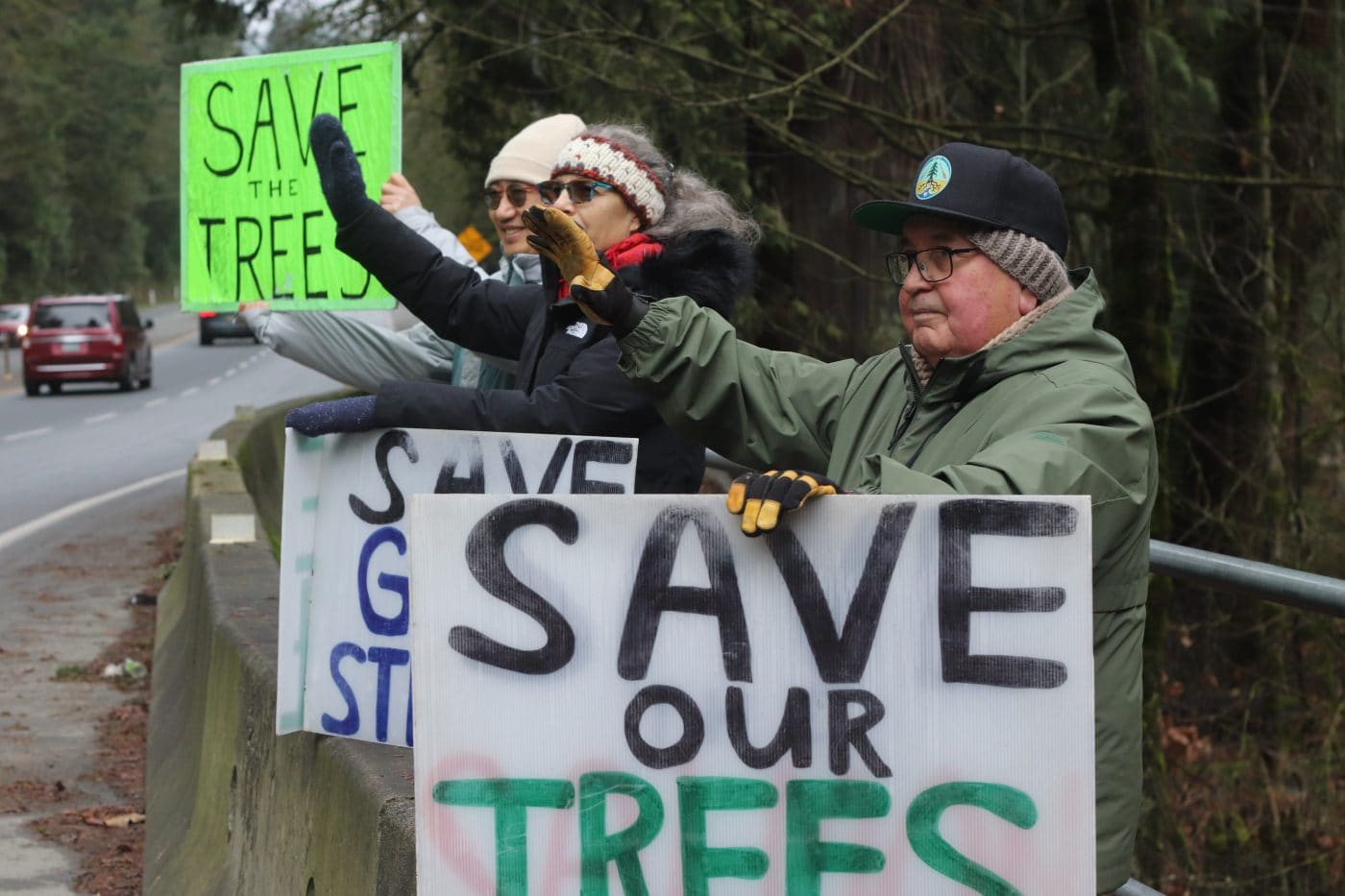


News 23-08-2026
Vancouver storm, “Lucky” mystery and wildfires: News digest
A powerful thunderstorm with thousands of lightning strikes paralyzed Vancouver, Amsterdam police rejected a theory about the identity of a mysterious stranger, and a wildfire broke out in West Vancouver. Here is an overview of the day’s main events.
Rare storm paralyzes Vancouver: More than 7,000 lightning strikes and airport chaos
Last night, British Columbia’s South Coast experienced an unusual natural phenomenon for the region: an exceptionally powerful thunderstorm that moved up from the equator, bringing thousands of lightning strikes, torrential rain and severe transportation disruptions. Residents of Vancouver and its suburbs witnessed an impressive light show, but the consequences were far more serious than mere spectacle—the storm halted operations at the country’s largest airport for several hours and left thousands of homes without power.
CBC meteorologist Joanna Wagstaffe described the storm as “quite a powerful system,” noting that the moisture-laden center of the cyclone moved ashore near Richmond, bringing hundreds of lightning strikes directly over the city. Preliminary data showed that more than 1,800 strikes were recorded over the Lower Mainland alone, while the provincial wildfire service counted more than 7,000 strikes across British Columbia. For a region where thunderstorms are rare, those figures set a remarkable record.
Vancouver International Airport found itself at the center of the chaos. The storm raged for more than five hours, dumping 64 millimetres of rain on the runways—more than twice the average rainfall for August. Airport representative Stephen Smart explained that landing aircraft during such a storm is technically possible, but it was unsafe to send staff onto the airfield or authorize takeoffs. As a result, passengers whose flights were cancelled or delayed found themselves in a difficult situation: they were issued new boarding passes but were not allowed to pass through security again, leaving them to spend the night on the floor in the departures area. One affected passenger, Simone McCallum, described the situation as “a complete nightmare,” noting that the hard surfaces made it impossible even to stretch out properly, while the circumstances were unbearable for people with children or disabilities.
The power infrastructure was also affected. B.C. Hydro reported numerous outages, and by Sunday morning more than 3,800 customers in the Lower Mainland and on the Sunshine Coast were still without electricity. Forecasters warned that it was too early to relax: a storm warning remained in effect for the southeastern part of the province, including the Kootenays, Boundary and Arrow Lakes region, while a high streamflow advisory was issued for central areas.
Interestingly, the storm also had a positive side. Anticipating its arrival, the wildfire service deployed additional crews to the most vulnerable areas, allowing them to respond quickly to new fires. Lightning caused at least 48 fires over the past two days, but 60 per cent of them had already been brought under control. Service information officer Sarah Budd said the heavy rainfall had significantly reduced fire activity, but warned that the rain could not make up for months of drought. Some hotspots could continue smouldering underground for several days before bursting into flames.
Residents planning to travel should exercise caution. Road crews issued an advisory for Highway 99 between Pemberton and Lillooet, where heavy rain could lead to sudden closures. The airport is urging passengers to check their flight status before leaving home, as the effects of the overnight storm continued to affect the schedule on Sunday. The thunderstorm was a vivid reminder that even regions with mild climates can face surprises for which neither infrastructure nor residents are fully prepared.
Amsterdam’s mysterious “Lucky” was not missing Canadian: Police continue search
For several weeks, the world has followed the story of a man found unconscious on an Amsterdam street in the spring of 2023. He was given the name “Lucky”—the only thing known about him. He had no documents or phone and could not speak coherently; after suffering a stroke, he lost the ability to communicate. Dutch police received more than 500 responses from people around the world, but the stranger’s identity remains a mystery. Last week, there was hope that he might be a Canadian who disappeared in 1994, but that theory has now been disproved.
Earlier this week, Vancouver police announced that they were considering the possibility that “Lucky” was John Russell Kenney, who disappeared from British Columbia more than 30 years ago. The news sparked a surge of interest because, if confirmed, the theory would have given the story at least a definite ending, if not a happy one. However, Amsterdam authorities said Saturday that a comparison of fingerprints showed that the two men were different people. “This lead was investigated jointly with Canadian police, and it has now been conclusively established that Lucky and Mr. Kenney are not the same person,” Amsterdam police spokesperson Marieke Stor said. Vancouver police spokesperson Meghan Lui confirmed this by email, noting that the biometric data did not match. Interestingly, Canadian police are not taking part in the investigation going forward—all new leads are now being pursued solely by Dutch detectives.
The story began in May 2023, when passersby found a man who had collapsed on the street. He was taken to hospital, where doctors diagnosed him with a brain hemorrhage. The patient survived but lost the ability to speak, read and understand spoken language—a condition known as aphasia. He is now living in a specialized facility where he receives care, but spends most of his time alone. “We don’t know how much he understands about what is happening. We have tried different ways of communicating, including speech-enabled tablets and pointing to letters, but we still have not been able to determine who he is,” Stor explained. The only words he sometimes says are “nonsense,” “definitely” and “positive,” which apparently serve to express agreement or disagreement.
Police continue to maintain that the man most likely came from North America. The theory is based on accounts from visitors and employees of the Soep en Zo café on Waterlooplein, where “Lucky” occasionally appeared. Locals called him “Chris the Canadian” and said he had a clear American or Canadian accent. However, Stor cautioned: “That does not mean he is definitely from there, but it is a very real possibility.” In the week since the release of a video appealing for help, police have received more than 500 messages, at least nine of which included specific names that are now being actively checked.
It is important to clarify that this is not a criminal investigation but what is known as a “social investigation.” The police are not trying to find a criminal; they are trying to determine who the man is and possibly reunite him with family or friends. This is an unusual practice in Europe, but it reflects the humane approach of Dutch authorities: they want not only to establish his identity but also to give him some connection to his past. As police emphasize, “Lucky” currently spends his days in isolation, and even one meeting with someone who knew him could change his life.
While the public continues to send in tips, the story remains unresolved. Each new theory—whether it involves a missing Canadian or someone else—brings investigators closer to an answer, while also highlighting the fragility of human memory and the importance of strangers’ help in such complicated situations. Further details continue to emerge in this Global News report, which has followed the case from the beginning. Perhaps we will soon learn who is hiding behind the name “Lucky.” But even if we do not, the story has already become a reminder that everyone deserves to be found.
Small wildfire near Sunset Beach in West Vancouver: What we know so far
On Sunday, shortly before noon, the BC Wildfire Service reported a fire near Sunset Beach in West Vancouver. The fire currently covers just 0.009 hectares, making it extremely small in scale. However, its “out of control” status indicates that the flames may be spreading or are expected to move beyond their current boundaries. Fire crews are already on scene, and residents and travellers should be prepared to see smoke from the fire along the Sea to Sky Highway and from the area around Sunset Beach.
The cause of the fire remains under investigation, but specialists have already linked it to recent weather conditions. According to a statement from the BC Wildfire Service, a storm moved through many areas of the Coastal Fire Centre between Friday and Saturday, bringing an increased risk of lightning-caused fires. The agency is now assessing affected areas for additional hotspots and monitoring existing incidents. Although small, the episode serves as a reminder of how quickly conditions can become dangerous during the warm season, when even a single lightning strike can ignite dry forestland.
Against the backdrop of this localized incident, the overall situation across the province is more concerning. British Columbia currently has 176 active wildfires, 60 of which started within the past 24 hours. This indicates that the wildfire season is in full swing, and every new outbreak requires a rapid response to prevent the flames from growing to catastrophic proportions. The close attention being paid to even a tiny fire such as the one near Sunset Beach is telling: in dry, windy conditions, it can quickly increase in size.
People in the West Vancouver area should remain vigilant and monitor updates from official sources. The BC Wildfire Service reminds residents to report any signs of fire, including even light smoke, immediately by calling 1-800-663-5555 or through the agency’s mobile app. Early detection is crucial in fighting wildfires: the faster firefighters arrive, the greater the chance of containing the blaze before it spreads to neighbouring areas.
Although the current incident does not yet pose a serious threat to residents or infrastructure, it is an important reminder that nature in the region remains unpredictable. Local authorities and fire services have been mobilized, and the situation is under control, but residents are advised to avoid the fire area and not interfere with emergency crews. More information will become available as the situation develops, and it is important to follow official updates so that any changes can be addressed promptly.
The incident also underscores the importance of reporters covering local events. As noted in the Vancouver Is Awesome article, the report was written by Abby Luciano, a journalist whose work was made possible through the Local Journalism Initiative. Such reporting helps residents stay informed about events taking place right on their doorstep and understand what precautions they should take during challenging weather conditions.


News 22-08-2026
Vancouver Investments, Justice and Its Future: Key Events of the Week
A look at the day’s top stories: multimillion-dollar investments in the city’s power grid, a sentence in a high-profile case and a potential deal that could determine the fate of a soccer club.
Whitecaps and BC Place: A Deal That Could Save the Club
The Vancouver soccer community was rocked by major news this week after respected local journalist Michael McColl, who specializes in covering the Vancouver Whitecaps, said on his podcast that the club and the British Columbia government had allegedly reached an agreement giving the club control of BC Place for five years. According to McColl, the information was confirmed by three independent sources, and an official announcement could come as early as next week. If true, it could be a genuine lifeline for a club that has spent the past 20 months living with uncertainty over its future in Vancouver. However, as is often the case in the world of big money and politics, things are not that simple: Whitecaps CEO Axel Schuster denied that any documents had been signed, while the club issued an official statement saying that “no new or different agreement with the province has been reached.”
As McColl describes it, the potential deal would involve the provincial government transferring operational control of BC Place to the Whitecaps. This would not be a sale or a conventional lease. Rather, the club would be responsible for the stadium’s commercial operations, attracting sponsors and organizing events, and would presumably receive revenue from those activities. Once the five-year term expires, the agreement could be extended for another five years. This arrangement is not unique in North America. In Toronto, for example, BMO Field is owned by the city but operated by Maple Leaf Sports and Entertainment, which also owns the local soccer club, Toronto FC. Similar arrangements are common in the United States, where many municipal stadiums are placed under the control of the professional teams that play there.
Why is the British Columbia government considering such an arrangement in the first place? The answer is fairly prosaic: BC Place is reportedly a loss-making asset for PavCo, the Crown corporation that currently manages the stadium. The huge facility, built for the 2010 Winter Olympics, requires substantial maintenance spending, while event revenues do not always cover its costs. Transferring management to a private organization is an attempt not necessarily to make the stadium profitable, but at least to reduce the burden on the provincial budget. The Whitecaps appear to be a logical candidate: the club has a vested interest in keeping the stadium busy, generating revenue and, ideally, creating additional funding sources for the team itself.
Interestingly, MLS Commissioner Don Garber effectively hinted at this scenario when he met with reporters in Vancouver last November. He said at the time that BC Place needed “a different approach and a different vision,” emphasizing that the club was prepared to take responsibility for commercial operations, including selling naming rights—a deal the stadium has so far failed to secure. “We’ll take that in a heartbeat; we’re good at it, and we have no choice,” Garber said, clearly indicating that MLS saw potential in this management model. Those words now sound almost prophetic.
Despite the journalist’s optimism and that of his sources, officials have remained silent or cautiously denied that anything has been signed. In response to media inquiries, the club’s communications department issued a restrained statement saying that discussions are indeed underway, but that the club is awaiting “clarification of key details.” This is a typical diplomatic formulation that could mean either that the deal is close to completion but has not yet been finalized, or that the parties are still at an early stage of discussions. Daily Hive also contacted representatives of PavCo and the provincial government for comment, but no response had been received at the time of publication. In its report, the outlet also quotes McColl directly acknowledging that even if an agreement has been reached, official confirmation could be delayed.
For Whitecaps fans, the news is a glimmer of hope after a long string of worrying reports. Over the past 20 months, media outlets have repeatedly reported that the club could leave Vancouver, with its owners considering a move to another city because of unresolved stadium issues. The current BC Place lease apparently satisfies neither side. If the deal does go through, it would mean the club was receiving more than a long-term lease—it would effectively gain control over a key asset, opening up entirely new opportunities for monetization. In addition to soccer matches, the club could organize concerts, exhibitions and other events itself, keeping all the profits.
Still, the question of whether managing a huge stadium would be an asset or a burden remains open. Some experts point out that BC Place is a massive facility with a retractable roof and complex engineering infrastructure, and that maintaining it requires enormous resources. For a club already covering the costs of its team, academy and marketing, the additional responsibility could become a serious burden. On the other hand, control over the stadium’s commercial operations would give the Whitecaps the opportunity to fully realize its potential—something many believe is not happening under the current arrangement.
The coming days will show how closely McColl’s information matches reality. If an official announcement does come next week, it would be one of the most significant events in the club’s history. If not, people will have to settle for another round of rumors and an expectation that could drag on for several more months. In any case, the very fact that such talks are actively taking place suggests that the parties are looking for a solution and may finally be approaching a compromise that will keep the Whitecaps in Vancouver.
22 Years in Prison for Crimes Revealed Years Later: A Vancouver Island Case
In Port Alberni, a small town on Vancouver Island, a years-long case has come to an end—one that required genuine persistence from police. Local resident Shaun Pater has been sentenced to 22 years in prison for a series of past sexual offenses. The sentence was handed down last week, and the man’s name will now be associated with one of the region’s most high-profile cases of its kind in recent years. This was not a single incident but a series of offenses committed over an extended period and involving several victims, including very young people.
According to authorities, the charges included sexual interference with a person under 14, two counts of sexual interference with people under 16 and one count of sexual assault. These terms may sound dry in Canadian law, but behind them are years of suffering endured by people who decided to testify despite the fact that the events occurred long ago. Inspector Kim Bruce, speaking on behalf of the Royal Canadian Mounted Police, emphasized that the investigation was “historical” in nature, meaning that the crimes came to light a significant time after they were committed. This added to the difficulty: witnesses might have forgotten details, evidence might have disappeared and emotional wounds might have grown deeper without becoming any less painful.
Police had to make “exceptional efforts” to bring the case to trial. Bruce noted that investigative work in such cases is not simply a matter of collecting facts but genuine detective work requiring patience and sensitivity. An official statement published on the CBC website particularly highlighted the courage of the victims and witnesses. Their willingness to testify in court was a key factor in securing a conviction. Bruce expressed hope that the decision would bring the victims “some measure of relief” and a sense of closure, since for many of them the path to justice had been long and exhausting.
It is important to understand that the term “historical” crimes in Canadian legal practice does not mean that they are no longer relevant. It simply means that they were committed in the past, sometimes many years before authorities learned about them. There is no statute of limitations for such serious offenses, allowing perpetrators to be held accountable regardless of how much time has passed since the incident. This creates a legal precedent that offers hope to other victims who may have remained silent for decades—a reminder that their voices matter even if it seemed that everything had long been forgotten.
The Shaun Pater case is not an isolated one in British Columbia. The province has seen previous cases in which adults faced justice years after committing offenses in their youth. This sentence is particularly notable, however: 22 years is a substantial term reflecting the seriousness of the crimes and the number of people affected. The court evidently considered the systematic nature of the convicted man’s actions, since the charges involved different people and different periods, pointing to an established pattern of behavior rather than an isolated mistake.
The victims and witnesses in the case were granted anonymity, with the court imposing a publication ban on any information that could identify them. This is standard practice in sexual-offense cases, intended to protect people from further trauma and public pressure. Nevertheless, their testimony formed the foundation of the prosecution’s case, and without their courage, the verdict would not have been possible. Port Alberni police described the sentence as the result of a joint effort, but above all as a tribute to those who chose to tell the truth despite fear and pain.
The case also raises questions about how society responds to crimes of this kind. On the one hand, a 22-year prison sentence demonstrates that justice can ultimately prevail. On the other, it is a reminder that many victims remain in the shadows, afraid or distrustful of approaching police. Perhaps this sentence will serve as a signal to others: even after many years, it is possible to receive support and obtain justice, however difficult the journey may seem.
Investing in Vancouver’s Energy Core: How a Substation Upgrade Will Support Growth
The British Columbia government has announced a major investment in Vancouver’s electrical infrastructure, marking an important step in the development of one of the city’s most dynamic areas. Ninety million dollars will be directed toward expanding the Mount Pleasant substation, allowing up to 50,000 new customers to connect to the grid. This project is not merely a technical upgrade but a strategic response to the challenges of rapid urbanization, transportation electrification and housing construction along the famous Broadway Corridor, which is experiencing a major building boom.
The substation upgrade is part of BC Hydro’s broader “Powering Growth, Fueling Opportunity” program, which focuses on energy conservation, optimizing existing capacity and building infrastructure for the future. A key component of the project will be the installation of a third transformer, scheduled to arrive at the site in early September. Notably, space had already been prepared for it: an empty bay designed during the original construction. This demonstrates the foresight of the engineers, who built the possibility of future expansion into the project from the outset. As BC Hydro President and CEO Charlotte Mitha puts it, this is a “smart investment” that allows already planned capacity to be used now, at a time when the city urgently needs more power.
The Mount Pleasant substation performs a critically important function in the city’s electrical system: it converts high-voltage transmission power into lower-voltage electricity that is safe for homes and businesses. Expanding its capacity will directly support new housing construction, business development and the adoption of cleaner technologies. Energy and Climate Solutions Minister Adrian Dix emphasized that the rapidly growing Broadway Corridor needs an electrical grid capable of keeping pace, providing “clean and reliable electricity for decades to come.” Most construction will take place within the existing substation, minimizing disruption for nearby residents and businesses. The project is expected to be completed in early 2029.
This investment is just one part of a broader strategy to modernize Vancouver’s energy infrastructure. BC Hydro is implementing several other major initiatives in parallel. These include upgrading the 70-year-old Mainwaring substation, which will improve the reliability of electricity service for more than 60,000 homes and businesses. The aging Dal Grauer substation in the west of the city is also being replaced, ensuring a stable supply of power for approximately 50,000 customers downtown. In the east, the nearly 80-year-old Murrin substation is being replaced with a modern facility designed to accommodate future growth in housing construction and commercial activity. Vancouver Mayor Ken Sim emphasized the importance of ensuring that critical infrastructure keeps pace with the city’s growth, creating the conditions for new homes and economic opportunities.
Union leaders have also welcomed the investments. MoveUP President Annette Toth said the project would strengthen not only the power system but also the position of workers by creating new jobs and supporting the idea of public, clean and reliable electricity. The announcement is a clear example of how infrastructure projects can act as catalysts for sustainable urban development, combining economic efficiency with long-term planning and environmental stewardship. More information about the initiative is available in the official British Columbia government release.



News 21-08-2026
Vancouver: Housing Crisis, Broadway Power and an Award-Winning Home
This roundup covers Vancouver’s record construction slump, BC Hydro’s substation expansion to power the future Broadway district, and the sale of an award-winning home in West Vancouver.
Vancouver Faces Its Worst Construction Crisis in Three Decades: What’s Happening to the Housing Market
Housing construction in Vancouver is experiencing an unprecedented downturn: the number of new projects in July fell by 42 percent compared with the same period last year. The figure, released by the Canada Mortgage and Housing Corporation, has alarmed developers and analysts, as a decline of this magnitude has not been seen in the city in the past 30 years. Mike Drummond, executive director of the Urban Development Institute, says plainly that building housing has become unprofitable, calling the current situation “the worst housing crisis in three decades.” He stresses that behind these figures are real people losing their jobs and real wages being eroded as construction projects come to a halt.
The statistics look especially stark compared with other major Canadian cities: Toronto saw a decline of only 10 percent, while Montreal recorded a 3 percent increase. Tania Bourassa-Ochoa, CMHC’s deputy chief economist, attributes the trend to broader problems with launching new projects, noting that similar dynamics are affecting many markets, though not on the same scale. At the same time, she offers some reassurance, saying that the large number of projects already under construction will continue adding to the housing supply in the near future. For Vancouver, however, that is little comfort, as analysts say the city is dealing with systemic problems rather than a temporary market fluctuation.
Drummond, who represents developers’ interests, sees a solution in drastically reducing construction costs. He says a building that would have cost $100 million in 2015 now costs twice as much. In his view, taxes and fees on housing construction must be reduced, and the approach to foreign investment reconsidered. He points to Australia, where foreigners are allowed to buy only new homes and are prohibited from purchasing on the resale market, helping prevent speculative price increases for existing properties. Canada, by contrast, has a ban on foreign homebuyers that is due to expire in 2027, and Drummond says it is time to start considering what the country’s new approach to foreign capital should be.
Andy Yan, director of Simon Fraser University’s city program, takes a different view, pointing out that the problem is not only construction costs but also the lack of affordability for local residents. His calculations show that about 70 percent of unsold condominiums in Vancouver are priced above $1 million, putting them out of reach for most residents. Yan raises a fundamental question: are we actually building the housing people need, or are we continuing to build properties that do not match what buyers can afford? He also notes that every new home requires infrastructure investments—roads, water systems and sewers—which he estimates at approximately $107,000 per housing unit. This raises a reasonable question: who should pay for these costs—the developer, the buyer or the city?
Yan also urges caution regarding the Australian model proposed by Drummond. He says blindly copying individual practices does not work, and that an influx of foreign capital into the housing market has contributed to bubbles in the past. In his view, Canada has already learned this lesson, as foreign investment helped fuel the current housing affordability crisis. Instead, he calls for deeper analysis and a comprehensive approach that considers not only construction volumes but also residents’ actual incomes.
Additional context comes from a fact not mentioned in the article but that seems obvious: inflation and rising construction-material costs in recent years have affected not only Vancouver but other regions as well. In Vancouver, however, these pressures have been compounded by the city’s unique geographic constraints and limited land supply, magnifying the impact of rising costs. At the same time, persistently strong housing demand—which previously drove the market—is now running up against high interest rates and declining purchasing power.
Together, these factors create a complex picture. On one hand, developers are calling for lower taxes and less bureaucracy; on the other, experts say the city needs more carefully considered planning policies and housing that middle-income residents can afford. For now, the market remains uncertain, and economists expect this trend to continue in the coming months. The full study and expert comments are available in the original CBC article.
BC Hydro Expands Vancouver Substation to Prepare for Broadway Growth
Canadian energy company BC Hydro has begun an ambitious project to expand the Mount Pleasant substation, located at the southwest corner of West 6th Avenue and Alberta Street. The strategically important project is intended to provide electricity for tens of thousands of new residents and commercial properties in Vancouver’s rapidly growing Central Broadway area. Built in 2014, the substation was originally designed with room for future expansion. Now, that reserved space is being put to its intended use.
The project is estimated to cost $90 million and involves installing a third transformer in an area deliberately left vacant for that purpose. In addition to increasing capacity, the upgrade is intended to improve the reliability of the overall power system. BC Hydro President and CEO Charlotte Mitha said projects like this are the result of years of planning: the company built the potential for growth into its infrastructure from the outset. She said the expansion will help support the homes, businesses and clean-energy technologies that will shape Vancouver in the coming decades.
The project’s importance is underscored by figures in the City of Vancouver’s second-quarter 2026 progress report on the Broadway Plan. At present, 169 active projects are under development. Of these, 59 have received development permits or are at later stages, while another 59 have approved rezoning applications. Together, the projects would create approximately 25,000 homes, including about 17,900 purpose-built rental homes, 3,800 below-market rental homes, 2,500 market condominiums and 800 social-housing units. For comparison, 20 projects are at the pre-application stage, 24 are submitting rezoning applications, 49 have received rezoning approval, 35 are going through the development-permit process, seven have building permits, and two have already received occupancy permits.
In addition to residential construction, the district is expected to see significant commercial and public-infrastructure development. Thirty-two non-residential projects and 89 mixed-use projects with non-residential components are under development, together creating approximately 11.4 million square feet of non-residential space. This includes 4.1 million square feet of institutional space, 2.5 million square feet of office space, 2.3 million square feet of hotel space, 1.2 million square feet of industrial space, and 940,000 square feet of retail, restaurant and service space. The hotel sector is particularly notable: 16 projects would create approximately 3,600 rooms, while 36 projects include local community amenities such as cafés and restaurants in residential areas.
However, current economic conditions are forcing developers to adjust their plans. The difficult market is expected to be a key factor determining the pace and timing of construction starts for many projects. By the end of the second quarter, only 10 building permits had been issued, reflecting developers’ caution under current conditions.
It is important to understand that this large-scale growth is directly linked to transportation infrastructure. The six new stations on the SkyTrain Millennium Line, part of the extension to Arbutus, will be the main catalyst for dense development along Broadway. The new extension is expected to open in late 2027, making the Mount Pleasant substation expansion timely preparation for the surge in activity that will inevitably follow the launch of the new transit service.
For those unfamiliar with the terminology, a substation is a power-system facility that converts high voltage into lower voltage suitable for use by residential and commercial buildings. Expanding a substation effectively means increasing its capacity—its ability to serve more customers simultaneously. With tens of thousands of new homes and commercial spaces planned, the district would face an electricity shortage without this expansion, seriously limiting its development.
In conclusion, the expansion of the Mount Pleasant substation is not merely an engineering project but a crucial element of long-term urban planning. It demonstrates how designing infrastructure in advance, with future needs in mind, enables cities to grow methodically and adapt to new challenges. While developers and city officials work through questions of financing and construction schedules, the power infrastructure is already being prepared to support the ambitious plans to transform Broadway into one of Vancouver’s fastest-growing centres. More information about the project is available in the original Daily Hive article.
Award-Winning West Vancouver Home Listed for $5.75 Million
A home in West Vancouver, one of British Columbia’s most prestigious areas, has entered the real-estate market after collecting a series of major architecture awards in just two years. Known as Howard House and designed by Architecture Building Culture (ABC), the residence has attracted the attention of both prospective buyers and industry professionals. In 2019, shortly after construction was completed, it was recognized by several juries, including the Lieutenant Governor of British Columbia Award in Architecture for Merit from the Architectural Institute of British Columbia. The property is now looking for a new owner, with its $5.75 million asking price reflecting both the project’s uniqueness and the status of its location.
The home has four bedrooms and four and a half bathrooms, but its most notable feature is how the architects responded to the challenging site. The shape of the lot resembles a kite, and that characteristic determined the overall design. The house consists of two interconnected wings that meet at a central courtyard, creating a sense of privacy while remaining open to nature. The bedroom wing is raised on columns and extends southeast, while the western wing contains the living spaces, a double-height entrance, the main staircase, an office, a games room and a balcony. This arrangement makes the most of the natural light and views from the property.
The market has already offered its own assessment of the property. According to BC Assessment data, the home sold for $5.83 million in 2024 and is now listed at $5.75 million—$80,000 below its previous sale price. This could reflect either a revision of the seller’s expectations or current conditions in the region’s luxury-home market, where demand for distinctive architectural properties remains steady but buyers have become more cautious. West Vancouver is traditionally considered one of the country’s most expensive municipalities, and homes of this calibre are not unusual there. However, design awards can be a decisive factor for buyers seeking not merely a house but a work of art.
For readers unfamiliar with architectural terminology, a “double-height space” is a room that extends across two storeys, creating a sense of spaciousness and allowing light to penetrate deep into the interior through large windows. As for the shape of the lot, “kite” is not a metaphor in this context but a literal description of land that narrows and widens like a kite, requiring an unconventional approach to the floor plan. The ABC architects clearly treated this not as a limitation but as a challenge, turning the site’s disadvantage into its defining strength.
Buying a home like this is not simply an investment in square footage but also an investment in reputation and aesthetics, as recognition from the professional community automatically raises a property’s status. Potential buyers should nevertheless keep in mind that maintaining buildings with unconventional geometry and extensive glazing can involve additional heating and maintenance costs. For those who value modern architecture and are willing to pay for uniqueness, however, Howard House could be a rare find. Details about the floor plan and the project’s history can be found on the Architecture Building Culture website, while information about the current listing is available in the Castanet listing, which includes photographs of the unusual home.


News 20-08-2026
Weekend in Vancouver: Festivals, Ferries and a Waterborne Feat
B.C. Ferries is cancelling sailings because of storms, a daredevil will cross the strait on a water bike to help sick children, and the city is preparing for a dragon boat regatta, an Indonesian celebration and fireworks.
Storm forecast: Why B.C.’s ferry service is taking an enforced break
Residents of Vancouver and Vancouver Island have grown accustomed to checking their plans against the ferry schedule in recent days, but instead of the usual sailings, they are now facing a series of official cancellations. B.C. Ferries has announced widespread schedule disruptions that will last for several weeks. These are not isolated rescheduling decisions caused by technical problems—the move is a systemic one that will affect thousands of passengers, including tourists, residents and commercial shippers.
As is often the case in coastal regions, the cause lies in the weather. Strong winds, storm waves and limited visibility make navigation through the Strait of Georgia and other narrow sections of the routes unsafe. Ferry captains follow strict instructions: when wind speeds or wave heights exceed certain thresholds, a sailing is cancelled to avoid endangering lives or the vessels themselves. However, what began as a temporary measure lasting a few days has now turned into a longer-term forecast, forcing passengers to adapt to a new reality.
It is worth explaining why B.C. Ferries is particularly vulnerable to the elements. It is one of the world’s largest ferry systems, serving more than 40 routes along the British Columbia coast. Ferries here are not merely a tourist option but a vital artery connecting island communities with the mainland. Unlike bridges or tunnels, ferries depend entirely on sea conditions, and even modern vessels equipped with stabilization systems cannot guarantee safety during hurricane-force gusts. The situation becomes especially difficult in winter, when Pacific storms arrive one after another.
The company has already warned that cancellations will affect both morning and evening sailings on the busiest routes—including those between Vancouver and Victoria, as well as routes to the Sunshine Coast and the Gulf Islands. For many people, this means more than a change of plans; it creates serious logistical problems. Some will be unable to get to work on time, others will lose money on hotel bookings, and freight carriers will have to seek alternative ways to deliver goods. Local media have already reported lines of vehicles forming at terminals, with people waiting for hours for the chance to board.
Interestingly, in its official statement, B.C. Ferries emphasizes that cancellations are made solely for safety reasons and are not open to debate. However, passengers are increasingly asking whether the current situation is also the result of insufficient investment in infrastructure and an aging fleet. Some experts note that the company postponed vessel upgrades for years, relying on peak-season revenues to cover its needs. Now, as the climate becomes increasingly unpredictable and storms intensify, the cost of that short-sightedness could be very high.
For those planning a trip in the coming weeks, there are several important points to keep in mind. First, passengers should regularly check the carrier’s official website and mobile app, where up-to-date sailing information is posted. Second, even if a sailing appears on the schedule, that is no guarantee it will operate—weather conditions can change at any time. Third, the company recommends having a backup plan. Alternative forms of transportation, such as flights with smaller airlines, may be worth considering, although they will put additional pressure on travellers’ budgets.
The ferry situation is not merely a local problem affecting one region. It is a vivid example of how global climate change is influencing the everyday lives of ordinary people. If storm season was once confined to clearly defined months, it is now expanding into new periods of the year. For British Columbia, where ferry service is the foundation of economic activity and social connectivity, this is a challenge that requires not only immediate solutions but also strategic planning for decades to come.
For now, passengers can only be patient and monitor updates. According to CTV News, the cancellations will last at least several weeks, and this may only be the beginning—if winter is as harsh as forecasters predict, the company will face many more difficult decisions. Ultimately, this is a story about how even systems that appear highly reliable can prove fragile in the face of nature, and how sometimes it is better to wait out a storm on shore than risk everything to keep to a schedule.
From land to sea: Vancouver man to cross the strait on a water bike for sick children
Vancouver resident Tiernan Tinnelly is preparing for an unusual challenge. On September 20, he plans to cross the Strait of Georgia on a water bike to raise money for BC Children’s Hospital. The 60-kilometre route will connect Vanier Park in Vancouver with Maffeo Sutton Park in Nanaimo, and the journey is expected to take between 13 and 15 hours. The adventurer’s goal is to raise $10,000 in donations.
Tinnelly, who was born in the village of Rostrevor in Northern Ireland, admits that he has spent his entire life far removed from water sports. He grew up playing Gaelic football and soccer on land and, in his own words, “water was never really my thing.” What is more, at the beginning of the year he could not swim. Friends persuaded him to take part in a triathlon and an ultramarathon, during which he covered 150 kilometres over six days, but in the water he looked, as he put it, “like a drowning man.” Nevertheless, that lack of experience gives his undertaking an added sense of daring and humanity.
His choice of vehicle is no accident. Tinnelly is the managing partner of Vancouver-based GoEasy Water Bikes, a company specializing in water-bike rentals. His craft is a hybrid of a bicycle and a mini-catamaran, with an aluminium frame, pontoons, chain drive and pedals that propel the structure forward. He stresses that being in good physical shape helps, but admits: “It could take 12 hours, it could take 24, but it doesn’t matter—you just have to keep going, and sooner or later we’ll get there.”
Despite the bravado, Tinnelly is realistic and taking safety seriously. A rescue vessel will accompany him, and he will wear all the necessary protective equipment. In the near future, he plans to meet with representatives of the Royal Vancouver Yacht Club to study tidal currents and safety protocols. If the weather deteriorates, the plans will be adjusted as needed. Food and drinks will be secured to his torso, and the need to relieve himself will be handled directly in the ocean—without false modesty—while other bodily needs will have to wait until he reaches Nanaimo.
People around him have reacted to the idea in different ways. Some have called Tinnelly “a complete idiot” and described the plan as foolish, but he responds: “You can’t always listen to everyone, otherwise you’ll never do anything. I respect the ocean and I don’t underestimate it.” Importantly, behind the humour and affected bravado is genuine motivation. Tinnelly has no children of his own, and no one in his family has been treated at BC Children’s Hospital, but that does not stop him from wanting to help. He says that even if he raises not $10,000 but only $100—and that money buys a sick child a toy that lifts their spirits—that would already be a victory.
The story highlights how personal physical challenges can become tools for charity, bringing people together around shared values. For readers unfamiliar with the context, a water bike is a pontoon-supported vessel propelled by leg power, resembling a pedicab on water. The Strait of Georgia, between Vancouver and Vancouver Island, is known for challenging currents and changeable weather, making the crossing risky even for experienced sailors. The BC Children’s Hospital Foundation raises money for treatment and research at British Columbia’s children’s hospital, one of the largest in Canada. Donations connected to Tinnelly’s journey can already be made through the foundation’s website, as noted in this Vancouver Is Awesome article. Ultimately, Tinnelly’s story is less about a sporting record than about how even someone with no experience—and a willingness to laugh at himself—can make a meaningful difference when his heart is in the right place.
14 vibrant Vancouver weekend events: From dragon boats to an Indonesian festival
Vancouver will become a major attraction for anyone who cannot imagine life without memorable experiences over the coming weekend, from August 21 to 23. Local outlet Daily Hive has compiled a selection of 15 diverse events to suit a wide range of tastes, from fans of outdoor recreation and water sports to admirers of ethnic culture and foodies. The biggest highlights are expected to be the famous dragon boat regatta, the colourful Indonesian festival and the spectacular fireworks festival in New Westminster—all three events are completely free to attend.
The centrepiece of Saturday, August 22, will be the grand Concord Pacific Dragon Boat Regatta, which promises to be especially large this year. Organizers have prepared a one-day outdoor festival along the scenic False Creek waterfront and at the Concord Pacific Place public space. This is more than a sporting competition; it is a full-scale celebration of life. From early morning until evening, from 9 a.m. to 6:30 p.m., guests can expect exciting races, an immersion in Chinatown culture, performances by Indigenous artists, a local artisan market and, of course, plenty of food trucks. The day will culminate in a concert by internationally renowned EDM artist Hoang, who will make a special trip to his hometown to see out the summer with energizing dance music. Admission is free, making it an ideal option for a family outing.
On Sunday, August 23, the celebrations will continue with the Indonesian Festival at šxʷƛ̓ənəq Xwtl’e7énḵ square, located at 850 W. Georgia Street. Organized with the support of the Consulate General of Indonesia in Vancouver, the event will offer residents and visitors a chance to take a short journey through Southeast Asia without leaving Canada, from 11 a.m. to 7 p.m. Visitors can enjoy captivating traditional dances and musical performances, workshops on traditional crafts, authentic cuisine and numerous interactive activities for children and adults. It is an excellent opportunity to learn about the rich culture of the country of a thousand islands.
That same Saturday evening, in neighbouring New Westminster, the Summer Music and Fireworks Festival will light up the night. Organized by the Hyack Festival Association, the event will begin at 4 p.m. at Westminster Quay and continue until 9:30 p.m. Guests will be entertained during the day with live music and a range of activities, while after dark the sky over the Fraser River will be illuminated by a colourful fireworks display, providing a spectacular finale. Those looking to add variety to their weekend can also choose from other events mentioned by the outlet, including WNBA games, allowing everyone to create their ideal weekend itinerary.





News 19-08-2026
Economy and the Elements: This Week’s Top Stories
A utilities strike threatens dredging work, the rental market is shifting toward mid-sized cities, and Summerland residents are returning to a smouldering wildfire.
Metro Vancouver strike could derail dredging work in Burrard Inlet
Metro Vancouver utility workers have launched an indefinite strike, potentially affecting the schedule for dredging work in Burrard Inlet—a crucial shipping route through which large oil tankers must pass to reach the terminals. The Greater Vancouver Regional District Employees' Union has sent its members to picket lines, blocking two key water-infrastructure projects in Vancouver and North Vancouver. Without the completion of this work, the union says, dredging beneath the Second Narrows Ironworkers Memorial Bridge, scheduled for September, cannot begin. That, in turn, threatens the federal government’s plans to increase the waterway’s capacity for vessels with deeper drafts.
The dispute between workers and the regional district has already lasted 19 months. During that time, there have been several rounds of negotiations, picketing and partial strikes, but the parties have still failed to reach an agreement. Union president Jesse Medeiros says workers do not want to interfere with major infrastructure projects but have been forced to take drastic action. “Until we reach an agreement and ratify a new contract, the union will continue escalating pressure, up to and including stopping projects such as dredging in Burrard Inlet,” Medeiros is quoted as saying by CBC News. Metro Vancouver says it is trying to minimize the impact by bringing in contractors and temporary workers, but acknowledges that deadlines could be missed if the pickets continue.
The latest round of mediated talks ended on July 22. The district is currently offering workers a 10-per-cent raise over three years—the same increase previously agreed to with the Teamsters union. However, that does not appear to be enough, and both sides continue to exchange strongly worded statements. The Vancouver Fraser Port Authority, which is responsible for the dredging work, has so far cautiously said the project remains in the pre-construction phase and that it is too early to assess the strike’s impact.
What is important to understand about this situation? Dredging Burrard Inlet is not merely a technical procedure. It involves expanding access for large oil tankers and forms part of the federal strategy to increase export capacity. Delays caused by a labour dispute could have far-reaching consequences not only for port infrastructure but also for Canada’s reputation as a reliable energy supplier. For workers, on the other hand, the dispute concerns fair wages and working conditions they consider unacceptable. With negotiations at an impasse, both sides appear prepared for a prolonged standoff. For residents of the region, this means familiar utility services may be disrupted; for port operators, vessel schedules could be adjusted in either direction. Still, as often happens in such cases, a final resolution will probably be found at the negotiating table. But time is running out: September is approaching, along with a dredging window that cannot be postponed indefinitely.
Canada’s rental market turns toward mid-sized cities as Vancouver loses ground
Canada’s rental housing market is undergoing a noticeable transformation, with Vancouver at the centre of the shift as it rapidly loses appeal among renters. According to a new analytical report from RentCafe.com, residents of the country’s largest cities are increasingly turning their attention to mid-sized communities, where they can find more affordable housing without sacrificing quality of life. This is the first time in the company’s tracking history that none of Canada’s largest metropolitan areas has made the top 10 most sought-after rental locations. Notably, Vancouver dropped five spots from the second quarter of 2026 to 13th place, while British Columbia’s capital, Victoria, and Nanaimo on Vancouver Island are seeing rapidly growing interest from renters.
After examining data from 25 Canadian cities, RentCafe.com analysts identified a paradoxical situation: while Vancouver’s rental supply continues to shrink, activity among prospective renters is declining at a record pace. The number of available rental properties in Vancouver fell by 23 per cent, yet listing views plunged by 60 per cent, while the number of properties saved as favourites dropped by more than half. Experts attribute this to the fact that Vancouver’s market has lost its balance: prices remain exceptionally high, while supply is so limited that renters prefer to look for alternatives elsewhere. Particularly telling is that declining interest in Vancouver is occurring amid a nationwide trend: large cities are no longer magnets for renters and are being displaced by more affordable mid-sized municipalities.
The clearest example of this new reality is provided by two cities on Vancouver Island, which both entered the top 10 for renter interest. Victoria, which rose to third place in the ranking, is showing remarkable momentum: the number of available listings fell by 59 per cent from the previous year, one of the sharpest supply reductions in the country, according to analysts. At the same time, the number of listings added to favourites rose by 78 per cent, pointing to intense competition among renters for the remaining options. Analysts emphasize that Victoria’s appeal stems not only from its climate and proximity to Vancouver, but also from the fact that many people disappointed by the opportunities available in the metropolitan area see the city as a more rational alternative in terms of housing value.
Nanaimo is an even more striking example, climbing five places to eighth. Traditionally considered a bedroom community for people working in Victoria, the city is now attracting independent renters because of its low vacancy rate and, particularly, its relative price stability. While most major Canadian cities have seen a sharp decline in listing views, the decrease in Nanaimo has been minor, indicating sustained demand. Researchers say the appearance of two Vancouver Island cities near the top of the ranking is a clear signal: renters tired of Vancouver’s exorbitant prices are actively creating a new migration flow toward more affordable areas of British Columbia.
It is worth explaining that RentCafe.com calculates a so-called “rental interest index” using a combination of factors: the availability of vacant properties, the number of page views, the number of listings added to favourites and saved searches. This comprehensive approach makes it possible to assess not only the market’s actual occupancy but also real demand from prospective renters. In this context, falling activity in Vancouver alongside shrinking supply creates a paradoxical situation in which the market remains formally undersupplied but is losing its appeal to end consumers. This points to a structural imbalance that is unlikely to be overcome soon without sweeping changes to housing policy.
The trend has long-term consequences not only for the real estate market but for the region’s economy as a whole. The movement of renters from Vancouver to mid-sized cities will accelerate the development of infrastructure in those communities, while also creating new challenges for local governments, which will have to address housing affordability for existing residents. Analysts warn that if the current trend continues, Victoria and Nanaimo could face the same shortage of affordable rental housing that Vancouver is experiencing today within just a few years. For renters themselves, however, this period offers a unique window of opportunity: while large cities continue to lose their appeal, mid-sized markets are offering more reasonable options.
In his report for Daily Hive, RentCafe.com researcher Florin Petrut noted that “for the first time since tracking began, none of the country’s largest cities made the top 10 most attractive markets for renters.” This statement should be seen as an important indicator that Canada’s rental market is entering a new phase, in which the traditional model of “everyone wants to move to the big cities” is giving way to a more nuanced approach to choosing where to live. For Vancouver, this means rethinking its housing-sector development strategy; for the rest of Canada, it shows that provincial centres can offer a worthwhile alternative without sacrificing quality of life.
The fire retreats but does not surrender: Summerland residents return home
A wildfire burning near the British Columbia town of Summerland remains active, despite local residents being allowed to return home. The news, reported on the CTV News website, sounds like a breath of fresh air for thousands of people who anxiously watched over the fate of their property. At the same time, it serves as a reminder that the danger has not yet passed.
The situation is unfolding according to a familiar pattern in the region’s response to natural disasters. Authorities have lifted the evacuation order covering more than 3,000 properties, and residents have received long-awaited permission to return. However, as often happens in such cases, the relief of returning is tempered by the continuing evacuation alert. This means people may stay in their homes but must be ready to pack up and leave at any moment if the flames approach again. The approach helps reduce pressure on temporary shelters and gives residents an opportunity to assess the damage, but it also creates an atmosphere of uncertainty and constant stress.
What does this tell us? Above all, it suggests that firefighters have gained partial control of the situation, but it is still too early to claim complete victory over the elements. An active wildfire status means the fire continues to spread or smoulder, and any gust of wind or change in weather could trigger a new flare-up. For people unfamiliar with firefighting terminology, it is important to understand the difference between lifting an evacuation order and cancelling an evacuation alert. Lifting an evacuation order is a positive sign, indicating that the immediate threat to life has passed. An alert, however, is a safety net that remains in place until all fire pockets have been fully extinguished.
The key figure here is 3,000 properties. This is not merely a statistic but thousands of families whose homes, cars, photo albums and memories were at risk. Returning allows them to begin the recovery process, assess what survived and perhaps sleep peacefully in their own beds for the first time in days. For those who have returned, however, life is unlikely to return to normal immediately: the smell of smoke, ash on windowsills and constant monitoring of smoke on the horizon will become part of their new reality. Psychologists note that events like these leave a deep mark, and even after the situation is fully resolved, residents may need time and support to cope with the stress they have experienced.
Summerland is a small, picturesque town in the Okanagan Valley, known for its vineyards and orchards. Wildfires are unfortunately common in the region, but each one presents a serious challenge. Local authorities have likely already developed plans for the next steps: increased patrols, additional resources to extinguish smouldering areas and, importantly, public information efforts. Residents have probably been reminded to prepare emergency kits, keep their phones charged and monitor official communication channels.
Ultimately, this story is a reminder of how fragile human comfort is in the face of nature. Returning home is a victory, but a temporary and conditional one. Firefighters continue their dangerous work, residents remain on alert, and the hope that rain or the efforts of response crews will bring the fire to a complete end remains the only light at the end of the tunnel. For those watching from afar, it is another example of why it is important to respect authorities’ decisions and place safety above the familiar routines of everyday life.


News 18-08-2026
32 impaired drivers caught on Vancouver Island over the summer
A court awarded more than $1 million after a neighbour’s shooting, an award-winning home was listed for $5.75 million, and police reported the results of their impaired-driving crackdown.
B.C. Supreme Court awards couple more than $1 million over neighbour’s shooting
A high-profile civil lawsuit on Vancouver Island has concluded after several years, following a criminal case involving a violent dispute between neighbours. Anthony and Wendy Nelson of Sooke, on Vancouver Island, won their civil case: their neighbour, Paul Trigier, who is already serving a seven-year sentence for an armed attack, has been ordered to pay them more than $1 million in damages. The case stems from an incident in May 2022, when Trigier shot Anthony Nelson at virtually point-blank range with a .22-calibre rifle, causing severe and irreversible health consequences.
As is often the case in such stories, the circumstances arose from a long-running feud between neighbours. B.C. Supreme Court Justice Julie Gibson, issuing her decision Monday, not only upheld the claim but also sharply criticized the defendant’s conduct during the proceedings. Trigier, notably representing himself and attending hearings by video from prison, continued to insist that the shooting had supposedly “not been proven,” despite having previously been convicted in criminal court of aggravated assault and unlawful firearms offences. Justice Gibson specifically noted that this position amounted to an abuse of process and demonstrated an “exceptionally poor understanding of the situation and a complete disregard for the suffering of the Nelsons.”
The judgment includes several substantial awards that together make up a significant compensation package. Anthony Nelson will receive $767,000 for the assault and resulting bodily injuries. His wife, Wendy, who directly witnessed her husband being shot, was awarded $279,000 for the intentional infliction of mental suffering. In addition, the court ordered Trigier to reimburse the provincial government approximately $64,000 for medical services related to the victim’s treatment. The total financial obligations to all parties therefore exceeded $1 million, making the case one of the region’s most notable in recent years.
Interestingly, the criminal judgment included Trigier’s own explanation that he had taken the firearm with him allegedly to warn his neighbours that a bear had entered their property. However, the judge in the criminal case found that explanation to be a lie and determined that Trigier had gone to the Nelsons’ home with a premeditated intention to shoot someone. In her civil ruling, Justice Gibson also emphasized that even if she had not been bound by the findings of the criminal proceedings, she would have reached the same conclusions about the defendant’s liability based on the evidence presented in court. The verdict is a striking example of how civil justice can supplement criminal punishment by providing victims with at least partial financial compensation for the terror they endured and the lives that were upended, while also establishing an important precedent for similar cases in the future.
For those unfamiliar with the Canadian legal system, it is worth explaining the difference between the two proceedings. Criminal court determines guilt and imposes punishment, such as imprisonment, protecting society from the offender. Civil court, by contrast, deals with compensating the injured party, usually through a monetary award. The fact that Trigier had already been convicted significantly simplified the Nelsons’ lawyers’ task in the civil case. Even so, the defendant attempted to dispute obvious facts, drawing criticism from the judge. As reported by CityNews Vancouver, the decision was issued on Aug. 17, 2026, and has already generated widespread public attention because it touches on the sensitive issue of safety in small communities and accountability for one’s actions. The Nelson family’s story is a reminder that tragedy can occur even in quiet suburbs, and that the consequences of a single reckless act can permanently alter the lives of several people. Financial compensation, unfortunately, cannot restore someone’s health, but it can at least help ease the financial burden placed on the victims.
Award-winning West Vancouver home listed for $5.75 million
A home in the prestigious West Vancouver neighbourhood has returned to the real estate market, attracting the attention of not only potential buyers but also architecture critics. The property is the renowned Howard House, designed by Architecture Building Culture (ABC). This four-bedroom, four-and-a-half-bathroom residence has already received several prestigious awards, including the Lieutenant Governor of British Columbia Award for Architectural Excellence from the Architecture Foundation of British Columbia. It has now reappeared in listings with an asking price of $5.75 million, slightly below the amount paid for it just one year ago.
This is not simply another expensive mansion in a Canadian suburb. Its uniqueness lies in the way the architects responded to the characteristics of the site. The lot has an unusual kite-like shape, and that feature determined the entire design concept. The house consists of two interconnected wings that meet to form an inner courtyard. The bedroom wing is raised on columns and extends southeast, while the western wing contains the living room, a double-height entry hall, the main staircase, an office, a games room and a balcony. The design is not only visually striking but also makes highly efficient use of the lot, creating private areas and open terraces.
The home was sold for $5.83 million in 2024 and has now returned to the market at a slightly lower price. This could indicate that the seller wants to complete the transaction quickly, or it could reflect adjusted market expectations amid current conditions in Vancouver’s luxury real estate sector. According to BC Assessment, the property’s assessed value also reflects these fluctuations. For buyers who value architecture and uniqueness, however, the price difference is unlikely to be the deciding factor.
The reason the home has attracted so much attention is that the Lieutenant Governor’s Award is one of British Columbia’s most significant architectural honours. It recognizes outstanding projects that demonstrate an innovative design approach and integrate harmoniously with their surroundings. For a buyer, it serves as a kind of quality guarantee and evidence that the home was created to the highest standards. In addition, the layout’s emphasis on natural light and a connection with nature makes it appealing to families seeking not merely a residence but a genuine work of art.
Nevertheless, a $5.75 million price tag represents a major investment, and even with its architectural credentials, prospective buyers will need to weigh all the advantages and disadvantages. Vancouver’s real estate market remains one of the most expensive in Canada, and the high cost of properties like this is often linked not only to the house itself but also to its location—with ocean views, proximity to the mountains and well-developed infrastructure. As noted in an article by Vancouver Is Awesome, the home has been listed before, and its return to the market may attract the attention of real estate collectors and admirers of contemporary architecture.
For those unfamiliar with local conditions, it is important to understand that West Vancouver is one of Canada’s wealthiest municipalities, where average home prices are significantly higher than in the city. Many prominent businesspeople, athletes and cultural figures live there, and architectural projects in the area often become models for others to follow. Buying a home like this is therefore not only an acquisition of property but also an investment in status and lifestyle. Experts nevertheless advise approaching such transactions cautiously by thoroughly checking the documents and assessing all hidden costs, including property taxes and maintenance. Ultimately, Howard House is a vivid example of how architecture can transform an ordinary lot into something exceptional, and its new listing will likely attract considerable attention from both buyers and those simply following the luxury real estate market.
32 drivers impaired by alcohol or drugs caught on Vancouver Island in six weeks
The B.C. Highway Patrol has released the results of its summer impaired-driving campaign, and the figures are, to put it mildly, mixed. Over six weeks, from June 15 to July 31, officers on Vancouver Island stopped 32 drivers who had been behind the wheel while impaired by alcohol or drugs. That may seem like a small number, but it represents only the tip of the iceberg when viewed against the provincial total.
Law enforcement officers caught 224 impaired drivers across British Columbia during the period. That is nearly three times fewer than last year, when 626 people were arrested during a comparable but longer period of 10 weeks. Police, however, attribute the decline less to improved public awareness than to organizational factors. This year’s campaign was four weeks shorter, and some personnel were reassigned to provide security during a major international sporting event—the World Cup. Superintendent Laurie Orstad, who leads the highway patrol, said directly that now that resources have returned, enforcement will resume at its previous, more intensive level.
The regional breakdown is also revealing. The largest number of impaired drivers—97—were caught on the South Coast. Northern B.C. came second with 58 arrests, followed by Vancouver Island with 32, the central region with 24 and the Kootenays with just 13. Last year’s distribution was different: the South Coast led with 150 arrests, the North recorded 146, Vancouver Island 131, the central region 111 and the Kootenays 88. The figures clearly show how serious the problem was last season.
Superintendent Orstad said officers at familiar road checks had observed some improvement, but the number of people who knowingly get behind the wheel while impaired remains concerning. She emphasized that police were proud of their contribution to safety during the soccer tournament but are now returning to their regular duties—and drivers should think twice before taking the risk.
Statistics from the Insurance Corporation of British Columbia (ICBC) add further context. About 65 people die in crashes involving impaired driving in the province every year, and alcohol or drugs are linked to roughly one-fifth of all fatal collisions in British Columbia. Behind every percentage point in those statistics are real lives, devastated families and irreversible consequences.
ICBC is reminding people of basic advice that not everyone seems to follow: if you plan to drink, arrange a safe way to get home in advance. That could mean taking a taxi, using a car-sharing service, taking public transit or relying on a sober friend willing to be the designated driver. It may sound obvious, but ignoring this advice leads to preventable tragedies. Police, meanwhile, warn that patrols are not going away and that increased roadside checks should be expected in the near future. In practice, however, that is not enough to deter some drivers.
In Canada, the term “impaired driving” refers to operating a vehicle while under the influence of alcohol or drugs, including prescription medications that reduce reaction times. The Summer Impaired Driving Campaign is an annual initiative during which police conduct intensified checks on major roads, particularly during the vacation season, when the number of trips and parties increases. As the highway patrol emphasizes, the decline in arrests this year should not be misleading: it resulted exclusively from the shorter campaign and the reallocation of resources, not from drivers suddenly becoming more law-abiding. The full report is available in a CHEK News article.


News 17-08-2026
News Digest: Nature, Clean Air and Sports in British Columbia
A roundup of the latest events: voting for the best roadside attraction, the lifting of Vancouver’s air-quality warning, and a key CFL game between the BC Lions and Saskatchewan Roughriders.
Which Vancouver landmark will be named British Columbia’s best roadside attraction?
Summer is in full swing, which means it is time for the traditional vote CBC British Columbia holds among its readers. After choosing the province’s best small town, lake and landmark, it is now time to select the best roadside attraction. We are currently watching the Vancouver Island final, where two completely different contenders have gone head to head: a majestic old-growth forest and a store with goats on its roof. It is a clash between nature and commerce, the spiritual and the humorous, the monumental and the cozy.
Matthew Bowes, a geography professor at Vancouver Island University who studies tourism and natural ecosystems, remembers first arriving on the island from Ontario in the early 1990s. He set out on the famous West Coast Trail and was overwhelmed by the scale of the local wilderness. “All that flora, slugs and ferns. I felt incredibly small and humbled,” he says. But the real revelation came on the way back, when he was hitchhiking along Alberni Highway and found himself in a grove of ancient Douglas firs. For Bowes, who now studies the relationship between people and nature, Cathedral Grove is not simply a forest but a symbol of British Columbia, where the timeless conflict between economic interests and conservation is unfolding in real time.
Cathedral Grove is part of MacMillan Provincial Park, and its unique feature is its accessibility. Half a million visitors a year can park right by the roadside and, without putting on a backpack, find themselves beneath the canopy of centuries-old giants after just a few minutes’ walk. “You feel the grandeur of this forest, and it is incredibly accessible. I don’t think you can find anything else like it anywhere in British Columbia,” Bowes says. It is a place where visitors can have an almost religious experience without making any effort.
But if nature’s grandeur does not impress you, you can drive just 20 minutes farther and have a completely different—but no less memorable—experience. This is Old Country Market, better known as Goats on the Roof. For half a century, goats named Pip and Penny have decorated its green roof. General manager Arthur Uri explains that the owners were originally inspired by Norwegian turf roofs dating back to the Viking era. Then, according to legend, during one lively dinner—one that, he hints, “may have involved wine”—someone decided to add a couple of goats from a nearby fair in Coombs to the grass. The result was a blend of Scandinavian architectural tradition and farmyard charm.
These two finalists are a study in contrasts. Cathedral Grove is a public asset, a government-managed park, while Goats on the Roof is a private business. According to Bonnie Zabolotny, a design professor at Emily Carr University, private attractions survive precisely because they know how to adapt. “They are able to adapt through commerce and interaction, and as a result, the public becomes a co-creator of these places’ meaning and a maker of memories,” she says. And indeed, as Uri puts it, such places are “just a great way to bring people together.” Voting will continue until Wednesday evening, and readers will decide what matters more to the island’s identity: extraordinary natural grandeur or the novelty of private enterprise. In practice, however, these two stops have long been essential parts of the same trip for many residents and visitors to the province.
Vancouver can breathe again: air-quality warning lifted
Residents of Metro Vancouver and the Fraser Valley can finally breathe easier—in both the literal and figurative senses. Metro Vancouver has officially lifted the air-quality warning that had been in effect since August 12 because of heavy wildfire smoke. As reported by CityNews Vancouver, credit goes to coastal winds that pushed the smoke eastward, away from densely populated areas.
The reason the warning lasted so long was fine particulate matter known as PM2.5. These are tiny airborne particles less than 2.5 micrometres in diameter and one of the main components of wildfire smoke. Their danger lies in their extremely small size: they can penetrate deep into the lungs and even enter the bloodstream, causing respiratory irritation, asthma flare-ups and cardiovascular problems. Children, older adults and people with chronic illnesses are particularly vulnerable.
The decision to lift the warning was not made spontaneously. Meteorologists and environmental specialists tracked the movement of air masses for several days. Winds from the Pacific Ocean, which usually bring coolness and moisture, acted as a natural cleanser this time. They effectively blew the smoke out of the region, dispersing it toward East Chilliwack, Agassiz and Hope, where it will eventually dissipate.
Regional officials say air quality will continue to improve as the remaining smoke gradually leaves the atmosphere. Residents are still advised to remain vigilant by monitoring local air-quality readings and weather reports. Wildfires in British Columbia have become an almost annual reality in recent years, and short-term relief does not guarantee that similar warnings will not return. For now, however, the return of clean air is a small but important victory.
BC Lions vs. Saskatchewan Roughriders: A battle for the West that could shape the playoffs
On August 23, BC Place in Vancouver will host one of the Canadian Football League’s (CFL) most significant rivalries. The BC Lions will welcome the Saskatchewan Roughriders in a game that goes far beyond an ordinary regular-season matchup. For both teams, this is not merely a game—it is a chance to strengthen their position in the Western Division standings and build crucial momentum ahead of the championship’s decisive stage. With two divisional points at stake, every touchdown, interception and minute of possession could have consequences later in the fall, when the playoffs begin.
Saskatchewan, rightly considered to have one of the league’s most devoted fan bases, is known not only for its support in the stands but also for its hard-nosed, physical style of play. Their fans, famous for being willing to cross the country to support their team, will turn the visitors’ section at BC Place into a sea of green, creating an atmosphere usually associated with Roughriders home games. That will add another layer of intensity to an already heated matchup. The Lions, meanwhile, will count on home-field support and try to impose a fast pace on their opponents, using their familiarity with the field and the crowd noise as their main weapons.
The author of the piece in Vancouver Is Awesome rightly notes that for fans, this is a rare opportunity to see two bitter rivals face off in a game that could reshape the second half of the season. In the CFL, where the balance of power in the Western Division can change almost every week, such a game becomes a turning point: the winner gains not only points but also a psychological advantage that can often prove decisive in the playoffs. A loss, meanwhile, could force coaching staffs to rethink their tactics and make lineup adjustments, which always carries the risk of instability.
For those unfamiliar with the finer points of the CFL, the Western Division is a group of teams from Canada’s western provinces, and games within the division carry extra importance: they directly affect the standings, which determine who receives home-field advantage in the playoffs. The Saskatchewan Roughriders are a team from the province of Saskatchewan, historically regarded as one of the league’s most decorated and popular clubs despite the relatively small size of its market. Their supporters, known as “Rider Nation,” are a phenomenon in the sports world: they buy tickets to all of the team’s away games, turning them into home contests for Saskatchewan. The Lions represent Vancouver and Greater Vancouver, and for them, a game against the Roughriders is not only a sporting challenge but also an opportunity to prove their superiority to a demanding local audience accustomed to winning.
The game is scheduled for 4 p.m. local time, with tickets starting at a modest $25, making it accessible to a broad audience. Organizers are clearly expecting a sellout, and it is easy to see why: when two teams with such a rich history of rivalry meet, there is simply no room for indifference in the stands. Notably, the article prepared by the Vancouver Is Awesome content studio contains affiliate links to Ticketmaster, a common way of supporting local journalism—a small detail, but one that underscores how even sports coverage in regional media requires financial support. Either way, for fans of both teams, the day will be a true celebration, while for the players it will be a serious test of character. In the CFL, where any game can become the last of the season, matchups like this are remembered for years.


News 16-08-2026
Safety, Treatment and Animal Welfare: British Columbia News Digest
A look at key developments: a bear encounter in a Vancouver Island park, debate over involuntary addiction treatment, and an ambitious project for a new BC SPCA headquarters.
Bear Encounter in a Vancouver Island Park: Safety Lessons
On Friday morning, an incident on Vancouver Island forced authorities to close Stoney Hill Regional Park east of Duncan. A woman walking her dogs off-leash encountered a black bear sow and her cub. Protecting her offspring, the bear attacked the dogs, and when the woman tried to intervene, it attacked her as well. Fortunately, both the dogs and the woman survived, although the extent of her injuries was not disclosed. Conservation officers and police searched the area but were unable to locate the bear—hardly surprising, since sows with cubs typically remain in secluded areas until they sense a threat.
The key lesson from this incident is the authorities’ response. Specialists quickly classified the attack as defensive rather than predatory. This distinction is crucial because the classification determines the animal’s fate. In this case, officials decided not to search for or euthanize the bear: it had acted instinctively to protect its offspring rather than hunting a person. The park was closed, warning signs were installed, and bear activity in the area is now being monitored. It is a classic example of how authorities balance public safety with wildlife conservation.
The inevitable question is: why were the dogs off-leash? Conservation officials explicitly identified this as a serious mistake. Dogs, especially those running freely, are perceived by bears as either a threat or prey. A sow with a cub is the most volatile scenario: any sudden noise, barking or approach toward the cub can trigger an attack instantly. In reality, the incident could have ended far more tragically. Statistics show that most bear attacks on people occur when someone places themselves between the animal and the source of its concern—whether that is a dog, food or a cub.
The conservation service’s statement also reiterated basic rules that many people inexplicably ignore: travel in groups, keep pets on a leash and carry bear spray. Notably, these recommendations are repeated after every similar incident, yet the number of people who disregard them does not decline. Bear spray really does work—it is effective in 90% of attacks when it is readily accessible, rather than buried in a backpack. But even with bear spray, it is important not to panic: the main rule is not to run, but to back away slowly without turning your back.
Authorities emphasize that the park closure is temporary, but also meaningful. It reminds people that wildlife does not tolerate familiarity. The forest is not a city park, and its inhabitants follow their own rules. For tourists and local residents, this incident is another reminder that we are merely guests in this ecosystem, and our habits—letting a dog run free or walking alone—can cost us our health or our lives. As noted in a Global News report, the decision not to pursue the bear also acknowledges that the conflict was caused by human behavior, not the animal. Perhaps this lesson should be taken seriously enough to ensure that the next encounter with a predator does not end in tragedy.
Does Vancouver Need a Plebiscite? B.C. Premier Backs Involuntary Treatment
The question of involuntary treatment for people with severe addictions and mental-health disorders has once again stirred public debate in Canada. This time, the focus is Vancouver, where local officials are seriously considering holding a plebiscite—a direct vote by residents on this difficult issue. However, the premier of British Columbia has already made it clear that the province supports involuntary care and, in his view, an additional vote may be unnecessary. The situation exposes a deep divide among politicians and residents alike, who have very different views on how to address the street crisis affecting the region’s largest cities.
The Vancouver initiative itself is fairly radical. A plebiscite is an uncommon instrument of direct democracy in Canada, generally reserved for truly momentous decisions, such as changing boundaries or approving major infrastructure projects. Putting a question involving medical intervention without a patient’s consent to a public vote would be both bold and controversial. Supporters argue that residents have the right to directly express their views on how the city should respond to the opioid addiction epidemic and the growing number of people living on the streets. In their view, the current system, based on voluntary treatment and harm reduction, has clearly failed, and tougher measures are needed—even if they restrict some individuals’ freedom for their own benefit.
The provincial premier, however, sees the situation differently. In a recent statement, he stressed that the provincial government is already working on a legislative framework for involuntary treatment and considers it a necessary step amid the crisis. His position is that holding a plebiscite would be a waste of time and resources because the decision has already been made at a higher level. He noted that British Columbia is facing an overdose emergency and that delays could cost lives. He also questioned whether ordinary citizens have enough information to make such complex medical and ethical decisions, arguing that this is more appropriately the responsibility of specialists and elected officials.
Yet beneath this seemingly administrative dispute lies a much deeper problem. Involuntary treatment is a double-edged sword. On one hand, there are real stories of people who survived and began new lives because of such intervention. For many families who have lost loved ones to drugs, it represents a last hope. On the other hand, psychiatrists and human-rights advocates are sounding the alarm: treatment without a patient’s consent is often ineffective and can sometimes be traumatic. Recovery from addiction requires a person’s internal desire to change, and without it, even the best medical intervention will not produce lasting results. Such measures could also seriously damage trust between vulnerable populations and the health-care system, ultimately discouraging people from seeking help.
It is also worth noting that Canadian law already recognizes involuntary treatment, but it generally applies when a person poses a clear danger to themselves or others. Extending those powers to all people with addictions would be legally and ethically treacherous. Doctors fear they could be turned into instruments of social policy, forced to treat people who do not want treatment and thereby made responsible for systemic failures in the social sphere. The true causes of the crisis include not only the availability of drugs, but also a lack of affordable housing, employment and adequate mental-health support. Involuntary treatment could be merely a patch over a far more serious wound, and supporters of the approach appear unwilling to acknowledge that medical measures alone cannot solve the problem.
Interestingly, the very discussion of a plebiscite has already influenced public opinion. Such a vote could set a precedent in which city residents directly decide questions of health policy—something generally uncommon in Canada’s political system. An interview with CTV News Vancouver notes that polls show public opinion split roughly down the middle, with older generations more likely to support tougher measures while younger people favor more humane and voluntary approaches. This suggests that society is far from consensus, and that any decisions made “from above” could meet resistance from citizens who feel their voices have not been heard.
Ultimately, the plebiscite debate is only the tip of the iceberg. The real discussion is not about the voting procedure, but about how the state should treat its most vulnerable citizens. Should authorities have the right to forcibly save people from destructive habits, even when those people resist? Or should respect for personal freedom be absolute, even if it leads to tragic consequences? The answers cannot be simple, and any decision—whether a plebiscite or a provincial government order—will leave some people dissatisfied. The premier is clearly betting on decisive action, hoping voters will reward his firmness in the next election. But the question remains whether British Columbians are willing to sacrifice their moral principles for the promise of orderly streets—and whether this victory could prove Pyrrhic.
A New Home for Animals: What the Updated BC SPCA Headquarters in Vancouver Will Look Like
The British Columbia Society for the Prevention of Cruelty to Animals (BC SPCA) is preparing a major infrastructure upgrade in East Vancouver. The organization has submitted an ambitious proposal to city council that would completely replace the outdated buildings with a modern complex bringing all key functions under one roof. If approved, the current structures at 1245 East 7th Ave. would be replaced by an impressive three-storey, 77,000-square-foot facility that would become a province-wide hub for animal welfare.
The organization’s headquarters currently occupy a site that also includes a veterinary clinic and office space. However, the main building, constructed more than six decades ago, no longer meets modern requirements in either size or functionality. According to the official proposal submitted to the municipality, the redevelopment would replace outdated infrastructure and consolidate dispersed operations in a single purpose-built facility. The project places particular emphasis on creating a nonprofit veterinary hospital—an important addition in a region where the cost of pet care continues to rise.
The architectural concept for the new complex is impressive: a modern design with panoramic glazing, green terraces and carefully planned areas for animals. In addition to the clinic and shelter, the facility would include dog-training spaces, public education classrooms and administrative offices. Combining these functions would allow the BC SPCA not only to assist animals more efficiently, but also to engage more actively with the community through educational initiatives. In essence, this is not simply a renovation, but a complete transformation of the organization’s approach to its work.
The project is currently at the public consultation stage, and anyone can submit feedback to the city before a final decision is made. The timeline for demolishing the old structures and completing construction has not yet been announced, but it is already clear that the project would represent an important step forward for thousands of animals and their owners. As Vancouver Is Awesome reports, images of the future complex have already been released, providing a clear idea of what the new home of the BC SPCA will look like.
For those unfamiliar with the organization’s work, the BC SPCA is a nonprofit society dedicated to protecting animals from cruelty, rescuing and treating them, and finding them new homes. It is funded through donations and operates throughout the province, but the Vancouver center is its heart. The new hospital will provide services at reduced rates, which is especially important at a time when treating a pet can cost thousands of dollars. Bringing the shelter and clinic together in one building will also simplify logistics: animals will not need to be transported between different facilities, reducing their stress and speeding up rehabilitation. This is undoubtedly positive news for animal advocates and for all concerned city residents who hope the upgraded center will work even more effectively.

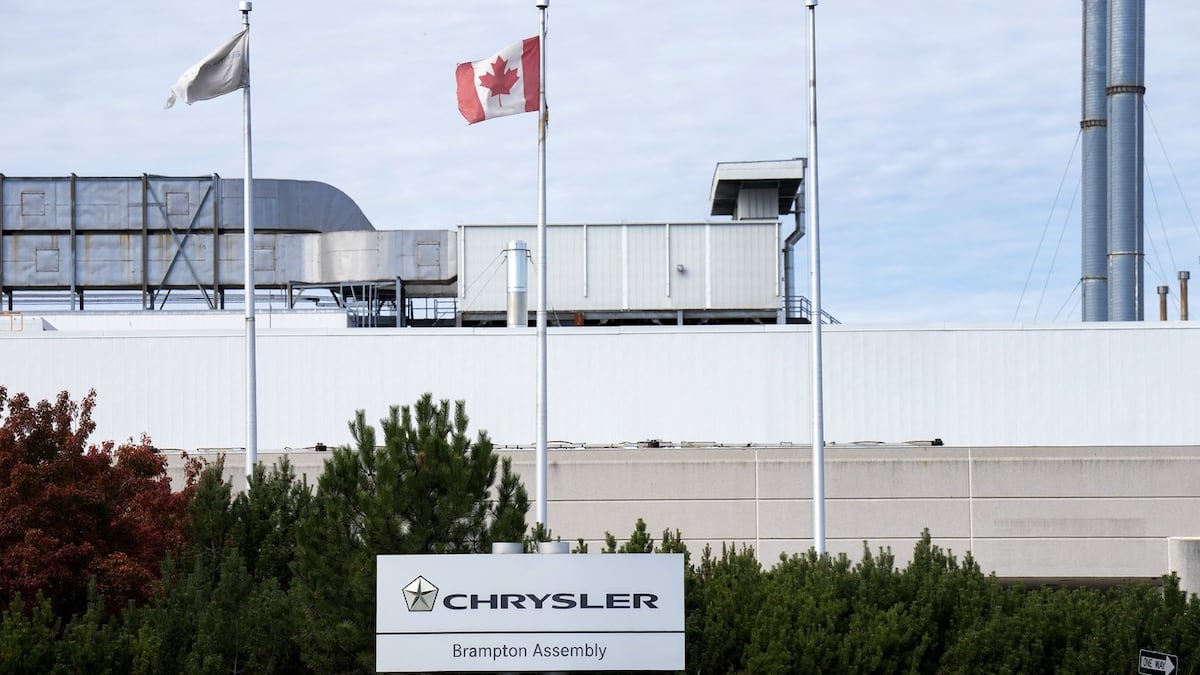


News 15-08-2026
Vancouver Storm: Infrastructure Hit and Other Developments
An unprecedented thunderstorm left thousands of residents of the Canadian metropolis without power, while the region prepared for its largest reptile expo and an investigation into a police-related incident—a look at the key events in British Columbia.
Vancouver storm: More than 11,000 residents left without power by severe weather
Friday morning, August 14, 2026, proved truly extreme for Vancouver residents. A powerful storm front that swept across the capital of British Columbia caused a major power outage, leaving more than 11,000 households in the Lower Mainland without electricity. According to BC Hydro data published on its official outage list, the storm’s main impact was felt in the city itself, where 11,160 customers lost power at once because of a substation failure. The incident occurred between 8 and 9 a.m. The utility noted that the duration of the outages varied by neighbourhood: in some areas, the power was out for only a few minutes, while elsewhere residents waited several hours for service to be restored.
Notably, in addition to the major substation failure, the city experienced a series of smaller incidents. Some were related to scheduled equipment work, but one affecting 14 homes was directly caused by a lightning strike during the morning storm. The weather itself proved particularly unpredictable. Meteorologists had warned in advance of the risk of morning thunderstorms, linking them to the passage of a low-pressure system that brought moisture, strong wind gusts and general atmospheric instability. At the time of the outage, local residents saw not only lightning and heard thunder, but also experienced an actual hailstorm, which experts preliminarily suggested may have contributed to the equipment damage.
BC Hydro responded quickly, sending emergency crews to the scene. By 9:30 a.m., specialists had arrived to address the problems, while the company actively posted updates for concerned residents on social media. In its posts, the utility said repair work was well underway and expressed hope that power would be restored soon. Interestingly, similar problems affected neighbouring Richmond the previous day, Thursday, where approximately 359 residences lost power. Smaller outages were also recorded in Hope and Langley. This suggests that the storm affected a relatively broad area of the region.
By 2 p.m., according to updated information, power had been fully restored to most of the affected homes in Vancouver, although completely resolving the consequences of the failure took additional time. While the official cause of the major outage was identified as a “substation defect,” experts have not ruled out the possibility that extreme weather conditions—including hail and sharp temperature changes—triggered the technical failure. The editors of Vancouver Is Awesome contacted BC Hydro representatives for comment, but no detailed explanation had been received by the time of publication. The situation clearly demonstrates how vulnerable urban infrastructure can be in the face of a rapidly changing climate, when even a brief but intense storm can paralyse entire neighbourhoods. Local authorities and utilities are once again being forced to consider modernising their networks and improving their resilience to such natural disasters, which appear to be becoming increasingly common.
For those unfamiliar with Canadian terminology, BC Hydro is a Crown corporation responsible for generating and distributing electricity in the province of British Columbia. The term “Lower Mainland” refers to the densely populated region in the southwestern part of the province, including Vancouver and its suburbs. A “substation” is a key part of the electrical grid that transforms voltage and distributes power flows. When such a facility fails, thousands of customers can automatically lose electricity. In this case, as reported in the Vancouver Is Awesome article, one source of the failure affected multiple neighbourhoods at once, requiring coordinated work by repair crews. Residents of the region should pay closer attention to weather forecasts and keep backup power sources on hand, as nature continues to produce surprises—and they are not always pleasant.
British Columbia prepares for its largest reptile expo: What to know
In late summer 2026, Vancouver residents and visitors will have a unique opportunity to enter the world of cold-blooded creatures. The annual reptile expo is considered the largest and longest-running event of its kind in the province. Organised by a local reptile club, it promises to be a true celebration for anyone interested in exotic wildlife. The expo will be held at a conference centre in Abbotsford, approximately a 90-minute drive from downtown Vancouver, making it a potential destination for an excellent day trip.
Visitors will find an impressive variety of living creatures, from familiar snakes, lizards and turtles to more unusual terrarium inhabitants such as tarantulas, scorpions and even tuataras—remarkable reptiles considered living fossils that are rarely seen in captivity. The expo will also feature exotic plants, invertebrates and themed merchandise, ranging from terrariums and feed to taxidermy displays, fossils and handmade items, including jewellery. Organisers have clearly worked to create an atmosphere that will appeal both to dedicated herpetologists and to families with children who simply want to see something new and unusual.
However, this fascinating event also has another side that anyone planning not merely to look at an animal but to purchase one should consider. Unlike cats or dogs, reptiles and amphibians require highly specialised care. Many need elaborate terrariums with precise temperature, humidity and lighting conditions, and their diets may shock an unprepared person. For example, some snake species eat only live rodents, which can become a serious moral barrier for many potential owners. Organisers and experienced breeders therefore strongly advise people to carefully weigh the pros and cons before deciding to buy, since these pets live for many years and require constant attention.
As for the practical details, the expo will run for two days: Saturday, September 12, from 10 a.m. to 5 p.m., and Sunday, September 13, from 10 a.m. to 4 p.m. The venue is the aforementioned conference centre in Abbotsford, at 32470 Haida Dr. Tickets are reasonably priced: admission for adults is $10, children under 13 can enter for $7, and a family ticket covering two adults and up to three children under 13 costs just $25. Children under four enter free, making the event particularly appealing to young parents. According to information from the Vancouver Is Awesome article, last year’s expo attracted considerable interest, and organisers expect a similarly strong turnout this time.
The mention of tuataras deserves particular attention, as these creatures are rarely seen even in professional zoos. For those unfamiliar with the species, tuataras are ancient reptiles found only in New Zealand. They look like lizards, but actually belong to a separate order that existed as far back as the time of the dinosaurs. They have a unique feature known as a parietal eye, a light-sensitive organ on the top of the head that helps regulate their sleep-wake cycles. Seeing such a creature in person is a rare opportunity that, by itself, may be worth the trip.
It is also important to understand that the expo is not merely a show but an educational platform. The British Columbia Reptile Club actively promotes responsible attitudes toward exotic animals, explaining the challenges involved in keeping them and the importance of species conservation. In a world where many reptile species are threatened with extinction because of habitat destruction and illegal trade, events like this play an important role in raising public awareness. So even if you do not plan to get a snake or lizard, visiting the expo can be a useful and educational experience that broadens your horizons and may even change your attitude toward these remarkable creatures. Ultimately, it is an excellent way to spend a day off with family or friends while learning something new about the natural world, which often remains outside the frame of everyday life.
British Columbia police watchdog seeks witnesses to North Vancouver incident
The Independent Investigations Office of British Columbia (IIO) has appealed to the public for help in clarifying the circumstances surrounding a man’s arrest that took place on the evening of August 10 in the Lonsdale Quay area of North Vancouver. The incident initially appeared to be a routine medical call but became the subject of a serious investigation after it emerged that the arrested man’s injuries may have been more significant than first believed.
According to the watchdog, the incident began when members of the North Vancouver Royal Canadian Mounted Police received a call requesting medical assistance. Arriving at approximately 8 p.m., officers found a man who appeared to need medical attention. The situation took an unexpected turn when the man climbed onto the roof of a police vehicle instead of waiting for paramedics. This behaviour naturally required immediate police intervention. The man was taken into custody and transported to hospital for examination and treatment.
The most significant part of the story came afterward. Initially, police did not notify the watchdog about the incident because they believed the man’s injuries were minor. Later, however, the IIO received information that caused officials to question that assessment. Reports indicated that the injuries may have been more serious. As a result, the office decided to launch a full investigation to establish what happened and determine whether the man’s rights were violated during the use of force.
Investigators are now seeking witnesses who may be able to shed light on the incident. Given that Lonsdale Quay is a busy area that is typically crowded in the evening, the office has reason to believe that someone may have witnessed the incident or recorded it on video. Investigators are particularly interested in passengers in a grey Tesla Model Y that was nearby at the time. They may have captured what happened on the vehicle’s cameras, which often operate continuously.
As reported by CityNews Vancouver, IIO representatives are asking anyone with information, video footage or other evidence to contact the office. The case highlights the importance of independent oversight bodies in monitoring police conduct. Even when a situation initially appears straightforward, there is always room for doubt and further review. The IIO was created specifically to ensure objective investigations into incidents involving law-enforcement officers, and this case demonstrates how civilian oversight works in practice by responding to new information even when the initial assessment appeared conclusive.



News 14-08-2026
Thunderstorm in Vancouver and Other Stories: News Digest
Nighttime lightning over Vancouver, the historic transfer of land to Indigenous peoples on Vancouver Island, and a unique photograph of a stork against the backdrop of a solar eclipse: the main events in British Columbia in one digest.
Thunderstorm over Vancouver: What’s Behind the Nighttime Lightning and Downpours
Residents of Metro Vancouver and British Columbia’s southern coast woke up on Friday to an alarm that is hardly familiar in these parts—the rumble of thunder and flashes of lightning piercing the sky from early morning. Environment Canada quickly issued a severe thunderstorm warning, saying the storm’s epicentre was over the Belcarra area, with Seymour Heights, Deep Cove and Mount Seymour Park also affected. According to meteorologists’ data, lightning was recorded directly over Vancouver, North Vancouver and Burnaby as well, making this a truly widespread weather event across the region.
As Environment Canada meteorologist Brian Proctor explained, the storms were typical of nighttime conditions, when air masses over the North Shore mountains and Vancouver Island collide with warmer, more humid air, creating conditions for powerful cumulonimbus clouds to form. However, the sheer number of lightning strikes was unusual: about 1,600 strikes were recorded across the southern part of the province over a 12-hour period, significantly exceeding the usual nighttime total. Proctor noted that although thunderstorms are considered rare in the Vancouver–Squamish area, especially during daylight hours, their appearance at night adds an element of surprise and requires residents to remain particularly vigilant.
The effects of the storm were felt quickly: localized flooding and hail were reported in northern Burnaby, a Vancouver suburb. In addition, four wildfires on Vancouver Island may have been caused by lightning strikes, according to preliminary information from the provincial fire service. This is a reminder that even a brief thunderstorm can trigger serious consequences during a dry summer. Meteorologists warn that this is not the last round of bad weather: thunderstorm activity may continue Friday evening and last into the weekend. Residents are therefore advised to follow a simple but vital rule—when you hear thunder, go indoors immediately and avoid open areas, where there is a risk of injury from flying debris or hail.
For those unfamiliar with Canada’s warning system, it is worth explaining that a “yellow” warning from Environment Canada signals potentially dangerous weather conditions that may include strong winds, hail or heavy rain. A “severe thunderstorm” warning means that one or more of these factors are occurring with significant intensity. Such warnings are not unusual on the Prairies or in Ontario, but for coastal Vancouver, where the climate is generally milder, this serves as a reminder of nature’s power, which does not conform to familiar stereotypes. More details about how events unfolded that day can be found in the original CBC article, which brings together meteorological data and eyewitness accounts. Ultimately, the storm was not only a test for the city’s infrastructure but also a reminder that even regions with moderate climates can face surprises that deserve to be taken seriously.
Hatley Castle and Victoria’s Lands: What Lies Behind the End of 30 Years of Negotiations
The Canadian province of British Columbia is on the verge of a historic development: after more than three decades of negotiations, five Indigenous nations on Vancouver Island may gain control of significant parcels of land, including the famous Hatley Castle and the grounds of Royal Roads University. The agreement, being pursued under the modern treaty process, could become one of the largest transfers of public land in the region’s history. However, it has sparked both hopes for reconciliation and heated debate over what the broader public might lose.
Spencer Chandra Herbert, the minister responsible for Indigenous relations and reconciliation, confirmed that negotiations with the Te’mexw Treaty Association, which represents the interests of five communities, are in their final stages. Under the proposed treaty, the federal land at Hatley Park, home to Royal Roads University and the grand Hatley Castle—known for its appearances in Hollywood films—would be transferred to the Songhees Nation. However, the minister stressed that the transfer would not happen immediately: the process could take years, and the federal government is also involved.
The key question concerning local residents is access to these scenic locations. Chandra Herbert has sought to reassure the public, saying that both the Indigenous nations and the university are interested in preserving the campus and maintaining public access. In his interview with CityNews Vancouver, he compared any future restrictions to the temporary park closures already implemented for Indigenous cultural and environmental needs, including hunting. Nevertheless, documents prepared for public consultations explicitly state that after the land is transferred into treaty settlement lands, access could be restricted or even closed entirely, particularly if the parcels are used for housing.
In addition to the castle, the treaty provides for the transfer to the Songhees Nation of two downtown Victoria parking lots, including the area near the provincial legislature, as well as Discovery Island Marine Park. This is only part of the land package causing concern among opposition politicians. Conservative Party leader Kerri Lynn Findlay says the government should immediately halt the transfer, calling the negotiations “secret deals” and a “betrayal of democracy.” She warns that this is only the beginning and that more than 150 Indigenous groups in the province are waiting for their turn, potentially leaving British Columbia without a significant portion of its public assets.
In response, Chandra Herbert countered that the public had been involved in the process and that “the fact that the Conservatives are finally paying attention doesn’t mean this was a secret.” He also defended modern treaties as an alternative to endless litigation and a catalyst for economic growth.
The Te’mexw Treaty Association, for its part, is urging people not to reduce a complex historical process to political slogans. In a statement, its representatives emphasized that the negotiations reflect decades of work by governments of different political stripes, and that reducing the treaty to a “political shortcut” distorts its true purpose—reconciliation and justice.
For ordinary residents of the province, the news means that familiar recreational areas and historic landmarks could change status. It is important to understand that modern treaties are not expropriation, but formal recognition of Indigenous peoples’ rights to land that historically belonged to them. However, the practical consequences, including potentially reduced access to popular parks, require careful public discussion. For now, both sides—the government and Indigenous communities—say they are ready for dialogue. In the coming months, Victoria residents will likely see how this historic compromise is put into practice.
Master of Light and Shadow: How a Vancouver Photographer Captured a Stork in a Total Solar Eclipse
Vancouver photographer Liron Gertsman has once again shown that patience, mathematical precision and a little luck can transform an astronomical event into a work of art. While residents of Canada, including Vancouver, were unable to see even a partial solar eclipse in August 2026, Gertsman travelled to Spain to capture a unique image: a white stork returning to its nest exactly 30 seconds before totality. The photograph, the photographer admits, was the result of more than a year of planning and 10 exhausting days of travelling across Spain in search of the perfect shooting location.
The difficulty of Gertsman’s task is hard to overstate. He had to synchronize three key elements: the precise time and coordinates of totality, the behaviour of a wild bird that does not follow human plans, and weather conditions capable of overturning all his calculations at any moment. As Gertsman wrote in his Instagram post, these were the most challenging photographs of his career. The difficulty was not only technical but emotional as well: the stork, the central subject of the image, nearly ruined the photographer’s plan by returning to its nest just half a minute before the decisive moment. Gertsman compares the experience to a miracle, emphasizing that all the images are real, single-frame photographs—not artificial intelligence or photo composites—which makes them particularly valuable in the digital age.
This triumph was no accident. The 24-year-old Gertsman has already made a name for himself on the international stage, winning the prestigious Bird Photographer of the Year award in 2025 from a field of more than 33,000 competitors. His winning image, showing a bird flying against the backdrop of a total solar eclipse, was taken in the Mexican city of Mazatlán, which lay along the path of totality. That experience inspired the photographer to take on a new ambitious challenge: to repeat his success with another feathered subject, this time in European skies. Gertsman is not limited to photographing solar phenomena. His portfolio also includes crows against a blood moon, photographed in Vancouver, as well as striking images of grizzly bears, Arctic foxes and so-called sea wolves. His work combines a love of wildlife and outer space, with each photograph becoming a miniature story about the connection between all living things and the infinity of the universe.
For those unfamiliar with the astronomical terminology, it is important to explain that this was a unique event: a total solar eclipse occurs when the Moon completely covers the Sun, allowing observers to see only the dazzling corona around the disk. The phenomenon can be seen only from a narrow strip known as the “path of totality.” This time, the path crossed parts of Siberia, the Arctic, Iceland, Portugal and much of Spain. Thousands of tourists from around the world travelled there to safely remove their protective glasses and enjoy the spectacle during the brief minutes—or even seconds—of totality. Unlike most observers, Gertsman watched the sky through a camera lens, but his excitement is difficult to put into words. As he himself noted, no words can describe how majestic a total solar eclipse is, or how special it feels to see your plan become reality.


News 13-08-2026
Vancouver’s Sky: An Eclipse Instead of a Crisis
August Skies over Vancouver: Why the Lunar Eclipse Will Outshine the Solar One
While the world watched in awe as a total solar eclipse plunged Spain and other parts of the planet into darkness on Wednesday, residents of Metro Vancouver missed out on the spectacular show. However, August’s sky has its own, no less impressive surprise in store for local observers later this month. Although it will be a partial lunar eclipse rather than a total solar eclipse, the event promises to be breathtaking.
The event that drew thousands of tourists to Spain, where the sky darkened in broad daylight, was truly unique: the moon completely blocked the sun, allowing observers to see the star’s corona without special glasses. But residents of Canada’s West Coast need not despair. On August 27, they will be able to witness an almost total lunar eclipse, when Earth’s shadow covers the moon so extensively that it becomes a crimson disk. As Rosanna Tilbrook, an astronomer at the MacMillan Space Centre, explains, eclipses are interesting partly because they occur in pairs, separated by roughly two weeks—half of a lunar cycle. It is a kind of cosmic symmetry: first, the moon blocks the sun for one part of the world, and then Earth blocks the moon for another.
Those planning to observe the event should understand the difference between the types of eclipses. Unlike a solar eclipse, a lunar eclipse is completely safe to view with the naked eye and requires no eye protection. The reddish hue the moon takes on occurs because sunlight is scattered through Earth’s atmosphere; this effect has given the phenomenon its romantic nickname, the “blood moon.” The eclipse is expected to begin at 7:56 p.m. local time, peak at 9:12 p.m., and end after midnight, giving observers more than four hours to enjoy the spectacle. However, everything depends on the weather, although Vancouver’s August nights are generally known for clear skies and ideal conditions for astronomical observation.
While the Spanish eclipse was accessible only to those willing to pay for airfare, Vancouver residents are much luckier: they do not need to travel anywhere—simply step outside and look up. Although this will not be a total solar eclipse, an event that occurs only once every few years and draws crowds of enthusiastic spectators, a partial lunar eclipse of this magnitude is both rare and beautiful. Experts note that the moon’s nearly complete immersion in Earth’s shadow makes the event visually striking, even if it is less dramatic than its solar counterpart. As Vancouver Is Awesome reminds us, the most important thing is the opportunity to touch infinity without leaving one’s hometown and to feel part of a universe that continues to surprise us with its rhythms.
A Cross-Border Crisis: Why British Columbians Are Visiting the U.S. Less Often
The past summer provided yet another confirmation that cross-border tourism between British Columbia and the United States is experiencing a prolonged decline that has now lasted a year and a half. Not long ago, trips south were a familiar ritual for many Canadians; now, statistics are steadily recording falling traffic by both air and land. An analysis of data collected from public sources shows that this is not a temporary fluctuation but a sustained trend rooted in economic and political factors.
Let’s start with the air gateways. According to information published by Business in Vancouver, the Vancouver Airport Authority (VAA) released its figures for June. The number of passengers on so-called “transborder” flights connecting YVR with U.S. cities totaled 608,928. That was 1.8 percent fewer than during the same period last year, when the airport handled 620,218 travelers. Notably, the decline occurred even though Vancouver hosted five FIFA World Cup matches in June, which should have generated additional traffic. At the same time, total passenger traffic through the airport rose by almost 2.6 percent, reaching 2.49 million people—clearly indicating that travelers’ interests are shifting.
Where is the traffic going? The answer is obvious: Asia. Traffic on Asia-Pacific routes rose an impressive 14.1 percent year over year, with the total number of passengers reaching 418,183. This is no coincidence. In November last year, China restored Canada to its list of countries with approved destination status for tour groups, and since February 17 of this year, Canadians with ordinary passports have been able to enter China visa-free for up to 30 days. Analysts say the policy will remain in effect at least until the end of the year, making Asia an increasingly attractive alternative to Canada’s southern neighbor.
The situation on the ground is no less telling. Data collected through the Cascade Gateway Border Data Warehouse and the Whatcom Council of Governments cover July traffic at four key border crossings: Peace Arch, Pacific Highway, Lynden, and Sumas. In July, 120,856 passenger vehicles with British Columbia license plates traveled south through these crossings. That was 11 percent fewer than in July 2025 and a staggering 36 percent fewer than in July 2024. It should be noted that the data collectors themselves encountered technical problems with the platform between March and June, when some days were not recorded at all. It is therefore more accurate to rely on the February figures, which showed a thirteenth consecutive month of decline in southbound traffic, down 16.6 percent. The July figure merely confirms that the trend has not been reversed.
The main reasons for the decline are obvious. First, there is the weak Canadian dollar. According to foreign-exchange company OFX, the loonie averaged about 71 U.S. cents in June and July of this year, compared with roughly 73 cents a year earlier. Two cents may not seem like much, but for a family planning a trip by car or plane, it represents a noticeable additional cost for gas, hotels, and entertainment. Second, the political context cannot be ignored. After U.S. President Donald Trump began threatening to impose tariffs, then actually introduced them, and made remarks about annexing Canada, relations between the two countries cooled significantly. This created not only economic uncertainty but also a purely psychological reluctance among many Canadians to spend money in a country whose leader appears hostile.
Interestingly, airlines have already responded to the change in demand by reducing the number of routes and the frequency of flights to the south. This, in turn, could create a vicious cycle: fewer flights mean less convenience, which means fewer passengers. By contrast, new routes are being added to Asian destinations, and carriers are increasing flight frequency, although, as the report notes, air connectivity with Asia has still not returned to pre-pandemic levels. Clearly, a new map of preferences is emerging for tourists and business travelers, with the United States no longer the unquestioned leader.
In summary, the decline in British Columbians’ travel to the United States is not a temporary phenomenon but a structural shift driven by a combination of factors: currency fluctuations, political tensions, and changing global tourism trends. If the current dynamic continues—and data from the past 18 months suggest that it is intensifying—Canadian-American cross-border tourism may have to find a new equilibrium. The only question is whether improved diplomatic relations or a stronger economy can change this trajectory, or whether we are witnessing a long-term reorientation of travelers from south to east.
British Columbia on Fire: The Situation Remains Critical
The wildfire situation in British Columbia, in western Canada, remains extremely tense. As of mid-August, more than 100 active fires were burning across the province, while thousands of residents were still being forced to leave their homes under evacuation orders. Authorities and emergency services continue to describe the situation as critical, and there is little indication that it is stabilizing.
Canadian provinces face wildfire season every summer, but this year has been particularly severe. Severe drought, extreme heat, and gusty winds have created ideal conditions for fires to spread. Despite the efforts of firefighting crews—including additional forces brought in from other regions—as well as the use of aircraft, the fires have not yet been brought under control. As the local emergency management department notes, the main danger is not so much the number of fires as their unpredictability: flames can suddenly change direction, threatening new communities.
This news is directly connected to a report by CTV News, which emphasizes that the situation in British Columbia remains critical. Evacuation orders have affected several communities, particularly in the central and northern parts of the province. People are being forced to leave their homes with only the essentials. For many, this is not their first evacuation in recent years, increasing psychological pressure on residents and undermining their confidence in the future.
For those unfamiliar with the Canadian system, it is worth explaining that British Columbia has a strict alert and evacuation system. Evacuation orders mean that people’s lives are under immediate threat and that they must leave the area at once. Evacuation alerts, by contrast, indicate a potential threat and give residents time to prepare to leave. In the current situation, thousands of people are under evacuation orders, underscoring the high level of danger.
Experts link the scale of the current fires to climate change. Rising average temperatures are bringing more frequent and intense periods of drought, making forests more vulnerable to ignition. In addition, decades of suppressing small fires have led to the accumulation of large amounts of dry vegetation, which now serves as excellent fuel for wildfires. Scientists warn that seasons like this could become the new normal and that authorities need to rethink how forested areas are managed.
The economic consequences of the current fires are also significant. In addition to the direct damage caused to homes and infrastructure, the forestry industry—one of the region’s key sectors—is suffering. Road closures and worker evacuations are slowing timber harvesting, affecting supplies and prices. The tourism sector, which had been recovering after the pandemic, is also losing revenue: national parks and popular routes are closed to visitors, while tourists are canceling bookings.
Provincial authorities are urging residents to take precautions and follow official instructions. Restrictions have been imposed on open fires and the use of fireworks, while some areas are under a complete ban on access to forests. Fire crews are working in an intensified response mode, but forecasts for the coming days are discouraging: meteorologists are not expecting significant precipitation, and the heat will continue. This means the fight against the fires will go on, and British Columbians should be prepared for further challenges. For now, the priority is protecting people’s lives and health—and organization and mutual support within Canadian society will play a decisive role.


News 12-08-2026
Land Transfers, Scandalous Spending and Cultural Contrasts: Canada News Digest
This edition covers the transfer of 300,000 acres of Crown land in British Columbia, controversial spending on a single tenant in Vancouver, and a city guide for travelers from Seattle.
Crown Land Transfer in British Columbia: A New Stage in Talks with First Nations
In recent days, heated debate has erupted in the Canadian province of British Columbia over government plans to transfer more than 300,000 acres of Crown land to five Indigenous groups located on Vancouver Island. According to published documents, the proposal involves approximately 30 sites, including both iconic natural areas and urban properties such as Hatley Castle, the Royal Roads University grounds, Victoria’s waterfront, a site near the legislative assembly, and Discovery Island and Sooke Mountain provincial parks. The initiative, which forms part of the modern treaty process, has drawn sharp criticism from opposition forces and legal experts, who say it undermines democratic principles and lacks public consultation.
The proposal would place land currently owned by the government under the control of five Indigenous groups whose territories stretch from Parksville to Victoria. This is not merely a symbolic gesture but an actual transfer of rights that would automatically make the land private property. It is important to understand that Canada has two types of treaties with Indigenous peoples: historical agreements, such as the Douglas Treaties signed in the 1850s and covering southern Vancouver Island, and modern treaties negotiated as part of the settlement of land claims. As lawyer Jeffrey Moyes, who advised the province on Aboriginal law for decades, points out, there is no legal need to revisit the Douglas Treaties—they have already settled questions of land rights. In his view, the current decision is political rather than legal, adding “modern treaty attributes” to the old agreements and potentially creating a dangerous precedent.
Critics, particularly those from the Conservative Party, have called the move a “betrayal of the foundations of democracy.” Conservative leader Kerry-Lynne Findlay stresses that the province belongs to all British Columbians, who should have a say in such important matters. Activist Steve Kunner adds that the government is systematically ignoring public consultation and overriding democratic oversight. These concerns are reinforced by the fact that the transferred land would become private property without any obligation to preserve public access or comply with existing zoning. This means that popular places such as provincial parks could be closed to ordinary citizens, while future use of the land would be determined solely by its new owners.
Notably, the province’s minister responsible for Indigenous affairs did not respond to inquiries from Global News journalists, further strengthening the impression that the process lacks transparency. At the same time, it should be noted that such transfers are not unprecedented in Canadian history. However, their scale and the selection of specific sites, including parks and university property, have generated particular concern. Ultimately, the issue touches on fundamental principles: how to balance the rights of Indigenous peoples, which have historically been violated, with the interests of the province’s population as a whole. Supporters of the initiative point to the need to correct historical injustice and recognize First Nations’ sovereignty, while opponents see it as a threat to public assets and a sign of insufficient transparency. A Global News article also notes that the mayor of Richmond asked one of the communities to provide written confirmation of guarantees concerning private property, reflecting growing concern among municipalities. It remains to be seen how the situation will unfold, but it is already clear that it will be a serious test for British Columbia’s political system as it moves toward reconciliation with Indigenous peoples.
Vancouver: The Perfect Sequel to Seattle for Those Seeking Something New in the Familiar
When you live in Seattle, it can seem as though you have already seen everything the Pacific Northwest has to offer. But once you cross the border, the world seems to expand, revealing a city that feels both familiar and entirely different. Vancouver is not simply another metropolis on the map; it is Seattle’s mirror image, with its own distinctive character, capable of surprising even the most experienced traveler. Authors at The Seattle Times suggest an unconventional approach to planning a trip: instead of relying on a standard list of “must-see” attractions, start with the things you enjoy doing at home.
Imagine that you are a fan of Seattle’s famous Pike Place Market, with its fishmongers’ calls and endless rows of flower stalls. Vancouver will not disappoint: Granville Island is not just a market but an entire island where the bustle of the city blends naturally with a creative atmosphere. You can spend several hours admiring local artisans’ work, sampling oysters straight from the counter, and watching chefs compete in the art of preparing the freshest seafood. The Granville Island Public Market is only part of the picture, however. The island is also home to an art school, theaters, and numerous small boutiques selling items you are unlikely to find in Seattle.
For those who cannot imagine a Seattle weekend without a trip to Discovery Park or Green Lake, Vancouver offers Stanley Park—a true wilderness oasis within the city. The park is nearly three times larger than New York’s Central Park, and visitors can stroll along well-maintained trails while spotting raccoons, squirrels, and even herons. Be sure to climb to the Prospect Point lookout, which offers breathtaking views of the bay and mountains, then walk along the famous seawall. On a clear day, you can see the outline of Mount Baker in the distance—the same mountain familiar to Seattle residents.
If your love of Seattle begins with its coffee culture, prepare for a pleasant discovery: in recent years, Vancouver has become a true specialty-coffee capital. The city’s cafés do not simply copy Seattle’s, but instead borrow its best practices while adding a Canadian laid-back attitude and multicultural flair. One place worth visiting is 49th Parallel Coffee Roasters, a company that began as a small roasting workshop and now serves some of the best lattes on the continent. After your espresso, head to Gastown, with its famous steam clock and cobblestone streets—one of the few parts of the city where you can feel the presence of history reaching back to the gold-rush era.
Vancouver also has pleasant surprises in store for art and museum lovers. If you are accustomed to spending time at Seattle’s Museum of Pop Culture or art museum, be sure to visit the Museum of Anthropology at the University of British Columbia. It is more than a museum: it is a temple of Pacific Northwest Indigenous culture, housing totem poles, ceremonial masks, and other artifacts that tell the region’s story in far greater depth than any textbook. The building was designed by renowned architect Arthur Erickson, and its interiors, with views of the ocean and mountains, are themselves works of art.
A trip to Vancouver requires a little preparation, particularly if you plan to drive. The border crossing can take anywhere from 30 minutes to two hours, depending on the time of day and day of the week, so experienced travelers recommend leaving early in the morning or late in the evening on weekdays. If you want to avoid the hassle, you can take a bus or train—both options allow you to relax and enjoy the scenery while someone else handles the transportation. For air travelers, a direct flight from Seattle takes just an hour, making Vancouver an ideal destination for a spontaneous weekend getaway.
Vancouver manages to maintain a remarkable balance between nature and urban life, offering attentive travelers not just a collection of tourist attractions but a whole palette of experiences unavailable in Seattle. The city continues to surprise with its food scene—from Asian restaurants in Richmond, considered among the best in North America, to innovative downtown establishments serving dishes made with local ingredients grown in the nearby Fraser Valley. The main advice from seasoned travelers is not to try to see everything in a single day. Instead, choose what genuinely appeals to you—whether art, food, or nature—and allow Vancouver to reveal itself in the way cities do when they truly welcome their guests.
Vancouver Pays $101,000 a Month for One Tenant in Former Hotel: What’s Happening?
British Columbia authorities are at the center of a scandal: the provincial government is spending astronomical sums to house a single resident in a building it had promised to close. The site is the former Luugat hotel on Granville Street, where Ryan Donnelly, a man with a severe seizure disorder, still lives despite official statements that the facility would cease operations. According to data from the Ministry of Housing, the cost of his accommodation totaled $101,000 in July alone—and he remains there.
The situation has baffled not only taxpayers but also city politicians. Vancouver Coun. Sarah Kirby-Yung makes no secret of her outrage: she calculated that the same amount could have paid the market rent for a decent one-bedroom apartment for more than four years. This is not a matter of luxury accommodation but basic housing for one person. Even compared with the city’s most expensive options, the amount appears absurd. For example, a room at the Fairmont Vancouver, including breakfast and evening lounge snacks, would cost approximately $70,000 a month—about one-third less.
Most notably, the government still has no clear timetable for closing Luugat. Housing Minister Christine Boyle declined to comment to the press, further raising suspicions about the ineffectiveness of the decisions being made. Officials previously said the building would be decommissioned, but Donnelly has apparently been living there since at least mid-July, and the prospects for his relocation remain unclear.
Why does housing one person cost so much? The answer likely lies in the nature of his medical needs. Donnelly suffers from epileptic seizures and, by his own account, requires a spacious room. Even taking round-the-clock medical care, specialized equipment, and enhanced security into account, however, $101,000 appears excessive. Experts note that costs like these often arise because no alternative options are available: when the government must urgently house someone with special needs, it may pay private contractors’ highest rates without holding a tender or comparing prices.
The situation at Luugat is only the tip of the iceberg in Vancouver’s broader affordable-housing crisis. The city is facing severe pressure: property prices continue to set records, while the supply of social housing units is catastrophically inadequate. Under these conditions, every instance of ineffective public spending is especially painful, since the money could have gone toward addressing systemic problems. Commenting on the situation for Global News, Kirby-Yung emphasized that this is not merely a matter of accounting but one of public policy and accountability to society.
For now, the story appears to have reached an impasse. The government remains silent, the tenant stays put, and the expense meter keeps running. Unless a more sensible solution is found—such as placing him in a specialized facility with a fixed cost of care—these expenses could continue indefinitely. That means taxpayers will continue paying every month to house one person in a building that was officially supposed to be empty.

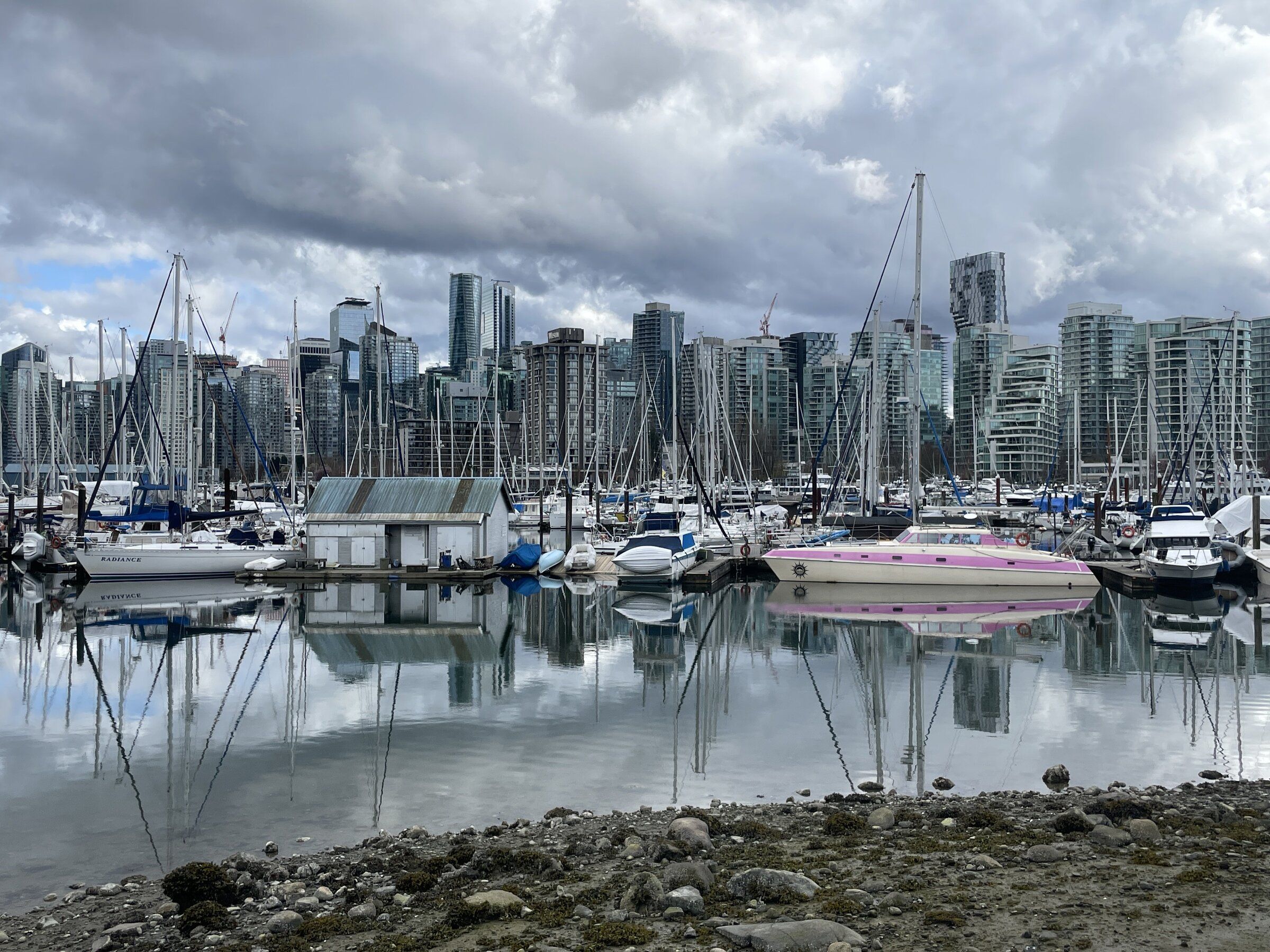
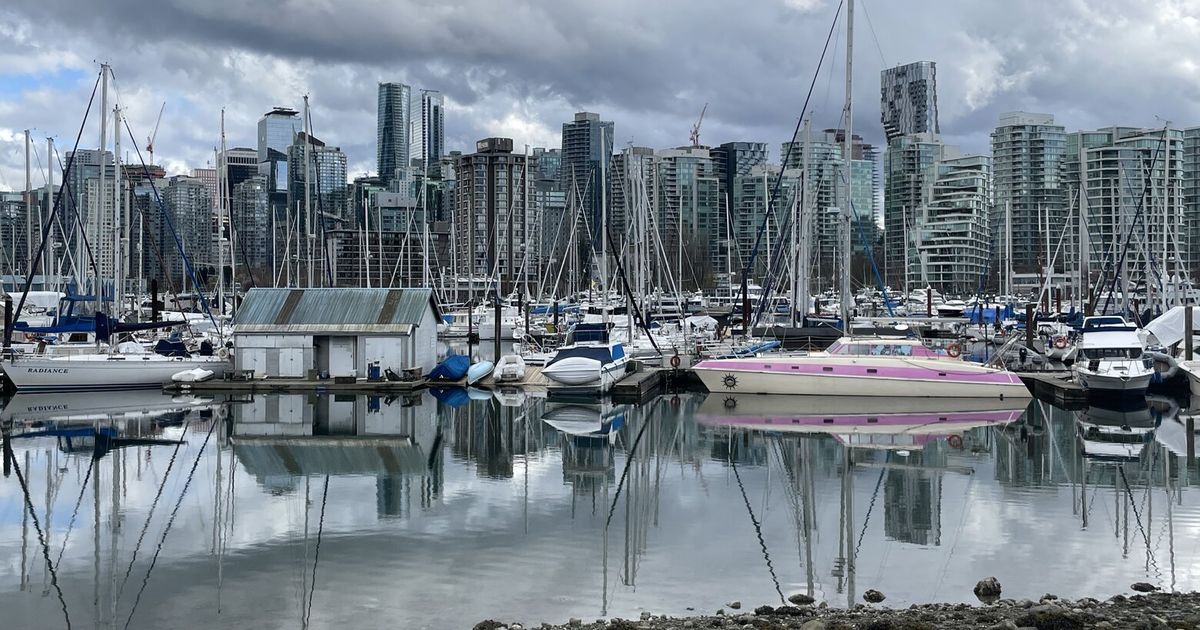
News 11-08-2026
Smoke over Vancouver, Land Disputes and Mexican Reinforcements: What’s Happening in B.C....
Vancouver residents are bracing for the return of wildfire smoke, the province has revealed the scale of land transfers to Indigenous peoples, and Mexican firefighters are arriving in the Okanagan to help battle the flames. Together, these developments paint a complicated picture of summer 2025 in British Columbia.
B.C. wildfire smoke will blanket Vancouver again
Vancouver residents who enjoyed relatively clear skies over the past weekend may soon face a familiar problem once again: meteorologists warn that thick smoke from wildfires burning in the province’s Interior could return to the city as early as Wednesday morning. The news comes as thousands of people have been forced from their homes by major fires, while the region faces the prospect of another period of poor air quality.
As Environment and Climate Change Canada meteorologist Morgen Schull explains, westerly winds are currently carrying wildfire smoke toward the Rocky Mountains, but the situation is expected to change by midweek. A weak area of low pressure, known as a trough, is expected to move from the Interior toward the coast, altering the direction of airflow. According to Schull, this shift will cause smoke to begin moving into Metro Vancouver on Wednesday morning and likely remain there until the weekend, as no significant changes in weather conditions are expected in the coming days.
However, the exact intensity of the smoke remains uncertain. On one hand, the same low-pressure trough could bring brief rainfall to the Interior, which might help settle some of the smoke and slow the spread of the fires. On the other hand, Schull notes skeptically that the precipitation is unlikely to be heavy enough to extinguish such massive fires. Winds are also not expected to be particularly strong, meaning the smoke could linger in the air and create a dense haze.
Notably, Vancouver had already issued an air-quality advisory just a week ago because heavy smoke hung over the city for several consecutive days. Now, with the official air-quality index at just 2 out of 10 on Monday—corresponding to low risk—residents should prepare for conditions to worsen. In essence, this is a classic summer story for Canada’s West Coast, where massive fires thousands of kilometres away can shape daily life in the city. A Vancouver Is Awesome article notes that the disaster has already affected thousands of provincial residents, while enormous quantities of harmful pollutants are being released into the air.
To understand what is happening, it is worth explaining the meteorological terminology being used. A trough is an elongated area of low atmospheric pressure that often produces unsettled weather and can alter the paths of air masses. In this case, it acts like a kind of pump, drawing air from east to west—from the fire zone directly toward the densely populated coast. Air quality during such events also depends heavily on concentrations of tiny PM2.5 particles, which can penetrate deep into the lungs and are particularly dangerous for people with respiratory conditions, older adults and children.
The takeaway for residents is simple and predictable: if firefighters cannot contain the main fire zones within the next two days—and current forecasts offer little reason for optimism—the second half of the week in Vancouver will once again unfold beneath smoky skies. Although forecasters say dangerously high smoke concentrations are unlikely, elevated air pollution is almost certain. During such periods, experts recommend limiting time outdoors, keeping windows closed and using air purifiers indoors, especially if you or someone close to you has health problems.
B.C.’s quiet transfer: the scale of land agreements with Indigenous peoples
The British Columbia government, led by the NDP, has revealed striking figures in its annual financial reports for the first time: more than 334,000 acres of Crown land have already been set aside for transfer to Indigenous peoples under modern treaties. To grasp the scale, consider that this is an area twelve times larger than the City of Vancouver, or nearly half the size of the entire Metro Vancouver region. The figures, published in the Public Accounts for the 2025/2026 fiscal year, have prompted sharp criticism from the opposition B.C. Conservatives, who claim the actual scale could be 70 times greater—comparable in size to Portugal or South Korea.
The most striking aspect of the data is not simply the total area, but its enormous concentration. The two largest agreements—with the Kitsumkalum and Kitselas peoples in the province’s northwest—account for nearly 60 per cent of all land set aside. Together, they cover more than 200,000 acres, primarily in resource-rich areas, adding particular intensity to the debate. They are followed by smaller but still significant land transfers involving the Wuikinuxv, Haisla and Yekooche peoples. The list of 20 Indigenous nations published in the report demonstrates the geographic spread of the process—from the Central Coast to the northern parts of the province—but the northwest is clearly at its epicentre.
The financial consequences of these agreements go far beyond the simple transfer of land. As the report itself notes, the final cost to the province remains uncertain because the federal government generally assumes responsibility for capital payments, while provincial land represents only one element of a complex settlement formula. The strategic implications, however, appear more significant: by transferring land, the province gives up not only control over its development but also potential tax revenue and the ability to use resources to fund public services ranging from health care to infrastructure. Critics reasonably argue that decisions made without broad public participation raise questions about transparency and democratic accountability.
The fact that some important agreements previously reported in the media are missing from the published list has fuelled additional controversy. The Conservatives point to negotiations with the Tahltan Nation, whose potential settlement area could encompass as much as 23.7 million acres of land—an outcome that would call a significant portion of the province into question. Party leader Kerr-Lynne Findlay has used strong language, calling the process a “betrayal of democracy” and saying that “nothing will be left of British Columbia” once all the processes are complete. While such statements are clearly exaggerated, they reflect genuine concern among a significant portion of the provincial population, which is confronting large-scale territorial changes for the first time.
The process, which began in 1994 with the launch of modern treaty negotiations, has resulted in active or completed talks with 37 Indigenous groups representing 61 communities. That is only a small portion of the more than 150 First Nations in the province, suggesting that the current figures may be just the beginning of a long process. It is important to understand that not all nations have chosen the formal negotiation route; some have pursued court cases involving land and resource rights, consultation and compensation, creating additional pressure on the province’s budget and legal system. Although the Yale First Nation treaty was ratified by all parties back in 2013, its implementation has stalled because the parties have not agreed on an effective date—another illustration of the complexity and many layers of these processes.
Mexican firefighters arrive in B.C. to battle wildfires
A major battle against the elements is unfolding in the Okanagan, a Canadian region known for its picturesque vineyards and lakes. As residents of the B.C. resort community of Summerland anxiously await news about the fate of their homes, international reinforcements are rushing to help local firefighters. Mexican specialists are arriving to strengthen the forces battling the destructive Bald Range wildfire. The move underscores the seriousness of the situation, as local resources are no longer sufficient and thousands of evacuees have everything at stake.
The fire burning near Summerland has forced thousands of people to leave their homes in a hurry, taking only essential belongings with them. The atmosphere of uncertainty grows more tense by the hour: evacuees do not know whether they will return to intact homes or find only ash and ruins. It is at moments like this that the need for additional assistance becomes especially clear, and the arrival of Mexican firefighters serves as a symbol of international solidarity. These wildfire crews are no newcomers to the job. They bring extensive experience fighting wildfires in Mexico’s hot climate, making them valuable allies in Canada’s heat and dry conditions.
Firefighters from Mexico and other countries are often brought in to assist in Canada and the United States under special mutual-aid agreements. When a disaster spirals beyond control and local crews are working at the limits of human endurance, international reinforcements not only increase the number of people on the front lines but also give exhausted Canadian crews an opportunity to rest. It is a complex logistical operation requiring coordination and teamwork, since firefighters from different countries may use different equipment and tactics, even though the basic principles of fighting fires are the same around the world.
Meanwhile, information from the scene indicates that the fire has already destroyed large areas of forest and continues to spread, driven by the wind. Local authorities are doing everything possible to protect infrastructure and residential areas, but acknowledge that conditions remain extremely difficult. For thousands of evacuated Summerland residents, the wait has become a genuine ordeal, and every update about the fire’s progress is met with pain and anxiety about the future of their community. The arrival of their Mexican colleagues offers at least a faint hope that combined efforts will bring the wildfire under control and minimize losses. Unfortunately, details about the extent of the destruction remain limited for now, as access to affected areas is restricted because the fire is still burning and conditions remain life-threatening. Developments can be followed in a CTV News report, which is providing ongoing coverage of the situation.





News 10-08-2026
Vancouver Island: From Goats to Bears — Summer Challenges
British Columbians continue to grapple with the consequences of the warm season: while Vancouver Island chooses the best roadside attraction from among goats, forests and murals, families in other parts of the province are recovering after a bear attacked a child, and meteorologists warn that wildfire smoke will return to Vancouver by Wednesday.
Vancouver Island semifinal: A battle of goats, forests and murals
While some regions of British Columbia debate what should be considered the province’s top roadside attraction, the competition on Vancouver Island has reached a new level. The second round of CBC British Columbia’s annual summer contest features four completely different contenders: the famous goats on the roof of the store in Coombs, the ancient Cathedral Grove forest, the murals of Chemainus and the modern Malahat Skywalk. What, one might ask, do these sites have in common? More than simply being located beside a road, it turns out: each tells a chapter in the history of tourism in the province.
Bonnie Zabolotny, a design professor at Emily Carr University, points to the semifinalists’ remarkable diversity, ranging from natural wonders to human-made works of art. That diversity, she says, is what makes the competition particularly intriguing, since it is difficult to predict which type of interaction with the public will ultimately prove most appealing. Historian Ben Bradley, author of a book about the development of automobile culture in British Columbia, adds that the sites reflect the evolution of road tourism in the region. As early as the 1920s and 1930s, when the province was only beginning to develop a network of highways, local entrepreneurs and entire communities realized that they needed to stand out in some way to attract drivers’ attention. However, the real roadside-attraction boom began after the Second World War, when cars became more affordable for the masses and competition among towns for tourists grew fiercer than ever.
Notably, two of the four semifinalists emerged organically, without a clearly defined plan—and that may be the secret to their longevity. Cathedral Grove, with its giant Douglas firs along Highway 4 between Qualicum Beach and Port Alberni, became a popular stopping point as early as the 1920s. Old Country Market, which opened in 1973 and features goats on its roof, turned a quirky idea into an iconic attraction. Zabolotny emphasizes that you cannot simply build something and expect people to be drawn to it automatically. Success comes when a site develops a life of its own, like these goats, which can be seen from the road and watched by visitors.
Chemainus and the Malahat Skywalk, by contrast, represent a more deliberate approach. After the town’s only sawmill closed in 1983, Chemainus reinvented itself completely, becoming an open-air gallery: its streets are now decorated with dozens of murals and sculptures depicting the history of the local community. The 40-metre Malahat Skywalk, which opened in 2021, was designed as a ready-made attraction for modern travellers.
In the Vancouver Island semifinal, Coombs faces the Malahat Skywalk, while Cathedral Grove—which received 90 per cent of the vote in the first round—takes on the murals of Chemainus. Voting is already open and will continue until Wednesday, with the regional winners meeting in the final before Labour Day. The contest is more than just entertainment; it is a way to reflect on what makes a place memorable to travellers: natural grandeur, creative vision or simply a pleasant roadside surprise. Read more about the contest and voting in this CBC article.
For readers who may be unfamiliar with some of the terminology, Cathedral Grove is the name of an ancient forest containing fir trees that are several hundred years old. The Malahat Skywalk is a relatively new attraction featuring a spiral structure that offers panoramic views of the Salish Sea and the mountains from the top. The CBC British Columbia contest runs throughout the summer: each week in August, readers vote for the best attraction in one of the province’s regions, ultimately determining a champion from the four finalists.
Bear attack on toddler in British Columbia: Mother describes the shock
A British Columbia woman is still struggling to recover after a bear attacked her young child in the backyard of their home. The woman, whose name has not been disclosed to protect the family’s safety, shared chilling details of the unexpected incident, which left a deep impression on everyone who witnessed it. According to her, an ordinary day turned into a nightmare within seconds when the predator appeared without warning and maternal instinct took over, compelling her to act immediately to save her child from imminent danger.
The story, which the mother recounted in an interview with CTV News, began with the family spending time in their yard as usual. The toddler, who is only a few years old, was playing nearby when a black bear suddenly emerged from the bushes. The woman admits that she was overcome with terror, but she did not freeze; she rushed toward the child and tried to drive the animal away. The bear nevertheless managed to injure the toddler before the mother could intervene and force it to retreat. Only after her desperate screams and determined actions did the bear finally leave the property, leaving the family stunned and unable to believe what had happened.
It is worth explaining that black bears, which are common inhabitants of British Columbia’s forests, generally avoid contact with people. Under certain circumstances, however—such as when searching for food or protecting their young—they can become aggressive. In this case, preliminary information suggests that the animal was likely attracted by the smell of food or garbage, prompting it to approach the home. Wildlife experts emphasize that although such incidents are rare, they are becoming more common in areas where urban development encroaches on natural habitat, leading to inevitable encounters.
Fortunately, the child survived and was taken to the nearest hospital after receiving first aid, where doctors described the condition as stable. The mother says that although the physical wounds are healing, the psychological trauma will remain with the family for a long time, and everyone is now learning to feel safe in their own home again. She also expressed gratitude to medical personnel and neighbours who immediately responded to her cries for help, and urged other residents to remain more vigilant and avoid leaving food outdoors to prevent similar tragedies.
The incident raises serious questions about how humans should coexist with wildlife as cities continue to expand. On the one hand, animals cannot be blamed for their natural instincts; on the other, more effective conflict-prevention measures are needed, including wildlife-resistant garbage containers and educational programs for residents. Local authorities have already said they are investigating the incident, while conservation officers are searching for the bear to prevent further attacks. However, as experience shows, even the best precautions cannot guarantee complete safety. The case is a harsh reminder that nature remains an unpredictable force with which humans must contend.
Wildfire smoke will cover Vancouver again by midweek
Wildfires burning in British Columbia’s Interior continue to release enormous amounts of smoke into the atmosphere, forcing thousands of residents to leave their homes. Although the Vancouver metropolitan area has not yet been directly affected by the fires and skies over the city remain clear, meteorologists warn that this temporary calm could end as early as Wednesday. Environment and Climate Change Canada specialist Morgan Schull says computer models point to a high probability that the smoke will return during the morning and early afternoon on Wednesday. The city was choking under heavy smoke just last week, prompting an air-quality advisory that remained in effect for several days, and the situation could now repeat itself.
The change is being driven by a shift in airflow. Westerly winds are currently carrying the smoke toward the Rocky Mountains, but on Wednesday a weak area of low pressure—known as a trough—is expected to move from the Interior toward the coast. This will alter the circulation, turning the winds and drawing the smoke-filled air masses back toward the ocean. The meteorologist notes that it is difficult to predict exactly how intense the smoke will be: the trough could bring unsettled weather, including brief showers that might help settle some of the smoke. However, even if precipitation occurs, it is unlikely to extinguish the enormous fires burning deep inside the province. Winds are also expected to remain light, which will not help disperse the smoke quickly.
If the smoke does return, Schull says it will remain at least until the end of the week, as no major weather changes are expected after the trough passes. While the trough remains over the coast, it will continue to “draw in” air from the Interior. Only a truly major weather front would be capable of dispersing the haze, and forecasters do not currently see such a development. As of Monday, the air-quality index in Metro Vancouver stood at just 2, indicating “low risk,” but that picture could change dramatically within a couple of days. Residents—particularly those with respiratory conditions—should prepare in advance for a possible deterioration in air quality.
To understand what is happening, it is important to clarify some of the terms used by meteorologists. A trough is an elongated area of low atmospheric pressure that often produces clouds and precipitation, but in this case it acts as a “switching mechanism” that changes the direction of the wind. The air-quality index is a scale used to assess pollution levels: readings up to 3 are considered low risk, 4 to 6 moderate risk, and above 7 high risk, when vulnerable people are advised to reduce the time they spend outdoors. The fires themselves are the result of the abnormal heat and drought that have affected the province in recent weeks, creating ideal conditions for the spread of flames. The situation is made more difficult by the enormous resources required to fight large fires in remote, mountainous terrain. Even the rain in the forecast will not fundamentally change the situation—extinguishing the fires would require prolonged, heavy precipitation rather than brief showers.
Experts point out that such episodes are becoming more frequent and intense because of climate change, and Vancouver—historically considered a city with clean air—is now regularly facing summer smoke cover. This places additional pressure on the health-care system, increases the number of people seeking help for asthma and cardiovascular conditions, and harms the region’s appeal to tourists. As Schull himself noted in an interview with Richmond News, the current forecasts are preliminary, and the exact picture will become clearer over the next few days. Nevertheless, residents should monitor updates from Environment Canada and, if necessary, use air purifiers and masks, especially if the air-quality index again reaches dangerous levels. For now, people can only hope that nature delivers a surprise in the form of stronger winds or rain to clear the smoke—but based on the meteorologist’s comments, that is not something to count on.


News 09-08-2026
Renting in B.C.: A “Generational Path” or an Illusion of Progress?
British Columbia sees light at the end of the rental tunnel, but the numbers tell a more ambiguous story
British Columbia’s Ministry of Housing was quick to announce a “generational path to prosperity” after the release of Rentals.ca’s latest national rental report. However, the newest data paint a far more complex and contradictory picture than the optimistic statements from officials suggest. The August 2026 report, which analyzes July figures, continues to show that the province’s rental market remains one of the most strained in the country, despite some positive trends.
North Vancouver has drawn particular attention, once again confirming its status as the most expensive city for renters in all of Canada. The average asking price for a one-bedroom apartment there reached $2,588 per month, an astonishing 5.3 percent jump from June 2026—the largest monthly increase among all cities included in the report. Curiously, the year-over-year figure shows a 1.5 percent decline, creating the impression of a market in turmoil that has yet to find a stable point of equilibrium. Vancouver itself offers a slightly more encouraging picture: renting a one-bedroom apartment costs an average of $2,377, down 0.6 percent from the previous month and 4.8 percent from July of last year. Burnaby, which rounds out the top five most expensive markets, is also showing mixed movement, with an increase from the previous month but a decline compared with last year.
At the other end of the spectrum is Kamloops, where the average rent for a one-bedroom unit is $1,742—less than in Surrey, where the figure is $1,794. The ministry proudly notes that 15 cities in the province made the list of locations with the largest year-over-year declines in rents for purpose-built housing: Abbotsford recorded an impressive 12.4 percent drop, Langley fell 7.6 percent, Coquitlam declined 7.3 percent, New Westminster dropped 6.6 percent, and Richmond fell 6.1 percent. These figures do look encouraging and suggest that a shift may be emerging in some segments of the market.
Housing Minister Christine Boyle linked these successes to a recent agreement between Premier David Eby and Canadian Prime Minister Mark Carney, calling it a “multibillion-dollar” deal and saying it opens a “generational path to prosperity.” In her statement, she emphasized that the province is working with the federal government on “rent-to-own” programs intended to help Canadians who earn a good salary and can afford mortgage payments but struggle to save for a down payment because of unfair tariffs and the rising cost of living. Boyle called the report proof that “good policy can have a real impact” and expressed confidence that falling rents are only one part of the promise to make life affordable for everyone in the province.
However, a closer look at the figures makes it clear that it is too early to celebrate. A 5.3 percent increase in North Vancouver in a single month is a troubling signal, indicating that the market remains extremely volatile and sensitive to external factors. Despite year-over-year declines in most cities, absolute rental prices remain prohibitively high for a significant portion of the population. Rents in the $2,000 range for a one-bedroom unit cannot be described as affordable housing, even if the trend is moving in the right direction. In addition, the Rentals.ca report reflects asking prices rather than completed transactions, which may create a distorted picture.
Some of the apparent improvement can be explained by the high-base effect: after several years of unchecked price growth, even a modest decline is perceived as a victory. But for young families and early-career professionals trying to enter the housing market, the situation remains extremely difficult. The minister’s statements about a “path to prosperity” sound appealing, but in reality they must be backed not only by reports but also by concrete actions capable of stabilizing the market over the long term. For now, all that remains is to watch whether the province can maintain the positive momentum—or whether another price surge will appear in a few months, similar to the one seen in North Vancouver. In any case, as highlighted in the Daily Hive article, British Columbia’s rental market remains one of the most difficult and unpredictable in the country, and it would be premature to claim that the housing crisis has been solved based on a single report.
British Columbia wildfire leaves a wasteland: empty foundations, burned-out vehicles and charred trees
The Bald Range wildfire continues to burn in the southern Okanagan, forcing approximately 20,000 people to leave their homes. Video footage cited by CTV News shows the fire’s devastating aftermath: only empty concrete foundations remain where homes once stood, burned-out vehicle frames are scattered throughout the area, and once-green trees have been reduced to blackened skeletons. The fire, which began near Summerland, spread rapidly, and residents now face not only the challenge of rebuilding infrastructure but also the need to reconsider what it means to live in an area at high risk of wildfire.
Aerial footage reveals an apocalyptic scene: where well-kept homes and garages stood just days ago, there are now gaping voids. The fire spared no one—it moved so quickly that people had virtually no time to evacuate, while emergency responders were forced to work under extreme conditions. According to authorities, the hardest-hit areas were residential neighbourhoods on the outskirts, where dense development combined with dry vegetation that provided ideal fuel for the flames. The exact number of structures destroyed has not yet been released, but preliminary estimates indicate that dozens of homes have been lost, and that figure could rise as crews clear the debris.
It is important to understand that the Bald Range fire is not an isolated event but the predictable result of years of drought and abnormally high temperatures, which have broken records in British Columbia for the third consecutive year. Climate change is turning a region once considered relatively safe into a zone of chronic disasters. Fire services say the flames have behaved unpredictably this season: rather than simply creeping along the ground, they have been leaping kilometres ahead, igniting new hotspots because of strong winds and low humidity. A particular danger is the so-called “firestorm,” in which the flames create their own weather and can jump natural barriers such as rivers and highways.
For the 20,000 evacuees, this is not their first scare in recent years, and many fear that even if their homes survive, they may be uninhabitable because of toxic smoke and infrastructure damage. Authorities have set up temporary shelters in neighbouring communities, but the psychological stress caused by property loss and uncertainty is immense. The economic consequences are also serious: the Okanagan region is traditionally a centre of winemaking and tourism, and the destruction of vineyards and tourist facilities will hurt local government finances for years to come. Preliminary estimates suggest that the damage could amount to hundreds of millions of dollars, not including the long-term costs of reforestation and erosion control.
Significantly, experts and environmentalists are increasingly calling for a fundamental reassessment of urban planning in wildfire-prone areas. There are already calls to ban new construction in the highest-risk regions, equip existing homes with specialized fire-suppression systems and use fire-resistant materials. Such measures require political will and substantial investment, while the current situation demonstrates that preventive action is always cheaper than dealing with the aftermath. The Bald Range fire is yet another grim reminder that nature will have its way, and that humanity must learn to coexist with fire rather than try to defeat it. For now, Summerland residents and those in surrounding areas are hoping for rain and a shift in the winds, but meteorologists are offering little comfort: hot and dry conditions are expected to continue for at least the coming week.
Fire at Vancouver’s doorstep: Belcarra Park engulfed in flames
Residents of a quiet Metro Vancouver suburb encountered the true terror of wildfires this summer for the first time—fires that had previously burned only in remote parts of the province. On Wednesday afternoon, a fire broke out in Belcarra Regional Park, located directly beside a densely populated area, and quickly grew out of control. The blaze has already consumed approximately 1.5 hectares of forest, and witnesses say columns of smoke could be seen from many kilometres away. Authorities in the Village of Anmore, north of Port Moody, responded immediately by issuing an evacuation alert for residents of roughly 30 homes located near the fire zone. Two homes on Fern Drive have already had to be evacuated.
According to preliminary information, the fire was human-caused, making the situation all the more frustrating. Anmore Acting Mayor Doug Richardson confirmed that local crews and firefighters are doing everything possible to contain the blaze, while helicopters equipped with specialized water-bombing systems are assisting from the air. This is the first major wildfire within Metro Vancouver’s boundaries this season, and its appearance is an alarming signal for a region accustomed to considering itself well protected from such disasters. By comparison, fires in the southern Interior of British Columbia have already destroyed hundreds of homes and forced thousands of people to leave, and now the flames have reached the province’s largest metropolitan area.
An “evacuation alert” is not an order to leave immediately; rather, it is a warning that residents should be prepared to leave at a moment’s notice. In such situations, people are advised to gather documents, medications, essential supplies and pets in advance so they do not lose time if a more serious evacuation order is issued. The fact that only two homes have been directly evacuated indicates that firefighters’ main efforts are focused on protecting residential neighbourhoods on higher ground, from which the fire could quickly move downhill through dry grass and brush. It is worth noting that this year’s climate conditions—abnormally high temperatures and prolonged drought—have created ideal conditions for fires to spread even in urban parks, which are usually considered the “green lungs” of the metropolitan area.
Anmore residents’ concern is entirely understandable, as Belcarra is more than just a park: it forms part of a natural corridor connecting separate forested areas with residential neighbourhoods. In recent years, experts have repeatedly warned that wildfires are approaching cities more frequently because of climate change and poor forest management. For many Vancouver residents, however, news that a fire was burning just a half-hour drive from downtown came as a shock. While the province’s Interior regions have already grown accustomed to evacuations, this is an unfamiliar and stressful scenario for coastal municipalities. Authorities hope that the swift response from ground crews and aircraft will bring the fire under control before nightfall, when changing winds could cause it to spread more rapidly.
Details of the incident continue to emerge on social media, where witnesses are sharing images of smoke and flames, while official sources including the BC Wildfire Service regularly update information about the size of the fire and containment efforts. For now, all that can be hoped is that the incident remains localized and does not develop into a full-scale disaster. However, it has already served as a harsh reminder that nature does not compromise, and that fighting fire requires vigilance from every resident, whether they live in a remote village or a suburban neighbourhood of a major city.


News 08-08-2026
Renting in Vancouver: Prices Are Falling, But Break Records; Transit Faces Threat
Canada’s rental market continues to cool: in July, the average rate fell 4% year over year, but Metro Vancouver remains the country’s priciest region—North Vancouver still leads, with $3,458 for a two-bedroom. British Columbia has seen declines for 25 months in a row, though prices are rising in Atlantic Canada. Meanwhile, bus drivers and SeaBus crews have rejected a tentative agreement with Coast Mountain Bus Company for the second time: starting August 17, they will stop wearing uniforms, but will continue working for now. If a compromise isn’t reached, Vancouver risks facing a full transit strike.
Metro Vancouver Rent Remains Canada’s Highest, Despite Yearly Price Drops
Canada’s housing rental market continues to surprise: in July, the countrywide average rent fell four percent compared with the previous year, reaching $2,037. This marks the 22nd month in a row of price declines, though the pace of the drop is gradually slowing—the July figure was the smallest decrease since February 2026. Nevertheless, Metro Vancouver residents still pay more than anyone else in the country, and the trend appears likely to persist for a long time.
According to a Rentals.ca report published Thursday, August 6, North Vancouver took the top spot among major markets by rental cost: two-bedroom apartments there rent for an average of $3,458 per month, down 1.7% from a year ago. One-bedroom units in the area cost an average of $2,588, down 1.5%. Vancouver itself ranked second, with $2,686 for rental housing of all types—down 4.8% from July last year. Burnaby and Coquitlam round out the top five and six largest markets, where renters pay an average of $2,543 and $2,626, respectively.
Notably, while most provinces across Canada are seeing rental rate declines, Atlantic Canada is the only region where prices have increased—up an average of 6.5%. Nova Scotia led the provinces with a 4.5% rent increase, bringing the average cost to $2,377, narrowly ahead of British Columbia, which sits at $2,357. Experts explain this seeming paradox by pointing to Nova Scotia’s relatively high share of new builds and larger apartments, which attracts tenants willing to pay more for modern living conditions.
The largest year-over-year drops in apartment and condo prices were recorded in Alberta (down 4.3%), British Columbia (down 4.1%), and Ontario (down 3.7%). At the same time, British Columbia also posted record declines for three-bedroom apartments—down 5.3%, to $3,265 in July—while in the other provinces, such rates either stayed stable or increased. Over the past three years, British Columbia has seen the biggest decline in average rental rates—down 10.1%—followed by Ontario with a 7.9% decrease, while prices have gone up in other provinces.
Market structure also deserves particular attention. Purpose-built rental buildings showed the most resilience: their average cost fell by only 2.6% year over year to $2,041, and three-bedroom units in these buildings saw little change in price. Condos dropped more sharply—down 6.3% to $2,063—largely driven by a 9.6% decline in studio rents. Houses and townhomes rented out by private landlords proved the most vulnerable: prices fell 7.5%, to a $2,007 average.
It’s worth clarifying that the difference between purpose-built rentals and condos is crucial for understanding the market. Purpose-built rental housing refers to buildings originally designed and built to be rented out, typically operated by large companies. Condos, meanwhile, are apartments in residential complexes where each unit is privately owned, and owners rent them out at their discretion. It is precisely condos and private homes that have been more sensitive to market swings, since their owners often have to compete for renters as demand declines.
As noted in Business in Vancouver’s report, these figures reflect a broader trend: Canada’s rental market is gradually cooling, but even this cooling has not made housing affordable in the country’s most expensive regions. For everyday renters in Metro Vancouver, a 4–5% rent drop means saving about $100–150 per month, which—given current income levels—probably won’t drastically change their situation. Analysts warn that slower declines may indicate the market is nearing a bottom, meaning no further major decreases are expected. For those hoping for a more noticeable drop in rental rates, it’s a troubling sign: even a three-year decline of 10% hasn’t brought prices down to a level that would be considered comfortable for most residents of the region.
Rental Rates Continue Falling in British Columbia: What’s Behind the Numbers
British Columbia’s rental housing market continues to show a sustained trend of falling prices, and July’s data from Rentals.ca is another confirmation that this is not a temporary fluctuation but is developing into a long-term trend. According to the published report, rental rates in the province fell 4.5% compared with July last year, with especially notable declines across the Metro Vancouver area municipalities. Abbotsford recorded a record drop of 12.4%, followed by Langley (down 7.6%), Coquitlam (down 7.3%), New Westminster (down 6.6%), and Richmond (down 6.1%). Vancouver itself—long considered one of Canada’s priciest cities for renting—now shows a 20% decline from its August 2023 peak. Notably, according to Rentals.ca, British Columbia and Ontario are the only provinces where rental rates have fallen over the past three years, setting these regions apart from the rest of the country.
Housing and Municipal Affairs Minister Christine Boyle commented on the data, emphasizing that the report marks the 25th month in a row of year-over-year rental rate declines. In her view, this means more than two years of falling prices, directly tied to the provincial government’s efforts to improve housing affordability. Boyle said that increasing housing supply remains a key element of the province’s strategy to improve conditions in the market. Notably, in July, Premier David Eby and Prime Minister Mark Carney announced a multi-billion-dollar housing agreement that includes funding for the Canada’s Community Housing Fund. Already, the program has helped bring 275 new affordable housing units online in communities such as Sunshine Coast, Penticton, and Chilliwack. However, despite the optimistic remarks from officials, it’s important to recognize that these figures reflect complex economic processes, and not all categories of renters may feel improvements at the same pace.
Rental rate declines in British Columbia cannot be viewed in isolation from broader macroeconomic factors. Rising interest rates that began in 2022 significantly cooled the housing market—making home buying less accessible and simultaneously reducing the attractiveness of renting apartments for property owners. Many investors, faced with high mortgage payments and tighter requirements for renting, chose to sell their properties, increasing the supply on the rental market. In addition, the provincial government is actively encouraging the construction of new residential complexes, which also contributes to market saturation. However, it’s important to note that falling average rates do not necessarily mean uniform price drops across all segments. Analysis suggests that the biggest declines are occurring in higher-cost municipalities, while in remote areas or in the small-unit (low square-footage) apartment segment, the decline may be less noticeable. In the context of Canada as a whole, British Columbia looks encouraging—especially compared with other provinces such as Alberta or Nova Scotia, where rental rates continue to rise. For renters, this is good news, allowing them to revisit their housing plans. Experts, however, caution that it remains unclear how sustainable this trend will be, particularly if economic conditions change and new construction slows due to bureaucratic or financial barriers. As noted in a CityNews Vancouver story, the government intends to keep working in this direction, but the key question is not only how much housing is being built, but also its quality and how well it matches the real needs of the population. For many residents of the province, lower rents have already provided meaningful relief—allowing them to spend less on housing and more on other needs, which is especially important amid continued increases in the cost of living. In the long term, this situation could lead to population shifts between cities, as more affordable municipalities such as Abbotsford become increasingly attractive places to move. However, fully understanding what’s happening will require watching future quarterly reports and data analysis, since the rental market is a dynamic system responding to many factors, from migration flows to changes in legislation.
On the Brink of a Strike: Vancouver Bus Drivers Reject Another Tentative Agreement
Metro Vancouver has once again been at the center of a labour conflict: transit workers represented by the union Unifor rejected a tentative deal with the employer, Coast Mountain Bus Company, for the second time. The union’s decision—made public in a statement—signals a new stage of tension, though it has not yet escalated to a full-scale strike. The first step will be a symbolic but noticeable act of non-compliance: starting August 17, drivers and other employees covered by locals 111 and 2200 will stop wearing uniforms. Unifor leadership says the measure is intended to make the dispute visible to the public, but it is deliberately designed to “not cross into service disruption”—buses and SeaBus will continue operating on schedule.
The situation is building momentum. As far back as late July, after the first agreement fell apart on June 22, negotiators sat down again and appeared to have reached a compromise. However, rank-and-file union members—whose votes ultimately determine the fate of the deal—again said “no.” This sends an unambiguous message that the workers’ key demands—whether it’s pay levels, working conditions, or job security guarantees—remain inadequately addressed. Coast Mountain Bus Company, which controls more than 96% of all bus routes in the region, and also operates SeaBus and community shuttles, now has to navigate between operational obligations and rising dissatisfaction within the bargaining unit. For its part, the union says it’s ready to return to talks “at any time,” but after two consecutive rejections, any new proposal will be met with heightened skepticism.
To understand what’s happening, it helps to clarify a few points. Unifor is Canada’s largest private-sector union, and its locals 111 and 2200 represent not only bus drivers, but also SeaBus crews, as well as staff responsible for maintenance and other related functions. This broad coverage means that even a “soft” form of protest—such as refusing uniforms—creates psychological pressure on negotiators and demonstrates solidarity across all categories of workers. To an untrained eye, refusing a uniform may seem minor, but in practice it’s a classic tactic in union toolkits: it helps the union “save face” without paralyzing the city, while sending a clear message to the employer that escalation is on the table. If an agreement isn’t reached, the next step could be full stoppages—an especially serious test for Vancouver, where public transit is a lifeline.
The facts behind this conflict are telling. The first rejected deal from June 22 already showed that rank-and-file members were not satisfied with the terms, and a renewed “no” only strengthens the suspicion that the gap between workers’ expectations and the employer’s proposals remains significant. The specific numbers for the demands have not been disclosed, but the fact that negotiators failed to persuade the group twice points to a systemic problem in the bargaining process. For metro residents who rely on buses and ferries every day, this is a reason to closely monitor developments. As CBC News reminds readers, services remain fully operational for now, but the fragile balance could be broken at any moment if the parties can’t reach common ground in the coming days.

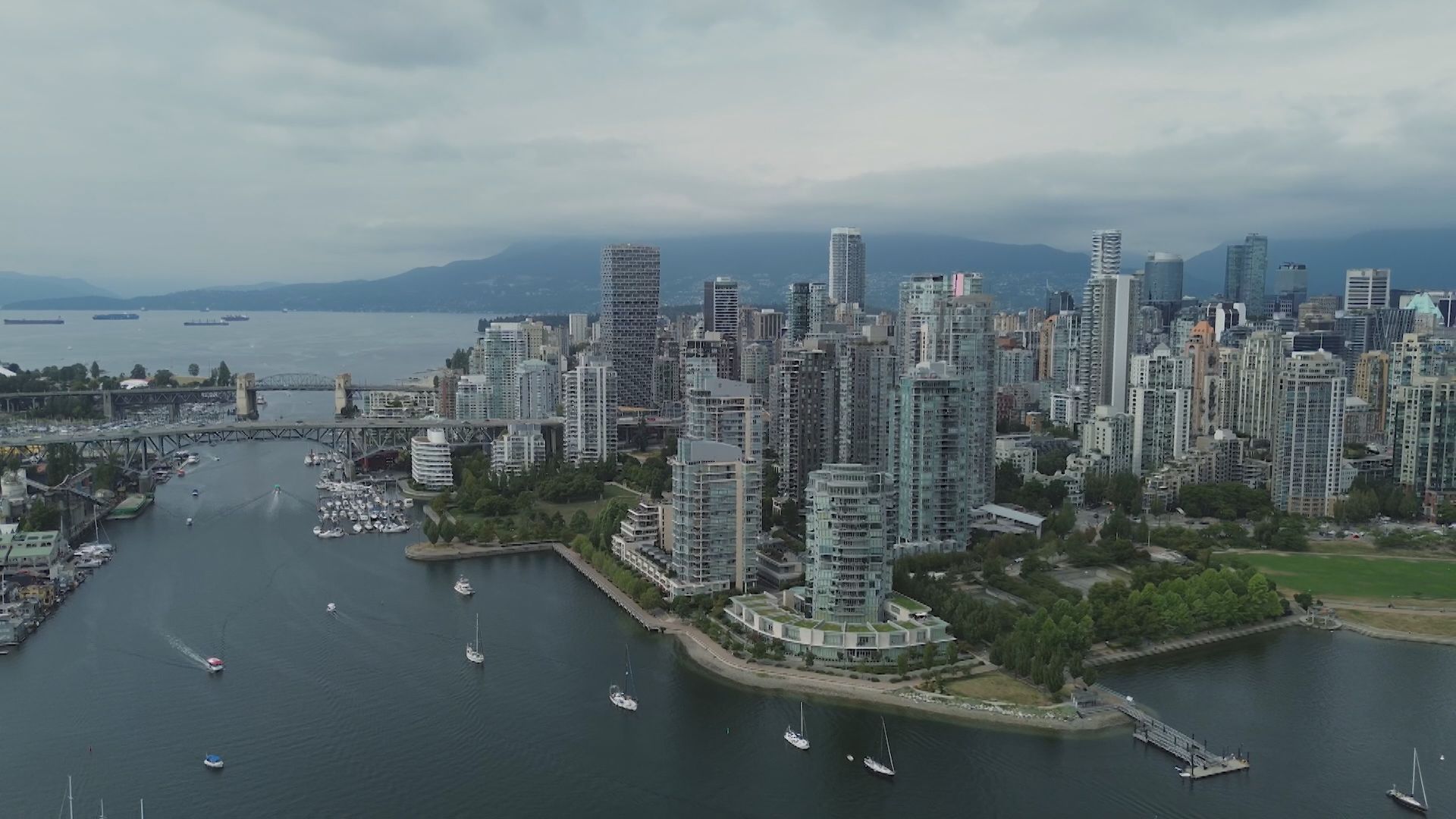
News 07-08-2026
British Columbia News: Rentals, Wildfires, Energy
Rent is continuing to drop across the province, but housing remains expensive. Police are investigating possible arson amid major wildfire activity. BC Hydro is buying a gas power station to improve grid reliability.
Rental in British Columbia keeps getting cheaper, but affordability is still a long way off
British Columbia’s rental market is in a landmark phase: housing prices have been falling for the 25th month in a row, marking the longest streak of price declines in recent years. According to a new report from Rentals.ca and Urbanation, the average asking rent across the province in July fell 4.5 per cent year over year to $2,384. Meanwhile, in Vancouver—traditionally one of the country’s most expensive cities—condominium apartments and purpose-built rental properties saw prices drop by nearly 20 per cent from their August 2023 peak levels.
In an interview with CBC Radio, the province’s housing minister, Christine Boyle, linked the trend to government efforts. She said crackdowns on speculation and limits on short-term rentals have freed up thousands of units for long-term renters. She also pointed to legislative changes that made it easier to build townhomes and multiplexes, particularly near transportation hubs. But economist Brandon Ogmundson, who represents the Real Estate Association for the province, believes local measures alone won’t be enough. He said falling prices are being driven by federal immigration policy, incentives to build purpose-built rental housing, and a noticeable weakness in the condominium market—one that is pushing developers to shift toward rental projects.
The suburbs of Vancouver are especially telling. Abbotsford, Langley, Coquitlam, New Westminster, and Richmond all posted double-digit or near-double-digit declines in asking rates year over year—down between 6.1 and 12.4 per cent. Analysts attribute this to the reality that, with high interest rates, many potential homebuyers have been forced to remain in rentals. At the same time, builders have increased the supply of new homes, creating an oversupply in local markets. David Hutnyk, president of Landlord B.C., said the market is now much more competitive for landlords themselves: to keep good tenants, they have to offer discounts or conditions comparable to market rates, since finding new renters costs more.
Even so, despite the positive momentum, the average rent across the province remains the second-highest in Canada, trailing only Nova Scotia, and is nearly $300 higher than the national figure of $2,037. North Vancouver continues to hold the title of the most expensive municipality in the country, with an average rent of $3,019 per unit. In that context, Christine Boyle acknowledged that the government still has “an enormous amount of work” to make housing truly affordable. She said that even with rental rates falling, renting in British Columbia remains an extreme burden for many families—especially amid a high cost of living—and that the province still has a long road to a more balanced market.
Interestingly, this kind of price decline comes with a paradoxical effect. As CBC explains, official statistics typically take into account leases signed in previous years, while Rentals.ca tracks asking rates for the current month. That means many renters’ actual payments—especially those with long-term contracts—are falling much more slowly than headlines suggest. For new renters, the situation has indeed improved, but for the market as a whole, the gap between “old” and “new” prices is narrowing very cautiously, which observers say could affect decisions about future projects and the region’s investment appeal.
British Columbia police investigate arsons amid catastrophic wildfires
While the south of British Columbia is gripped by unprecedented wildfires that have destroyed hundreds of homes and forced thousands of people to evacuate, provincial police have begun investigating a series of suspicious fires that appear to have been intentionally set. Incidents in the picturesque Shuswap region—known for its lakes and resorts—as well as in the popular Belcarra Regional Park near Metro Vancouver are of particular concern. Local authorities and fire services worry that the actions of whoever is responsible could worsen an already critical situation made worse by extremely dry weather, when even a small spark can quickly become a catastrophe.
According to the Columbia-Shuswap Regional District, officers with the Royal Canadian Mounted Police (RCMP) began checking after residents reported three fires that flared up almost simultaneously in a roadside ditch along Highway 1 between Squilax and Anglemont. Witnesses said the fire sources were roughly 100 metres apart, which immediately raised suspicions of arson. The situation escalated further while firefighters were en route: additional reports came in of two more fires in the nearby Anglemont Estates area. Thankfully, all the blazes were brought under control quickly, but throughout the night, crews carried out tactical patrols in residential areas to prevent any flare-ups and to ensure public safety.
A similarly serious investigation is also underway in a Vancouver suburb. Coquitlam police are asking for witnesses and people who recorded video to come forward with any footage shot at Belcarra Regional Park on Wednesday, since they believe the large fire there sparked the first evacuation alerts this season for the Municipality of Anmore. Investigators want to determine the exact cause and are asking anyone who was in the park between 1 p.m. and 4 p.m. to respond. At the same time, Kelowna police are investigating a series of smaller fires that, based on preliminary information, were intentionally set in a city park in the Black Mountain area near the Gopher Creek Linear Park. Witnesses said the flames appeared very close together, and it was only due to quick action by local residents and park visitors that the fire was put out before official services arrived.
These incidents are unfolding against a backdrop of critical wildfire conditions in the province’s interior, where the recent surge in fire activity is hitting hardest. Of particular concern is an out-of-control fire near the town of Clinton, where new evacuation orders were issued on the night of Thursday. The Squamish-Lillooet Regional District reported that more than 40 additional properties southeast of the massive Pearl Lake wildfire received mandatory orders to leave. Evacuation alerts were also issued for new areas, including around Marble Canyon Park and Pavilion Lake. The Pearl Lake fire itself—covering more than 1,300 square kilometres—continues to burn and remains among the five most dangerous out-of-control wildfires, according to the BC Wildfire Service.
Reinforcements continue to arrive in the province from other regions and countries to fight the blaze. In a statement posted on social media, the Australia-New Zealand National Council for Fire and Emergency Services said 41 firefighters from the two countries have already been sent to British Columbia. At the same time on Thursday, another group of 200 Mexican specialists arrived in the province to help tackle complex fires. There are currently about 100 active wildfires burning in British Columbia, with roughly half classified as out of control. More than 1,400 personnel have been mobilized to fight the flames, working at the limits of their capacity amid extreme heat and dryness.
It’s worth noting that the term “fire of concern” is used by Canadian services to describe blazes that pose a serious threat to the public, infrastructure, or require significant resources to suppress. The situation is made worse by dry weather and strong winds, which create ideal conditions for flames to spread rapidly—making even small fires extremely dangerous. Experts say that under these conditions, intentional arson is not just vandalism, but a real threat to the lives of thousands of people and entire ecosystems. Police are urging everyone to stay vigilant and report any suspicious activity in forested areas, and they also remind the public that intentional arson carries severe criminal penalties in Canada, including up to life imprisonment.
For the first time, suspicions about fires in the Shuswap region and in Belcarra Regional Park were reported by CityNews Vancouver, which continues to track the developments. While firefighters are heroically battling the wildfire conditions, the main task for law enforcement right now is not only gathering evidence into possible arson, but also preventing new incidents that could turn into a real tragedy for the province—once again, for the second year in a row—already dealing with the effects of climate change and abnormal heat.
BC Hydro acquires gas power station on Vancouver Island: a strategic step for energy security
The government of British Columbia announced that the public corporation BC Hydro will purchase the Island Generation power station, located in Campbell River on Vancouver Island. The deal is intended to ensure reliability of the power supply for an island that is growing through population increases, transportation electrification, and expanding industrial development. Notably, the facility being purchased is not new “green” generation. It is a natural gas unit with a capacity of 275 megawatts that has been used very rarely in recent years—only about 15 days per year—as a backup in case of peak demand. Still, authorities view the move as an important part of the broader Powering Growth strategy, aimed at combining energy conservation, upgrades to hydro facilities, building renewable generation, and energy storage systems.
As noted in the official release, purchasing Island Generation will allow BC Hydro to provide stability during moments of maximum demand—such as the coldest days of winter. At the same time, the corporation is investing in new clean capacity, including a newly announced first-on-the-island utility-scale battery energy storage system. The province’s minister of energy and climate solutions, Adrian Dix, said British Columbia’s economy is growing, and more homes, businesses, and industrial sites are choosing clean electricity. He said this asset will provide the backup power needed to support that growth, while the province continues its historic investments in renewable energy and infrastructure.
Campbell River mayor Kermit Dahl called the news an important step for the city and for the entire island, noting that the municipality has long advocated for keeping the station in operation. He said Island Generation plays a critical role not only during peak loads, but also in emergencies, and that having such an asset creates confidence for future industrial investments. Dahl added that it allows clean energy expansion to be paired with practical, reliable support for the system.
A key factor behind the decision was updated consumption forecasts. The latest estimates indicate that British Columbia will need additional capacity sooner than originally expected. Growth in population, the shift to electric vehicles, and new industrial construction are driving the change. Island Generation has been operating since 2002 under a long-term electricity purchase agreement with BC Hydro, so the deal essentially formalizes the existing relationship and ensures long-term access to a strategically important facility. The station also supports 15 jobs in the region, which will remain after the assets transfer under the control of the Crown corporation.
It’s important to understand that British Columbia has one of the most environmentally friendly power systems in North America: about 98% of the electricity generated by BC Hydro comes from clean or renewable sources. However, hydropower depends on weather conditions—especially precipitation levels and snowpack that feed reservoirs. That is why having a gas backup that can be started quickly during periods of peak demand or unusually cold weather is critical for stability. BC Hydro president and CEO Charlotte Meithe said it is the corporation’s responsibility to provide customers with reliable, affordable electricity every day, including during periods of extremely high demand, and that Island Generation will complement the hydro system.
Within the larger strategy, 2025 has already included the commissioning of the Site C hydropower project, which added about 1,100 megawatts of clean capacity to the system. At the same time, BC Hydro is implementing a modernization program for its hydropower fleet, including installing a sixth generator at the Revelstoke station, which should provide an additional more than 1,000 megawatts of capacity. Combined with energy conservation programs, construction of solar and wind projects, and investments in transmission networks, these measures are expected to meet the province’s growing needs for decades. Against that backdrop, the acquisition of Island Generation looks like a practical solution: rather than risking a capacity shortfall during extreme cold snaps, authorities are hedging with a readily available, proven asset that can be retired as new clean capacity fully replaces the functions it provides. Judging by the province’s official government statement, the deal is not a departure from climate goals, but rather a tool for managing a transition period—when older infrastructure must support the power system until major investments in renewable energy are completed.

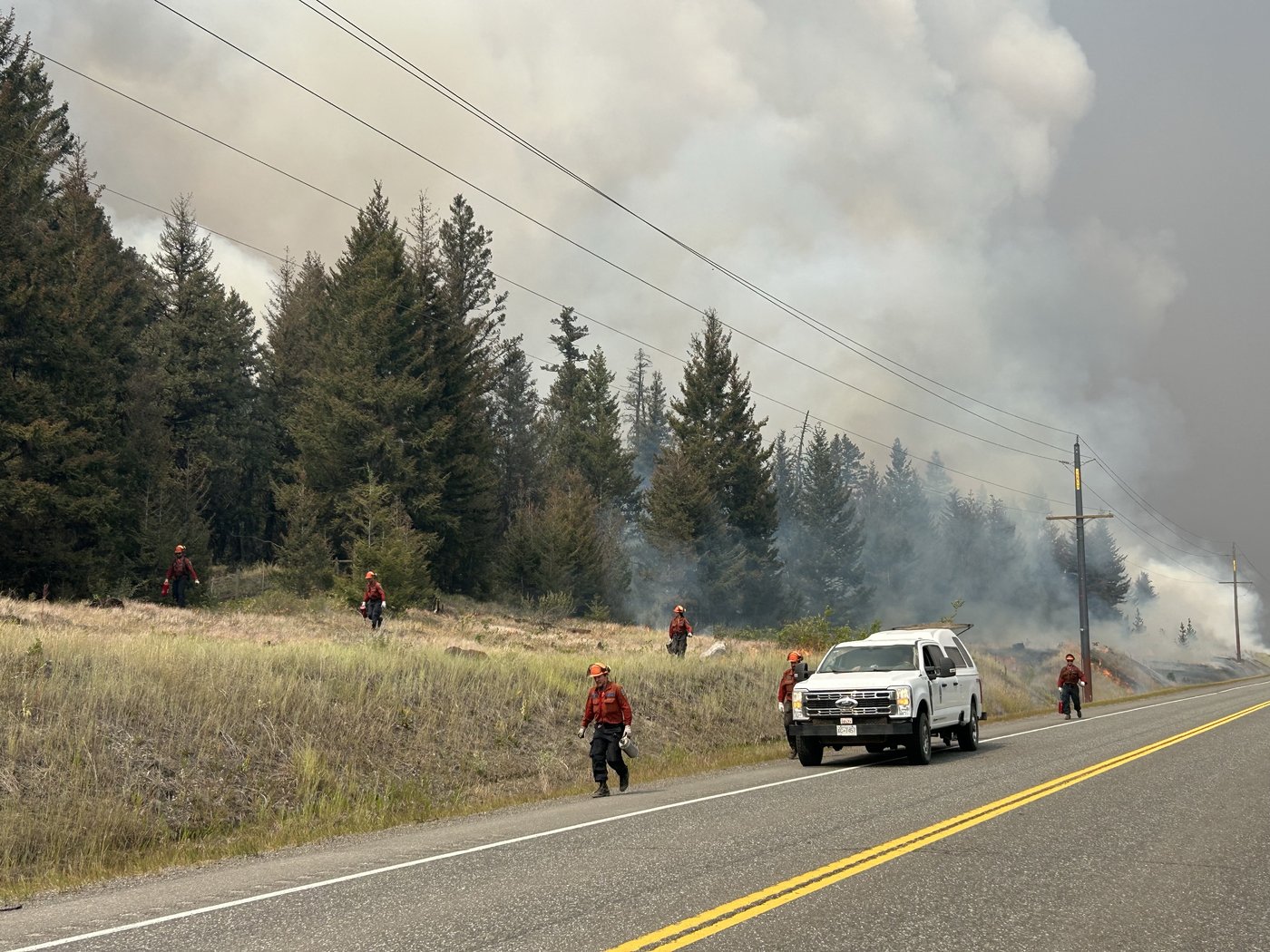
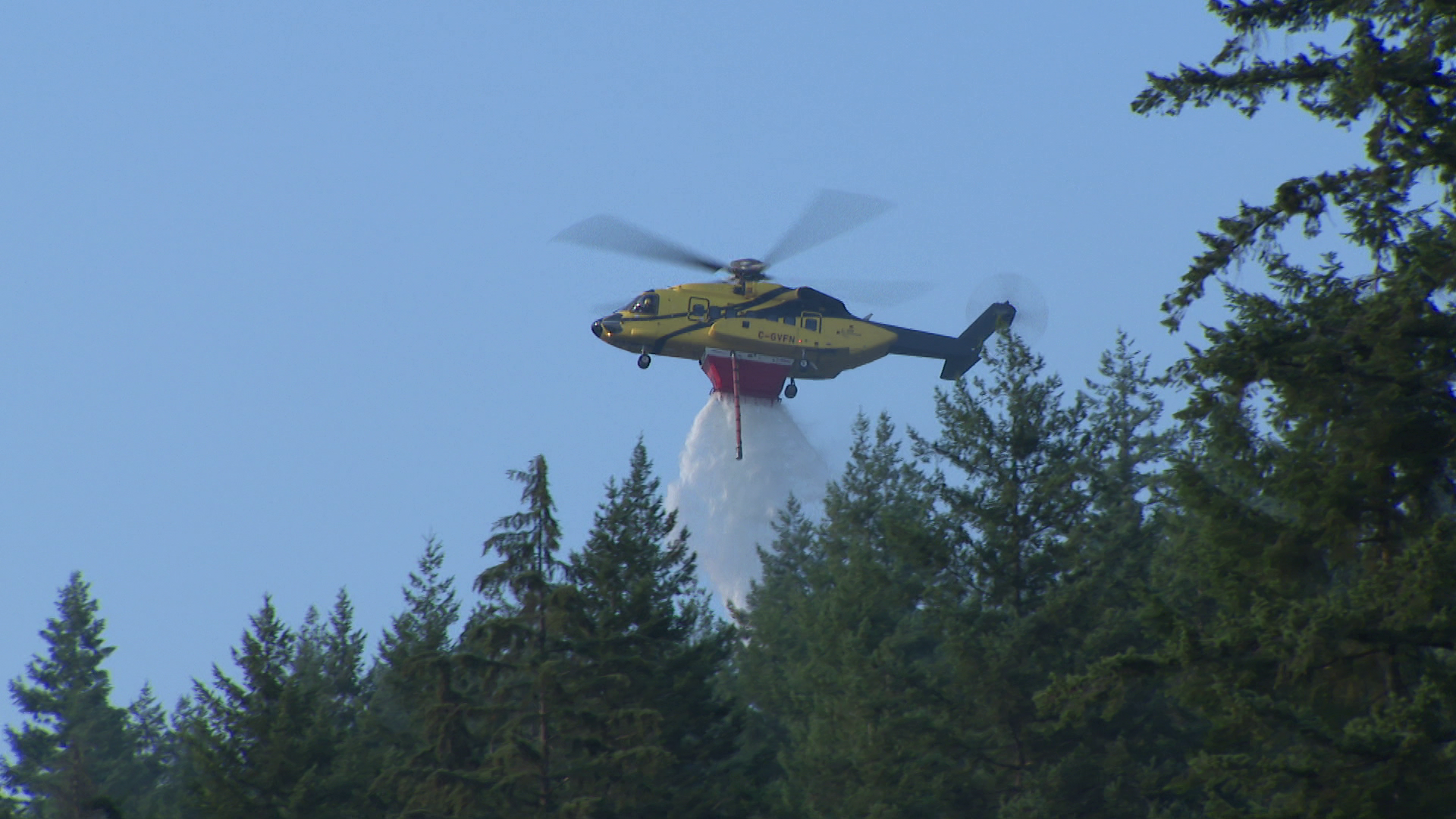
News 06-08-2026
Vancouver: top-tier stadium, tourist rescued, fire in the park
Top stories of the day: BC Place was named one of the best concert stadiums in the world, a missing tourist was found alive after three nights in the wilderness, and in the Belcarra Regional Park near Vancouver, a wildfire was brought under control.
BC Place named one of the world’s best stadiums for concerts
Vancouver’s BC Place has made a list of the top twenty stadiums in the world, according to live-industry experts. The ranking, called “Stadium Stars,” was compiled by the British magazine IQ Magazine, which tracks the global live performance market. This is the second year in a row that the publication surveys workers in the music industry—promoters, tour organizers, producers—and asks them to name the most comfortable, technically equipped, and impressive venues for concerts. As reported by Vancouver Is Awesome, BC Place became the only Canadian stadium on the list.
Notably, the recognition came right after the stadium hosted seven FIFA World Cup matches, and before that it was in the spotlight worldwide for Taylor Swift’s Eras Tour final shows. In IQ Magazine’s write-up, it states that “Vancouver’s BC Place has turned into one of North America’s fastest-growing stadium venues, welcoming a record 1.2 million visitors in 2024.” The authors of the ranking also noted that the stadium manages to pair its concert lineup with other events, including matches featuring two professional teams—BC Lions and Vancouver Whitecaps—along with one-off events. BC Place itself responded to the award on social media, thanking organizers and fans and saying the venue works to make the visitor experience unforgettable for both supporters and the artists and technical crews.
For Vancouver, this is more than just an honorable mention. Over the past couple of years, BC Place has indeed become a destination for the world’s top music elite. It hosted the final concerts of Taylor Swift’s landmark tour, drawing huge crowds of fans from across Canada and the United States. In 2024, Diljit Dosanjh performed at the stadium—this concert became the biggest Punjabi show outside of India. And the largest performance in the venue’s history to date belongs to Ed Sheeran: in 2023, he drew 65,061 spectators while performing on a smaller stage at the center of the field. In addition, at various times BC Place has hosted concerts by The Weeknd, AC/DC, The Rolling Stones, Jonas Brothers, and Beyoncé. Upcoming plans include performances by Noah Kahan, Guns N’ Roses, and no fewer than five Bruno Mars shows over the course of one week in October.
It’s worth clarifying that IQ Magazine is a specialized industry publication rather than a mass media outlet, so its ranking reflects the views of people who directly organize tours and know stadiums from the inside. For them, it’s not only about capacity and acoustics, but also behind-the-scenes logistics, how quickly equipment can be unloaded, conditions for artists, and overall service. That’s why the “Stadium Stars” list includes venues such as London’s Wembley—of course, London in England, not the city with the same name in Canada’s province of Ontario—Paris’s Stade de France, and Hong Kong’s Kai Tak Stadium. The fact that BC Place landed among such company suggests that Vancouver is perceived by the international music industry not as a peripheral market, but as a full participant in the global concert calendar. For the city, that in turn promises new major tours, an influx of tourists, and additional revenue for local businesses, and for fans—more reasons to keep an eye on the stadium’s lineup.
Found alive: the story of a missing tourist who spent three nights in Vancouver Island backcountry
The story of 26-year-old tourist Keshav Jindal, who went missing in a remote area of Vancouver Island, ended happily: the young man was found alive after three nights spent in the Strathcona Provincial Park backcountry. As reported by CTV News, search and rescue personnel from Comox Valley Search and Rescue used a helicopter to search, and it was aerial reconnaissance that allowed them to locate the tourist in difficult-to-reach terrain. The incident once again highlights how treacherous Canada’s wilderness can be—even for those who consider themselves experienced travelers.
Strathcona Park is the largest provincial park on Vancouver Island, covering more than 250,000 hectares of pristine land with mountain ranges, glacial lakes, and dense forests. The area attracts hikers from around the world, but its beauty can be misleading: there is no reliable mobile coverage, the weather can change rapidly, and trails are often lost amid fallen trees and rocky scree. For someone unprepared, even a single day in such terrain can become a serious test—let alone three nights without a sleeping bag and food supplies.
The rescue operation that unfolded after Jindal failed to return at the appointed time demonstrates the coordinated work of volunteers from Comox Valley Search and Rescue. Using a helicopter is standard practice in cases like this, since on-foot search teams aren’t always able to quickly cover rough, broken terrain. Aerial patrols allow rescuers to cover huge areas in a short time, and thermal imaging and visual observation from the air often succeed where ground searches hit a dead end. In this case, the helicopter played a decisive role—though details about exactly where the tourist was located and what condition he was found in are not disclosed in the original report.
Surviving three nights in the wilderness without specialized equipment is always a matter of physical endurance, psychological resilience, and luck. Sudden cold snaps, rain, dehydration, or loss of orientation can lead to fatal outcomes as early as the first day. Specialists tend to explain why Jindal stayed alive by a combination of factors: weather that was relatively mild for that time of year, the availability of water sources nearby, and likely basic knowledge about how to behave in an emergency. Experienced instructors emphasize that in such circumstances, the main thing is to remain calm, stay put or move only along clear landmarks, and conserve energy until help arrives.
This story also has a broader context, because incidents involving missing tourists in Canadian parks occur regularly. According to statistics from British Columbia’s search and rescue services, most people who get lost are those who underestimate the difficulty of a route, fail to tell family members about their plans, or set out without a minimal survival kit: maps, a compass, spare clothing, food, and water. Experts recommend always leaving a detailed route plan with loved ones, checking the weather forecast, and remembering that in the mountains it can change within an hour. Rescuers also remind people that even a short day hike can turn into a multi-day ordeal if something goes wrong—such as a broken ankle, sudden fog, or a river that’s too full to cross on the way.
For Keshav Jindal and his family, the story ended safely, but it serves as an important reminder for everyone planning hikes in wild areas. Canadian backcountry isn’t a theme park; it’s a harsh environment that doesn’t forgive carelessness. Each year, hundreds of volunteers risk their own lives to pull people out of the woods when they get into trouble. Their work deserves special respect, and the experience of the person who was rescued should be examined carefully. Perhaps this case will prompt someone to reconsider their approach to preparation before heading out, and for others, it will be confirmation that even in the most hopeless situation, it’s not worth giving up—help can come from the sky at the most unexpected moment.
Wildfire in Belcarra Regional Park near Vancouver: evacuation, helicopters, and power lines shut off in time
On Wednesday, a wildfire broke out in Belcarra Regional Park, located in Metro Vancouver, forcing authorities to begin evacuating residents of the nearby community of Anmore. The fire was discovered about one kilometer southeast of the popular White Pine Beach on Sasamat Lake, according to the British Columbia Provincial Wildfire Service. By the evening, the area engulfed by the blaze had reached one and a half hectares—and that was despite firefighters facing difficult conditions: in the first hours, access to the fire was blocked by nearby power lines belonging to the hydropower company B.C. Hydro.
The evacuation began with two homes on Fern Drive, where ground crews were dispatched. Initially, the evacuation warning covered twelve properties, but by around 8:30 p.m., Anmore expanded the alert zone to include thirty-five homes. Homes along Fern Drive north of Magnolia Way were put at risk, as were those on Oak Court and the north-eastern portion of Crystal Creek Drive. It’s important to understand the difference between the two levels of threat used by Canadian services: an evacuation warning means residents should be ready to leave their homes at any moment, while an evacuation order requires them to leave immediately. In this case, it was only a warning—though the situation remained tense.
Multiple units were brought in to fight the fire—including the Sasamat Fire Department, Metro Vancouver Regional District, the provincial service in British Columbia, firefighters from Port Moody, and local volunteers. However, at the initial stage, ground crews couldn’t get close to the fire’s source due to energized B.C. Hydro wires. As Metro Vancouver incident commander Brant Arnold-Smith said in an interview with CBC News, without those lines the advance would have been faster, but they became a serious barrier to response. That’s why, at first, the fire was contained exclusively from the air: three helicopters dropped water onto the fire. Only after the utility company de-energized the infrastructure in the fire area did ground crews gain access to the blaze. By 8 p.m., the aircraft had already done a good job wetting the area, and forty firefighters moved into direct action against the flames.
A particularly important part of this incident was that firefighters had to ask people who were on the water not to interfere with helicopters when they were taking water from Sasamat Lake for firefighting. Until further notice, the popular Buntzen Lake recreation area, also owned by B.C. Hydro, was closed as well. Authorities urged residents and visitors to stay away from Belcarra Regional Park and the community of Anmore until the situation was declared safe.
Fortunately, the weather that evening was on the firefighters’ side. Arnold-Smith noted that they were very lucky to have no wind, which made the work significantly easier and safer for the personnel. By Thursday morning, officials reported that the fire was close to being contained. Still, the incident once again underscored how vulnerable suburban forest areas can be—even in metropolitan regions—and how important timely coordination is between energy companies and emergency services. The delay caused by the need to shut down power lines could have cost precious time, but effective aerial operations and coordinated actions by all agencies helped prevent a catastrophe. For the small community of Anmore, which according to the local website had fewer than 2,500 residents in 2022, the wildfire became a serious test of emergency preparedness.


News 05-08-2026
Wildfire smoke blankets Vancouver and cities across British Columbia
Wildfires in British Columbia have led to heavy smoke across Vancouver and other cities. The air quality index has reached dangerous levels, and residents have been advised to cut back on time outdoors. The Bradley Creek fire has destroyed about 230 homes, and thousands of people have been evacuated.
Wildfire smoke blankets Vancouver: orange alert level in the Fraser Valley
The Canadian province of British Columbia is once again dealing with the fallout of large wildfires, and this time the smoke has reached the densely populated Lower Mainland, home to Vancouver. As reported by CBC News, the Metro Vancouver Regional District has raised the air quality warning level for the eastern part of the Fraser Valley. On Tuesday, August 4, an orange alert was issued for the cities of Chilliwack, Agassiz, and Hope—meaning “a very high health risk.” A day earlier, a yellow level was in effect, during which officials recommended reducing outdoor physical activity. Now, residents are strongly advised to avoid any outdoor activity altogether.
The worsening conditions are linked to major fires burning across the province for several weeks. Smoke sources highlighted as especially significant include clusters of fires near Clinton and Boston Bar—some of which have been burning since early July. Their smoke plumes have turned the sky over Vancouver gray and given the sun a reddish-orange hue. At the same time, air quality readings within Vancouver itself remain in the low-risk range, but specialists warn this is temporary. Christopher Lam, president of the B.C. Lung Foundation, explained that the smoke’s trajectory is changing and that pollution will begin to build over the coming days even in the metro area. According to Lam, Metro Vancouver air quality monitors will record rising pollution levels, so residents should be prepared for conditions to deteriorate.
The situation is broader than it might appear at first glance. Wildfires in British Columbia have triggered widespread evacuations: thousands of people have been forced to leave their homes—especially in areas where the Bradley Creek and Quilpituk fires near Vernon are spreading rapidly. According to the provincial health risk air quality index map, much of the Okanagan is rated as moderate risk, Kamloops is also seeing moderate risk, while the eastern Fraser Valley is rated as very high. This type of tiering can be confusing, so it’s important to understand how the rating system works. In Canada, the Air Quality Health Index uses a scale from 1 to 10 plus labels such as “low,” “moderate,” “high,” and “very high” risk. The orange code in the Fraser Valley corresponds to the highest danger level, when even short periods outside may be harmful for vulnerable groups—including people with asthma, cardiovascular disease, older adults, and children.
A telling quote is included in the CBC piece from local resident Diana Pentland, who has asthma. She said she is worried about going outside too often, even though she did go for a walk in Chilliwack. Her words reflect a real dilemma faced by many Canadians: on the one hand, the need to maintain a familiar routine and keep moving; on the other, the obvious health threat posed by toxic smoke. Christopher Lam, representing the B.C. Lung Foundation, said with a touch of irony that residents now have an official excuse to skip a workout. But behind the joke lies a serious problem: respiratory illnesses worsen, doctor visits are increasing, and the health-care system is already under strain.
It’s important to emphasize that what’s happening in British Columbia is not an isolated event, but part of a wider trend. Climate change is extending the fire season, increasing fire intensity, and as a result, leading to more frequent smoke episodes in urban areas. Experts have repeatedly noted that wildfire smoke contains fine particulate matter—PM2.5—that penetrates deep into the lungs and enters the bloodstream. Even for healthy people, prolonged exposure to such air can trigger inflammatory processes, while for vulnerable groups it can lead to serious complications. That’s why the advice to stay home and avoid outdoor physical activity is not just a formality, but a necessary precaution.
Notably, even in Metro Vancouver itself—where on Tuesday morning the smoke was clearly visible to the naked eye—the official index was still in the low range. This can create a misleading sense of safety, especially against the backdrop of photos showing runners along the seawall near the Burrard Bridge and passengers on Highway 99 in Surrey. But specialists warn that the picture could change in just a few days. Winds, which determine the movement of smoke plumes, can shift—and then the toxic haze could blanket the million-person metropolis. Recent years’ history shows that Vancouver, which is often associated with clean mountain air and ocean breezes, is increasingly becoming subject to a smoke veil. And each such episode is a reminder that wildfires have long stopped being a problem limited to remote northern regions, and have become a reality for residents of Canada’s largest cities.
Thick wildfire smoke blankets Vancouver: residents asked to cut back on outdoor exertion
Metro Vancouver has been hit by dense wildfire smoke coming from southern British Columbia. The city and surrounding areas are under a haze, and air quality has deteriorated to critical levels—the Environment Canada environmental health index reached nine out of ten points. That means the smoke is considered “high risk,” and specialists are urging all residents to reconsider their day plans: if possible, to avoid intense workouts outdoors or to move them indoors, and for people in vulnerable groups to do so immediately. The situation is compounded by temperatures continuing to rise, with meteorologists forecasting dry thunderstorms that could spark new fires in the region.
The smoke blanket has stretched across a significant portion of the metro area, affecting neighborhoods north of the Fraser River: Vancouver itself, Burnaby, the North Shore, Coquitlam, Maple Ridge, and the eastern part of the Fraser Valley. Residents in these areas have been seeing the characteristic smoky haze for several days, and in some places the smell of burning has become part of the landscape. Fire services, meanwhile, continue to battle one of the most destructive fires of the season: the Bradley Creek fire, which on Saturday rapidly swept through the Okanagan Indian Band reserve on the shore of the eponymous lake. The scale of the tragedy is only beginning to be understood: according to the latest figures, the flames have destroyed about 230 homes. Okanagan Indian Band Chief clarified that approximately 30 of those belonged to members of the band, and about 200 were non-Indigenous tenants who had rented land on the reserve.
The fire—literally wiping out the lakeside homes along the shore and leaving only foundations—has still not been brought under control. As a result, numerous evacuation orders and evacuation alerts are in effect. According to Emergency Preparedness Minister Kelly Green, only because of this fire, about eight thousand people across the province have been forced to leave their homes, and that number could rise.
Weather forecasts for the coming days are especially worrying for specialists. Cliff Chapman from the British Columbia Wildfire Service warned that temperatures could rise to the mid-30s, with dry thunderstorms expected on Thursday. This is an extremely dangerous combination: lightning without accompanying rainfall can easily ignite dry vegetation. Nearly all of the roughly 115 active fires currently burning in the province are concentrated in the southern interior areas, where it remains hottest and driest. Of these, five have been officially designated as “fires of note,” and they are burning in close proximity to the communities of Boston Bar, Clinton, Vernon, and Kimberley.
Chapman assured that the service is ready for new challenges: helicopters and planes equipped with water-dropping systems are on standby to respond quickly to any new ignitions. Still, he said, the coming week is expected to be extremely difficult for fire crews. In this situation, authorities are advising residents in smoky areas to watch updates to the air quality index and, if possible, stay indoors with windows closed to minimize exposure to harmful particles. As noted in the CityNews Vancouver report, a current rating of nine means that even healthy people may experience irritation of the eyes and respiratory tract, while for seniors, children, and people with chronic conditions it is already a direct reason to seriously limit time outside. Specialists stress that wildfire smoke contains fine suspended particles capable of penetrating deep into the lungs, so ignoring the guidance can have serious health consequences. While firefighters continue their heroic battle against the blaze in the south of the province, residents of Vancouver and nearby cities are learning to live in conditions where the sky turns orange—and where every breath requires extra attention.
Wildfire smoke made British Columbia’s cities the dirtiest in Canada
The Canadian province of British Columbia is once again under the grip of wildfires, and the impact on air quality has been immediate. According to data from the international IQAir platform, which tracks pollution levels in real time in the world’s largest cities, the situation is becoming truly alarming. While at the beginning of August Vancouver was only beginning to climb in the ranking of cities with the worst environmental conditions, now ten municipalities in the province have taken the top spots on the list of the most polluted Canadian cities. Moreover, this is not just an unpleasant smell of smoke, but a real health threat: in some places, the concentration of harmful particles in the air has reached levels that specialists describe as dangerous to life.
As of the morning of August 5, Vancouver ranked 34th in the global pollution ranking with an Air Quality Index (AQI) of 81—already a cause for concern on its own. But the truly critical situation extends well beyond the metropolis. The absolute anti-leader was a small community, Ashcroft, located in the south-central part of the province. There, the air quality index reached an absurd 899 points, which is classified as “hazardous.” For comparison, the dirtiest major city in the world at that time was Portland in the U.S. state of Oregon, but its 159-point figure looks almost harmless next to the numbers recorded in British Columbia. Even Chilliwack with 247 and Hope with 215 points significantly outpaced Portland in pollution levels. At the same time, it should be understood that even an AQI of 81 recorded in Vancouver is already considered moderately harmful for sensitive groups, not to mention figures approaching nearly 1,000.
Local authorities responded to the worsening conditions right away. The Metro Vancouver Regional District, responsible for air quality management, issued a yellow-level warning advising residents of several cities—ranging from Vancouver and Burnaby to Surrey and Langley—to reduce time outdoors and lower the intensity of physical activity. Areas of the Fraser Valley were placed into a separate category, where the health risk was assessed as very high. The cause of the situation was described as smoke from many fires burning in different parts of the province: in the South Cariboo area, in the South Interior, and from a large complex of fires near Boston Bar. As the district notes, smoke levels can change quickly depending on weather and fire behavior, so residents are advised to follow real-time updates.
Particular attention in the authorities’ messages is given to fine particulate matter known as PM2.5. These particles are so small that they can penetrate deep into the lungs and even enter the bloodstream, placing a serious strain on the cardiovascular and respiratory systems. They are the main component of wildfire smoke, though in everyday urban life their sources can also include vehicles, industrial emissions, and burning materials. While PM2.5 concentrations remain high, experts recommend avoiding going outside if possible, postponing outdoor sports activities, and seeking refuge in places with clean-air filtration systems.
Canada’s Prime Minister Mark Carney also did not stay silent, expressing support for everyone affected by the disaster. In a post on social media, he mentioned that just one fire in the Bradley Creek area in recent days had forced thousands of people to leave their homes, and he thanked firefighters and emergency workers for their dedicated work. At the time of publication, 116 fires were still burning in the province, eight of which started just within the last day. Vancouver city officials also urged residents and visitors to think ahead about what to do in smoky conditions, reminding them that smoke affects people differently and that the most severe impacts may be experienced by people with chronic illnesses. Recommended safe places to shelter include libraries, community centers, and other indoor spaces with air-cleaning systems.
This situation once again demonstrates how vulnerable even the most well-off region can be in the face of climate change and natural disasters. For British Columbia, wildfires have long been a familiar part of the summer season, but the scale of the current smoke haze is prompting people to consider that adapting to this new reality will be required not only from emergency services, but also from ordinary residents—who are increasingly having to change their plans due to the air outside. More information about the current air situation is available in the Daily Hive article, which provides up-to-date data for all affected cities. For now, all that remains is to hope that weather conditions and firefighters’ efforts will help control the flames, and that residents across the province will closely heed the authorities’ recommendations to minimize risks to their health.


News 04-08-2026
Smoke and Fire: British Columbia Encircled by Wildfires
Wildfires in British Columbia have turned deadly and destructive: near Vernon, the fire has destroyed hundreds of homes, and thousands of people have been evacuated. Smoke has reached Vancouver and the Fraser Valley, where air quality warnings have been issued. Meteorologists expect conditions to improve along the coast starting Wednesday, but eastern areas will remain under smoky skies for longer.
Smoke over Vancouver: Where the haze came from and when it will lift
In these days, residents of Vancouver and the surrounding area are seeing unusually hazy skies and smelling smoke in the air. Thick haze has settled over the city, and many are wondering whether the experience with the eastern fires earlier this summer—when smoke blanketed huge parts of North America—will repeat itself. But as meteorologists explain, this current smoke is not coming from far away. Its source is within British Columbia itself, in areas relatively close to the coast.
According to Environment Canada meteorologist Brian Proctor, starting Tuesday, the smoke over Vancouver has been building from four separate wildfire areas in the south of the province: Pemberton, Vernon, Boston Bar, and Clinton. Two of these complexes are playing the biggest role—Clinton and Boston Bar. It is there that major fires are burning, and they have already led to evacuations of nearby communities. Because of what’s called an “outflow” wind from the interior of the province, the smoke is moving west and settling over coastal areas, including Vancouver. Even in the city itself, the dense shroud has made even sunlight noticeably dimmer, although air quality on Tuesday morning was still within normal limits.
The situation, however, is expected to worsen through the day. Proctor warns that smoke will continue to come in from the interior, and the portion already hanging over the city will begin settling closer to the ground. According to the Metro Vancouver air quality tracker, conditions are currently at a “low risk” level, but the meteorologist expects a rise to moderate—or even high—risk. The Fraser Valley will be worst off: forecasts call for air quality to reach high or very high levels of pollution. For the eastern part of the valley, an air quality warning has already been issued, but for Vancouver, no such warning has been issued so far.
That said, there is some good news. Areas closer to the ocean may feel relief as early as Tuesday evening: a light westerly wind is expected to push the smoke back away from the coast. However, Proctor notes that the effect of this wind will be limited. A more significant improvement is expected on Wednesday evening, when stronger winds should blow the smoke eastward and clear the sky over Vancouver and the western portion of the Lower Mainland. For residents of the Fraser Valley, though, the smoky conditions may last longer—conditions could remain unfavorable for several more days after things clear in Vancouver. Meteorologists say they cannot yet say for sure how long the haze will persist in that region.
For anyone unfamiliar with local geography, here is the basic context: Metro Vancouver is a metropolitan area that includes Vancouver and surrounding cities; the Lower Mainland is a broader region around the mouth of the Fraser River; and the Fraser Valley is the eastern part of that region, stretching inland along the same-named river. That is where smoke from interior fires lingers the longest, because coastal winds do a worse job of “venting” the narrow valley. An “outflow” wind is air moving from the interior of the province toward the ocean, carrying the products of combustion with it. The air quality indicator mentioned by meteorologists refers to a health risk scale, where low means minimal health impact, and high or very high signals serious danger—especially for older adults, children, and people with respiratory conditions.
The situation once again highlights how vulnerable coastal cities are to the effects of wildfires burning in the interior. Even if the fires themselves do not threaten major cities directly, smoke can travel vast distances and significantly worsen air quality. As Brian Proctor notes in a comment for Vancouver Is Awesome, the most difficult part of this situation is its length and uncertainty. If Vancouver may soon see relief, the Fraser Valley could remain under smoke for several more days—meaning local residents should watch for warnings and, where possible, limit time outdoors.
Wildfire smoke blankets Canada’s Fraser Valley: Air quality warning issued
The published item, judging by the short news note and accompanying photo showing a helicopter dropping water on a forest fire in the Boston Bar area, appears to be a brief update. But even from the headline it’s clear the situation is far more serious: smoke from the wildfires has spread across a large area and triggered an official air quality warning in the Canadian province of British Columbia. The impacted region is the Fraser Valley—one of the most densely populated areas, which in recent years has increasingly been affected by climate change and abnormal heat.
As reported by CTV News Vancouver, the warning was prompted specifically by wildfire smoke from fires burning in hard-to-reach terrain. In a photo taken by The Canadian Press photographer Darryl Dyck on Thursday, July 9, 2026, a helicopter is seen trying to contain the spread of the fire near Brunswick Creek, close to Boston Bar—a small settlement along the Fraser River. This image alone illustrates one of the tactical methods used to fight the wildfire, but it also conveys the scale of the efforts firefighters must make.
The main message of the news is that smoke from such fires is not just a visual nuisance, but a tangible health threat. The air quality warning in question is not a formality but a signal for local residents—especially those with respiratory illnesses, cardiovascular conditions, older adults, children, and pregnant women. In these cases, it’s recommended to limit time outdoors, keep windows closed, and use air purifiers. Authorities typically also advise avoiding physical exertion outside, since heavy breathing brings more harmful particles into the body.
A key concept here is fine particulate matter, often referred to as PM2.5—particles smaller than 2.5 micrometers in diameter. They are so small they can penetrate deep into the lungs and even enter the bloodstream, triggering inflammation and worsening chronic conditions. The concentration of these particles is usually the main factor used when issuing warnings. In the Fraser Valley, where geography—mountains on both sides—helps pollutants accumulate in the lower levels of the atmosphere, wildfire smoke is particularly severe. Air masses stagnate, and smoke essentially “hangs” over communities for days.
The fire at Brunswick Creek is just one of dozens of hotspots that typically emerge in British Columbia every year during the dry season. Boston Bar is located in a relatively isolated area, about two hours’ drive north-east of Vancouver. Judging from the photo, the fire is moving toward forested areas, creating a direct threat to infrastructure and possible evacuations. Using helicopters with water-dropping equipment is a standard but expensive measure—it helps buy time and prevents flames from spreading into residential zones. But aerial firefighting is effective only in combination with ground crews and the creation of mineralized lines.
Despite the limited information in the news itself, several conclusions can still be drawn. First, Canada’s so-called “fire season” is becoming longer and more intense. Second, smoke from such fires does not recognize administrative boundaries: it can travel hundreds of kilometers, worsening air quality even in cities not directly in the path of the flames. Third, these warnings are a reminder that climate change has real, everyday consequences—including for people’s health and safety.
Experts have repeatedly noted that over the past decades, wildfires in western North America have become more destructive due to prolonged droughts and record-high temperatures. The situation in the Fraser Valley in July 2026 is likely not to be an exception. Local residents are left to watch official updates, while authorities have to strike a balance between putting out fires and long-term planning aimed at reducing future risks. For now, smoke over Boston Bar is not just a news story—it is a worrying signal that once again underlines how fragile ecosystems are, and how vulnerable people are to nature’s forces.
A fire that wiped out an entire settlement: How British Columbia is facing one of the worst wildfires in its history
While the entire world watched the summer heat news, a full-scale catastrophe unfolded in western Canada. In British Columbia, near the city of Vernon, a wildfire known as Bradley Creek destroyed hundreds of homes within hours and forced thousands of people to flee with only minutes to spare. Smoke from these fires has already reached the Vancouver metropolitan area and the Fraser Valley, blanketing densely populated areas with a thick, acrid cloud. This is not just another seasonal wildfire—it is an event that local residents are already comparing to a war zone, and that representatives of Indigenous communities describe as the most devastating in their community’s history.
According to CP24, the head of the Okanagan Indian band, Dan Wilson, confirmed that the fire destroyed about 230 homes. Of those, roughly 30 belonged to members of his community, while the rest were homes belonging to residents not part of the band. Wilson, who surveyed the area by helicopter, said the reserve now looks like a battlefield: “It was hard to recognize your community from the air when all the buildings and the forest were gone.” He stressed that the fire spread at a horrifying speed—during wind gusts up to 115 kilometers per hour, some people had only five minutes to evacuate. This is not a metaphor: people abandoned everything and literally jumped into their vehicles to escape a wall of fire.
The scale of the disaster is staggering. About 120 active fires are burning across the province, and roughly 50 of them are classified as out of control. The main hotspots besides Bradley Creek are in the Fraser Canyon, the Thompson-Nicola region, and East Kootenay—near communities such as Boston Bar, Clinton, and Kimberley. Overall, according to emergency services minister Kelly Green, evacuation orders affected about 8,000 people, and the number of active directives changes constantly—at the time of the briefing, there were 37. On Tuesday, the list expanded by more than 40 additional properties, because the fire has closed part of the roads and people had to organize departures in convoys with escort.
What makes this especially tragic is that this is not the first experience like this for people in the region. A 2021 fire was devastating too, but as Louis Freed, who has lived here his entire life, puts it, he has never seen anything like this. Together with his wife, Shorty, they tried to fight the fire on their property. Louis attempted to clear the grass with a tractor to create a barrier, but quickly realized it was useless. “The flames were literally licking his heels,” Shorty recalls. The wind was so strong that sparks burned their son’s hair, and he had to pull a cousin out from under the fire. To escape, they drove along the road, crossing broken power lines and detouring around poles that were still burning and hanging from the wires. Their home was lost, and only thanks to acquaintances who offered them a place to stay were they not left out on the street.
Understanding what’s happening also requires looking at how the emergency response system works. An evacuation order is not a suggestion, but a mandatory requirement to leave the area, while an “alert” means readiness in case an evacuation becomes necessary. In Canada’s classification, “out of control” means firefighters cannot contain the fire along its entire perimeter, and it may expand. At the same time, the province has not yet declared a provincial state of emergency, and officials explain that there is no need for it: every affected municipality and regional district has already put a local state of emergency in place, giving firefighters the authority they need to protect people and property. Declaring a provincial emergency state would allow movement to be restricted or fuel and housing to be rationed, but Minister Green emphasizes that those measures are unnecessary right now.
Still, the outlook is grim: forecasters and fire services warn that this week’s wildfire activity will intensify, because hot, dry weather is returning to British Columbia—even if strong winds are not expected. Smoke has already reached Vancouver and the Fraser Valley, worsening air quality and reminding everyone that the impacts of wildfire extend far beyond the immediate burn zone. For the Okanagan community, this is not only a loss of housing—it is a loss of memory, identity, and the familiar world. As Dan Wilson said, what’s happening feels surreal, and awareness of the full extent of the destruction is only just beginning. Questions about why wildfires are becoming increasingly destructive—and how to adapt settlement planning and emergency response to this new reality—will now be especially urgent, not just in Canada but in regions around the world where climate change is making fire a new norm.


News 03-08-2026
Summer in British Columbia: wildfire smoke and roadside wonders
British Columbia’s fire season is still under way: smoke from wildfires is again blanketing the south of Vancouver Island, and the head of the evacuated First Nation is warning that the situation has not eased—“the emergency isn’t over.” Against this backdrop, CBC is launching a tournament to crown the province’s best roadside attraction—from giant capes to the “Zero Mile” marker—reminding people of the small wonders along the sides of the road.
Searching for the best roadside attraction in British Columbia: the tournament for Vancouver Island gets under way
Every summer, CBC British Columbia runs something like a game for its readers: pick the best in the province—first the best small town, then a lake, then a symbol, and now it’s time for roadside attractions. These are the odd, tender, and sometimes absurd objects that line highways and tempt travelers to pull over, take photos, and spend a little money at a local café or motel. The organizers received more than 300 entries and selected 32, dividing the province into four regions: Vancouver Island, the southwest of British Columbia, the Interior, and the North. Each week in August, readers vote for one region, and then the four winners meet in a final that determines the champion before Labour Day. The first round focuses on Vancouver Island, where eight contenders are competing for a spot in the next stage—from the largest giant cape in the world (a growth on a tree) in Port McNeill to the “Zero Mile” marker at the end of the Trans-Canada Highway.
The history of roadside attractions in British Columbia, as explained by historian Ben Bradley, author of British Columbia by the Road: Car Culture and the Making of a Modern Landscape, goes back to the mid-20th century. That was when the era of rail travel began to decline, while mass car ownership, on the other hand, took off. People started driving across the country, and a real competition erupted among business owners for tourists’ attention—and their wallets. Some attractions were created to draw people into a specific business; others were free and served as a public good, but in both cases the logic is simple: a person pulls over, buys lunch, and may even stay overnight at a roadside motel. So a giant gnome, a golden frying pan, a lake, or a waterfall isn’t just decoration—it’s part of a carefully planned travel economy.
Bradley notes with some irony that in such tournaments everything gets mixed on the same cultural playing field: serious museums sit alongside enormous peaches with eyes, cliffs, and goats grazing on a rooftop. That may be the main charm of these rankings—they show that, for travelers, both historical heritage and pure commercial kitsch are equally valuable. In an article published on the CBC News site, it’s noted that unique roadside attractions can be found on Vancouver Island, in the north of the province, in small towns throughout the Interior, and in almost any place around Hope. The only question is which one is truly the best.
Voting for the first round is open until 8:00 p.m. Pacific time on Monday, and readers are invited to make their choice. The organizers emphasize that this is a summer tradition that brings people together for a fun argument about what makes a place truly memorable. Perhaps it’s these silly and lovable objects that best capture the character of a region—its geography, history, and commercial ingenuity. And while there will ultimately be only one winner, the tournament itself has already become a reason to remember the small wonders waiting at the edges of big roads.
Wildfire smoke is expected to return over southern Vancouver Island on Monday
Residents of southern Vancouver Island and the Greater Victoria area will once again be able to smell the smoke and see a haze on the horizon: according to Environment Canada’s FireWork smoke-prediction model, a layer of wildfire smoke is expected to move over the region starting around 11 a.m. on Monday and linger into the early hours of Tuesday. This isn’t a forecast of real measured air quality, but rather a model prediction designed to estimate how smoke plumes may spread. Based on current FireRadar.ca data, concentrations of fine particulate matter (PM2.5) are expected to be relatively low—between one and forty micrograms per cubic meter. Even so, these levels can be noticeable for people with sensitive respiratory systems.
The return of smoke coincides with a significant uptick in wildfire activity in British Columbia. According to the BC Wildfire Service, there are currently 129 wildfires burning across the province, with 35 of them starting in the last 24 hours. Over the same period, 17 fires were brought under control, and over the past week, 114. On Sunday, responders reported “aggressive fire behavior”: an intense weather system brought the south of the province gusty winds up to 80 km/h and thunderstorms, seriously complicating firefighting efforts—both at active fire sites and when attacking newly started wildfires. Meteorologists warn that hot, dry, and windy conditions will return as early as next week, increasing the risk of fires growing and the development of so-called “smoldering” fires—hot spots caused by lightning that can burn unnoticed and flare up again under hotter, drier conditions.
At this time, no air-quality advisory has been issued for Vancouver Island, but provincial authorities have already released warnings for several interior regions, including the area around 100 Mile House, North Thompson, East Kootenay, Elk Valley, Kootenay Lake, and West Kootenay. Significant deterioration in visibility and air quality is expected there over the next 24 to 48 hours due to smoke. Medical professionals remind people that if smoke becomes noticeable, they should scale back outdoor activities—especially those at higher risk, including older adults, children, pregnant people, and anyone with heart or lung conditions.
It’s worth clarifying that PM2.5 refers to tiny airborne particles with a diameter of less than 2.5 micrometres that can penetrate deep into the lungs and cause serious health problems even after short-term inhalation. The FireWork model mentioned here is a forecasting tool based on weather data and known burn locations, so it does not replace monitoring stations—it only provides an approximate picture for the next few hours. “Smoldering” fires are among the most deceptive problems: they can burn underground or in tree roots for long periods, then break through when conditions become favorable.
BC Wildfire Service asks anyone who notices smoke or fire to report it immediately by calling 1-800-663-5555, by dialing *5555 on a mobile phone, or through the official mobile app. As noted in a CHEK News report, the situation remains changeable, and people in coastal areas should keep an eye on updates to forecasts and local authorities’ recommendations—especially when windy and hot weather returns.
“The emergency isn’t over”: the head of an evacuated First Nation in British Columbia describes the wildfire situation
A wildfire known as the Bradley Creek fire, which broke out near Vernon, British Columbia, forced authorities to issue a mandatory evacuation order for the Okanagan Indian Band Reserve on August 1, 2026. Addressing residents and the media, the head of this First Nation emphasized that—even with some progress against the fire—there’s no need to relax yet: “the emergency isn’t over.” The statement sounded like a warning to anyone who may have already started to hope for a quick return to normal life.
The Okanagan Indian Band is a First Nations community of the Salish people, whose lands are historically located in the Okanagan Valley in the south of British Columbia—a region that is both exceptionally scenic and among the most wildfire-prone parts of the province. The reserve in question is located right near Vernon, meaning the evacuation affected not only Indigenous residents but also the surrounding infrastructure—roads, tourism routes, and agricultural lands for which the area is known. The Bradley Creek fire gets its name from the creek along which it began to spread. Based on how the fire has behaved, it moved rapidly through rugged terrain—fuelled by hot weather, low humidity, and strong winds typical of late summer in these latitudes.
Evacuation itself is an extremely complex logistical process, especially when it involves Indigenous communities, for many of whom ancestral land is not just a material asset but also holds deep spiritual meaning. People are moved to temporary accommodation centres, often in nearby cities, separating families and pulling them out of their usual way of life. For older community members who remember times before any early-warning systems existed, these experiences can be especially difficult. The community leader, quoted by CTV News Vancouver, is not emphasizing danger by chance: wildfires are unpredictable, and even when flames appear to recede, smoldering hotspots can flare up again due to wind gusts or shifts in wind direction.
The situation around Bradley Creek fits into a broader picture that has become increasingly worrying for the entire province of Canada in recent years. British Columbia is experiencing one of the most destructive wildfire seasons in its history, and climate scientists link this to global warming. Average temperatures in the region continue to rise, snowpack melts earlier than normal, and summer droughts are lasting longer. Together, these factors create ideal conditions for so-called “fire storms”—fires that develop so quickly that they are almost impossible to control with ground crews, and then aircraft and specialized firefighting teams from other provinces—and even from abroad—are brought in.
For the Okanagan First Nation, this fire was not the first time the community has faced a threat like this. The community has already been dealing with wildfire risk in past years, and each time it has left a deep mark on its social and economic life. Beyond the obvious threat to homes and outbuildings, fire destroys forests that provide sources of traditional livelihoods—hunting, gathering berries, and medicinal plants. For many Indigenous people, this is not simply the loss of natural resources, but the destruction of a cultural code passed down from one generation to the next. That’s why the community leader’s comment that “the emergency isn’t over” should be understood not only literally, but more broadly: even after the fire is put out, the community faces a long road to recovery—both materially and emotionally.
Provincial fire service representatives, according to the source, continue to keep the perimeter under control, but forecasts for the coming days remain unfavorable. Meteorologists warn of possible thunderstorms with lightning but without precipitation—an all-too-common trigger mechanism for new ignition points in remote, hard-to-reach locations. In many remote parts of Canada, it is lightning—not human factors—that causes most major fires, and it’s virtually impossible to predict lightning strikes in advance. Under these conditions, even the most advanced satellite monitoring systems can’t provide a complete guarantee that no new hotspots will go unnoticed.
Evacuated residents who have ended up in reception centres can only wait for official permission to return. However, as past experience shows, returning home is just the beginning of a long process. Damage assessments must be done, communications restored, children returned to school, and medical facilities put back into operation. In the case of remote reserves, there’s an additional challenge: transportation access. The fire may not only destroy forests, but also the roads used to supply the area. Based on his statement, the community leader is already preparing the public for the fact that recovery could take months—and possibly years.
Meanwhile, the question remains what measures will be taken at the government level to prevent similar disasters in the future. The Canadian government has long discussed strategies for managing forested areas, including controlled burns that reduce the amount of dry vegetation that serves as fuel for fires, and improving early-warning systems. But as this current season shows, those measures are still not enough. For Indigenous communities whose reserves are often located in high-risk areas, the issue is especially urgent—and perhaps it’s time for First Nations communities themselves to play a more active role in developing wildfire policy. For now, looking at the smoke over the Okanagan Valley and listening to the community leader’s warnings, it’s hard not to acknowledge this: nature is reminding people of its power, and for all of humanity’s technological strength, it isn’t always something people can quickly control.


News 02-08-2026
Fires, Traffic, and Pride: Weekends in British Columbia
In British Columbia, the long weekend is being overshadowed by wildfires and evacuations, chaos in the air, on ferries, and at the border. Meanwhile, the Vancouver Whitecaps are announcing a Pride match with a touching story about a young fan named Jack.
Storm front in British Columbia: Lightning sparked new wildfires and expanded the evacuation area
The situation with wildfires in the Canadian province of British Columbia continues to intensify — both literally and figuratively. Another round of thunderstorms that swept across the region in early August led to new fires, prompting local authorities to immediately expand both mandatory evacuation orders and warnings of possible evacuation. As reported in a CTV News report, the situation remains extremely dynamic, and every new gust of wind or lightning strike can radically change the balance in the fight against the flames.
Particular attention in the updates is focused on the Bradley Creek wildfire, which is burning to the west of Vernon, a city in the picturesque Okanagan region. A photo published by the Canadian Press service, taken on Saturday, August 1, vividly shows the scale of the threat: a thick column of smoke rises over the hills, while firefighting services wage an uneven battle against the blaze. The photo, provided by the BC Wildfire Service, is among many pieces of evidence of just how complex the current firefighting campaign has turned out to be. The fact that authorities have to tap every available resource, including aircraft and ground crews, underscores the severity of the situation.
A key trigger for the current escalation has been dry thunderstorms — a phenomenon in which lightning occurs with very little precipitation, so the strikes reach the ground, but the rain barely wets the vegetation. As a result, each lightning strike can potentially spark a new fire, and within hours the number of active wildfires across the province can multiply. Firefighters note that in these conditions, the priority becomes protecting communities and critical infrastructure rather than fully extinguishing every fire at once — simply because there are not enough resources or time.
For those watching from afar, it is important to understand the difference between the threat levels reported by authorities. An evacuation order means there is an immediate danger to life, and people must leave the area right away — delays could cost lives. An evacuation alert is a signal that residents should be ready to leave at any moment: gather documents, medications, essentials, and determine departure routes. In the current situation, both levels have affected many communities located close to the line of fire, creating a massive strain on logistics and emergency services.
Fire in British Columbia is not a new phenomenon, but year after year the wildfire season starts earlier and lasts longer, while the intensity of ignitions continues to increase. Climate change is bringing prolonged droughts and extreme heat that dry out forests and turn them into tinder. Experts emphasize that even the most effective response cannot completely rule out catastrophic scenarios as long as abnormal weather conditions persist. The situation in Vernon is only one episode of a broader picture affecting a significant portion of the province, and judging by forecasts, there’s no reason to relax.
Notably, the updates are coming from the heart of the Okanagan — the province’s tourism and agricultural hub, known for its vineyards and lakes. The threat of wildfire here is not only a matter of public safety, but also an economic, ecological, and lifestyle blow to thousands of residents. Smoke from the fires is already spreading for hundreds of kilometres, worsening air quality in cities and towns, which adds pressure to the healthcare system. Local authorities are urging people to strictly follow instructions and not return to dangerous areas until official permission is given, because the fire is treacherous and can return even where it may seem everything has already been extinguished.
While firefighters continue battling the flames and meteorologists monitor the movement of weather systems, all that remains is to hope the weather gives a break. But experience from past years suggests that August is the peak wildfire month in British Columbia, and there is likely more than one week of intense work ahead. Every new lightning strike brings a potential threat, and all services are on heightened alert to respond quickly to any changes. The Bradley Creek wildfire story is a reminder of how fragile the balance between people and nature can be — especially in an era of shifting climate,
Long weekend in British Columbia: Fires, a WestJet strike, and border traffic make travel harder
This year’s August long weekend for British Columbia Day has turned into a serious test for thousands of people in the province who planned to travel. Instead of the usual break, many face blocked highways, cancelled flights, packed ferries, and multi-hour queues at the U.S. border. As reported by CBC News, the situation is complicated by several factors at once: wildfires deeper in the province, a labour dispute at WestJet, and peak demand on transportation infrastructure.
The main problem is the large-scale wildfires that have spread to more than 100 locations across the province. About 2,900 properties are under mandatory evacuation orders, with another roughly 2,800 under warnings of possible evacuation. The fires have made major changes to motorists’ plans: a stretch of Highway 1 in the Fraser Canyon area between Hope and Lytton is closed due to the Brunswick Complex of fires. This is a key route through the scenic gorge, so drivers now have to use an alternative road — Highway 5, known as Coquihalla. But even there it’s not smooth sailing: large drainage works are under way between Hope and Merritt, so provincial authorities warn of significant delays.
The situation is even more difficult north of Lytton. More than a 60-kilometre stretch of Highway 97 between Cache Creek and 100 Mile House is fully closed due to a major wildfire at Okanagan Lake in the Clinton area. That fire led to evacuation orders for hundreds of homes in the Cariboo region. Authorities advise drivers to fill up with fuel or fully charge the battery of an electric vehicle before setting out, and to bring food and drinking water — people may be stuck on the roads for a long time.
Problems in air travel have not been avoided either. Vancouver International Airport expects about 340,000 passengers between July 31 and August 3. The most popular destinations include Toronto, Calgary, Edmonton, Montreal, Hong Kong, and San Francisco. But WestJet passengers have found themselves in a difficult position: the airline began cancelling flights in large numbers amid the threat of a flight attendants’ strike that could start on Sunday. By Saturday, 198 flights had already been cancelled. At the airport, YVR said 16 WestJet flights are affected, though that number could change throughout the day. Company representatives explained that the cancellations are necessary to avoid leaving crews and passengers in a difficult situation, and they strongly recommend checking a flight’s status before heading to the airport.
For those planning to get to Vancouver Island or the Sunshine Coast, there is also bad news. B.C. Ferries calls this August long weekend the busiest weekend of the year. Last summer, during a similar period, ferries carried more than 400,000 passengers and about 130,000 vehicles, and this year demand is expected to be similar. On many major routes, especially Monday’s sailings from Vancouver Island to the mainland, all seats are sold out for pre-bookings. B.C. Ferries spokesperson Lillian Kim warns that anyone hoping to get on a ferry without a booking will have to be patient — there may be long waits or no available spots. She recommends that those who truly need to travel consider walking instead of taking a vehicle. All ships in the fleet are being used and operating at full capacity, but that apparently isn’t enough.
Also not forgotten are those planning to cross into the United States. On Saturday afternoon, long, multi-kilometre lineups formed at border crossings in the Lower Mainland. According to DriveBC, the wait at Peace Arch and Pacific Highway reached three hours, at Aldergrove it was more than an hour, and at Sumas it was about an hour and a half. The Canada Border Services Agency expects a surge in travellers and asks people to check official wait times on its website in advance before heading out.
It’s understandable that terms like “evacuation order” or “evacuation alert” may be unfamiliar to people who are encountering Canada’s emergency notification system for the first time. An order means authorities are telling people to leave immediately because there is an immediate threat to life. An alert is a recommendation to be ready to evacuate at any moment, prepare documents, medications, and necessary items. It’s also worth noting that “standing in line for a ferry without a booking” means arriving at the terminal hoping there will be an available spot — but in the summer season, demand far exceeds supply. And the mentioned Coquihalla is a high-speed highway that runs through mountainous areas and is the main alternate route connecting the Lower Mainland to the province’s interior regions when Highway 1 is closed.
In essence, this weekend has become a stress test for the entire transportation system in British Columbia. The province is simultaneously dealing with the effects of climate change, which are making fires more frequent and more destructive, labour conflicts at major airlines, and ever-growing demand for domestic tourism. Authorities, transportation companies, and emergency services are working at full stretch, but travellers still need to be flexible, bring patience, and possibly rethink their plans. The situation highlights the fragility of infrastructure when multiple crises pile on top of one another and thousands of people try to spend the long weekend outdoors or by the sea.
“The Caps” return to BC Place: a Pride match supported by Telus and the story of 10-year-old Jack
Ahead of the Vancouver Whitecaps match on August 1, 2026, the club has published information for spectators. The announcement focuses not only on logistical details, but also on a human story — the account of a 10-year-old fan named Jack, who has been attending Whitecaps matches since he was two years old. This narrative is the emotional core of a message published on the club’s official website as part of the Pride Match announcement, with telecommunications company Telus serving as the presenting partner.
At age four, Jack was diagnosed with autism and a rare genetic condition, but as the text emphasizes, those diagnoses have never defined who he is. His passion for football, determination, and love of the game inspire everyone who knows him. The boy participates in gymnastics, baseball, multisport activities, and football through the Canucks Autism Network program — an organization created to support people with autism spectrum disorders and their families. At the same time, Jack remains a devoted Whitecaps fan: on match days, he walks to BC Place with his father, brother, and the famous supporter group Southsiders.
The very fact that this story is included in the context of a major match is symbolic. The Whitecaps are returning to BC Place with a big crowd, and the club is clearly aiming to highlight inclusivity as one of the event’s key values. Traditionally, the Pride match supports the LGBTQ+ community, but in this case inclusivity extends beyond that — including to families raising children with developmental differences. Jack’s story shows that the stadium should be a place where everyone feels like they belong, regardless of diagnosis, background, or identity.
For those who aren’t familiar with the Canadian sports context, it’s worth explaining: BC Place is an indoor stadium in downtown Vancouver, and the home arena of the Vancouver Whitecaps, who play in Major League Soccer (MLS). Southsiders are one of the club’s most active and visible fan groups, known for its atmosphere, songs, and support for the team throughout all 90 minutes of the match. Canucks Autism Network, meanwhile, is a non-profit organization founded shortly after the 2010 Olympic Games in Vancouver; it runs sports and social programs for people with autism, and partnerships with professional clubs — including soccer and hockey — help these families feel like part of a larger sports community.
It’s telling that in the official match logistics announcement — from gate-opening times to rules for behaviour in the stands — the editorial team found room for a portrait of the young fan. That suggests the club views its audience not as a faceless mass, but as a community made up of real people with their own stories. For many parents of autistic children, going to a stadium is a serious challenge: noise, crowds, bright lights, and the unpredictability of what might happen. But when the club and fans create a supportive environment, those barriers become manageable. Jack walking in with the Southsiders is a clear example that football really can be for everyone.
Ahead of the Pride match presented by Telus, organizers expect strong attendance. The Caps’ return to their home venue after a break is always an event, but on August 1, 2026 it takes on an extra dimension: it will be a celebration of diversity, with room for rainbow flags, children’s laughter, and a family that, ten years ago, could not even have imagined their son marching to the stadium surrounded by thousands of singing supporters. As noted in a Whitecaps FC website post, for Jack this match isn’t just a game, but a part of life he lives with immense love. And perhaps those are the kinds of stories that matter most to any sports club.
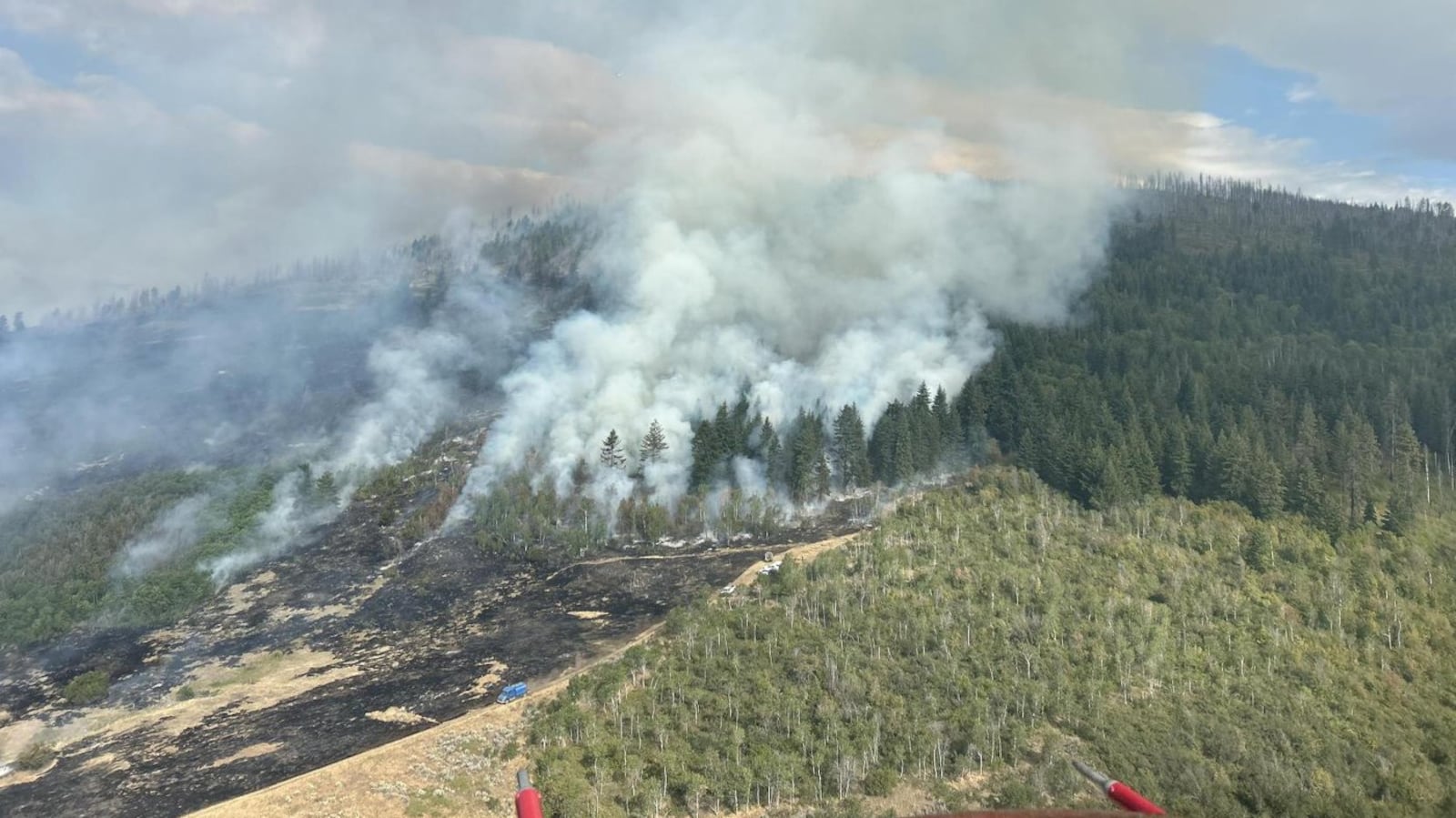


News 01-08-2026
Vancouver: skyscraper, compensation and the port
Canada news digest: a record 315-metre skyscraper has been approved, a court has approved compensation for victims of violence at Catholic schools, and the prime minister backed port expansion for trade independence.
Vancouver approves construction of the tallest skyscraper in Western Canada
Vancouver City Council has made a major planning decision that will significantly reshape the downtown core. On the morning of Monday, July 27, city officials approved a zoning change for an ambitious project worth $2.8 billion, with a 315-metre tower as its centerpiece. The building will be able to claim not only the title of the tallest in Western Canada, but also Vancouver’s first ever “super-tall” skyscraper—this is the international term for buildings 300 metres or higher. The project was developed by Henriquez Partners Architects for local developer Holborn Group and calls for the construction of four buildings: three buildings on West Georgia Street and a separate building on Abbott Street.
In addition to its record height, the complex is expected to include a 920-room hotel, which would become the largest in British Columbia, nearly 2,000 new residential units, more than 6,500 square metres of conference space, and major public amenities. Notably, the developer intends to transfer the Abbott Street tower to the city at no cost, including 378 social housing units, a daycare, and an Indigenous art gallery. Such a move is hard to overstate amid the severe housing crisis affecting Canadian megacities. Holborn Group president Joo Kim Thia described the project as a response to today’s challenges and an inspiration for future generations.
The architects drew inspiration from the nature of British Columbia—specifically, a glassy marine slug, an animal with a semi-transparent, almost lacy body. The tower’s exterior frame is designed as a diagonal grid, reminiscent of this pattern. Known as diagrid, the structure is not only visually unusual, but also provides high structural strength, allowing the building to be both light and stable.
However, the decision was not without controversy. The final vote ended 7–3: three councillors opposed the plan—Pete Fry, Sean Orr, and Lucy Malooney. Malooney said she was concerned that the project was being approved in haste, while the city council continues to review its policy on tall buildings. She also pointed to Holborn’s long-standing history with social housing: in 2008, the company bought a site from the city at Little Mountain, where a social housing complex was located, demolished it, and promised to build a replacement. But construction dragged on for more than a decade and will only be completed this year. According to Malooney, she does not believe it’s right to “reward” the developer for its long-term behaviour in the city, even though she acknowledges the value of new market-rate apartments and non-market housing.
There’s another nuance: if, during its review of the tall buildings policy, City Council sets a maximum height cap, the developer would have to reduce the height of the tower. In that case, it would remain the tallest building in Western Canada but would lose the “super-tall” status—something that would be especially symbolic for Vancouver. As noted in a BCBusiness article, the project involves more than records; it’s also an attempt to address inequality through the integration of Indigenous art and the transfer of social amenities to the city. That said, critics point out that for promises to become reality, much more is needed than attractive architecture and press releases.
BC court approves $30 million compensation for victims of violence at Catholic schools
The Supreme Court of British Columbia has put an end to one of the most high-profile cases of violence in Catholic educational institutions in Canada. Justice Simon Kowal approved a $30 million settlement that will resolve a class action against two private schools in Metro Vancouver—Vancouver College and St. Thomas More Collegiate—and against the Archdiocese of Vancouver. The case concerns decades of hidden cases of physical, psychological, and sexual abuse of students carried out by members of the Catholic order of the Christian Brothers of Ireland.
The story traces back to the notorious Mount Cashel shelter in St. John’s, Newfoundland, where in the 1950s–1970s children were subjected to horrific mistreatment. That is where the brothers were later transferred to Vancouver schools, and, as the court found, four of them were subsequently convicted of criminal offences when the crimes at Mount Cashel came to light in the 1990s. Among those named in the case are Edward Inghlish and Kevin Short, whose names have repeatedly surfaced in connection with the scandal.
More than 200 people joined the lawsuit. In approving the settlement, Justice Kowal said he had “no hesitation” about the amount, especially given the payment mechanism that has been developed. The application process will be confidential and designed to prioritize the psychological safety of survivors, sparing them the traumatic experience of giving testimony in open court.
According to the materials in the case, the abuse at Vancouver College occurred from 1976 to 2013, while at St. Thomas More it occurred from 1976 to 1989. The lawsuit was filed in 2021, gained class-action status in 2023, and a trial scheduled for 2024 was postponed to allow for settlement discussions. The settlement was reached in February 2026, and approval from the court was then required.
The court’s decision describes in detail the consequences: former students described sexual, physical, and psychological abuse that led to mental health problems, relationship and career difficulties, addictions, and a loss of faith. Notably, most of the class action participants did not oppose the amount, but many expressed disappointment that the defendants had not shown sufficient moral responsibility for the “terrible events that were allowed to happen” at these schools.
At the same time, the schools issued public statements expressing “deep concern and sympathy for the victims.” The Archdiocese of Vancouver, for its part, provided the court with statements saying it was “outraged and disappointed” that church leaders did not prevent the abuse, and instead covered up the offenders by transferring them elsewhere, showing indifference to the fate of survivors. It also emphasized a commitment to supporting victims on their path to healing.
Not all class action participants agreed to the proposed terms. Several applicants chose to opt out of the settlement in order to continue seeking justice through individual court proceedings against the defendants. This means the story involving Vancouver’s Catholic schools is apparently not over. As reported by CBC, the case is another reminder of systemic failures by church institutions—and of how crimes against children were covered up for decades, at the expense of hundreds of lives left broken. The compensation fund approved by the court is undoubtedly an important step, but for many survivors, the main goal remains not so much financial compensation as acknowledgment of responsibility by those who committed these atrocities or turned a blind eye.
Canada bets on the Port of Vancouver: a new stage in trade independence
Canada’s Prime Minister Mark Carney has publicly backed a major expansion of the Roberts Bank container terminal in Metro Vancouver, saying that the current capacity of the country’s largest port will soon no longer match Ottawa’s ambitious plans to diversify the economy and reduce dependence on the United States. The statement was made during Carney’s visit to Global Container Terminals’ facility in the Fraser River delta in British Columbia, where he toured the existing Deltaport terminal and discussed the strategic significance of the future Roberts Bank Terminal 2 project.
Carney emphasized the unique role of the Port of Vancouver in national logistics, noting that its throughput exceeds the combined capacity of the five largest Canadian ports put together. However, he said that even those volumes will not be enough in the coming decade. He called the expansion of port infrastructure and the associated transportation corridors a necessary condition for turning the country into a “stronger, more independent, and more diversified” economy. The core idea is to expand trade with Asian countries while simultaneously reducing export dependence on the American market, which has historically absorbed the lion’s share of Canadian goods.
According to the prime minister, the federal government is prepared to invest more than $10 billion in port expansion. This is expected to increase exports beyond the United States by more than 50%. Project implementation is estimated to create around 18,000 jobs during the construction phase and about 17,000 permanent jobs once the new capacity is operational. Carney also pointed to a multiplier effect: the benefits will go not only to logistics companies and exporters, but also to businesses across the country, since port expansion will spur growth in related industries—from manufacturing to agriculture.
The prime minister’s visit took place two weeks after the transport minister, Steven MacKinnon, announced at the port site that the expansion project had been transferred to the federal Major Projects Office for possible accelerated approval. The project itself includes building a new terminal with three berths, which would increase the port’s container capacity by 50%. According to MacKinnon, the expansion would add $100 billion to the annual value of trade. That scale is what led the government to treat the project as a national economic priority.
However, the project has long-standing opponents. Environmental organizations have opposed the Roberts Bank expansion for years, warning that construction and subsequent terminal operations threaten the habitat of endangered killer whales—so-called southern resident killer whales—and damage other marine ecosystems. In response to these concerns, Mark Carney said the government is working with local Indigenous peoples to distribute economic benefits while also protecting the environment. He also noted that Ottawa is already allocating significant funds to protect the killer whale and Pacific salmon populations.
As part of this project, federal authorities also promised that the Major Projects Office would begin consultations with Indigenous communities immediately. In addition, the port expansion plans include consideration of an ambitious project to build a pipeline from Alberta’s west coast, with Roberts Bank as the intended endpoint. That adds additional strategic significance to the project, but also intensifies public debate: port expansion is closely tied to oil interests, raising even more questions for environmental groups.
For audiences unfamiliar with Canadian specifics, it’s important to clarify a few points. Southern resident killer whales are a population of orcas found in waters between British Columbia and the U.S. state of Washington; they are considered among the most vulnerable, and any major infrastructure project in the area automatically draws close attention from conservation advocates. The term “container capacity” refers to the number of standard shipping containers a port can handle per year or at a given time, and increasing this figure is directly tied to volumes of international trade. The Major Projects Office is a federal Canadian mechanism created to speed up approval for complex investment projects that are nationally significant but often get stuck in bureaucratic processes due to numerous regulatory requirements. Finally, the referenced $100 billion in new trade potential refers to the estimated annual value of additional freight flows the port would be able to handle after construction is completed.
Judging by Ottawa’s current direction, the message is clear: Canada aims to reduce its economic vulnerability to political and trade fluctuations in the United States and to bet on the Pacific direction. In remarks on the port site, Carney made it clear that the Roberts Bank expansion is not just an infrastructure project, but part of a broader strategy of national independence. As reported by Global News, the prime minister’s support is a serious signal to investors and Asian partners: the Canadian government is prepared to commit significant budgetary resources to creating alternative trade routes and new jobs, despite ongoing environmental risks and the need for complex approvals with Indigenous communities. The final decision on the project will now depend in large part on whether the federal government can balance economic ambitions, environmental commitments, and the interests of local communities.