
News 31-01-2026
Timmy and the Traveling Rainbow Shell
Once there was a little turtle named Timmy. He was very shy and quiet, but he had one magical gift — his shell could absorb the joy and kindness he encountered on his travels. Timmy lived in a bright, multicolored wagon, painted with swirls of sky blue, sunny yellow, rosy pink, and grass green.
The wagon was driven by his best friend — a brave little fox named Pepper. She loved meeting new people and trying all the tasty treats in every town.
“Timmy, look!” Pepper called out cheerfully one morning. “There’s a new village ahead!”
But as they drew closer, Timmy came to a surprised stop. The whole village was gray. Gray houses, gray flowers, even the sky looked pale and sad. This was Ashgrove, a place where people had long since forgotten what joy felt like.
In the square Timmy spotted an elderly woman sitting by a dried-up fountain.
“Hello,” Timmy said softly. “My name is Timmy.”
“And I’m Granny Irene,” the old woman replied with a wistful smile. “Once our village was the most colorful place in the world. This fountain used to spout rainbow water, children laughed, and the flowers smelled of every color.”
“What happened?” Pepper asked.
Granny Irene sighed.
“One day the Keeper came,” she said. “He was so afraid moments of happiness would disappear that he started collecting them in glass jars. He caught children’s laughter, locked joy in vessels, and stacked memories on shelves. But he didn’t understand one thing — feelings can’t be stored. They must be lived. Gradually, all the joy slipped away from our village.”
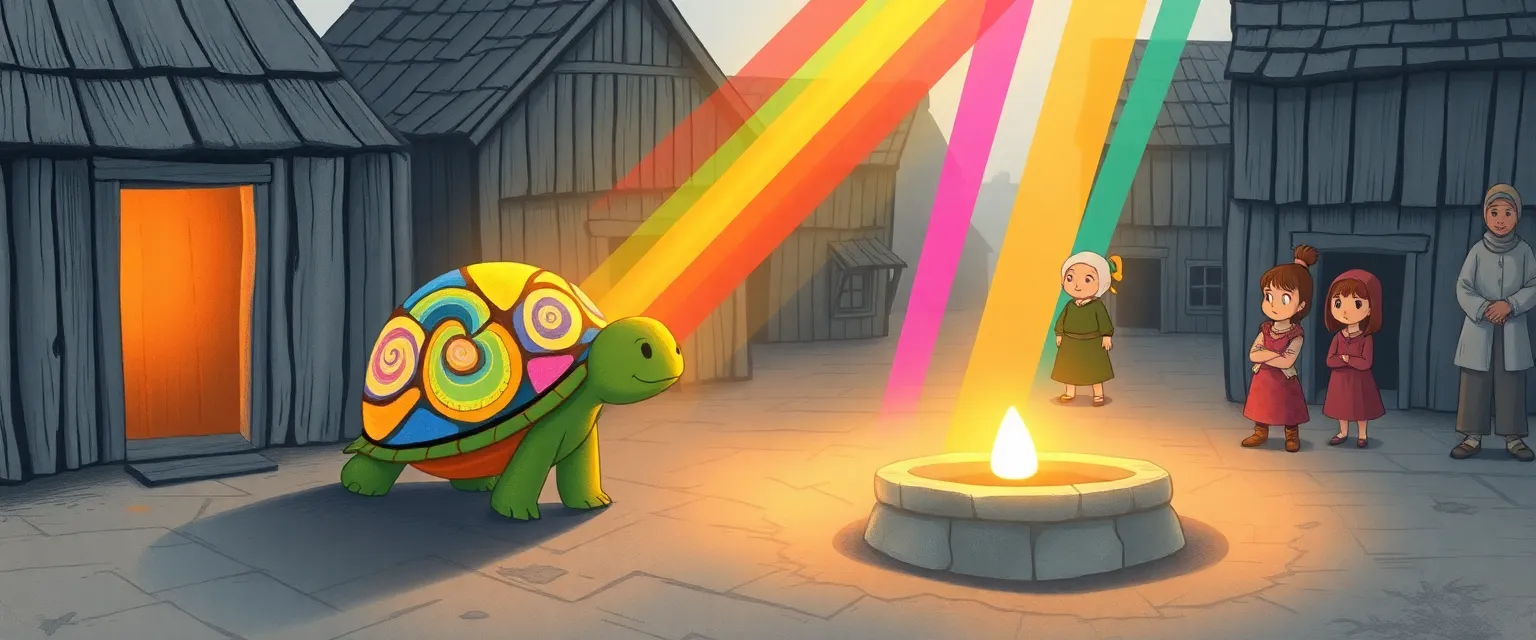
Timmy looked at his shell. It shimmered with every color of the rainbow — he had gathered so many wonderful moments on his journeys! Maybe he could share them.
Timmy closed his eyes and thought about all the kind people he’d met. His shell glowed with a warm light, and soft rainbow rays spread across the village. The villagers stepped out of their homes, staring in wonder at the miracle.
“How beautiful!” whispered a little girl.
But after a few minutes the light faded, and the grayness returned.
“That’s not enough,” Timmy said sadly. “I can show them joy, but they must make it their own.”
Pepper nudged him with her nose.
“Then tell them! You’re such a good listener and you understand people. Share what you’ve learned!”
Timmy was frightened. Speak in front of everyone? But he looked at the downcast faces around him and found courage.
“I… I want to tell you something,” he began softly, and his voice grew steadier. “In one town I saw a mother embrace her son after a long time apart. In another, neighbors baked pies together and shared them. I saw children play hide-and-seek and laugh until they cried. Joy is born when we share with one another, when we aren’t afraid to show how we feel.”
Granny Irene stood and took the little girl’s hand.
“He’s right,” she said. “We hid our feelings for so long, afraid they would be taken away. But true joy cannot be stolen — it can only be made again.”
She began to hum an old song she remembered from childhood. At first timidly, then louder. Other villagers joined in. Someone took a neighbor’s hand. Children started to spin and dance.
Then a miracle happened. The dried fountain shivered. Water burst forth — clear at first, then it shimmered with every color of the rainbow! Colors flowed through the streets, painting houses, flowers, and the sky.
From a distant house the Keeper came out carrying a box full of jars.
“I understand now,” he said quietly. “I thought I was protecting happiness, but I was locking it away. Forgive me.”
He opened all the jars, and little colored sparks flew out, dissolving into the air and returning to the people.
Timmy smiled. His shell now shone even more brightly — for it had absorbed the most important kind of joy: the joy of helping others.
“Thank you for teaching us to be brave,” said Granny Irene, hugging the shy little turtle.
Pepper gave her friend a proud wink.
“See? Even a soft voice can change the whole world when it speaks the truth.”
When the bright wagon left Ashgrove the next morning, colorful butterflies followed behind, and the villagers waved and sang. The village was full of color and joy again — but now it was their own joy, something they created anew each day.
News 30-01-2026
Milo and the Clockwork Garden
Deep in an enchanted wood, where the trees hummed soft melodies and flowers bloomed in colors that didn't exist in the ordinary world, lived a mischievous little monkey named Milo. He loved to leap from branch to branch, collecting shiny acorns for his secret stash.
One morning Milo woke to a strange sound. Tick-tock. Tick-tock. It wasn't like the usual rustle of the forest. He peeked out of his hollow and gasped. The violets beneath the old oak had turned into copper flowers that tinkled in the breeze like tiny bells. Their sweet scent was gone, and the petals were cold and hard.
"What is happening to our forest?" Milo whispered as he climbed down.
Day by day more plants turned to metal. Roses with bronze petals, trees with silver bark, blades of grass that ticked like tiny clocks. The forest was losing its living magic.
Milo decided to find the source of the trouble. He followed a shimmering trail of metallic butterflies until he came upon a tall wall of interlocked gears. Behind it lay the Clockwork Garden—a place the old trees had only whispered about.
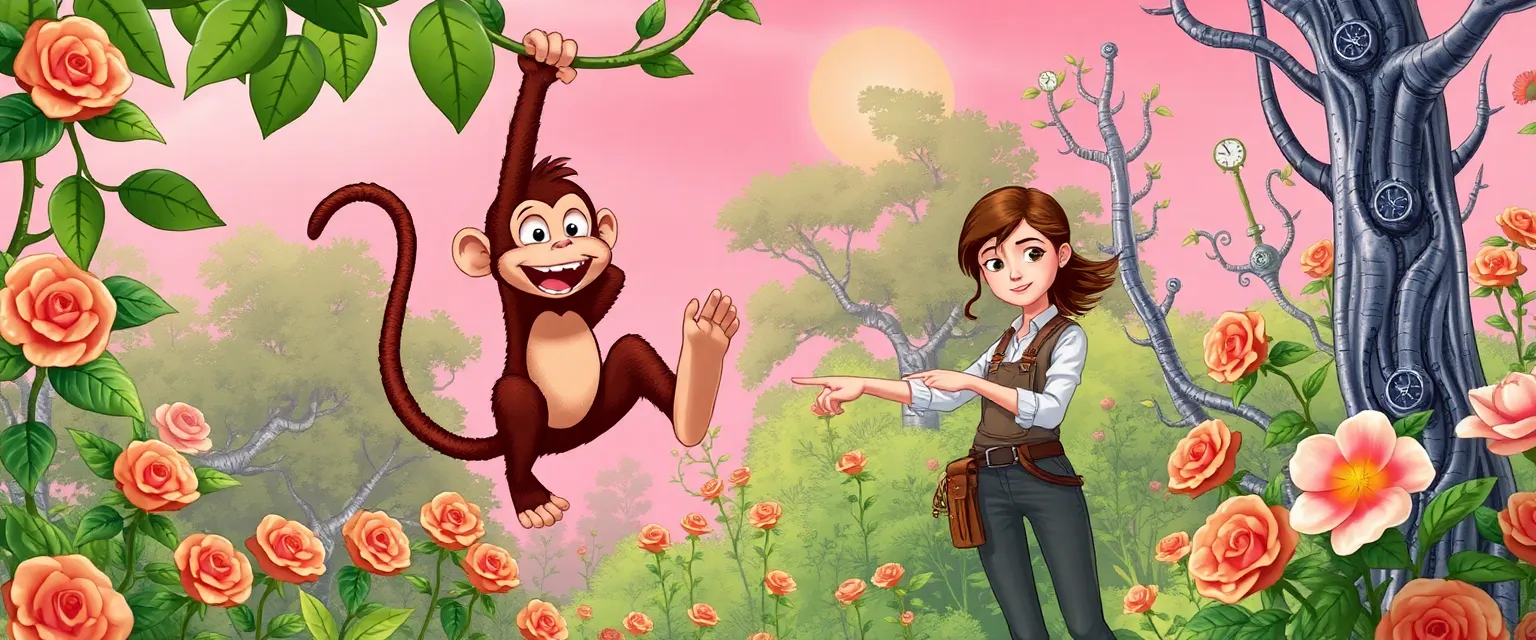
Milo squeezed through a gap in the wall and froze. The garden was divided into three sections. In the first, an eternal dawn glowed beneath a rose-colored sky. In the second, everything moved so slowly that dew hung suspended in the air. In the third, night changed to night every five minutes and the stars flickered like tiny lamps.
"Who's there?" a soft voice asked.
A girl of about eleven stepped out from behind a mechanical shrub, her fingers smudged with oil and a tool-belt around her waist. This was Iris, an apprentice clockmaker.
"I'm Milo! My forest is turning to metal! Do you know what's going on?"
Iris nervously toyed with a wrench.
"I saw someone deeper in the garden," she said. "A woman gathering forest magic into glass vials. But I can't get through... there are too many thorns and branches."
Milo remembered how nimbly he could swing through the trees.
"I don't really understand these time-zones," Iris admitted. "Maybe we can help each other?"
She hesitated, then nodded.
They moved forward together. Milo swung on vines, clearing a path, while Iris called out when to dash from one temporal zone to the next.
"Look!" Iris pointed to a metal butterfly. "If we sync our moves with the beat of its wings, we can pass through the slow zone faster."
They moved in time with the ticking, leapt at moments when one strange night shifted into another, and finally reached the heart of the garden.
There, among mechanical roses, stood an elderly woman with gray hair braided down her back. She was carefully pouring a glowing green liquid from a flower into a vial. She was the Keeper of Rust.
"Why are you ruining our forest?" Milo shouted.
The woman flinched and turned. There was no malice in her eyes—only deep sorrow.
"Ruin?" she whispered. "I preserve. Living flowers wither and die. Metal will last forever. I once lived in this wood, but everyone forgot about me. Now I create beauty that will never fade."
"But that beauty isn't alive," Iris said softly. "I make clocks. They are lovely, but they can't grow, breathe, or sing. The forest should be alive."
"Living things die," the Keeper murmured.
"Yes," Milo said. "But then new life comes. Spring follows winter. Oaks grow from acorns. That's the real magic."
The Keeper looked from her metallic creations to the vials of stolen magic. A tear rolled down her cheek.
"I was so lonely… I thought if I made something eternal, I would be remembered."
Iris stepped closer.
"We will remember you. And if you return the magic to the forest, you can live among us. I'll teach you how to make clocks that measure time for living things—so the flowers can know when to bloom."
The Keeper smiled through her tears. She opened every vial, and the green magic flowed back into the earth. The metallic petals shivered, greened, and softened. The ticking gave way to rustling leaves and birdsong.
Milo, Iris, and the Keeper of Rust left the Clockwork Garden together. The forest came alive again, filling with color and scent. In the center of the clearing the Keeper installed a special clock—not only showing the hour, but also the blooming time of each plant, helping the woodland flourish.
From then on Milo often visited Iris in her workshop, and the Keeper learned to make mechanisms that aided nature rather than replacing it. And everyone in the forest understood: the greatest treasure is when the living and the made work together, like friends.
News 29-01-2026
Milo and the Castle of Singing Bricks
On the top of a hill, surrounded by meadows of dancing wildflowers, stood an extraordinary castle. Every brick was special — red, blue, green, gold, purple — and each could sing its own little tune. Long ago their songs blended into a magical symphony that floated across the countryside.
But now the castle was silent.
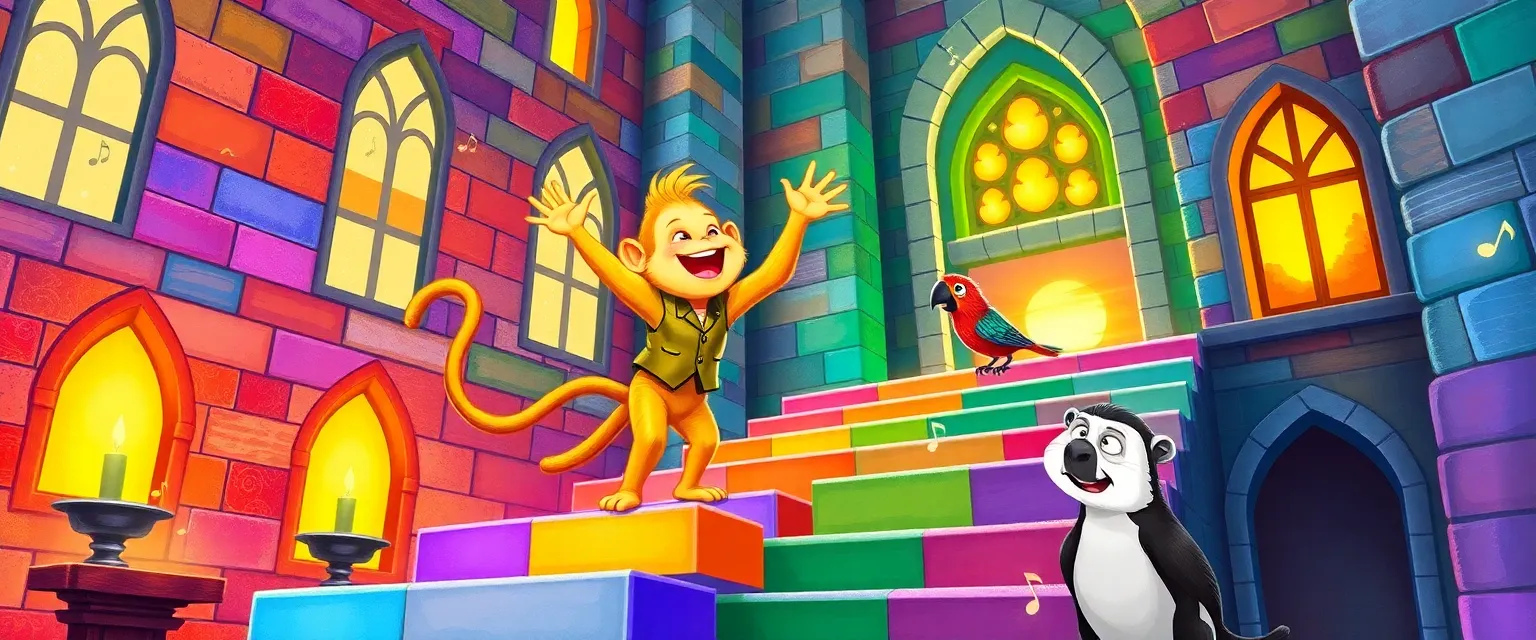
Milo, a mischievous little monkey with golden fur, sat atop the highest tower and watched the sunset with a sad face. Shiny stones jingled in the pockets of his vest — his favorite collection — but not even they could lift his spirits. Just yesterday morning five bricks in the east wall had lost their voices. Instead of cheerful songs they gave only a faint rasp, and by evening they were completely quiet.
“Harmony!” called Milo, and a wise old parrot with bright plumage fluttered down to his shoulder. “What should we do? The whole castle will be silent soon!”
Harmony tilted her head and listened to the faint melodies of the remaining bricks.
“The bricks whisper a riddle,” she said in her musical voice. “‘When laughter leaves the walls, we fade like shadows at dusk. Find the one who built us, and kindle joy again in hearts.’”
“The Rainbow Architect!” Milo cried, remembering old stories. “The turtle who built this castle long ago!”
“She lives beyond the Giggling River, in a maze of gardens,” Harmony nodded. “But the path there is not easy.”
Milo slid down the bannister to the cellar, where Grumble the badger snorted and snuffled amid old trunks.
“Grumble, we need your help!” Milo began.
“My help? Pfft!” the badger snorted, turning away. “I’m busy. Very busy. Sitting here in the dark and… doing important things.”
“The castle is falling apart,” Milo said quietly. “Soon it’ll collapse — even the cellar.”
Grumble froze. Then he sighed so deeply his whiskers trembled.
“All right,” he grumbled. “I know a secret passage to the river. But only because I don’t want my cellar to fall in!”
The next morning the three friends set off. Grumble led them through a hidden tunnel that opened right onto the bank of the Giggling River. The water did indeed laugh — bubbling over stones as if it were telling itself funny jokes.
“How do we cross?” Milo wondered.
“The river asks for a toll,” Harmony said mysteriously. “Not gold, but joy. Make it laugh — and it will let you pass.”
Milo scratched his head and then smiled. He pulled out his shiniest pebble, then began juggling all his treasures, hopping on one foot and making silly faces. Grumble looked away at first, but then the corners of his mouth twitched and he let out a quiet chuckle. Harmony laughed like a bell.
The river roared with delight, and its waves folded into a sparkling bridge.
On the other side lay the Giggling Grove. Trees swayed though there was no wind, their leaves whispering as if sharing a joke. Right before the travelers stood three glowing stones, each carved with a riddle.
The first stone asked: “What grows bigger the more you give it?”
“Joy!” Milo answered without hesitation, remembering how his laughter had spurred the river to laughter.
The second stone asked: “What can fill a room without taking up space?”
“A song,” Harmony whispered, thinking of the castle.
The third stone was trickiest: “What mends what isn’t broken, and builds what already stands?”
The three friends thought hard. Grumble suddenly mumbled:
“Friendship. It makes what’s already there stronger.”
The stones shone brighter and parted, revealing the entrance to a splendid garden-maze. In its center, on soft grass, sat an ancient turtle. Her shell shimmered in every color of the rainbow, and drawn upon it were plans that slowly shifted hues.
“I have been expecting you,” the Rainbow Architect said in a calm, deep voice. “You passed the trials and understood the heart of it. The bricks sing for the joy of those who live here. When the people left, the castle emptied not just of faces but of laughter, friendship, and warmth.”
“But how do we bring the songs back?” Milo asked. “There are only three of us!”
“Three is already a family,” the turtle smiled. “You’ve already begun. Didn’t you notice?”
Milo suddenly realized how close they had become on the journey. Even Grumble now smiled.
“Return home,” the Architect said. “Fill the castle with what makes any house alive. Celebrate every day. Laugh together. Care for one another. And…,” she winked, “you, Milo, can conduct the bricks with your tail. Try it!”
When the friends returned to the castle, Milo climbed the central staircase and began to wave his tail, drawing patterns in the air. To his surprise, the singing bricks answered — their melodies growing louder and brighter. Harmony sang along, and Grumble tapped his feet in time.
Then a miracle happened. The bricks began to glow; their songs grew stronger, and the mute blocks found their voices one by one. Cracks in the walls mended themselves. The castle came alive!
From that day on Milo, Harmony, and Grumble held celebrations every week. They invited woodside animals to concerts where Milo conducted the choir of singing bricks. They played hide-and-seek in rooms that rearranged themselves. They cooked dinners together in the big kitchen, laughing and swapping stories.
And the bricks sang. They sang of friendship, of joy, and of how a true home is more than a beautiful building — it’s a place where you are loved and awaited.
Their song could be heard far and wide, beyond the Giggling River, past the Giggling Grove, all the way to the garden where the wise Rainbow Architect listened to the symphony of happiness and her shell shimmered in every color of the rainbow.
News 28-01-2026
Milo and the Acorn Library
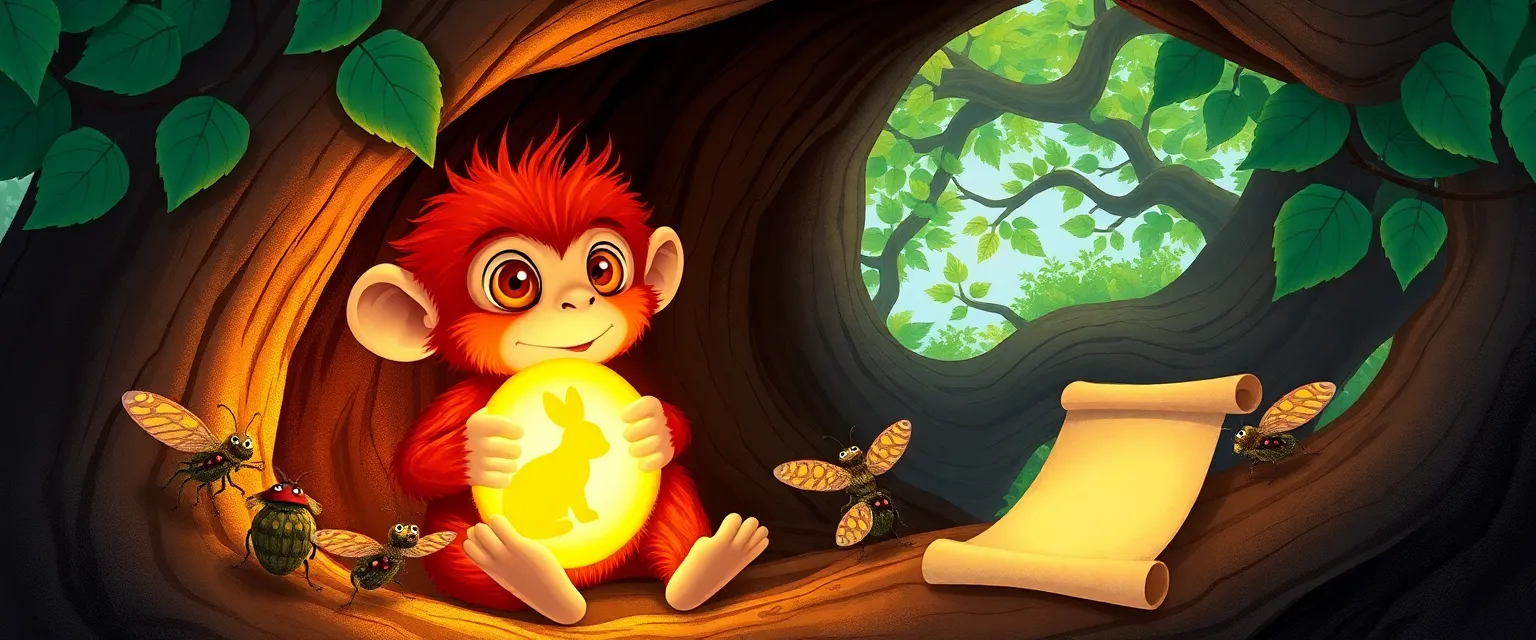
High on a hill where meadow flowers nodded in the breeze stood a great oak. Its branches reached for the sky like a giant's arms, and the leaves whispered songs heard only by birds. In a hollow of that oak lived Milo — a curious little monkey with bright ginger fur and hazel eyes.
Milo loved to collect things: shiny pebbles, feathers, bits of colored glass. His hollow was stuffed with treasures, but above all he adored the acorns from his tree. They were no ordinary acorns — each opened like a locket, and inside lay a tiny scroll.
One morning Milo woke to something strange. The oak was dropping leaves, even though it was the middle of summer. Golden and brown leaves swirled down, carpeting the ground in a sad blanket.
“What’s happening to my home?” Milo whispered, clutching an acorn to his chest.
The acorn suddenly popped open on its own, and glowing pictures flew out — a little hare sprinting through the woods to escape a storm. But the story cut off suddenly, and the pictures went dark.
“An unfinished story,” creaked a voice from below.
Milo scrambled down the trunk and saw an old squirrel with silvery fur. This was Grandma Maple, the wisest resident of the forest.
“Grandma Maple, why is the tree losing its leaves?” Milo asked.
“This oak is a keeper of stories,” explained the squirrel, adjusting spectacles made from nutshells. “Each acorn holds an unfinished tale. When too many stories are left unresolved, the tree grows weak. You must finish at least ten stories before the next sunrise.”
“But I’ve never written stories!” protested Milo.
“Every good story needs a beginning, a middle and an end,” said Grandma Maple. “And the Ink Beetles will help you.”
She tapped the bark with her paw, and three tiny beetles appeared: Dot, Dash, and Twirl, each with patterned shells.
“We’ll turn your words into writing,” the beetles chirped in unison. “But you must speak them aloud!”
Milo scrambled back into his hollow, where shelves held thousands of acorns. He opened the first one. The glowing pictures showed the hare hiding beneath a big burdock leaf.
“And then… the hare…” Milo scratched his head. “Oh, look — a butterfly!”
He darted to the window, forgetting the acorn. The beetles buzzed helplessly.
The same thing happened all day. Milo would start a tale about a brave hedgehog but be distracted by the knock of a woodpecker. He’d imagine an adventure for a field mouse but then remember he hadn’t had breakfast. The sun sagged toward evening, and the oak kept losing more leaves.
“Milo!” Grandma Maple called sternly. “If you don’t focus, the tree will die and all the stories will be lost forever!”
Her words shook the little monkey. He looked at the wilting branches of his home and understood: he had to settle down and try.
Milo took the acorn with the hare’s story and breathed in deeply.
“The hare hid under the burdock,” he began slowly. “The storm raged, but he remembered what his mother had taught him: after every storm, a rainbow appears. He closed his eyes and counted the raindrops. When he reached one hundred, the storm eased and the most beautiful rainbow he’d ever seen arched over the woods. The hare hurried home, where a warm burrow and his mother’s embrace waited.”
The beetles fussed and the scroll filled with golden letters. The acorn glowed and turned into a golden leaf that floated out the window and stuck to a branch of the oak.
“You did it!” Milo cried.
Encouraged by his success, he opened another acorn, then another. He told the story of the brave hedgehog who found his way home by following the stars. Of a little mouse who learned not to fear the dark. Of a titmouse that sang a song for the sad moon.
Night turned to day, but Milo did not stop. His voice grew hoarse, his paws grew tired, but he kept going. Grandma Maple brought him lime blossom tea, and the Ink Beetles cheered him with quiet buzzing.
When the first rays of the sun touched the oak’s crown, Milo finished the tenth story — about a tiny firefly who lit his lantern for the first time and guided lost travelers home.
The last golden leaf lifted toward the tree’s canopy. Then a miracle happened. The oak shuddered, and a rush of new green leaves burst forth from its branches. They multiplied and unfurled until the tree was lush and healthy once more. The meadow flowers bloomed brighter, and the air filled with a sweet scent.
“You did it, Milo!” Grandma Maple exclaimed. “You’ve learned the most important thing: finish what you start.”
Milo smiled at his tree. He realized that collecting pretty things was wonderful, but creating something with his own hands and bringing it to completion was true magic.
From that day on Milo opened one acorn each evening and finished the story inside. The oak grew stronger and taller, shading all the meadow’s creatures. And each golden leaf whispered thanks to the little ginger monkey who learned to make miracles with the power of words and patience.
News 27-01-2026
Felix and the Upside-Down Bakery
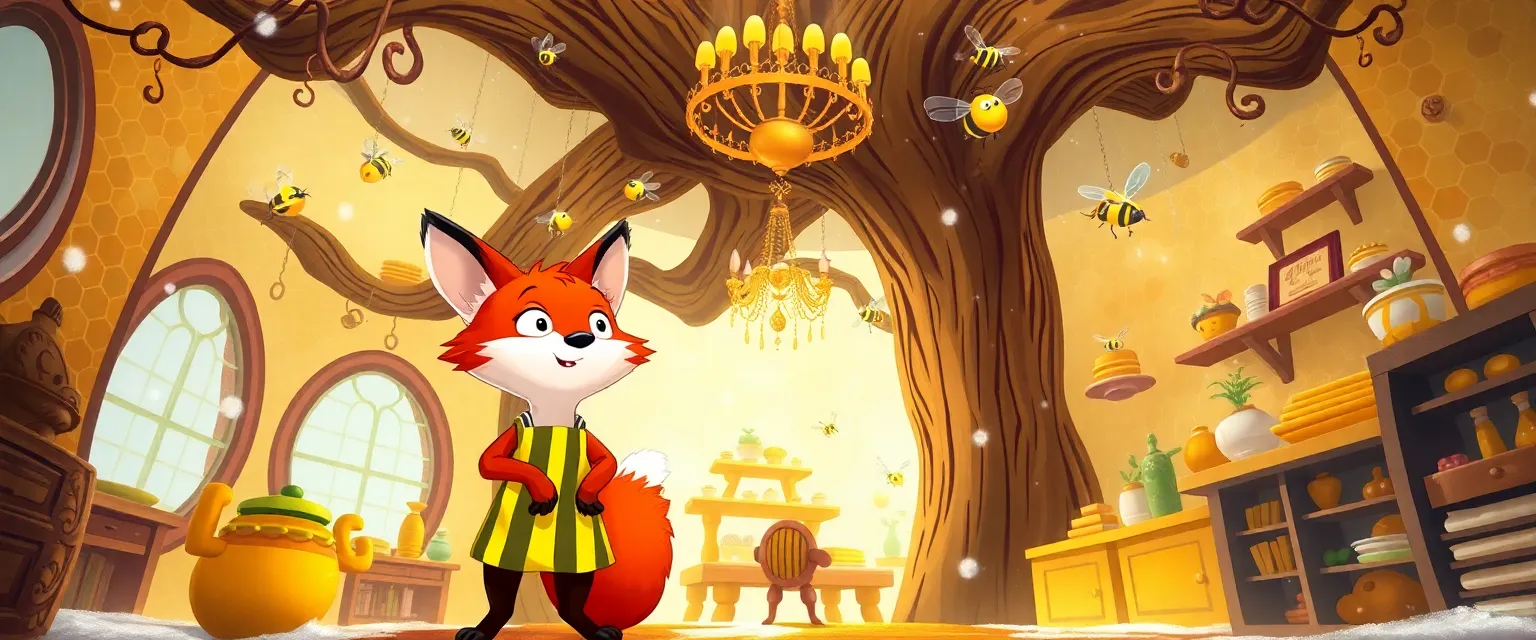
In an old oak at the edge of the forest sat the most extraordinary hive you could imagine. Its hexagonal rooms were linked by spiral staircases of beeswax, and in the largest chamber stood the famous honey bakery. That was where Felix worked, a young fox with a russet tail and merry eyes. His official title was "head taster," but really Felix was the master of jokes and riddles.
One morning Felix arrived at work and froze. The whole bakery had been turned upside down! Pastries floated beneath the ceiling, flour sifted upward, and the ovens baked backwards. Bees in striped aprons buzzed about in confusion, trying to work while upside down.
"What on earth happened?" Felix cried.
Beatrice, the head bee baker, flew up to him. Her wings trembled with worry.
"A disaster, Felix! Queen Bella's birthday is tomorrow and we can't even bake a simple honey cake! Everything went topsy-turvy after we heard a strange laugh last night."
Felix looked around and spotted a tiny creature sitting on the inverted chandelier. Its wings were tilted back and a mischievous grin stretched across its face.
"Hello," said Felix. "Do you know what happened here?"
The creature giggled and answered in rhyme:
"My name is Zigzag, friends and more, I love to joke and laugh galore. But the bees have grown too stern, Forgot the joy at their workbench turn!"
"So you're the one who turned everything over!" Beatrice exclaimed. "Put it back at once!"
"First you must solve three riddles fair, And find the joy you're meant to share. When laughing wakes within your heart, Then order back will play its part!" sang Zigzag, and he vanished in a cloud of golden dust.
Felix scratched behind his ear. He guessed Zigzag was lonely and wanted someone to appreciate his jokes. But how to help the serious bees remember how to have fun?
A scroll appeared on the table with the first riddle: "What becomes sweeter when you share it with others?"
"Honey!" the bees buzzed.
"No," Felix said softly. "Laughter."
He turned to Beatrice. "Remember how you used to sing while you worked?"
Beatrice fell thoughtful, and a dreamy smile softened her face. "Yes, we used to sing those cheerful songs about flowers and sunshine. It feels like ages ago..."
"Then let's sing!" suggested Felix.
He began to hum a silly song about a bear who got tangled in a beehive. Beatrice chuckled, then burst into laughter, and the other bees joined the tune. Suddenly a honey bun that had been floating in the air drifted gently down onto the table.
"It's working!" Felix cheered.
The second riddle appeared: "What is lighter than a feather, yet hardest to hold?"
Felix thought. "A smile? No... the breath of laughter!"
He told the bees funny stories from his own life: the time he tried to climb a tree for an apple and got stuck between the branches, the time he swapped salt for sugar and baked the oddest cake in the world. The bees laughed louder and louder, and one by one the things in the bakery began returning to their places.
Finally the third riddle appeared: "Who needs laughter the most?"
Felix glanced toward the doorway where Queen Bella stood. She had come to check the preparations and looked very tired and sad.
"Your Majesty," Felix said, "would you like to help us bake your very own cake?"
"But I'm the queen," Bella replied, surprised. "That isn't a royal duty."
"It is fun!" Felix smiled and handed her an apron.
The queen hesitated, then put the apron on. Felix showed her how to stir the batter and deliberately smudged his nose with flour. Bella laughed. Then she accidentally dropped an egg and it cracked on her paw. She laughed even louder. Beatrice and the other bees laughed too, helping the queen.
And then a miracle happened! With a loud "BOOM!" the whole bakery flipped right-side up. The ovens settled into place, ingredients returned to the shelves, and the wonderful smell of fresh baking filled the air.
Zigzag appeared again, but this time his grin was kind, not mischievous.
"You've learned my lesson, friends of mine, Work without joy is a sorry line. Now I see you know how to laugh, It's time for me to take my path."
"Wait!" Felix cried. "Will you stay? We need someone to remind us to have fun. You could be our official jester!"
Zigzag's eyes sparkled with delight. "Really?"
"Of course!" said Queen Bella, still smiling. "I'll even issue a decree: every day in the bakery there shall be time set aside for jokes and laughter!"
The next day the celebration was a great success. The royal honey cake turned out splendidly, and best of all—everyone laughed and enjoyed themselves. Beatrice sang her old songs, Zigzag told funny rhymes, and Felix... well, Felix simply glowed with happiness, because he had helped everyone learn a simple truth: work is better when you don't forget to rejoice in life.
From then on the honey bakery was always filled with laughter, and the baked goods tasted even sweeter. As Felix used to say, you must add a pinch of joy to every cake—and then it's sure to turn out wonderful!
News 26-01-2026
The Cartographer's Apprentice and the Island of Living Colors
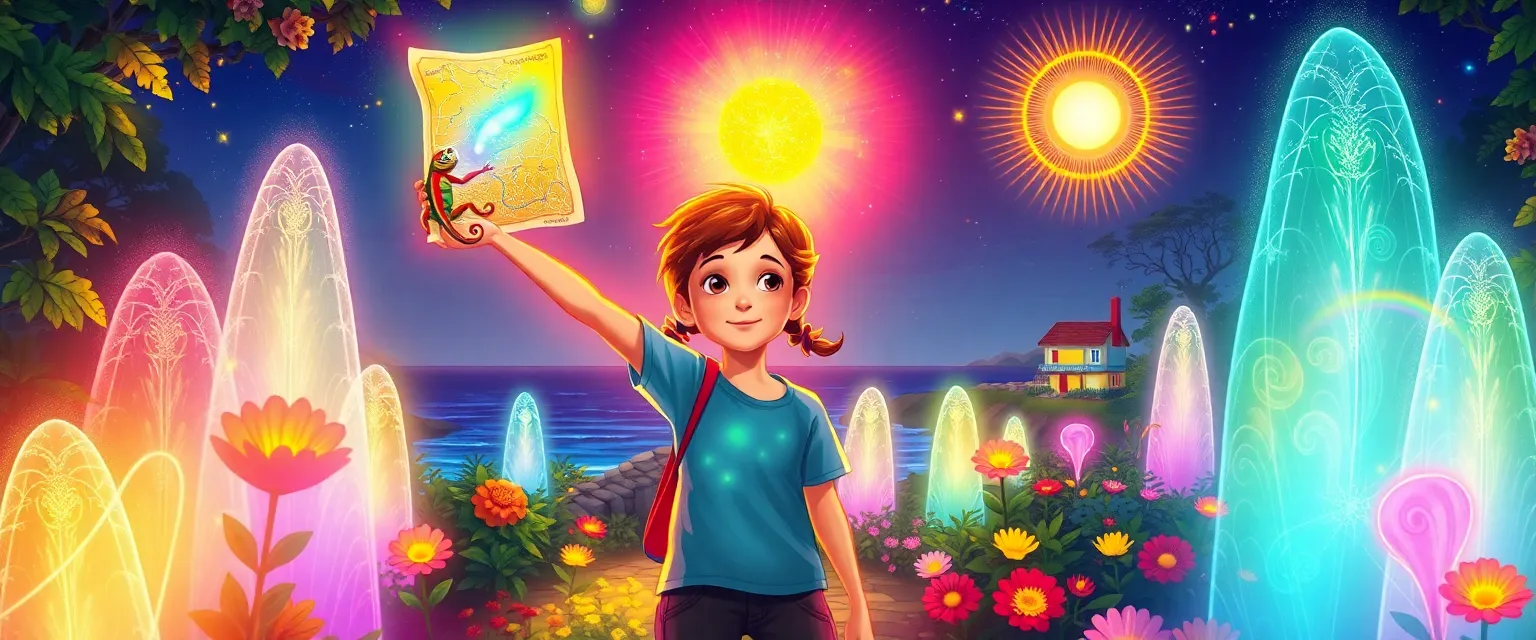
At the edge of the world, where ocean meets sky, there lay an island that pulsed with color. Here hibiscus flowers burned like orange flames, the sea shimmered in emerald and sapphire waves, and the villagers' houses shone in every shade of the rainbow. On that island lived ten-year-old Marina, the apprentice of her grandfather Orin, the village's chief cartographer.
Marina loved making maps more than anything. She noticed tiny details others missed: how the path curved around the old banyan, where the brightest starfish hid, which clouds meant rain. But whenever Grandpa Orin praised her work, Marina would shake her head.
“My maps aren't good enough, Grandpa,” she would say. “They're not as precise as yours.”
“My dear Marina,” Grandpa Orin would reply, stroking his gray beard, “maps tell stories, not just directions. Your maps tell stories only you can see.”
One morning Marina woke to find something had changed. The hibiscus outside her window, usually a bright red, had gone pale pink. By noon it had turned gray. By evening the whole garden had become shades of ash.
“Grandpa!” Marina cried as she dashed into the workshop. “The colors are disappearing!”
Grandpa Orin looked up from his charts, and Marina gasped. His normally kind, lively eyes were dim, and his face was pale.
“The Rainbow Springs are drying,” he whispered hoarsely. “Color is living energy that flows beneath our island. Without it we lose not only paint but joy, creativity—even memories.”
He handed Marina an old map, drawn with a trembling hand.
“You must find the Rainbow Springs before the new moon. Only there can the balance be restored. But remember: the path will not be shown by my map, but by your own heart.”
Marina took the map, feeling the weight of the task. How could she, a mere apprentice who didn’t even trust her own talents, save the whole island?
On the doorstep waited a little chameleon. Chameleons on the island usually shimmered with all the colors, but this one was gray.
“My name is Chromis,” the chameleon said in a sorrowful voice. “I lost my colors first. Help the springs, and I will be colorful again. In thanks, I'll be your guide.”
“How will you help me?” Marina asked.
“I taste emotions,” Chromis replied. “I can follow the trail of feelings left by other travelers. Also, I speak in riddles and rhymes, which makes the journey more fun!”
Marina smiled for the first time that frightening day.
Their journey began in the Crystal Caves. The cave walls had once shone like gemstones, but now they were fading before their eyes. Marina opened Grandpa Orin’s map, but the lines blurred and began to move.
“What’s happening?” she exclaimed.
“Where the path winds, there the truth hides,” Chromis sang. “The map is alive, the way changes—follow your heart, not the lines!”
Marina closed her eyes and remembered what Grandpa Orin had taught her: maps tell stories. She took out her own notebook and began to draw not what she saw, but what she felt. She sketched lines showing where the air felt warmer, where echoes sounded deeper, where the cave walls felt friendlier.
A miracle happened. Her map began to glow a faint blue, pointing the way forward.
They left the caves into the Singing Forest, where trees hummed in different notes. But the forest’s song was growing faint, its leaves losing their green.
“To pass through the wood,” Chromis said, “you need a bridge, but there is no bridge. What will you do?”
Marina looked at the remaining paints in her satchel: tiny jars of pigment she used to color her maps. She remembered Grandpa Orin’s words: color is living energy.
Carefully she mixed blue and yellow on her palm. The paints began to glow and turned into a luminous green bridge of light spanning the chasm.
“Brilliant!” cried Chromis. “Paints are not just color—they are the power to create!”
They crossed and came upon the Geometric Garden, where plants grew in perfect circles, triangles, and spirals. There they were met by a tall figure in a cloak of shifting hues—the Keeper of Colors.
“Why have you come, young cartographer?” the Keeper asked in a voice like the rustle of a rainbow.
“To save the Rainbow Springs,” Marina replied, trying to sound confident.
“Many have come before you,” said the Keeper. “But the springs open only to those who see the true connections between all living things. Draw me a map of this island—not an ordinary one. Show me the map that your heart sees.”
With trembling hands Marina took out her notebook. She could draw a usual map with mountains, rivers, and roads. But the Keeper asked for something different.
Marina closed her eyes and thought of all she had learned. She thought of Grandpa Orin, who taught her that maps tell stories. Of Chromis, who showed that feelings could be guides. Of how colors became bridges.
Then she began to draw.
She drew connections instead of borders. Lines that showed how one person’s joy passed to another. How the forest’s trees shared their songs with birds. How the ocean gave color to fish, and fish gave color to coral reefs. How her grandfather’s memories wove together with her own dreams.
When she finished, the map shone in every color of the rainbow.
The Keeper smiled.
“You have learned the most important thing,” she said. “The world is not a collection of separate places but a web of connections. The springs dry when people forget those connections, when they stop noticing the beauty around them and cease to bring joy to one another.”
The Keeper touched Marina’s map, and the ground trembled. Fountains of light burst from the earth—red, orange, yellow, green, cyan, blue, violet. The Rainbow Springs came alive again!
Color flowed across the island like rivers of light. Flowers blazed with brilliant hues. The ocean sparkled with emeralds and sapphires. And Chromis, the little chameleon, suddenly shimmered with every color of the rainbow.
“I’m colorful again!” he shouted with joy, shifting from red to gold and back.
When Marina returned home, Grandpa Orin met her at the door. His eyes shone once more, and his cheeks were rosy.
“You did it, my dear,” he said, embracing her. “You saved the island.”
“But I only drew what I felt,” Marina said. “My maps still aren’t as precise as yours.”
Grandpa Orin shook his head.
“Marina, your maps show what mine never will. You see the ties between things. You see stories. You see the world’s heart. That doesn’t make your maps less accurate—it makes them truer.”
From that day Marina no longer doubted herself. She kept making maps, but now they were special. They showed not only where places were, but how those places connected, what stories they held, what feelings they stirred.
Chromis remained her best friend and helper. Together they traveled the archipelago, mapping every isle—the Island of Singing Winds, the Island of Dancing Shadows, the Island of Laughing Waves.
And whenever someone on the island began to lose their joy or forget the beauty around them, Marina would show them her maps and remind them: the world is full of connections, and each of us is an important thread in this beautiful, colorful story.
News 25-01-2026
Felix and the Painted Door
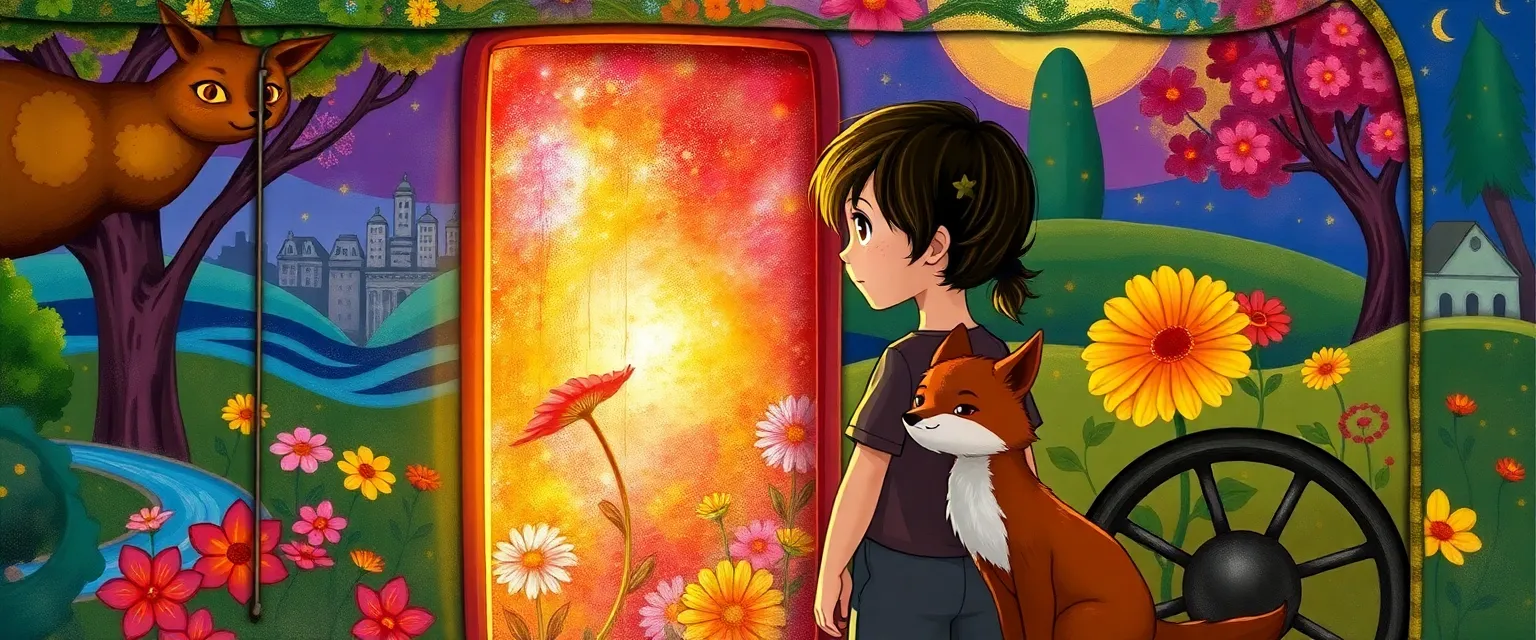
Felix was a fox with fur the color of autumn leaves and amber eyes that always sparkled with curiosity. He lived in a van painted with scenes from dozens of places — market squares, forests, riverbanks, and mountains. Each picture was a story, each brushstroke a memory of a town he had visited.
Felix prided himself on his cleverness. While others relied on strength or magic, he solved problems with his wits. People came to him when they lost keys, forgot their way, or sought an opportunity. He always found an answer. But one morning a girl approached his van with a request that changed everything.
Her name was Mira. She was ten years old, and her fingers were stained with paint. She stood in front of the painted van with a solemn face.
“I need your help,” she said. “I’m looking for my grandmother’s garden.”
Felix tilted his head. “Gardens don’t get lost, little one. Give me the address, and I’ll find it in a day.”
“You don’t understand,” Mira shook her head. “This garden… it disappeared when Grandma Iris died. I remember it in the smallest details — flowers that changed color with mood, a sundial that pointed to important moments instead of time. But I can’t find my way back.”
Felix felt an unfamiliar unease. He had never searched for something that existed only in memory. But something in Mira’s determination touched him.
“I’ve heard of the Painter,” he said slowly. “An old woman who travels between towns leaving special paints. They say her colors can capture not just images, but the feelings tied to places.”
Mira’s eyes lit up. “I’ve seen her! She gave me these paints.” She produced a small box of paints that shimmered with an odd inner light.
Felix knew the legends. If those paints were mixed with sincere emotion and used to paint a door on his van, it might open onto the painted place. But he had never tried it with a place that existed only in someone’s memory.
“You must paint the door yourself,” he said. “Mix the paints with what you feel. With your tears, your laughter, everything you remember about the garden.”
For three days Mira painted. She cried, remembering her grandmother, and her tears mixed with the blue used for forget-me-nots. She laughed as she recalled planting seeds together, and her laughter turned into golden sunflowers. She whispered the stories Iris had told her, and the words became green vines.
When the door was finished, it shone with every color of the rainbow.
“Ready?” Felix asked, placing his paw on the handle.
Mira nodded, but when the door opened, the garden beyond was blurred and unsteady. Flowers appeared and vanished. Paths shifted. Everything trembled like a reflection on water.
“Why won’t it hold?” Mira whispered.
Felix understood. “Your sorrow is too heavy. Memories are tangled with grief. The garden can’t stabilize until you separate them.”
“But how?” Mira’s voice trembled. “I miss her. Every time I think of the garden, I think of her being gone.”
Felix, who had always kept attachments at arm’s length, felt something unfamiliar in his chest. Fear. Not for himself, but for this brave girl.
“Listen to me,” he said softly. “Your grandmother built that garden from love. Every flower was a story. Each plant grew out of joy. If you enter carrying only sorrow, you will see only what you lost. But if you enter remembering the joy she gave you, the garden will come alive.”
“Isn’t that a betrayal?” Mira whispered. “To be happy when she isn’t here?”
“No,” Felix said, and for the first time in many years his voice trembled with feeling. “That’s what she would have wanted. She grew the garden to bring joy. Let it.”
Mira closed her eyes. She remembered her grandmother’s hands in the soil, her laughter when the flowers first changed color, the warmth of her embraces. She remembered not the loss, but the love.
When she opened her eyes, the garden steadied. Flowers bloomed in vivid shades — violet for gratitude, pink for tenderness, gold for hope. The sundial pointed to the moment Mira first planted a seed with her grandmother.
They stepped in together, fox and girl. Mira knelt and touched the earth. “I will take care of it,” she whispered. “I will come here and tell your flowers new stories, Grandma. I will remember you with joy.”
The flowers glowed brighter.
Felix watched, and something inside him changed. He had always traveled, never staying, never letting anyone matter. But by helping Mira he learned that true connection requires the courage to feel deeply, even when it hurts.
When they left the garden, the door remained on the van, shimmering and ready to open again whenever Mira needed it.
“Thank you,” Mira said, hugging Felix.
He did not pull away. For the first time in a long while he let someone be important.
“I’ll be here,” he said. “When you want to visit the garden again, you know where to find me.”
And though his van continued to travel dusty roads, Felix no longer felt alone. He had learned that some treasures are found not only by cleverness, but by the bravery to allow yourself to feel. And some doors open not onto lost places, but into the living memories we keep in our hearts.
News 24-01-2026
Felix and the Painted Door
Felix woke up late. The sun was already high above Blackberry Wood, and he had promised to meet Clover at the old oak at dawn. The red fox sprang up, shook his bushy tail, and raced along the path beside Truth Brook.
The brook babbled extra cheerfully that morning; its water was as clear as glass. Felix loved that stream, though he sometimes noticed the water growing cloudy. The old animals said the brook could sense lies, but Felix thought that was just a story.
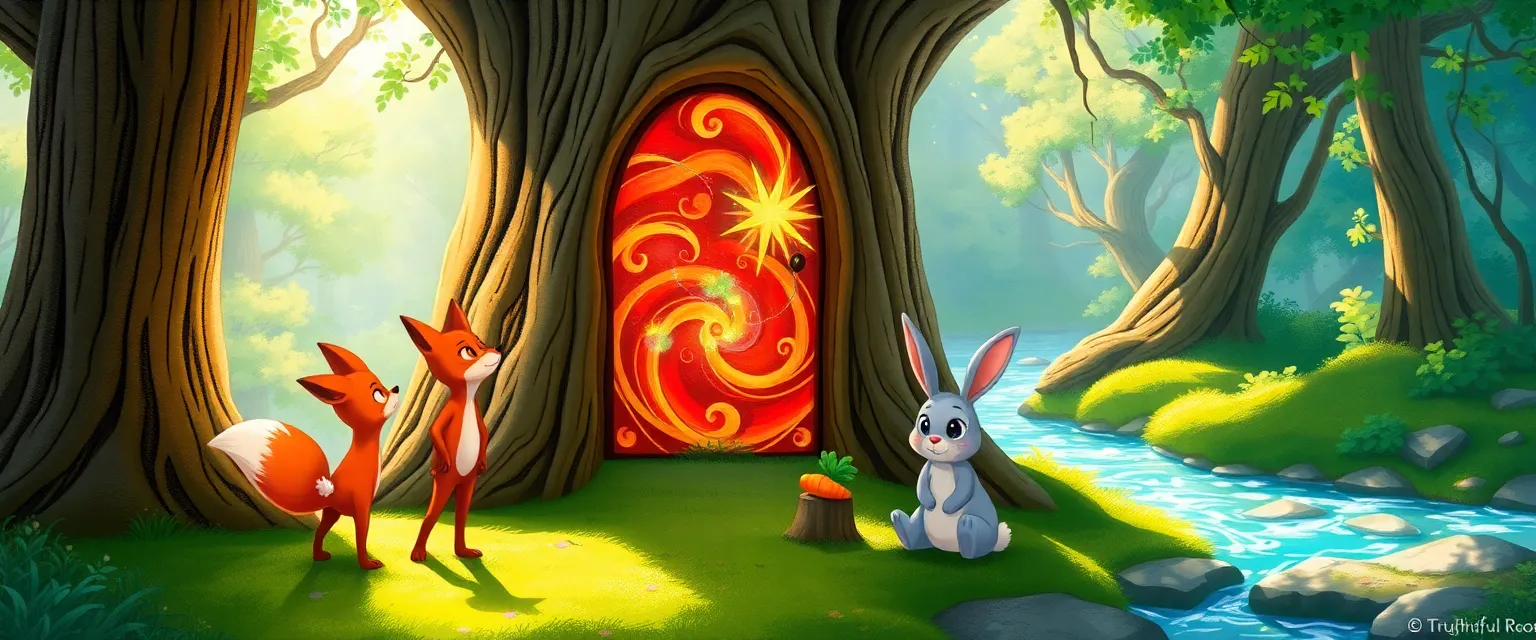
At the ancient oak, Clover was already waiting. The gray rabbit with long ears sat on a stump, chewing a carrot.
“Felix! You’re two hours late!” Clover cried. “What happened?”
Felix scratched behind his ear. Admitting he’d overslept felt awkward—yesterday he’d boasted he always rose with the first sunbeams.
“See,” the fox began, “I had to save a family of chipmunks from… from a giant eagle! I distracted it for an hour while they hid in their burrow.”
At that moment something strange happened. A door appeared on the oak’s bark. Not an ordinary door, but one painted in bright reds, golds, and emeralds. It shimmered and glowed, as if alive.
“Felix, look!” Clover jumped in surprise. “Where did it come from?”
Felix stepped closer. The door looked completely real, though he was sure it hadn’t been there a minute before. A small plaque hung on the knob: “Entrance for those who embellish the truth.”
“How curious!” Clover reached out a paw to touch the door.
“Don’t!” shouted Felix, but it was too late.
The door burst open, and a gust of wind sucked Clover inside. The rabbit didn’t even squeak—he vanished in an instant. The door slammed shut.
“Clover! Clover!” Felix ran to the door and grabbed the handle.
The door opened. Beyond it Felix did not find the usual forest but something unbelievable. Trees grew with their roots up toward the sky and their crowns hanging down into a bottomless blue. Flowers glowed in the twilight, though several suns shone overhead.
There was no choice. Felix stepped through.
The world flipped. The fox fell—was it down or up?—and landed on something soft. It was grass, but it grew from the sky. Everything here was upside down.
“Clover! Where are you?” Felix called.
“Felix!” came Clover’s voice from somewhere to the right. “I’m here, but I can’t move!”
Felix ran toward the voice and found his friend. Clover stood in the middle of a clearing, surrounded by a tall wall of mist.
“What is this?” Felix wondered.
“I don’t know! It appeared when I came here,” Clover replied. “I tried to walk through it, but it’s as solid as stone.”
Felix reached out to touch the mist. It was indeed firm. He walked around the wall—there was no opening anywhere.
“Welcome, travelers!” sang a melodious voice.
Perched on a branch of an upside-down tree was a magnificent bird—a peacock with a lavish tail. Its feathers shimmered in every color of the rainbow.
“I am the Keeper of Contradictions,” the bird introduced herself. “Welcome to the Kingdom of Opposites.”
“How do we free Clover?” Felix asked.
“That wall was born of your lie,” the Keeper explained. “Here, every untruth becomes an obstacle. The more you deceive, the harder your path.”
The peacock’s feathers suddenly dulled to gray.
“Are you inventing things again?” she asked sternly.
Felix flinched. He really had just thought about pretending he knew the way out.
“Sorry,” the fox mumbled. “How do we get out?”
“Only the truth opens the roads in my kingdom,” the Keeper said, and her feathers burst back into color. “Speak honestly, and the obstacles will vanish.”
Felix took a deep breath.
“All right. I lied to Clover. There was no eagle. I overslept because I stayed up late playing hide-and-seek with the squirrels, even though I promised myself I would go to bed early.”
Part of the mist wall melted, but not all of it.
“Keep going,” the Keeper encouraged.
“I often exaggerate my adventures to seem braver and more interesting,” Felix admitted. “But really I’m just a fox who sometimes fears the dark and isn’t always as clever as I’d like others to think.”
The wall dissolved completely. Clover dashed free and hugged his friend.
“Thank you for coming for me!”
“But how do we get home?” Felix asked the Keeper.
“The door will vanish at dawn,” she answered. “And here, dawn comes at midnight. You must reach the Door before the clock strikes twelve. The journey is not short.”
“Will we make it?” Clover fretted.
“If you are honest with each other and with those you meet,” the Keeper said. Her feathers flashed a dazzling gold. “Follow the path of white stones. It will lead you to the Door.”
The friends thanked the peacock and set off. The white-stone path wound between the upside-down trees. Soon they met a hedgehog with a cart full of sparkling crystals.
“Good day, travelers!” greeted the hedgehog. “I’m Thorn, trader of honest words. Would you like to trade for my wares?”
“What are the crystals?” Clover asked.
“They are honest words I have collected,” Thorn explained. “Every sincere confession, every truth turns into a precious gem. See—this ruby is someone’s apology. This emerald is an admission of a mistake.”
“Beautiful,” marveled Felix. “But we have nothing to trade.”
“Oh, you have something valuable,” the hedgehog smiled. “You just spoke the truth. You really have nothing. For that, I’ll give you a tip: ahead is a bridge over the River of Doubt. You may cross only by answering questions with absolute honesty. One lie, and the bridge will collapse.”
“Thank you!” the friends said and hurried on.
The River of Doubt was wide and rushing. A narrow rope bridge spanned it. As soon as Felix stepped onto the first plank, a voice rang out:
“Are you truly brave?”
Felix wanted to say “yes,” but he remembered confessing his fear of the dark.
“No—I’m not always,” he answered honestly. “Sometimes I’m afraid, but I try to overcome my fear.”
The bridge glowed, and the planks grew firmer. Felix took another step.
“Are you a good friend?” the bridge asked.
“I try to be,” Felix replied. “But sometimes I let those close to me down—like today, when I was late and lied to Clover.”
The bridge shone again. Felix reached the other side. Now it was Clover’s turn.
“Do you always tell the truth?” the bridge asked the rabbit.
“Yes, I try to be honest,” Clover answered.
“Even when it might hurt a friend?”
Clover paused.
“Sometimes I stay silent to avoid hurting someone,” he admitted. “But if a friend asks me directly, I will tell the truth, even if it’s hard.”
The bridge let him pass. The friends hugged on the far bank.
“Look!” Felix cried. “There—the Door is glowing among the trees!”
Indeed, the painted door shimmered in the distance. But a tall hedge maze blocked the way.
“How do we get through?” Clover fretted.
At the maze entrance hung a sign: “Every exaggeration adds a turn. Every honest thought shortens the way.”
“I see,” said Felix. “We must walk and think only truthful things.”
They entered. Felix went first and spoke aloud the honest things on his mind:
“I’m afraid we won’t make it. I worry about Clover. I regret lying this morning.”
With each truth the maze’s paths grew shorter and straighter. Clover spoke his own truths too:
“I’m glad Felix is my friend, even if he sometimes exaggerates. I know he came for me because he truly cares.”
Soon the maze vanished entirely and the friends stood before the Door.
“We made it!” Felix cheered.
The Keeper of Contradictions sat on a branch by the Door. Her feathers glowed pure gold.
“You have passed the test,” she said. “You have learned to value truth. You may return home.”
“Thank you,” Felix bowed. “I’ve learned a lot today.”
“Remember, little fox,” the Keeper said. “Truth can be uncomfortable, but lies always create bigger problems. True bravery is owning your mistakes, not inventing excuses.”
Felix nodded. He really understood it now.
The friends opened the Door and stepped through. The world flipped back, and they found themselves beside the old oak in Blackberry Wood. The painted door dissolved like morning mist.
The sun was only just rising—turns out time in the strange kingdom had flowed differently.
“Felix,” Clover said, “I’m glad you’re my friend. Even if you didn’t save chipmunks from an eagle.”
Felix laughed.
“I’m glad you’re my friend too—honest and true.”
They walked along Truth Brook toward home. The water was so clear that every pebble on the bottom showed. Felix smiled. From that day on he would try to keep the brook that clean.
Because the truth, even plain and ordinary, is always better than the prettiest lie.
News 23-01-2026
The Lighthouse Keeper’s Apprentice and the Tide of Tales
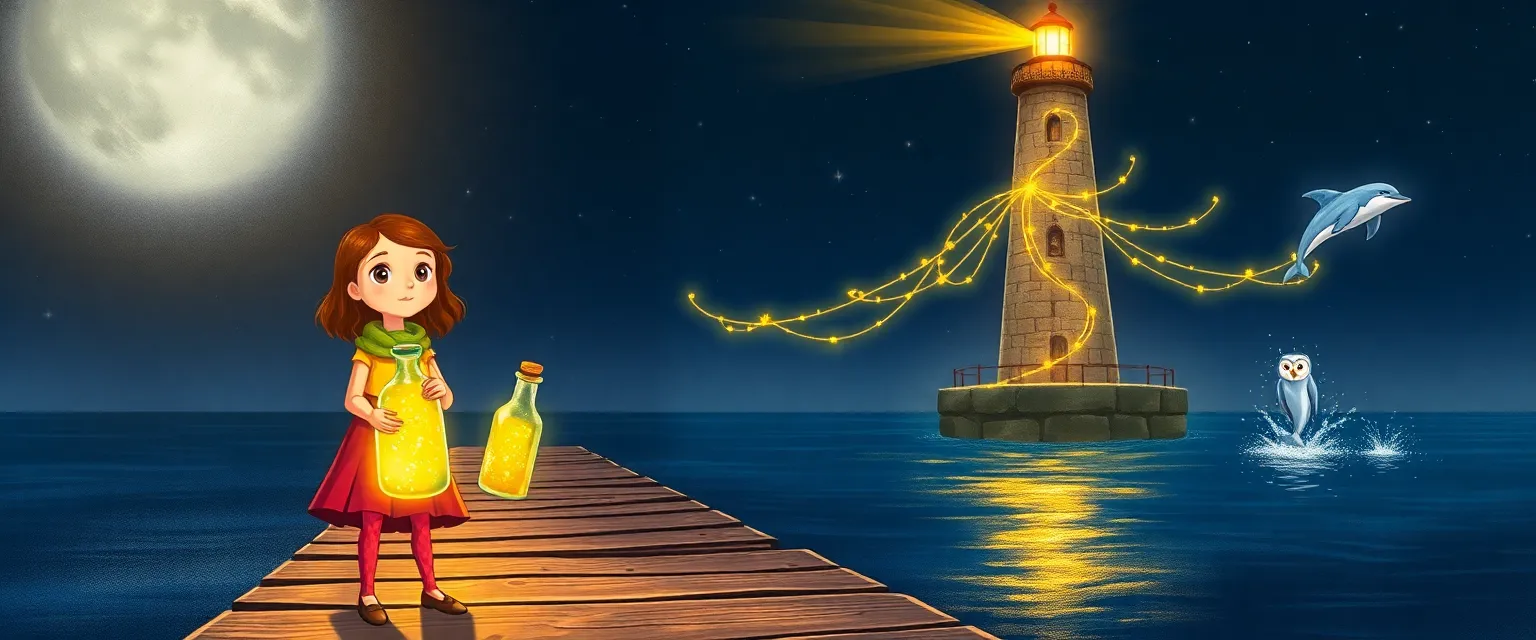
On a rocky island where two seas met stood a tall stone lighthouse. Each night its beam turned over the waves, guiding ships. But few knew that the light did more than illuminate the sea — it revealed something far more wondrous.
Marina lived in the fishing village on the shore. She was ten years old and loved stories more than anything. She remembered every tale, every detail, every word. One day, though, something strange happened in the village: grandparents began to forget the ends of their stories, and new tales stopped coming to the storytellers’ minds.
That was when Professor Gook arrived — a wise tawny owl with large amber eyes and feathers the color of old parchment.
“I need an apprentice,” he said in a low, gentle voice. “Someone who can listen and remember. The stories are in trouble, and only someone like that can help them.”
Marina agreed without hesitation. That night they flew together to the lighthouse. Inside, a round room was lined with shelves of bottles. In each bottle floated a golden glow.
“These are the stories,” Professor Gook explained, spreading his wings. “Every evening the sea brings books from all over the world. They arrive at our pier with the tide. My work is to gather them, pour them into bottles, and send them on so children everywhere can dream.”
Marina looked out the window. The wooden pier stretched toward the water, and indeed books in leather bindings bobbed on the waves, drifting toward the island like tiny ships.
But when they went down to the pier, Marina saw something was wrong. Pages in the books were scrambled. In a tale about a brave knight, characters from a story about moon rabbits would suddenly appear. Endings didn’t match beginnings. Some books were completely empty.
“That’s the trouble,” Professor Gook sighed. “The currents of the stories have become tangled. And I am too old to dive into the depths and find the cause.”
At that moment a dolphin with glinting scales leapt from the water.
“I’m Captain Ripple!” he announced cheerfully. “A messenger from the Underwater Library of Beginnings. The Tidespinner asks for help!”
“Who is the Tidespinner?” Marina asked.
“An ancient sea turtle,” answered Professor Gook. “She has swum the deep currents for centuries, gathering fragments of tales from distant lands and weaving them together. But she has grown old, and the threads are tangled.”
Marina looked from the lighthouse to the sea to the jumbled books. She knew she had to help.
“Teach me,” she begged. “What should I do?”
Professor Gook led her to the top of the lighthouse. When the beam flashed and began to turn, Marina gasped. In its glow she saw fine golden threads stretching over the water in all directions. They wove together in patterns, but many were knotted into tight tangles.
“These are the links between stories,” Professor Gook whispered. “Only in the lighthouse light can you see them. Now take this bottle.”
Marina took a small bottle with a flickering light inside. When she uncorked it, the golden glow wrapped around her and she suddenly found herself inside a story — in a forest where a lost princess searched for home. Marina felt that the tale needed hope, a warm light. She imagined the lighthouse beam cutting through the trees; the princess saw it and followed the light.
When Marina returned to the lighthouse room, the story in the bottle shone more brightly.
“You see,” Professor Gook smiled. “You can feel what each story needs.”
Captain Ripple guided Marina under the water. She could breathe in a bubble of sea foam the dolphin wove around her head. They dove deep, to where stood the Underwater Library — a majestic building of coral and pearl, glowing with a soft light.
In the center of the library, amidst swirling currents, floated an enormous old turtle. Her shell was covered in writing in every language of the world. Fragments of stories circled her — glowing words and images tangled into a chaotic ball.
“I am so tired,” the Tidespinner said slowly. “For centuries I have spun stories, sent them along the currents to those who need them. But now I cannot untie these knots. My flippers do not obey, my eyes no longer see the threads clearly.”
Marina swam closer. She remembered how Professor Gook had taught her to see the links between tales. She looked at the tangled threads and began to discern a pattern. Here, a tale of bravery must join a tale of friendship. There, a story from the far north answered a story about the stars.
Carefully, thread by thread, Marina began to undo the knots. She did not rush; she listened to each story, felt where it wanted to flow. Captain Ripple helped, darting around and holding freed threads while Marina worked on the next tangle.
Hours passed. At last the final knot loosened, and the stories flowed free, each along its own current — toward northern lands, southern isles, eastern mountains, and western woods.
The Tidespinner touched Marina’s hand with a grateful flipper.
“Thank you, child. But I cannot do this work alone anymore. I need an assistant.”
“I will help,” said Marina. “I will learn to read the currents. Professor Gook will teach me.”
When Marina returned to the lighthouse, dawn gilded the sea. Books arrived at the pier whole and right, full of completed tales. Professor Gook nodded approvingly.
“You have found your calling,” he said. “You will be a keeper of stories, as I am. You will watch the currents, help the Tidespinner, catch stories in bottles, and send them on.”
From that day Marina lived at the lighthouse. Each night she lit the lamp that revealed the golden threads between stories. She learned to dive into the depths and check the currents. She helped the old turtle untangle difficult knots when they appeared.
And in her village the tales began to sound again. Grandparents remembered their forgotten endings, and storytellers started to invent new stories. The currents flowed freely once more, carrying tales across seas and lands to all the children who loved to listen and dream.
Every evening, as Marina looked at the golden threads stretched over the water, she understood a simple truth: stories live only when they are cared for. They must be heard, remembered, and passed on. The most important work is not always to make something new, but to tend and restore what already exists, the threads that connect us across distance and time.
News 22-01-2026
The Watchmaker's Apprentice and the Garden of Borrowed Clocks
In a village where time flowed differently for everyone, there lived a ten-year-old girl named Irene Pendleton. She wore mismatched socks, collected curious pebbles, and asked questions nobody else even thought to ask. Irene was patient with puzzles but impatient with unfairness.
Her grandmother, Tickania Ivanova, was the village watchmaker. Her silver hair was braided and wound around her head like a crown of time. Grandmother spoke in riddles and hummed songs that made clocks run backward.
Their village was built in an unusual way. It spiraled outward, and in each ring time moved at a different pace. On the outer edges it dripped slow as honey, while at the center it rushed like a river. At the village’s heart stood an ancient clock tower.
One evening Irene noticed every clock in her grandmother’s workshop had stopped at exactly three thirty-three. The tower’s hands had frozen, too.
Tickania sighed. “It’s time I showed you a secret, my dear,” she said. “Beneath the tower there’s a door that appears only at dusk. Behind it is the Garden of Borrowed Clocks.”
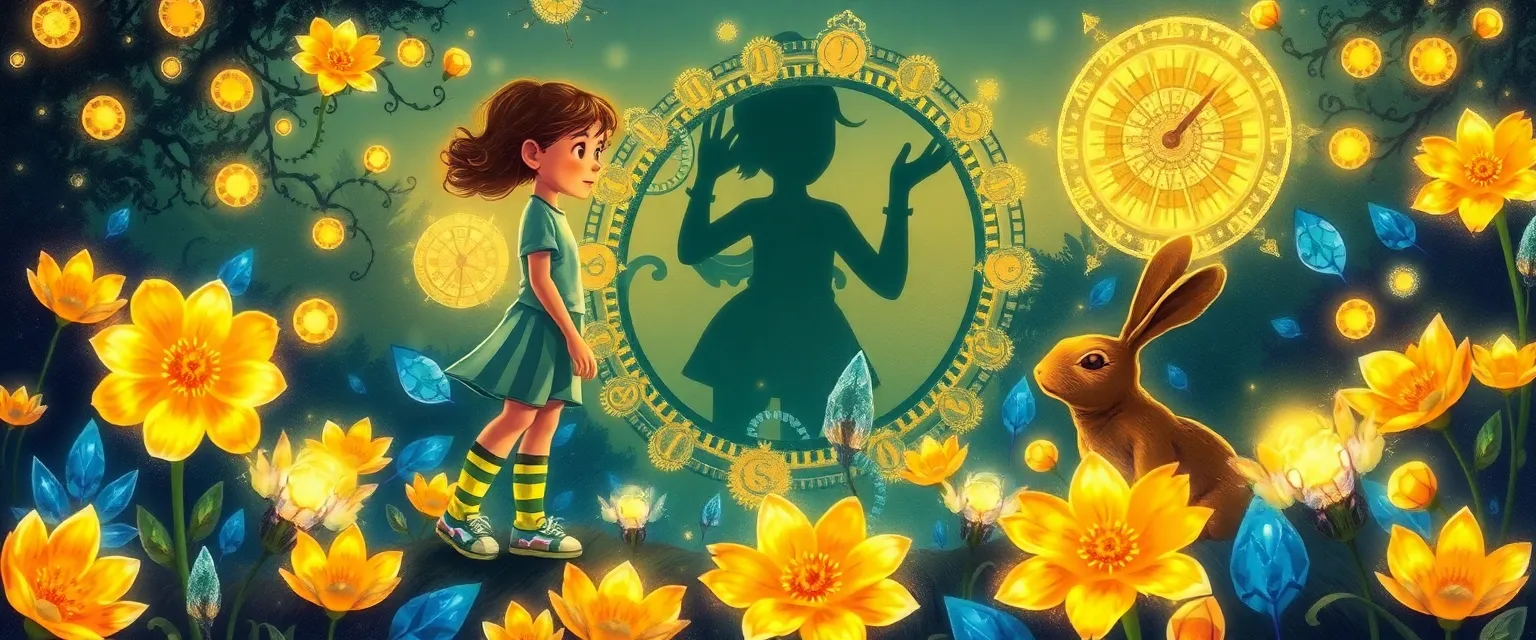
They went down to the tower, and sure enough, when the sun touched the horizon a small hatch opened in the stone wall. Beyond it lay an astonishing garden.
The flowers there were not ordinary. They glowed from within, like crystal. Blue petals held morning moments, golden ones held laughter, silver petals kept tears. Each blossom was someone’s memory.
A mechanical hare burst from behind a bush, made of brass gears and copper springs.
“I’m Tempo!” he introduced himself in a hurried voice. “We’re late! We’re late! The Minute Thief is stealing people’s happy memories!”
“Who is the Minute Thief?” Irene asked.
Grandmother explained, “It’s a creature made of frozen clock hands. It believes that by gathering all the joyful moments it can make a perfect day that never ends.”
Irene looked around and saw many flowers withering. With each wilted bloom, someone in the village lost a precious memory.
“How can I stop the Thief?” the girl asked.
“You must learn to weave time,” Tickania replied. “But remember: the strongest memories aren’t perfect. They’re woven from both joy and sorrow.”
Irene walked the garden’s paths. The walkways changed depending on her intentions. She sang the songs her grandmother had taught her, and the clocks around them began to run forward and backward.
At last, in the garden’s center, she found the Minute Thief. It was a shadow of frozen hands, surrounded by thousands of shimmering flowers.
“Why are you stealing these moments?” Irene asked.
“I want to make a day without sorrow, without end,” the Thief whispered. “A day of endless happiness.”
Irene looked at the flowers. She noticed the brightest ones had petals of different hues—gold and silver mixed together.
“But happiness can’t last forever,” she said gently. “It’s special because it passes. Look at these blooms. The most beautiful are the ones woven from both joy and sadness. A birthday is special because it happens once a year. A hug is precious because sooner or later you must let go.”
The Minute Thief froze. For the first time in a long while it hesitated.
Irene began to weave threads of time as her grandmother had shown her. She took golden and silver petals, morning and evening moments, and braided them together. Something new and beautiful took shape.
“If you let these moments go, they can return to people,” she said. “And new moments will grow. Isn’t it better to be part of living time than to be keeper of the frozen kind?”
The Minute Thief slowly unclenched its hands of clock hands. The flowers lifted into the air, turning into glowing butterflies that scattered across the village, returning memories to their people.
The tower’s hands began to move again. Time resumed its spiral through the village.
The Minute Thief started to change. Its sharp hands softened and it became like the wind that rustles the leaves, a reminder that each moment is precious precisely because it is unique.
Irene went back to her grandmother. Tempo hopped about, no longer fretting about being late.
“You understood the most important thing,” Tickania smiled. “Time is not something to trap or hoard. It is something to share.”
From then on Irene visited the Garden of Borrowed Clocks often. She tended the memory-flowers and learned the craft of watchmaking from her grandmother. Whenever someone in the village felt sad that a happy moment had passed, Irene would remind them: that is why it was so beautiful.
And in the garden new flowers kept growing—every day, every hour, every minute. For time does not end. It simply keeps blooming.
News 21-01-2026
The Architect Acorn and the Singing Meadow
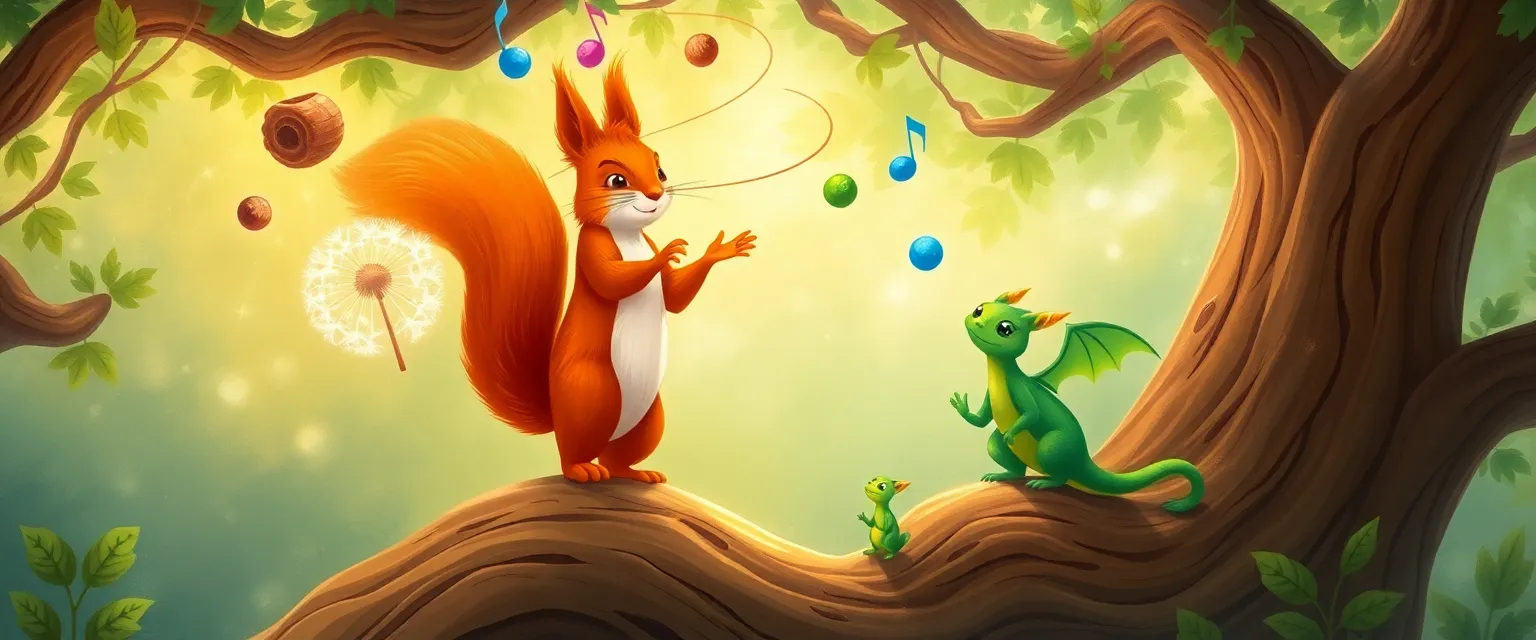
Maple sat on a branch of the ancient oak and scratched behind her ear with her copper paw. Something was wrong. The leaves whispered anxiously, and the bark under her claws felt drier than usual.
“Sparky!” she called. “Do you feel it?”
An emerald snout poked out of the hollow—the dragon the size of a cat. His amber eyes were full of worry.
“I feel it, Maple. The oak is dying. The songs are fading.”
Maple jumped down onto a thick limb. She loved a mystery, but this one frightened her.
“What songs?”
Sparky blew a puff of warm sparks that spun in the air, forming glowing threads.
“Look,” he whispered.
In the flickering light Maple saw four dim lines stretching from the oak’s roots toward different corners of the meadow. Once they had shone; now they barely glowed.
“These are the songs of the four corner seeds,” Sparky explained. “Earth, Air, Water, and Growth. They fed the oak for centuries, but now they’ve gone quiet.”
“Then we must find new seeds!” Maple was already ready to leap, but a wise voice stopped her.
“Patience, child.”
Granny Finch fluttered down onto the branch; her feathers were gray with age, but her eyes still sparkled.
“You won’t find the seeds until you learn to listen. Each seed will reveal itself only to one who learns its lesson.”
Maple nodded, though she was itching to act.
First she went to the eastern edge of the meadow, where the tall grasses grew. There she met the twin beetles Click and Clack, digging in the soil.
“Looking for the earth seed?” buzzed Click. “Go down. The roots know.”
Maple dove into a tunnel. In the dark she heard a low humming. Slowing down, she pressed her ear to the tunnel wall and listened. The roots whispered stories of patience, how they reach through the soil year after year. When Maple learned to tell their voices apart, a brown seed rose before her, humming a deep note.
The air seed hid atop a hill where the wind played with little bellflowers. Granny Finch taught Maple not to fight the wind but to move with it. When the squirrel spun in a dance, a dandelion-seed drifted down to her, singing a high, ringing note.
At the stream Maple found the water seed. It lay on the bottom, and Sparky helped bring it up with his sparks. But the seed stayed silent until Maple sat beside the water and listened to its babble. She understood that water rushes nowhere; it flows its own way. The seed began to sing a soft, flowing melody.
The growth seed was the trickiest. Clack led them to a tiny shoot between stones.
“That’s just a sprout!” Maple exclaimed.
“Growth is not size,” Granny Finch said. “It’s possibility.”
Maple carefully dug out the little sprout along with its seed. It sang of hope and the future.
Back at the oak, Maple felt puzzled. How could she make the seeds sing together? Sparky breathed sparks, and Maple watched the musical threads braid. Instinctively she began to swish her tail as if conducting.
The four seeds sang, their voices weaving into harmony. Earth hummed, air chimed, water babbled, and growth promised. Click and Clack helped plant the seeds in the four corners around the oak.
The oak shuddered. Its leaves rustled with joy, the bark darkened, filled with life. The glowing threads flared bright.
Sparky wrapped his tail around Maple.
“You learned to listen. Every voice matters.”
Maple smiled, listening to the meadow singing around her. She understood now: the biggest things begin by noticing the smallest wonders.
From that day on Maple became an architect of trees—the one who knows the language of nature and helps everything grow in harmony.
News 20-01-2026
The Coral Compass and the Singer of the Tides
Marina sat in her workshop on the edge of Pearl Haven, surrounded by pieces salvaged from old shipwrecks. Her unruly curly hair floated in the water current as she tightened the last bolt on her new invention. Her waterproof tool sat nearby, as always.
Beyond the transparent walls of the huge air bubble that protected the town, the ocean was behaving strangely. Currents tossed back and forth as if they had forgotten their ancient dance.
“Marina!” her father called from the next room. “The tides have shifted again. The crystalline tunnels to the Northern Dome are blocked. People can’t get home.”
Marina leaned out the window. The normally predictable flows of water had become chaotic. Glowing plankton darted in panic, throwing off uneasy flashes of light.
She grabbed her bag and went to see old Captain Rakovsky. If anyone knew the ocean’s old stories, it was him.
The captain lived in a vessel made from a giant nautilus shell. When Marina knocked, a hermit crab peered out, its antennae twitching in annoyance.
“I know why you’re here,” he grunted. “The tides. The Tidekeeper has fallen asleep. Without his song, the ocean loses its rhythm.”
“How do we wake him?” Marina asked.
“You need the Coral Compass. Only it will point the way to the Tidekeeper’s secret cave. But the compass only responds to the song of a sea dragon.”
The next morning Marina found Ripple at the bioluminescent kelp forest. The young sea dragon’s iridescent violet scales shimmered as he wove between glowing fronds, releasing intricate patterns of bubbles.
“You Ripple?” Marina asked. “Captain Rakovsky said you could help.”
The dragon nodded, but instead of speaking he sent out a stream of bubbles that formed the image of a musical note crossed out.
“You can’t sing?” Marina frowned. “Then how will we activate the compass?”
Ripple lowered his head; his scales dulled.
Marina thought for a moment. “Wait. Your bubbles… they’re like a language, right? Maybe there’s another way.”
Together they swam to the Twilight Trenches, where Captain Rakovsky had said the Coral Compass was hidden. The depths were cold and dark, but Marina pulled her self-made glowing lantern from her bag.
In a crevice between the rocks they found it — living coral that constantly grew and shifted, flashing every color of the rainbow.
Marina carefully lifted the compass. It was warm and pulsed like a heart. But its needle did not move.
“Try,” she said to Ripple.
The dragon approached and tried to sing, but no sound came from his throat. He recoiled, expelling a flurry of fretful bubbles from his nostrils.
Marina watched the bubble patterns dancing in the water. They were beautiful — complex, rhythmic, almost like… music.
“Ripple! Your bubbles! They make a visual melody! Aim them at the compass!”
The dragon hesitated, then sent a stream of bubbles across the coral. At first nothing happened. Then he closed his eyes and imagined the song he once could sing, releasing the bubbles in time with that imagined tune.
The compass flared with bright light. Its needle spun and pointed downward, to the deepest waters.
They followed the compass for hours through murky depths until they reached the Singing Caves. Here sound behaved impossibly — echoes arrived before the sound, and silence itself seemed to have a melody.
In the central cave they found the Tidekeeper — a being of living water, sleeping inside a gigantic shell.
“How do we wake him?” Marina whispered.
Ripple swam closer. This time he didn’t just shape patterns; he poured into each bubble all the grief for his lost voice, all the hope of saving his home, and all the gratitude he felt for his new friend.
Bubbles filled the cavern, and in the strange acoustics they began to sound. Each bubble released a soft note as it popped. Together they formed a song — new, different, but true.
The Tidekeeper opened eyes as deep as the ocean. He smiled and sang back. His voice braided with Ripple’s bubble-song, creating a harmony the ocean had never heard before.
The waters around them returned to their ancient rhythm. The tides resumed their natural dance.
When Marina and Ripple came back to Pearl Haven, the currents were calm and predictable again. The crystalline tunnels reopened, and families were reunited.
Captain Rakovsky clapped Marina on the shoulder with his claw. “Well done, inventor. And you too, dragon. It turns out a song can be many things.”
Ripple blew a stream of rainbow bubbles that formed the image of two friends swimming side by side.
Marina smiled. She had learned that true communication comes from the heart. And sometimes the strangest voices sing the most beautiful songs.

News 19-01-2026
Timmy and the Garden of Courage Stones
Once upon a time in a quiet village there lived a little turtle named Timmy. He was kind and observant, noticing things others missed, but he was very shy. If anyone came close, Timmy would tuck himself back into his shell.
In the center of the village stood the magical Stones of Courage. They protected the villagers from storms and bad weather, glowing warmly whenever someone nearby did something truly brave. But one morning Timmy noticed something no one else had seen: the Stones were dim. Their light had grown weak and cold.
A bright little robin named Rosie fluttered down to Timmy.
“Timmy, what’s wrong?” she asked, always ready for an adventure.
“The Stones… they’re losing their strength,” Timmy whispered. “We have to do something.”
They went to the Stone Keeper — a wise old salamander who lived by the first Stone of Courage.
“The Stones are fading because everyone has forgotten what true courage means,” the Keeper said. “To restore their power, someone must travel through seven gardens and collect one seed from each. But the seeds will grow only for someone who understands the real lesson of each garden.”
Timmy was frightened. Him? So timid?
“I… I’ll try,” he said quietly, and the nearby Stone gave a faint, hopeful shimmer.
The first was the Garden of Small Beginnings, where tiny flowers grew. Timmy was afraid of stepping on them.
“Just take one small step,” the flowers whispered.
Timmy tiptoed forward carefully, doing his best not to hurt a single plant. At the end of the garden he found a seed that hopped into his little foot. The first lesson: courage begins with small steps.
In the Garden of Helping Paws vegetables grew, and an old hedgehog gardener was digging in the beds.
“I’m so tired,” he sighed. “The harvest is so big.”
Rosie wanted to gather everything at once, but Timmy softly said, “Let me help. A little at a time, together.”
They worked until evening, and when the last carrot was pulled, the Gardener gave Timmy the second seed. Courage is helping others, even when you’re tired.
The Garden of Truthful Words was full of plants that changed color. When Rosie said she wasn’t tired at all, the leaves turned gray. When Timmy admitted, “I’m scared to go on, but I won’t stop,” the plants shone golden.
The third seed fell at his feet. Courage is speaking the truth, even when it’s hard.
In the Garden of New Friends there was a maze. Timmy met a nervous little mouse there.
“I’m lost,” she squeaked.
“I’m afraid too,” Timmy said. “But together we’ll find the way out.”
They moved slowly through the maze, supporting each other. When they reached the exit, Timmy received the fourth seed. Courage is asking for help and helping those who are smaller or weaker.
The Garden of Mistakes was full of wilted plants. Timmy accidentally stepped on a tender sprout.
“Oh! I’m so sorry!” he cried, and gently watered the plant.
It revived and bloomed. The fifth seed appeared among the petals. Courage is admitting your mistakes and making them right.
In the Garden of Tall Plants sunflowers reached toward the sky. Rosie flew high, but Timmy couldn’t fly.
“I’m just a little turtle,” he said. “But I will be myself.”
He slowly crawled forward, not pretending to be someone else. The sunflowers bowed to him, and one dropped the sixth seed into his path. Courage is staying true to yourself.
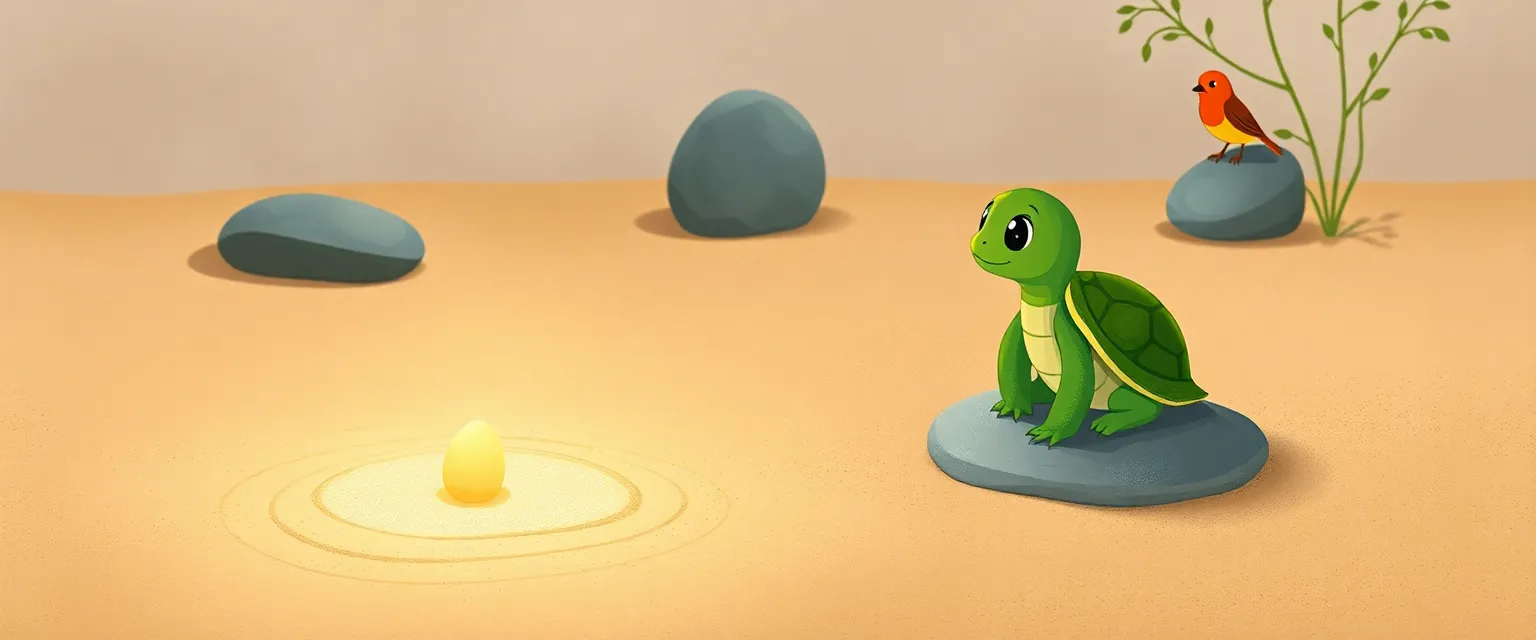
The last was the Garden of Inner Silence — a zen garden of sand and stones. It was so calm there that Timmy could hear his own heartbeat.
“You are afraid,” the wind whispered. “But you still came.”
“Yes,” Timmy replied. “Being brave doesn’t mean not being afraid. It means doing what’s right even when you are scared.”
The seventh seed appeared before him. Courage lives inside, even when everything outside seems frightening.
Timmy and Rosie returned to the Keeper. The little turtle planted all seven seeds around the Stone. They sprang up at once into beautiful plants, and the Stones of Courage burst into a warm, bright light.
“You understood,” the Keeper smiled. “Courage comes in many forms: helping others, telling the truth, admitting mistakes, being yourself. And you, little Timmy, showed them all.”
From then on Timmy still sometimes hid in his shell when he was scared. But now he knew: that didn’t make him a coward. True courage is doing the right and kind thing, even when your heart is pounding with fear. And the Stones of Courage shone brighter than ever, reminding everyone in the village of that important truth.
News 18-01-2026
Melody and the Symphony of the Seasons
Deep in the Enchanted Forest lived a rabbit named Melody. She owned a silver flute that sparkled in the sun like the first morning dew. Melody played so beautifully that birds would pause on branches to listen. But Melody had a secret: she believed she had to do everything herself to prove how wonderful she was.
One morning Melody woke to something very strange. On one side of her burrow snow was falling, while on the other side summer flowers were in bloom! Autumn leaves and spring butterflies were fluttering together in the sky.
“What’s happening?” Melody wondered, peeking out of her hollow.
She set off to see Maestro Oak — an ancient tree-conductor who knew all the forest’s secrets. But when she reached the clearing, the old oak slept a deep sleep. Strange words glowed on its bark: “When four songs sound in harmony, the seasons will flow again like rivers.”
“Four songs?” Melody whispered. “I’ll find them all!”
She took her flute and started her journey. First she came to the Spring Meadow of Ringing Bluebells. These flowers usually chimed like tiny bells, but now they were frozen and silent.
In the center of the meadow Melody found a turtle with a drum on his shell.
“Hello! I’m Tempo,” the turtle said slowly. “I’m looking for the Spring Song. Are you, too?”
“Yes,” Melody answered. “But I can do it on my own, thanks.”
Tempo smiled.
“Look at these flowers. Do you see the pattern of notes on their petals? I think we need flute and drum together.”
Melody frowned. She didn’t want to share her adventure. But Tempo was right — the frozen petals glowed with two kinds of musical notes: some for flute, some for drum.
“All right,” Melody sighed. “Let’s try together.”
When Melody played her flute and Tempo gently, steadily beat his drum, a miracle happened! Colored sparks flew from their instruments — blue from the flute and green from the drum. They wove through the air and the ice on the flowers melted. The bells rang, and the Spring Song appeared before them as a glowing musical trail.
“Hooray!” Tempo cheered. “We found the first song!”
They went on together to the Summer Grove of Singing Streams. Here the waterfalls usually hummed melodies, but now all the water had frozen.
A sad bird — a nightingale named Aria — sat by the frozen falls.
“I used to sing,” she whispered. “But once I forgot the words in front of everyone in the forest. I’ve been too afraid to sing since.”
Melody was about to say, “Don’t worry, we can manage without you.” Then she remembered how wonderful it had felt to play with Tempo.
“Maybe if we play, you’ll remember how to sing,” Melody suggested. “Don’t be afraid of making mistakes. We’re all learning.”
Aria nodded timidly. Melody played her flute, Tempo tapped his drum, and suddenly one note burst from Aria’s throat. Then another. And another! Her voice rang so beautifully that the ice on the waterfall began to melt. Water flowed, it sang, and the Summer Song appeared as rainbow droplets.
“I’m singing! I’m singing again!” Aria trilled joyfully and joined her new friends.
The three of them reached the Autumn Garden of Rustling Leaves. There the trees usually made rhythms with their leaves, but now every leaf lay still, dusted with summer’s dry breath.
“Look!” Tempo pointed to a great oak. “On its trunk is written: ‘Three voices are good, but a fourth will complete the symphony.’”
They looked around but saw no one. So Melody, Tempo, and Aria began to play together. Their music was so beautiful! The flute sang high notes, the drum set the beat, and Aria’s voice tied it all together.
Leaves on the trees rustled, rose into the air, and spun in a dance. The Autumn Song appeared as golden leaves that arranged themselves into a melody.
Finally the friends climbed to the Winter Peak of Crystal Chimes. There the icicles usually rang like glass bells, but now they had melted in the heat.
At the very top hung one large icicle. When the friends drew near, they heard a faint voice:
“I am the last Winter Icicle. I keep the fourth song, but I’m afraid I’ll melt.”
“We’ll help you!” Melody said. “If we play our three songs together, maybe the cold will return?”
The friends formed a circle. Melody played the Spring Song on her flute — blue sparks flew. Tempo beat the Summer Song on his drum — red sparks burst out. Aria sang the Autumn Song — golden sparks whirled around them.
The three melodies braided in the air, and magic happened! A chilly breeze gathered around the Winter Icicle. It gleamed more brightly and chimed the final, fourth melody. Silver sparks joined the others, and the four colors began to dance together, weaving wondrous patterns.
“We did it!” the friends cried.
The four songs, like four colorful ribbons, flew across the forest back to Maestro Oak. When they reached the ancient tree, it opened its eyes.
“Oh, how lovely!” Maestro Oak said in his deep voice. “The Symphony of the Seasons sounds again!”
He lifted his branch-arms and the four songs began to play as one. A wave of music rolled through the forest. Spring flowers bloomed where they should. Summer sunshine brightened its grove. Autumn leaves rustled in their garden. On the Winter Peak new icicles grew and rang merrily.
“Melody,” Maestro Oak said, “you found the four songs. But most of all you learned that real magic is born when different voices sound together.”
Melody looked at her new friends and smiled.
“I used to think I had to do everything alone to be a true musician. Now I know: together we make music far more beautiful than I could ever play by myself.”
“Like instruments in an orchestra!” Tempo added.
“Every one is important,” Aria sang.
From that day on Melody, Tempo, and Aria became best friends. They traveled the Enchanted Forest, playing music for anyone who wanted to listen. And the seasons began to change smoothly and on time, because the Symphony of the Seasons played in harmony once more.
And every time Melody played her silver flute, she remembered: the most beautiful music comes when we don’t play alone but with friends. In a real orchestra every instrument matters, and only together do they create a magical symphony.
News 17-01-2026
The Cartographer's Apprentice and the Unfinished Map
Ten-year-old Mira sat in her grandmother’s attic, surrounded by dusty trunks and old books. In her hands she held Grandma Vera’s last map — a large parchment that smelled of lavender and adventure. But something was wrong. The lines on the map were slowly fading, as if an invisible hand were erasing them.
“Grandma always said maps are alive,” Mira whispered, tracing a disappearing outline of a forest with her finger. “I thought she was joking.”
She pulled on Grandma’s worn traveling boots — they were too big, but they felt a little magical. Then she opened a strange compass, its needle spinning the wrong way. The moment Mira flipped it open, the needle sprang to life and became a tiny glowing figure.
“Finally!” the figure cried in a clear, chiming voice. “I am the Compass Rose, and I have waited centuries for a new cartographer. Your grandmother promised you would come.”
“Me?” Mira glanced at the map, uncertain. “But I don’t know how to draw maps. I even got lost at school last week.”
“Getting lost is the beginning of every discovery,” the Compass Rose said mysteriously. “Look! The map is fading because it is unfinished. Your grandmother left you her final lesson.”
Mira studied the map. Indeed, some places were only half-drawn. In the corner she found her grandmother’s handwriting: “Dear Mira, some places exist only when we are brave enough to imagine them. Finish what I began. With love, Grandma Vera.”
Suddenly the map glowed, and Mira felt the floor vanish beneath her. She fell and fell… and landed on soft grass.
She found herself in a peculiar forest. The trees were sketched in pencil — thin gray lines instead of solid trunks. When Mira touched one, it smudged a little.
“This is the Forest of Sketches,” the Compass Rose explained, circling above Mira’s head. “Everything here hasn’t decided what it wants to be yet. Ask a question!”
“A question?” Mira looked around. “What kind of question?”
“A true question. One you really want the answer to.”
Mira thought. Then she asked, “Why did Grandma love this place?”
At once the trees sharpened. Leaves appeared, and a path formed between the trunks. Mira followed it and found a little cottage. On the door was a note in her grandmother’s handwriting: “Here I first understood that maps are more than lines. They are stories.”
Mira smiled and took Grandma’s tools from her pocket: a ruler, a protractor, and a vial of ink. But when she tried simply to trace the fading lines on the map, they faded even faster.
“No, no!” cried the Compass Rose. “You don’t understand! You can’t just copy. You must understand!”
From between the trees came a strange figure made of moving cartographic symbols — arrows, dots, and flourishes. It was the Keeper of Ink.
“Who dares enter drawn worlds?” his voice rustled like old charts. “Do you know the rules? You may only draw what is true.”
“I want to finish my grandmother’s map,” Mira said, trying to sound brave though her knees trembled.
“Then you must go further. Through the Paper Mountains to the City of Legends. Only there will you learn Vera’s final lesson.”
Mira kept going. She crossed mountains that folded and unfolded, changing their peaks. She crossed a river of ink that flowed upward toward the sky. Each time she asked a true question about a place — “Why does this matter?” “What did Grandma feel here?” — the map grew a little clearer.
At last she reached the City of Legends. The street signs didn’t point directions but feelings: “To Joy — three steps,” “To Courage — turn right,” “To Love — follow your heart.”
In the center of the city Mira found her grandmother’s last note tucked into a fold of the map: “Dear Mira, the most important places on a map are not cities or mountains. They are the ties between people. Friendship that links distant homes. Love that makes a place a home. Memories that make an ordinary place sacred. Use my tools wisely.”
Mira looked at the tools. The ruler was labeled: “Measures friendship, not distance.” The protractor: “Calculates angles of courage.” The ink: “Draws only truth.”
She understood. Grandma hadn’t wanted her simply to copy lines. She wanted Mira to add her own discoveries, her own stories to the map.
Mira held the ruler and measured an invisible line between Grandma’s house and the spot where they used to drink tea every Sunday. A golden line appeared on the map. She used the protractor to mark the angle of courage — the moment Grandma taught her not to fear getting lost. She dipped the pen into ink made from pressed petals and drew a new place on the map: the Garden of Memories, where every flower her grandmother loved grew.
The map brightened. All the fading lines snapped into clarity. But now the map held more than Grandma had drawn. It held Mira’s stories too.
“You understand,” the Compass Rose whispered. “Maps live when each new generation adds its discoveries.”
The Keeper of Ink reappeared, and this time his symbols arranged into a smile. “You passed the test. The map is finished, but not finished. It will grow with you.”
Mira returned to the attic, map in hand. She now knew Grandma would not vanish as long as Mira remembered their stories and made new ones. Every place they loved together would stay on the map forever. And when Mira grew up she would add her own places, her own stories.
She hung the map on the wall and smiled. In the corner, in her grandmother’s handwriting, new words appeared: “I always knew you would find your way. Keep exploring, my brave cartographer. With love, Grandma Vera.”
Mira put on Grandma’s traveling boots. They were still a bit big, but that no longer mattered. She knew she would grow into them. For now she had a whole map of places to discover and a lifetime of stories to chart.
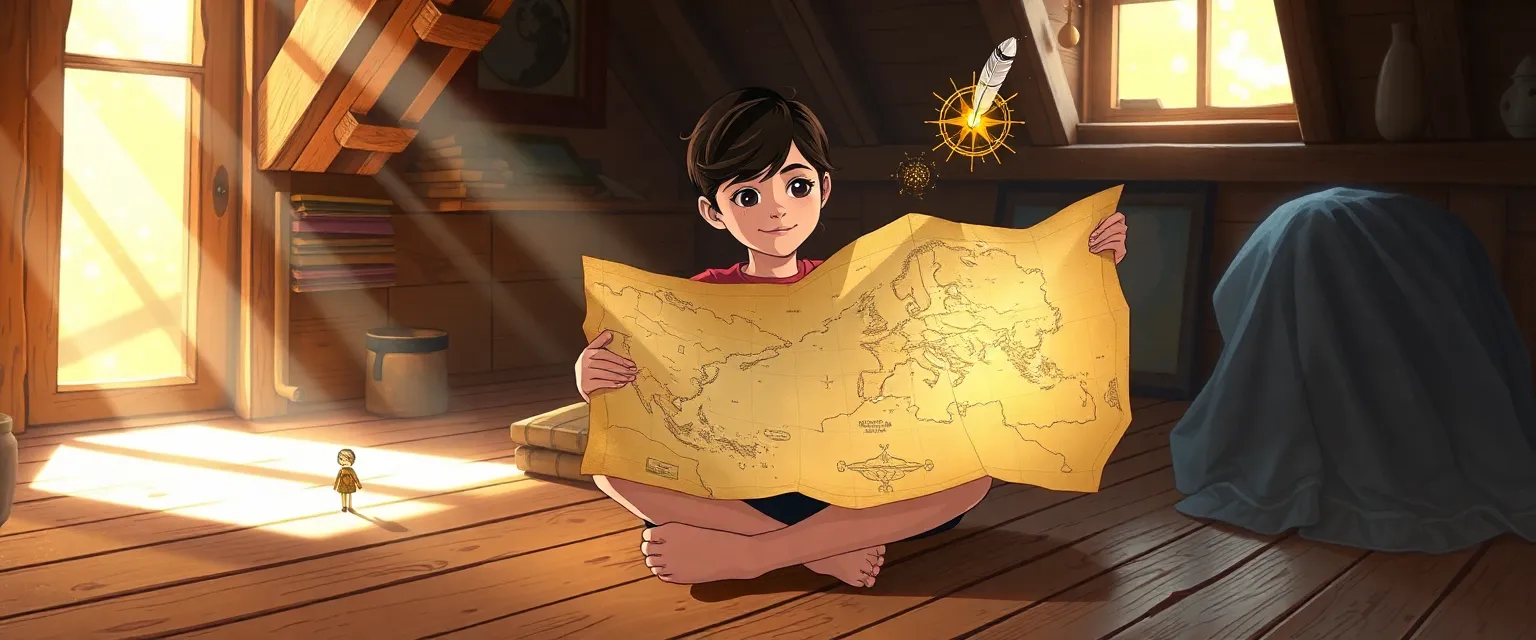
News 16-01-2026
Luna and the Castle of Ever-Changing Colors
Ten-year-old Luna stood in the middle of her yard, staring at the castle she’d built from toy blocks. She had been working on it all summer, and now it towered above the roof of the house, glinting with every color of the rainbow. But today something was wrong. The red towers that had blazed yesterday had gone pale, as if they’d been washed out by the sun.
“What’s happening?” Luna whispered, touching a gray block that had been crimson just yesterday.
Suddenly a tiny spark flickered between the blocks. A little multicolored person, no bigger than her finger, jumped out of a crack.
“I’m Spectrum, guardian of colors,” he sang in a lilting voice. “Your castle is sick; the colors are fading. Your emotions are storming—your blocks are suffering.”
Luna frowned. It was true: lately she’d been angry at her little brother, sad because her friend had moved to another town, and excited about new books. Her feelings were bouncing around like a pinball.
“How can I help the castle?” she asked.
“Walk through every wing,” Spectrum answered. “In each room you’ll face a challenge. Learn balance and bring the colors back. But hurry! The Gray Keeper is stealing the last hues.”
Luna stepped inside the castle and gasped. From the outside it had looked ordinary, but inside the corridors stretched on forever. She headed toward the Red Tower.
It was hot in the tower. The red blocks pulsed like a heartbeat. At the top she found a huge dragon built from bricks.
“You are angry with your brother,” the dragon growled. “Your rage feeds me, but it also tears this tower apart!”
Luna clenched her fists, then remembered how her brother had accidentally ruined one of her drawings. He hadn’t meant to. She took a deep breath.
“I was angry, but it passed,” she said calmly. “Anger can protect what matters, but not over small things.”
The dragon shrank, turning into a little red lizard that curled quietly on her palm. The red blocks shone a healthy scarlet once more.
In the Blue Chambers everything was the opposite—quiet and cool. Luna saw her reflection in a mirror made of sky-blue blocks. The reflection was crying.
“Your friend left,” it whispered. “You are so sad that the blue blocks are drowning in your tears.”
Luna felt a lump in her throat but didn’t hold back the tears. She cried, remembering the funny times with her friend.
“Sadness is okay,” she told her reflection. “But it doesn’t mean the friendship is over. We’ll write letters and call each other.”
The mirror cleared, and the blue blocks glowed the color of a calm sky.
In the Yellow Gardens Luna ran among flowers made from sunny yellow blocks, laughing. A whirlwind of joy spun around her so fast the blocks started to scatter.
“Your joy is wonderful,” the vortex sang. “But even happiness must be held!”
Luna understood: when she was too excited she couldn’t focus on homework or help her mom. She slowed her breathing, imagining gathering her joy into a warm ball in her chest. The whirlwind calmed and became a golden butterfly.
In the Violet Library, among shelves built of lilac blocks, Luna met the Gray Keeper. He was tall and sorrowful, made of faded blocks.
“I was protecting the castle,” he said in a hollow voice. “Your emotions were too strong. I took the colors so the blocks wouldn’t be destroyed by their power.”
“But without colors the castle dies!” Luna cried.
“Without emotions there is no pain,” the Keeper replied.
Luna stepped closer and took his gray hand.
“Emotions are not enemies. They make the castle alive. I’ve learned balance. Anger gives courage, sadness brings understanding, joy gives energy. Together they make something beautiful.”
She joined a red, a blue, and a yellow block. They sparked and created a new, shimmering shade. The Gray Keeper slowly began to color. His blocks filled with a soft silvery light—the color of wisdom and acceptance.
“You’re right,” he whispered, smiling for the first time. “I was an emotion too—fear. But now I can be more.”
The castle burst into every color of the rainbow. The blocks no longer dulled; they shimmered with the rhythm of Luna’s breath—steady and calm.
Spectrum appeared beside her, clapping his tiny hands.
“You found the secret,” he sang. “Feelings are power when you are their keeper!”
Luna stepped out into the yard. The castle shone again, alive and beautiful. She now knew: her emotions were not enemies but friends. The important thing was to listen to them, understand them, and find balance. After all, the whole spectrum of feelings is what makes life truly bright.

News 15-01-2026
The Reef Warden of the Coral Kingdom
Marina pressed her ear to the wall of her new bedroom and listened. In the underwater city of Aquamarine Heights everything sounded different — neighbors’ voices chimed like bells, and the currents hummed lullabies. The ten-year-old girl had moved here only a month ago and hadn’t made any friends yet. Instead, she had learned to hear what others missed.
This morning the ocean sounded worried.
Marina slipped out of her home and swam to the edge of the city, where the great coral reef began. What she saw made her heart tighten. The brilliant corals that had shimmered in every color of the rainbow yesterday were turning gray and hard as stone.
“They’re dying,” she whispered, touching the cold surface.
“I know,” came a thin voice behind her.
Marina turned and saw a small dragon with iridescent scales. From his mouth came not tongues of flame but glimmering bubbles.
“My name is Spark,” the dragon introduced himself, bowing his head a little shyly. “I know, I know — odd name for a dragon who can’t breathe fire.”
“I’m Marina. And I think your bubbles are beautiful,” the girl said earnestly. “Do you know what’s happening to the reef?”
Spark blew a large bubble; inside it swirled images — mermaids telling stories to coral, songs echoing through the water, laughter and joy.
“My grandfather used to say the sea folk fed the reef with stories,” Spark explained. “But everyone forgot that promise. Now the reef is starving.”
At that moment a massive turtle drifted past them, its shell scored with strange markings.
“Captain Muriel!” Spark called. “Tell them!”
The old turtle halted, and her wise eyes examined the unlikely pair closely.
“Long ago I captained the Storyship,” Muriel began. “We gathered tales from across the ocean and shared them with the reef. But the ship is gone and the songs forgotten. There is only one way to save the kingdom — find the three ancient singing conches and wake the Reef Warden.”
“Where are the conches?” Marina asked.
“The first is hidden in the Whispering Trenches, where sounds live their own lives. The second is in the Garden of Lost Things. The third… the third is guarded by the ocean itself, in the deepest place,” Captain Muriel frowned. “The journey is dangerous.”
“We can do it,” Marina said firmly, and Spark nodded, blowing a determined bubble.
The Whispering Trenches welcomed them with darkness and strange echoes. Every sound was repeated a hundred times, warped and turned into something frightening.
“How will we find a conch in all this noise?” Spark murmured.
Marina closed her eyes and remembered what she had learned in a month in her new home — how to truly listen. Through the chaos she caught a faint melody, ancient and sad. She swam toward that call, and soon her fingers found a smooth shell tucked into a crevice.
When she held it to her ear the conch sang. The water around them shimmered with golden waves.
In the Garden of Lost Things odd items from the surface — rusty anchors, broken bottles, misplaced toys — lay piled into mazes.
“The second conch is somewhere here,” Spark said. “But how do we find it among all this junk?”
Marina looked around and noticed some items giving off a faint glow. She swam to an old music box and carefully opened it. Inside, wrapped in seaweed, rested the second conch. When Marina took it out the box began to play a forgotten tune, and the conch picked up the song.
Spark released a bubble that caught the music and carried it up toward the city so everyone could hear.
Getting the third conch was the hardest. They descended deeper and deeper, to where even light feared to go. Marina felt the press of the water on her and a cold that reached into her bones.
“Should we go back?” Spark squeaked uncertainly.
“No,” Marina said, taking the dragon’s paw. “We need each other. You need me, and I need you. Together we’re stronger.”
Those words, spoken from the heart, made a bright wave in the water. In reply a column of light rose from the deep. The ocean itself handed them the third conch — the largest and most beautiful of the three.
When they returned to the failing reef the whole community had gathered. Captain Muriel waited with hope in her eyes.
“Play,” she whispered. “Play, and remember why you’re doing this.”
Marina, Spark and Muriel lifted the conches. When they sounded together the three melodies braided into one incredible symphony. The water around them burst into color — golden, emerald, sapphire waves.
From the reef’s very heart rose a figure woven of living coral. The Reef Warden woke after centuries of sleep. His voice was like surf and shell-whisper rolled into one:
“You remembered. You have returned power to the stories.”
The gray stone began to crack, and bright new coral shoots pushed through the fissures. The reef came back to life, more beautiful than before.
“Promise,” the Warden told everyone gathered. “Promise you will not forget again. Tell the reef your stories. Share your songs. Remember those who came before you, and care for those who will come after.”
“We promise!” the residents of Aquamarine Heights replied in unison.
From that day on Marina never felt like an outsider. Each evening the city gathered by the reef to tell stories. Spark became a hero, and his magic bubbles learned to carry tales to the farthest corners of the ocean. Captain Muriel rebuilt the Storyship, and anyone who wished could sail on it.
Marina understood that her gift of listening was not the weakness of a lonely girl but her greatest gift. Sometimes the most important thing is simply to hear what the world is telling you.
And every night, as the city slept, the reef sang a quiet song of thanks to those who remembered, to those who listened, and to those brave enough to be different.
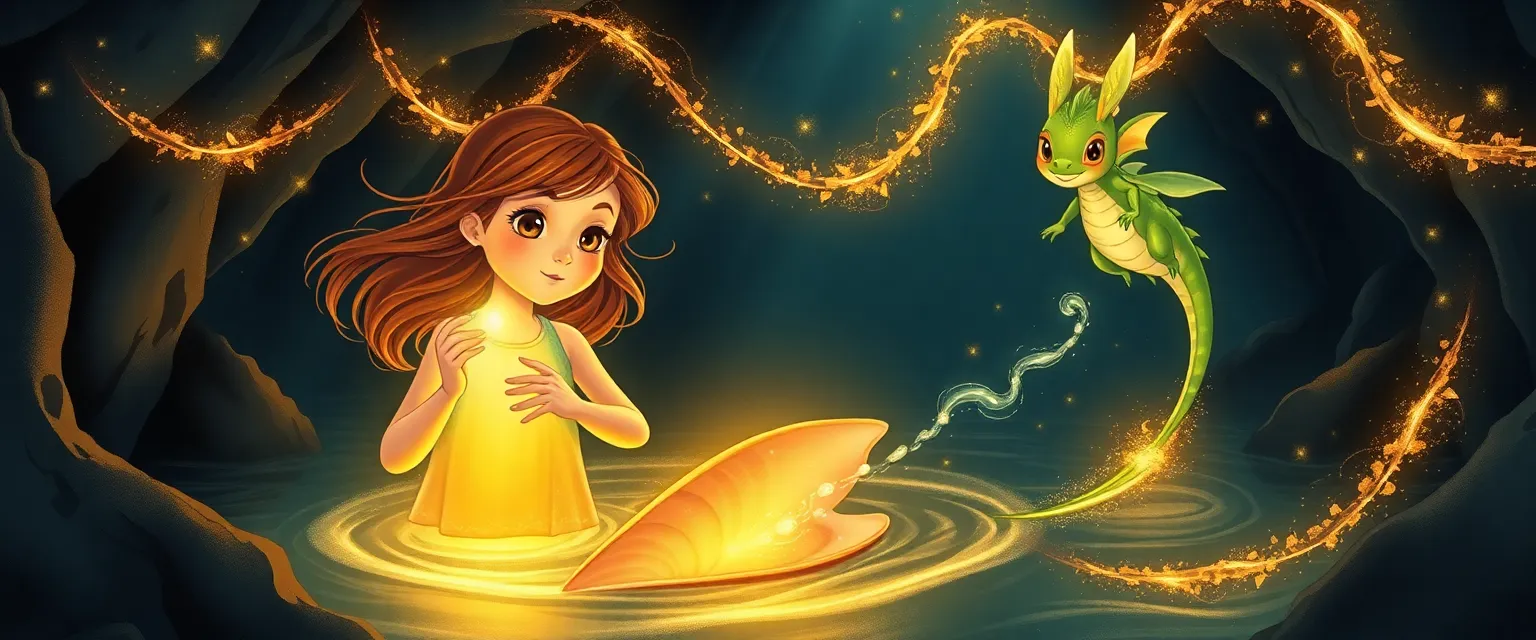
News 14-01-2026
Professor Hoot and the Wound-Up Constellation
High above the clouds, where the sky grows darker and the stars seem almost within reach, floated Professor Hoot's island. His observatory rose above gardens of night-blooming flowers that shimmered with a soft silver light. Professor Hoot was a wise old owl in round spectacles, and for three hundred years he had studied the secrets of the heavens.
But tonight something was wrong.
"Another star has gone," the professor whispered, flipping through his battered observation journal. His wings trembled with worry. "That's the seventeenth this month."
"Professor!" a ten-year-old girl burst into the observatory, a tumble of unruly curls bouncing around her shoulders. Stella had only recently arrived on the floating island. "I can hear them again! The stars are ticking—like clocks!"
Professor Hoot turned his head almost two hundred degrees and regarded her closely.
"Ticking? My child, are you sure?"
"Completely! Tick-tock, tick-tock," Stella said, pressing a finger to her lips. "Only now the ticking grows softer and slower."
The professor opened an ancient tome whose pages had yellowed with age. His talons quivered as he found the right passage.
"Incredible... the legend was true! The stars are winding mechanisms, crafted by ancient makers. They hold our islands aloft, but they must be wound with the Sky Key!"
At that moment something clinked at the window. A tiny mechanical hummingbird landed on the sill, speckled with rust. Its little metal wings squeaked.
"Rusty!" Stella cried, reaching out. To her surprise she heard a thin voice inside her head: "Help... the stars are dying... I used to be a star too..."
"Professor, she's talking to me!" Stella stroked the hummingbird. "She knows where to find the Sky Key!"
And so their journey through the Cloud Realms began. Professor Hoot spread his wings, Stella climbed onto his back, and Rusty flew ahead, leading the way.
Their first trial was a maze of mirrored clouds. In every reflection Stella saw different versions of the future: in one, an island plunged into the void; in another, the stars shone brighter than ever.
"Don't watch the reflections," the professor advised wisely. "Listen to your heart."
Stella closed her eyes and tuned in to the stars' ticking. One path sounded right, and she pointed the way with confidence.
Next they came upon a bridge of frozen rain that began to melt under the first rays of dawn. Professor Hoot knew an old spell to slow the sunrise, but it required energy. Stella remembered the thunderclouds they'd seen on the horizon.
"Rusty, can you fetch some lightning?" she asked.
The little hummingbird dove bravely into a dark cloud and returned sparkling with electric flashes. The professor used that charge, and they managed to dash across the bridge.
At last they met the Cloud Shepherd — a mysterious figure cloaked in drifting mist.
"The Key will be found by one who hears the song of the sky," a voice like wind rustling spoke. "But first tell me: which is heavier — a thousand stars or a single kind thought?"
Stella thought for a moment. Professor Hoot prepared to give a scholarly answer, but the girl beat him to it.
"A single kind thought," she said, "because it can light a thousand stars!"
The Cloud Shepherd smiled and pointed upward, where a path in the clouds revealed itself leading to the Celestial Clock Tower.
The tower was immense, all brass and crystal. At its heart giant gears turned, linked to every star in the sky. The ticking there was deafening, but with each passing second it grew fainter.
"Where's the Key?" Stella asked, looking around.
Rusty hovered near her heart and chirped: "The Key is kindness and curiosity. You've already found it."
At that moment a glowing golden key appeared in Stella's palm. It had been woven from her desire to help, the professor's wisdom, and Rusty's courage.
The girl slipped the key into the central mechanism and turned. A melodious chime rang out and every star flared brighter. Their ticking became steady and strong. Rusty suddenly gleamed, and her rust melted away into a sparkling golden finish.
"I'm a star again!" she chimed joyfully and shot upward to take her place in the firmament.
When they returned to the observatory, Professor Hoot wrote in his journal:
"Today I learned that the greatest discoveries are not made alone. Wisdom needs curiosity, and experience needs a fresh eye. Stella taught me to listen to what I'd forgotten to hear."
Stella, falling asleep in her room, smiled as she listened to the steady ticking of the stars. She now knew that to keep the world beautiful, you must care for it every day. And she would teach that to others.
From then on, every full moon Professor Hoot and Stella climbed the Celestial Clock Tower to wind the stars. All the children on the floating isles learned that if you listen closely, you can hear the sky breathe and count the moments of magic.
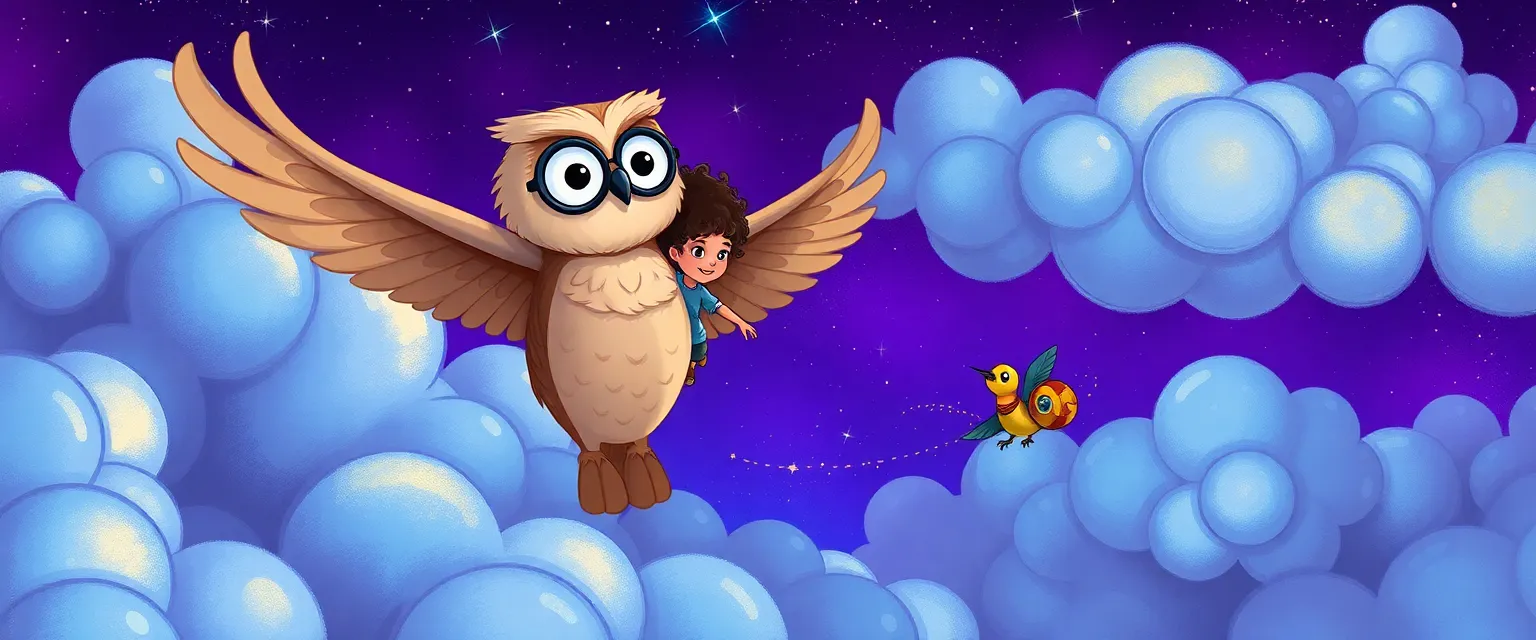
News 13-01-2026
Felix and the Carnival of Stolen Dreams
Felix woke to an odd silence. Usually the market square buzzed in the mornings with children’s laughter and cheerful shouts, but today the kids sat on the steps, yawning and staring into space. A red fox with silvery ear-tips stuck his head out of his patchwork wagon.
“What’s wrong?” he asked the baker.
“The children have stopped dreaming,” the baker sighed. “Three nights now. They wake tired and don’t seem to care about anything.”
Felix frowned. This was a proper mystery, and he loved mysteries. True, sometimes he rushed into solving them without thinking, but didn’t that make the adventures more fun?
That very night Felix didn’t sleep. He watched from his wagon window the sleeping girl next door. At midnight he saw something astonishing: a thin ribbon of multicolored mist drifted from the child’s bedroom window like the northern lights. From around the corner hopped a long-eared hare with a net on a long handle. She deftly caught the glowing haze and stuffed it into a glass bottle.
“Hey!” Felix shouted, leaping from the wagon. “What are you doing?”
The hare startled; the bottle slipped from her paws, but she snatched it back at the last moment.
“I… I’m collecting dreams for Madame Reverie,” she stammered. “For the Carnival of Stolen Dreams.”
“You’re stealing children’s dreams!” Felix protested.
“I know!” the hare pressed her ears back. “I’m so ashamed. My name is Clover, and I want to make it right, but I don’t know how. Madame Reverie is so lonely she’s forgotten how to dream.”
Felix scratched behind his ear. This was a more complicated puzzle than he’d thought.
“Then help me find this carnival and bring the dreams back,” he said decisively.
The next day they went to the only one who might help — the sleepy inventor Dorian. The small dormouse lived in the hollow of an old oak, surrounded by odd contraptions.
“Mm… carnival… mirrors… twilight…” Dorian mumbled, nodding off mid-sentence.
As soon as he snored, one of his machines came to life. Made of gears, little bells, and tiny mirrors, the device shook, chimed, and spat out a map drawn in glowing ink.
“Wow!” Felix admired. “Your inventions only work when you’re asleep?”
“Mmm-hmm,” Dorian confirmed without opening his eyes, and clambered onto Felix’s back.
Following the map they reached an old manor on the edge of town. At dusk every mirror in the house began to glow with a violet light. Clover knew the secret way — you had to turn around three times before a mirror and whisper, “Let me into where the dreams dance.”
The Carnival was a wondrous place. Striped tents changed color from red to blue, from green to gold. Carousels spun by themselves, and soap bubbles the size of watermelons floated through the air. Yet there was something sad about the place — everything ran like clockwork, without true joy.
In the center of the Carnival, in the largest tent, sat Madame Reverie. She was a graceful gray cat with sorrowful amber eyes. Hundreds of little bottles filled with colorful dreams stood around her.
“I knew you would come,” she said softly. “Clover has always been too kind for this job.”
“Why are you taking children’s dreams?” Felix asked, trying not to sound accusing.
Madame Reverie gave a sad smile.
“Long ago I lost someone I loved. Since then I cannot dream, I cannot feel joy. I thought if I collected enough dreams, I might feel again. But you know what?” A tear rolled down her cheek. “Other people’s dreams don’t warm you. They stand in bottles and remind you of what you don’t have.”
Dorian snored louder, and the little machine on his back began to tick. It released a small glowing orb that drifted to Madame Reverie and burst into a picture: the cat laughing, surrounded by children listening to her stories.
“Is that… my dream?” Madame Reverie whispered. “I can dream?”
“Of course you can!” Felix cried. “But first we must return what belongs to others. And then… maybe you can tell children about your Carnival? Real stories they’ll see in their dreams?”
Madame Reverie looked at the bottles, then at the friends, and nodded.
When they began opening the bottles, magic happened. The dreams shot upward in ribbons of color, filled with children’s laughter and sparks, and sped back to their owners. With each freed dream the Carnival grew brighter, the music grew merrier, and Madame Reverie grew happier.
By dawn all the dreams had returned home. Felix invited Madame Reverie to travel with him. Now beside his curiosity wagon rolled her little theater-carriage, where she told children marvelous tales. Clover became an assistant, and Dorian invented decorations that came to life while he dozed.
Most importantly — the children dreamed again. Bright, joyful dreams full of adventure. And sometimes they dreamed of a kind gray cat who had learned to dream again by sharing her imagination with others.
True magic, after all, is not keeping joy for yourself but giving it away. When you do, it grows for everyone.

News 12-01-2026
Pippin and the Upside-Down Birthday
In a little village lived a puppy named Pippin. She had soft golden ears and a tail that wagged merrily from side to side. Today was a special day — it was her best friend Ollie’s birthday. He was turning ten, and Pippin had promised to be the very first to arrive at the party.
That morning Pippin ran across the village square when she suddenly noticed something glittering. It was an old mirror in a beautifully carved frame she had never seen before. The glass shimmered with all the colors of the rainbow.
Curious, Pippin stepped closer. She stood on her hind legs to get a better look at her reflection, but a pebble slipped from under her paw. Pippin wobbled and—thud!—fell straight into the mirror, as if it were water!
When Pippin opened her eyes, she gasped. The whole world had flipped over! Houses stood on their roofs, rivers flowed up into the clouds, and trees stretched their roots toward the sky. The sun was setting even though the day had just begun.
“Oh no!” barked Pippin. “Where am I?”
“I can help you get back home,” a strange voice said.
Pippin turned and saw a girl walking backward. She wore an apron stitched with gears and tiny clocks.
“Sorry, I don’t understand,” Pippin tilted her head.
“My name is Tilda Tick,” the girl said, and Pippin realized Tilda’s words sounded like they were backwards. “You have fallen into the Upside-Down World.”
“My name is Pippin! I need to get home! It’s Ollie’s birthday today and I promised I’d come!” Pippin cried.
Tilda shook her head from right to left, looking sad.
“The mirror opens only at sunset. But… joy, what that is, we have forgotten. Everything here happens backwards because of that.”
Pippin thought hard. How could she help?
Suddenly three rabbits hopped out from behind an inverted bush. But they didn’t hop on their feet — they hopped on their ears! Boom-boom-boom — they bounced up and down on their long ears like springboards.
“We’re the Backwards Bunnies!” they said in unison. “We guard the mirror!”
“Please tell me how to get back home,” Pippin asked.
The smallest bunny stood on one ear and whispered, “The mirror will open only at a moment of true happiness. But here, all celebrations end before they begin. Cakes appear already eaten, gifts are already unwrapped, and laughter sounds sad.”
“That’s terrible!” Pippin exclaimed. “We have to do something!”
She looked around. The people of the Upside-Down World wore gloomy faces. A grandmother baked a pie that kept shrinking, turning back into flour and eggs. Children played ball, but the ball bounced away before they even threw it.
Then Pippin had an idea! She remembered how Ollie loved it when she did silly tricks.
“Everyone watch!” Pippin barked, and she began to run in circles trying to catch her own tail.
She spun faster and faster until she tumbled onto her back with her paws in the air. It looked so funny that Tilda suddenly laughed. A real laugh! And this time it sounded joyful, not sad!
At that moment a small golden patch of light appeared around Tilda. In that patch, time flowed correctly!
“It worked!” Pippin shouted. “True laughter makes time run right!”
The Backwards Bunnies clapped their ears in delight.
“That’s right! But we need more joy for time to flow properly everywhere!”
Pippin made a plan. She asked Tilda to gather everyone in the square.
“Let’s throw a party!” Pippin suggested. “But not the kind that happens backwards. Let’s make new happy moments!”
“We don’t remember how to do that,” the villagers said sadly.
“I’ll teach you!” Pippin barked. “In my world we start by coming together. Then we play, laugh, share treats, and take joy in one another!”
Pippin started showing tricks. She leaped over upside-down benches, chased soap bubbles that Tilda blew, and pulled such silly faces that even the saddest people began to smile.
The Backwards Bunnies joined the fun. They held a contest to see who could hop highest on their ears. The children started playing tag — this time correctly: they ran, then they chased!
Tilda baked a new pie, and it grew and grew, becoming bigger and more delicious. A grandmother wove flower crowns. A grandfather fetched a fiddle and played a cheerful tune that sounded right — from beginning to end!
With every laugh and every smile, more golden patches of light appeared. They merged together, and slowly the Upside-Down World began to change. Houses turned and settled on their foundations. Rivers uncurled and flowed downward to the earth. Trees spun so their roots pointed down and their branches reached up.
“Look!” Tilda cried, and now her words sounded normal. “Time is moving forward!”
The villagers hugged and cried with happiness. They could truly rejoice again!
Then the mirror in the square blazed with bright light.
“It’s time to go home!” said the wisest of the Backwards Bunnies. “You helped us remember what true joy feels like. The mirror has opened!”
Pippin looked up. The sun had already begun to set. She had to hurry!
“Thank you, Pippin!” Tilda said, hugging the puppy tightly. “You taught us that happiness must be made anew each day. Come visit us again!”
“I will!” Pippin promised and leaped into the shining mirror.
In the next moment she was back on her village square. Everything was where it should be — houses upright, the sun setting properly. Pippin raced on all fours toward Ollie’s house.
She arrived just in time! Ollie stood on the front steps, watching the road with hope.
“Pippin!” he cried when he saw his friend. “I knew you’d come! You always keep your promises!”
Pippin barked happily and jumped into Ollie’s arms, licking his cheeks. At the party she performed all her tricks, and the guests laughed and clapped. When everyone sang “Happy Birthday,” Pippin howled along in tune, which was so funny that Ollie laughed until tears rolled down his face.
That evening, after the party and when the guests had gone home, Ollie hugged Pippin.
“That was the best birthday ever! Thank you for coming.”
Pippin curled up beside her friend and thought that helping others find joy was the real kind of magic. True friendship will always find a way home, even through an Upside-Down World.
And you know what? Sometimes, when Pippin ran past the square, the mirror would twinkle with a special light, as if Tilda and the Backwards Bunnies were sending her a hello from their world — a world now full of laughter and joy.
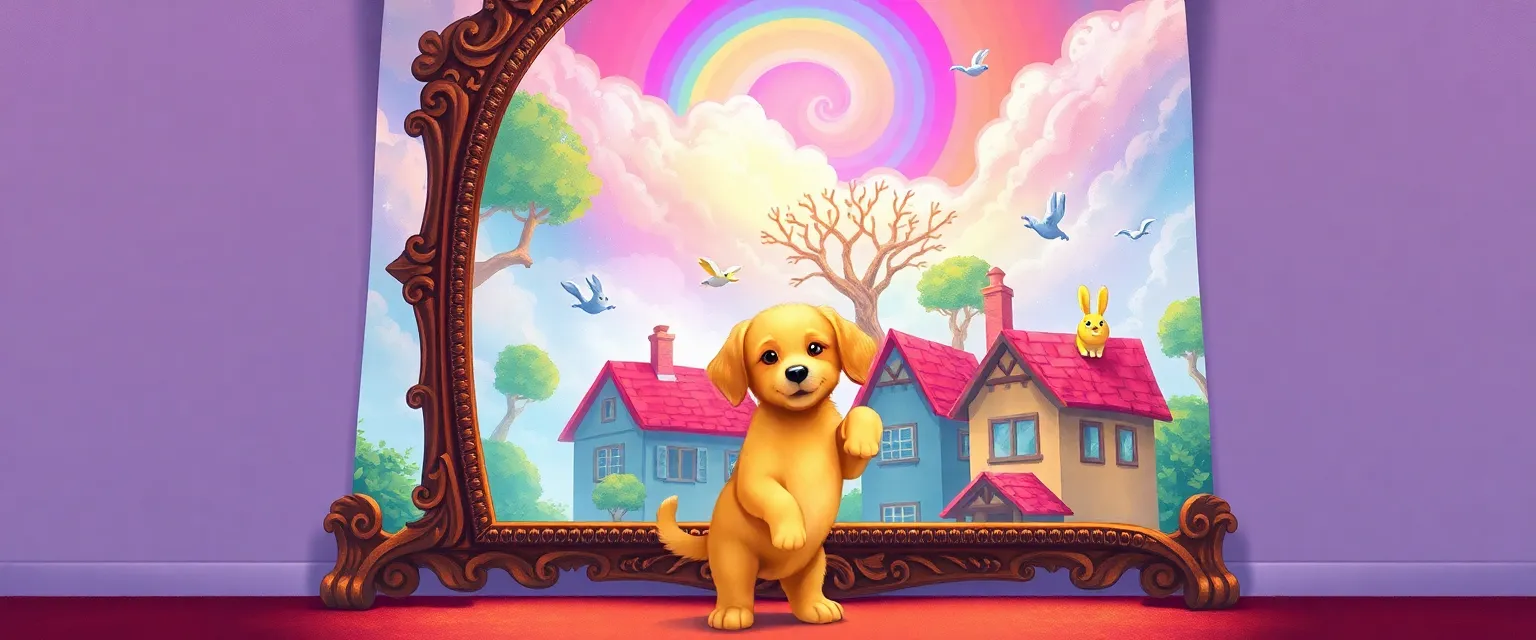
News 08-01-2026
Professor Hoot and the Garden of Borrowed Voices
In Petal Grove, every morning began with a symphony. The roses sang opera, the daisies giggled like little bells, and the tulips traded funny stories. But one morning Professor Hoot, a wise old owl in tiny spectacles, noticed something strange.
A red rose named Ruby unfolded her petals to sing her morning song, but no sound came from her center. Only her lips moved in silence. The other flowers gasped as the pink mist that always rose around Ruby when she sang vanished completely.
“What’s going on?” Professor Hoot whispered, adjusting his glasses. “Ruby, can you speak?”
The rose shook her head; her petals trembled with fear.
The next morning three daffodils lost their voices. Then the little bellflowers fell silent. Each day Petal Grove grew quieter and sadder. Voice-less flowers began to wilt and their colors dimmed.
Sunny, a young sunflower who preferred listening to talking, came to Professor Hoot. She still had her voice—the voices were disappearing starting with the loudest singers.
“Professor Hoot,” Sunny said softly, “I noticed something odd. Every night, just before a flower loses its voice, I see a blinking light near the garden wall. Maybe we should take a look?”
Professor Hoot nodded. “Good spotting, my dear. Tonight we’ll keep watch.”
When the moon climbed high, they saw it: a beautiful butterfly with rainbow wings, flitting from flower to flower. She carried a tiny crystal vial that glowed with a soft light. The butterfly gently touched a violet, and a purple mist streamed from the flower’s heart into the vial. The violet tried to speak but couldn’t make a sound.
“Stop!” Professor Hoot cried, launching from his branch.
The butterfly startled and dropped the vial. Inside swirled the voices of many flowers—pink, yellow, blue, and violet.
“Please don’t be angry,” the butterfly whispered, her antennae trembling. “My name is Melody. I didn’t mean to hurt anyone. I just… I wanted to take sounds back home.”
Sunny drifted closer; her golden petals glowed gently in the moonlight. “What do you mean?”
Tears shone in Melody’s large eyes. “I’m from the Quiet Meadow, a place where nothing grows and nothing sings. It’s so lonely, so empty. When I found your garden and heard all these lovely voices, I thought… I thought if I brought some of them home, my meadow might come alive again. I didn’t know it would hurt them. I thought they’d be sharing.”
Professor Hoot frowned, but his eyes were kind behind his glasses. “Melody, even with the best intentions, we can’t take what isn’t ours without asking. Those voices are part of who those flowers are. Without them, they wither.”
“I’m so sorry,” Melody sobbed. “I’ll give them back—every single one!”
“Wait,” Sunny said softly. “Professor Hoot, maybe there’s another way. Melody didn’t want to be cruel. She just wanted to bring beauty to her lonely place.”
Professor Hoot considered, his large head turning first to Sunny, then to Melody, then to the silent flowers around them. Then his eyes brightened. “My dear Sunny, you have the wisest heart in the garden. I have an idea, but I’ll need your help.”
“Anything,” Sunny said.
“Can you hum one of your tunes?” Professor Hoot asked.
Sunny closed her eyes and began to hum. Her voice was gentle and sweet, and as she sang, little golden musical notes rose from her center, dancing in the air like tiny fireflies. The golden notes wound around the crystal vials Melody had scattered on the ground.
“These golden notes,” Professor Hoot explained, “are seeds of Sunny’s voice. Melody, if you carry them to the Quiet Meadow and plant them in the soil, they will grow into new flowers. Flowers that will have their own voices, given freely—not stolen.”
Melody’s eyes widened with wonder. “Really? Can that happen?”
“With one condition,” Sunny added. “You must first return all the voices you borrowed.”
Melody nodded eagerly. She opened each crystal vial, and the colored mists flowed back to their flowers. The roses sang again, the daisies giggled, and a tulip told a joke that made everyone laugh. Petal Grove sprang back to life in sound and color.
Professor Hoot carefully gathered the golden notes into a little pouch woven from spider silk. “Plant them with love,” he told Melody. “Sing to them, speak to them, and they will grow strong. And remember: nothing precious should be taken. It must be given.”
“I’ll remember,” Melody promised, clutching the pouch with her wings. “Thank you both. Thank you for teaching me—and for giving me hope.”
When Melody flew toward the Quiet Meadow, Sunny turned to Professor Hoot. “Do you think she’ll succeed?”
Professor Hoot smiled; his eyes twinkled behind his glasses. “My dear Sunny, I think someone with such a kind heart and a new understanding will create the most beautiful garden of all. And that’s thanks to your wisdom.”
Sunny blushed as brightly as the rising sun.
From that day on Petal Grove sang louder than ever. Far beyond the garden wall, in the place once called the Quiet Meadow, new flowers began to grow, each with its own unique voice—offered freely and nurtured with love. And sometimes, on quiet evenings, if you listened very closely, you could hear the two gardens singing to one another across the distance—the song of friendship, forgiveness, and voices shared from the heart.
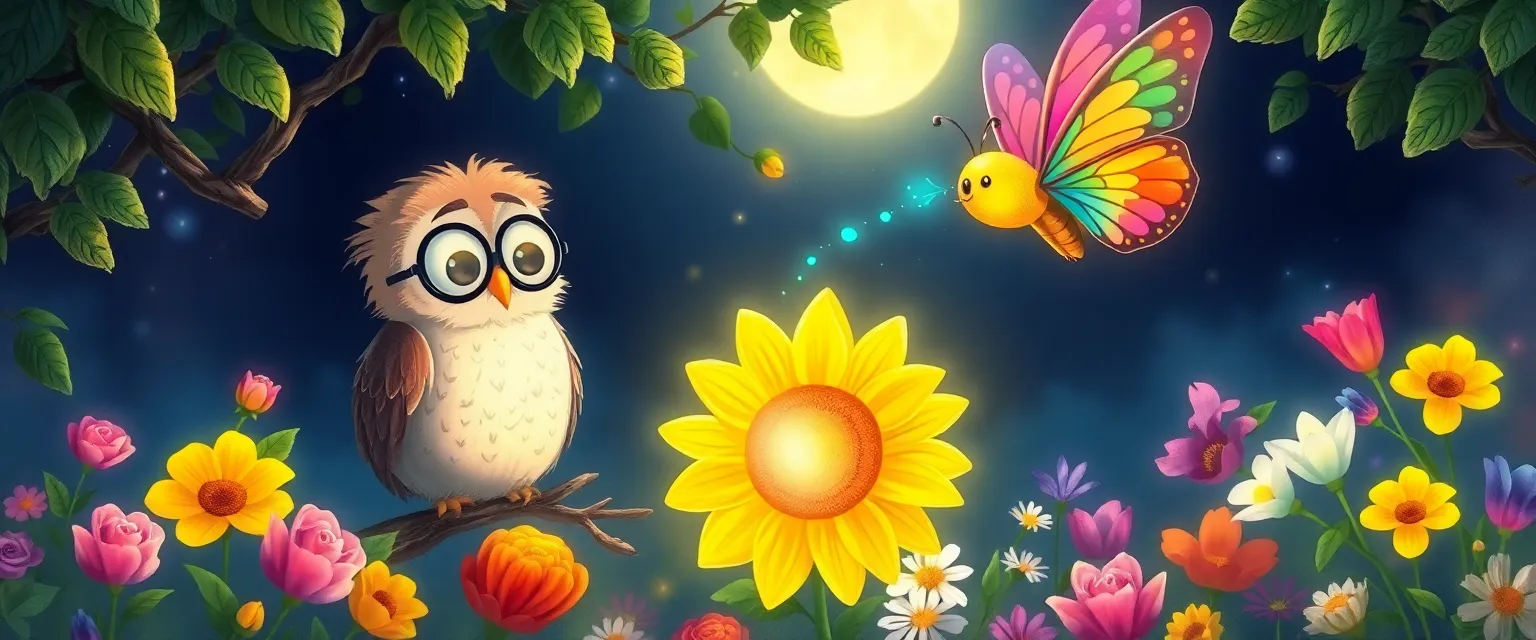
News 07-01-2026
Bouncy and the Traveling Dinosaur Circus
In a wondrous world where dinosaurs and modern animals lived side by side, an unusual circus traveled across the Great Flower Meadow. Its home was a delightful two-story wagon painted in every color of the rainbow. On huge wooden wheels it rolled from town to town, pulled by a wise old Triceratops named Captain Rumble.
Inside the wagon lived a golden puppy named Bouncy. She had big paws and a tail that never stopped wagging. Bouncy was the circus acrobat and always looked for the bright side of everything.
But the star of the show was a gentle lilac stegosaur named Petal. Despite her huge size, she danced so gracefully the audience would hold their breath in awe. When Petal was happy, the plates along her back chimed like little bells, and flowers would bloom all around her.
Traveling with them were the pterosaur twins — Zip and Zap. They performed aerial acts and always flew ahead to bring news from the next towns.
One day in Fern Village an accident happened. During her performance Petal stumbled and fell right in the middle of her dance. The audience gasped. Though they later applauded and said the show had still been beautiful, Petal was devastated.
From that day she refused to leave the wagon. She hid in her cozy corner and refused to rehearse.
"I’m too clumsy," she said sadly. "I can’t perform at the Grand Dinosaur Festival. Everyone will laugh at me."
Bouncy worried about her friend. There were only five towns left before the festival, and Petal grew sadder every day.
Captain Rumble spoke in rhyme, as always: — Don’t fear a slip, my dear friend true, each one has a gift inside of you!
But Petal didn’t listen.
When the circus reached Crystal Canyon, the townsfolk met them with worried faces.
"Our magic bridge is broken," explained an old Diplodocus. "Now the little dinos can’t get across the gorge to school. We need someone big and strong, but very careful."
Bouncy dashed to the wagon at once.
"Petal! We need you! Only you can help!"
Petal peered out. When she saw the sad little ones, her heart melted. Carefully, step by step, she lay across the chasm, turning her body into a bridge. Her plates chimed softly, cheering the children on. One by one the little dinos ran across her back to the other side.
"Thank you, Petal! You’re a real hero!" they shouted.
In the next town, Mushroom Wood, another trouble awaited. A young ankylosaur had fallen into a deep pit.
"We need someone with a long reach to pull him out," his mother said.
But Petal couldn’t reach. Then she had an idea. She began to dance slowly around the pit, and her plates rang so sweetly that strong vines sprang up. The youngster grabbed hold and climbed out.
This kept happening in every town. At the Singing River Petal helped build a dam. At the Rainbow Cliffs she danced so tenderly that sleeping seeds woke up and a whole garden grew.
Bouncy pranced beside her, her tail wagging happily.
"See, Petal? You’re needed for more than the stage! Your gift isn’t just your dancing. It’s your kindness, your strength, and your brave heart!"
At last they arrived at the Grand Dinosaur Festival. Creatures from all the lands had gathered to show their talents. Petal stood backstage trembling.
"What if I fall again?" she whispered.
Bouncy pressed against her enormous leg.
"Maybe you will. Maybe you won’t. But you know what? Everyone you helped came to see you. They don’t remember your mistake. They remember your beauty and your kind heart."
Petal looked out and saw all those she had helped in the audience. The little ones from Crystal Canyon waved their tiny paws. The ankylosaur held a bouquet of flowers that had grown from her dance.
Captain Rumble rhymed: — Talent’s not to be without a flaw, but to rise and try — that’s what we saw!
Petal took a deep breath and stepped into the ring. She began to dance. Slowly, gracefully, carefully. Yes — she nearly slipped once. But she steadied herself and kept going. Her plates chimed louder and more joyfully. Flowers bloomed around the arena. When the performance ended, the applause made the ground tremble.
The audience didn’t see a perfect dance. They saw courage. They saw beauty. They saw those sparks of joy that come when someone truly believes in themselves.
That night the wagon played its happiest tune. Zip and Zap twirled in the air. Captain Rumble smiled. And Bouncy and Petal looked up at the stars.
"Thank you for helping me remember," Petal said. "Sometimes we stumble. But that doesn’t mean we should stop dancing."
"Exactly!" barked Bouncy, her tail wagging even faster. "Now let’s sleep. Tomorrow brings new adventures!"
And the rainbow wagon rolled on across the Great Flower Meadow, carrying a circus where everyone knew: true talent is the courage to be yourself, even when you’re afraid.
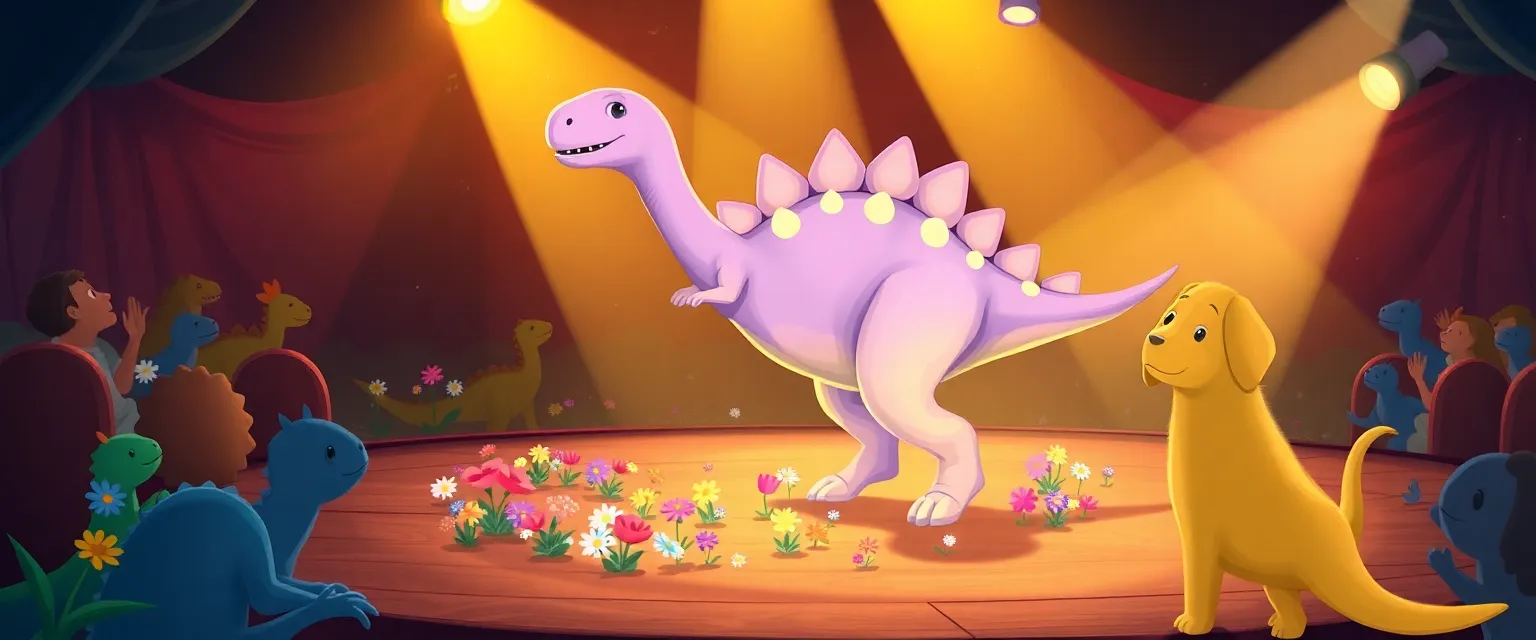
News 06-01-2026
Sparky and the Mystery of the Rainbow Blocks
High in a mountain valley where the meadows were dotted with wildflowers and the air smelled of honey and fresh grass, lived a young dragon named Sparky. His scales shimmered in every shade of purple, and his orange wings gleamed in the sun like autumn leaves. More than anything, Sparky loved building castles from his magical blocks, which changed color with his moods.
One morning Sparky stretched awake. Sunshine peeked into his cave window, promising a perfect day for building. But when the little dragon stepped out onto the lawn where his proud castle stood, he gasped. A huge hole gaped in the wall — the three top blocks were gone!
“Who dared steal my blocks?” Sparky demanded, and his scales darkened with anger to a deep navy.
The next morning five more blocks had vanished. Then seven. Sparky decided to catch the thief. He pretended to sleep, but kept one eye slightly open. At midnight he saw something astonishing — his blocks slowly rose into the air and floated toward the clouds! But who was carrying them, he could not see.
“Stop!” Sparky cried and leapt, trying to grab a floating block.
His paw brushed something soft and cool, and suddenly a small girl made of mist appeared in the air. She had big sad eyes and fluffy white hair.
“Please don’t be mad!” she sobbed. “My name is Nimbus. I didn’t mean to steal, but we had no choice.”
Nimbus explained that she and her brothers were cloud-children who’d been separated from their parents by a great storm. Their family lived on a neighboring cloud, but after the storm a wide chasm had opened between the clouds. The cloud children had been trying to build a bridge from Sparky’s blocks to get home.
“We only become visible when we hold something solid,” Nimbus said, clutching a block. “Without it I’ll fade away again.”
Sparky’s heart softened. His blocks shifted from purple to a gentle pink — the color of sympathy.
“I’ll help you,” the little dragon said decisively. “But my blocks aren’t enough for both a bridge and my castle. We’ll need another solution.”
That morning Sparky set off for Petra, the wise mountain goat who lived on the highest crag. Her silver horns sparkled in the sun and her eyes held the secrets of the ages.
“Ah, young builder,” Petra smiled. “You’re looking for the crystal quarries, aren’t you? Beneath these mountains lie caves full of magical blocks that sing when stacked together. Getting in isn’t easy — you must solve ancient puzzles.”
Petra led Sparky and Nimbus to a hidden cave entrance. Inside, thousands of crystalline blocks of every size and shape glittered! But the path was blocked by a stone door with many slots.
“We must place the blocks in the right order,” a thin voice whispered.
Sparky looked around and found a whole team of tiny beetles in little hard hats. They were the Architect Beetles, famous builders!
“We’ll help!” they buzzed in unison. “But we must work together.”
Sparky, Nimbus, and the beetles began trying combinations. When the dragon grew upset, his blocks turned gray and didn’t fit. But when he thought about reuniting Nimbus with her family, the blocks glowed gold and slid perfectly into place. At last the door opened with a melodious chime!
The cave was full of wonders. The crystal blocks hummed a soft song, and when stacked with kindness they became weightless and could float through the air!
“This is perfect for a sky bridge!” Sparky exclaimed.
They filled baskets with blocks. The Architect Beetles drew plans, and Sparky and Nimbus began to build. The dragon taught the cloud girl how to think happy thoughts so the blocks would glow and grow light. Soon a graceful bridge shone between the clouds, singing a gentle tune.
“Mom! Dad!” Nimbus cried, and her parents hurried across the bridge to meet her. When the family hugged, every block in the bridge burst into rainbow light.
Sparky built himself a new castle—bigger and more beautiful than before. Now he had plenty of blocks to share with friends. And the most wonderful thing — when he built with joy and generosity, his creations began to sing softly, drawing new friends from across the valley who wanted to build together.
From then on Sparky woke each morning to the song of crystalline blocks and watched cloud-children run back and forth across the sky bridge to visit one another. And the little dragon knew his true treasure wasn’t the number of blocks he owned, but the friends he’d gained by learning to share.
The Architect Beetles founded a building school in the valley where anyone could learn to create marvelous structures. The school’s golden rule was: “Build with kindness, and your creations will come to life!”
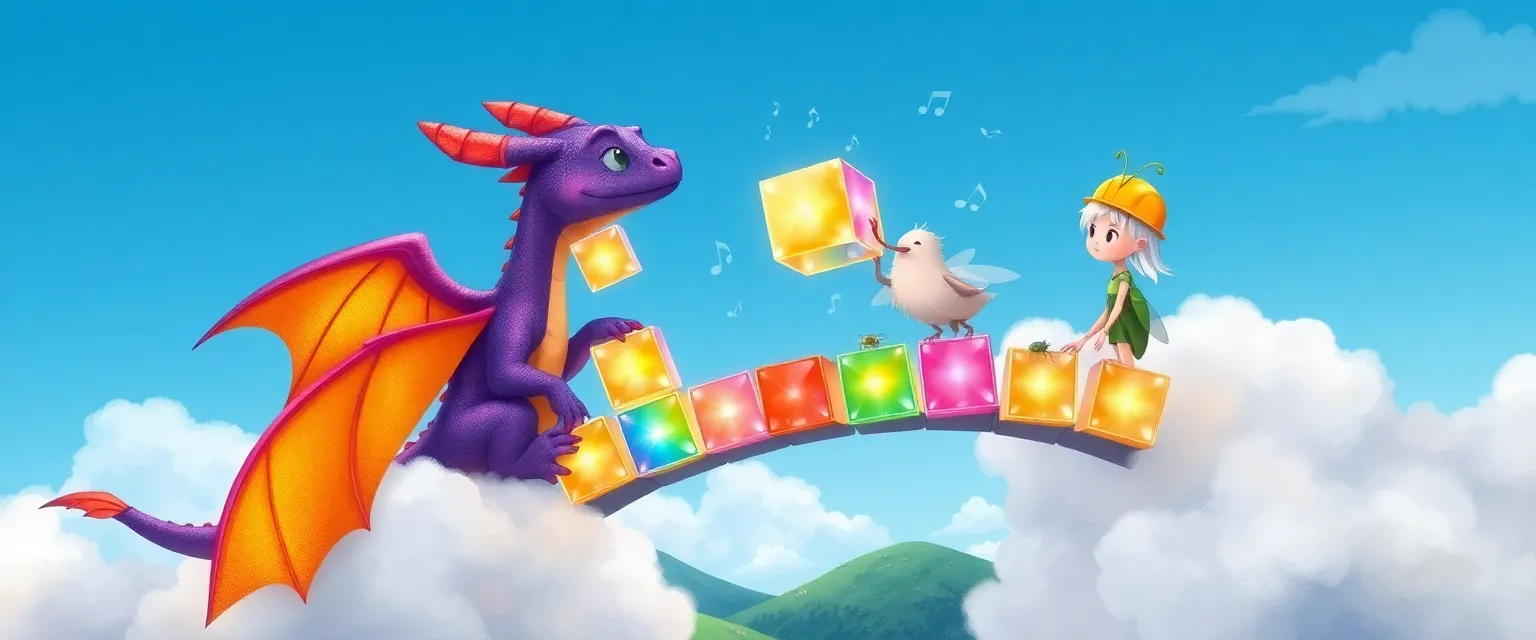
News 05-01-2026
Petal and the Clockwork Garden
High above the clouds, where the sky turns violet and the stars are visible even by day, floated the island of Petal. On that island lived a little fairy named Petal. Her wings were the color of a morning rose, and she could make flowers bloom instantly with a single touch.
One morning Petal woke to a strange sound. Or rather, to the lack of sound. Her whole life she had fallen asleep and woken to a faint ticking coming from deep within the island. Now there was nothing.
“Something’s wrong,” Petal whispered.
She looked out from her tulip-house and gasped. The island of Petal was sinking! The clouds that were usually far below now nearly brushed the island’s edge.
At the roots of the Old Oak, Petal found a hidden entrance leading down to a dim room. There, in the half-light, glowed the great Clockwork Heart of the island — a mechanism of crystal and brass. But it wasn’t moving. Three empty sockets gaped where gears should have been.
“Without those gears the island will fall into the stormy lower winds in three days,” creaked a small voice.
Petal turned. Perched on the edge of the mechanism was a tiny mechanical hummingbird with a bent wing.
“My name is Tinker,” he introduced himself. “I can show you where to find the gears, but the journey will be hard.”
“I can fly fast and I can make flowers grow!” Petal said proudly. “I’ll fix everything!”
Tinker shook his head but flew after her, hobbling through the air.
The first gear was in the Copper Cloud Cliffs, where the Keeper of Gears lived — an ancient cloud giant called Old Puff. He sat alone in his misty home, surrounded by hundreds of mechanical birds that had long since stopped moving.
“Give me the gear! My island is falling!” Petal demanded.
“A gear?” Old Puff looked at her with sad eyes. “I’ve been here so long I forgot what it was for.”
Petal was about to protest when Tinker quietly said, “Look around. Maybe he needs help.”
Petal paused and for the first time really looked. The mechanical birds… many had broken wings, like Tinker’s.
“Teach me how to fix them,” she begged. “Please.”
Old Puff was surprised but agreed. They worked together all day. Petal learned to fit tiny parts and tighten little screws. Her fingers, used only to petals, learned to work with metal.
When the last bird spread its wings and whirled into the air, Old Puff smiled.
“Now I remember,” he said. “Gears are for not being alone. For keeping islands in the sky where friends live.” He handed her the first golden gear.
The second gear belonged to Zephyr — a mischievous wind spirit who lived in the Spiral Winds, where everything spun and twisted.
“That gear is mine!” Zephyr laughed, dancing in the air. “Movement belongs to me!”
“But an island will perish without it!” Petal cried.
Zephyr only spun faster. Petal tried to follow, but she soon grew tired. The wind was everywhere and nowhere at once.
“She’s lonely,” Tinker observed. “No one can move as fast as she does.”
Petal thought for a moment, then asked, “Zephyr, teach me to ride your currents. I want to understand what it’s like to be the wind.”
Zephyr stopped, surprised. No one had ever asked to be taught; people always demanded she stop or go away.
She showed Petal how to catch air streams and glide along spirals. They flew together, and for the first time Zephyr felt she had company.
“You know,” she said at last, “movement is more fun if you share it.” And she handed over the silver gear.
The third gear sat on the Peaks of Silence, where time moved strangely — sometimes fast, sometimes slow. It was guarded by the Keeper of Time, a wise owl of cloud crystal.
“To earn the last gear,” he said, “you must sit here for one hour and do nothing.”
One hour! Petal had so little time left! But she remembered Old Puff and Zephyr. She sat down and waited.
At first it was very hard. Then Petal began to notice wonderful things: how clouds change shape, how starlight shimmered on the gears, how Tinker breathed beside her. She had never stopped simply to watch.
When the hour passed, the owl nodded.
“You have learned patience. That is the final lesson.” He gave her the bronze gear.
Petal and Tinker returned to the island of Petal just in time. The island had sunk so low that its edges brushed the gray clouds. Petal carefully, without rushing, placed all three gears into their slots.
The Clockwork Heart came to life. Tick-tock, tick-tock! The island shuddered and began to rise back toward the violet sky.
“I thought my flower-growing would be enough,” Petal told Tinker. “But I was wrong.”
“You learned to mend, to ride, and to wait,” Tinker replied. “But most of all you learned to listen and to understand others.”
From that day on Petal often visited her new friends. On the island she planted a special garden where flowers opened slowly and beautifully, each in its own time. Petal watched them with joy, in no hurry at all.
And the Clockwork Heart ticked beneath the earth, reminding everyone that patience and kindness hold the world as surely as any gears.
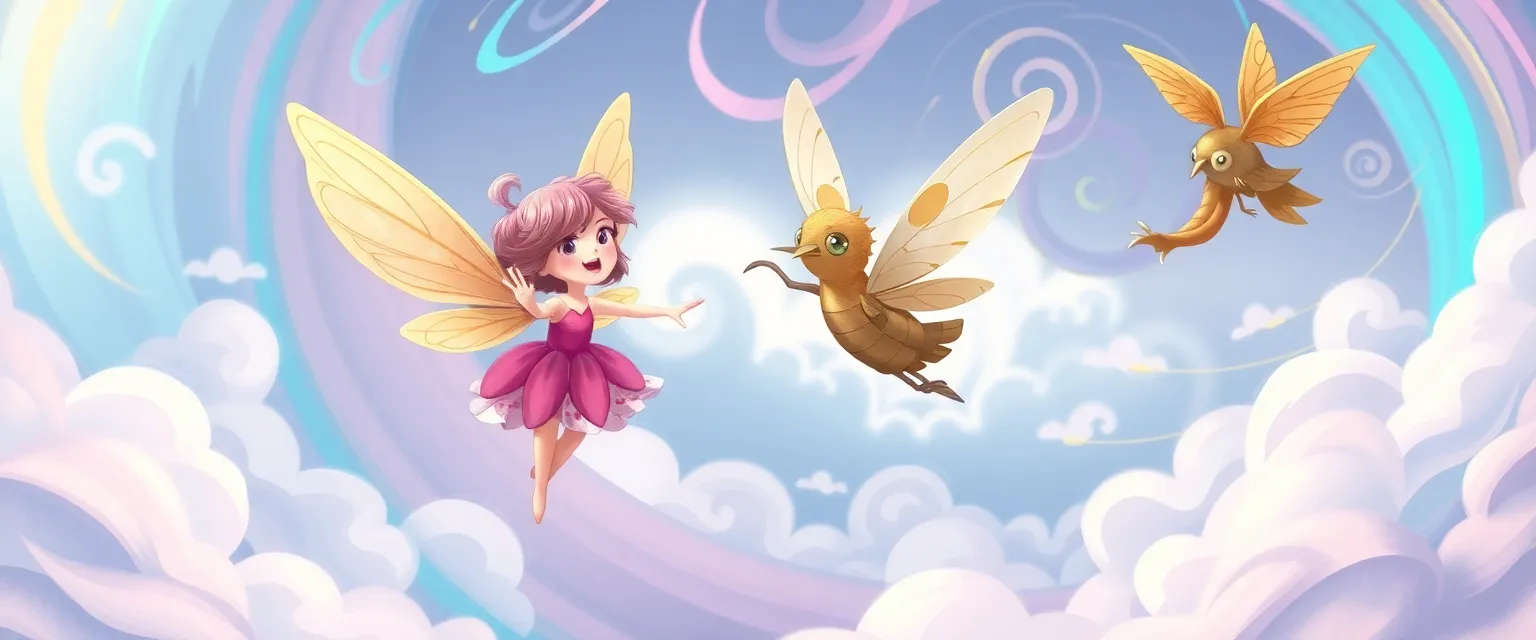
News 04-01-2026
Skip and the Blizzard Clock
In a small Siberian town, where the rooftops looked like sugared domes and the smoke from chimneys rose straight into the sky in neat columns, lived a golden puppy named Skip. She had enormous paws that kept getting tangled, and a tail that wagged so fast it kicked up a dusting of snow.
Skip loved to explore everything around her. She could never sit still. "Wait a minute!" people would call, but Skip was already racing toward the next adventure.
One frosty morning Skip dashed into the old museum on the main square. There, in the central hall beneath a glass dome, stood the ancient Weather Clock — a vast mechanism of gold and silver, adorned with snowflakes and suns. The townsfolk said this clock made sure winter wasn’t too harsh and that spring arrived on time.
Skip spotted something shiny spinning inside the clock. "Ball!" she thought, and without a second thought she leapt onto the glass display. The glass cracked, Skip tumbled into the mechanism, and three golden cogs flew out of the clock, scattering in different directions.
At that very moment the sky grew dark. A snowstorm began, growing heavier and heavier. The wind howled, and the temperature plunged so low the windows frosted over thickly.
Grandma Vera, an old horologist, came to the frightened Skip. Her kind eyes looked serious.
"You’ve broken the Weather Clock, little one," she said softly. "Winter will never end unless you return the three cogs. Each is guarded by a winter spirit, and each will test whether you’ve learned to take responsibility for your actions."
Skip dropped her ears. She was very ashamed. "I’ll fix it! I promise!"
Grandma Vera poured her a cup of warm tea with honey and said, "The first cog is with the Frost Keeper in the frozen fountain on the square. Remember: sometimes the hardest thing is doing nothing at all."
Skip bolted outside. The snow was already up to her knees. The central fountain had turned into an ice sculpture, and perched atop the highest spray sat an ice-snow snow leopard. Its eyes shone like stars.
"I am the Frost Keeper," boomed its voice. "The cog is yours if you stand perfectly still for a whole hour. Not a paw, not a wag."
An hour! Skip had never stood still for even a minute in her life. But she remembered the blizzard she'd caused and nodded.
She sat down in the snow. At first it was easy. Then a cat dashed by — Skip almost chased after it. Then the wind brought the smell of fresh bread from the bakery — Skip barely restrained herself. Her paws trembled with the urge to run, her tail wanted to wag, but she thought of the town and of her mistake.
When the hour ended the Frost Keeper inclined his head: "You have learned patience." He breathed on Skip, and the first cog appeared by her paws. From then on her footprints left delicate iced patterns in the snow.
The second cog was atop the tallest building in town — the communications tower. There Skip met the Wind Dancer, a spirit that looked like a whirl of snowflakes in the shape of a bird.
"Catch three special snowflakes," she sang. "But don’t jump or bark. Only patience and attention."
Thousands of flakes twirled around. Skip wanted to leap and snatch them with her teeth, but she remembered the Frost Keeper’s lesson. She stood very still and watched. Then she saw it: three snowflakes glowing with a golden light. She gently offered her paw, and they drifted down onto it by themselves.
"You have learned to observe," whispered the wind, and the second cog spun before Skip. Now she could ride the streams of wind and soar on them.
The last cog waited in the old train station. Among frozen locomotives and faded photographs sat the Memory Keeper — a spirit formed of mist, fragile as breath on a cold morning.
"Sit and listen," he said softly. "I will tell you the story of this town. All of it, from beginning to end. Do not interrupt. Do not be distracted."
This was the hardest test. The tale was long. The Keeper spoke slowly. Skip wanted to run along the tracks, sniff the old suitcases, and chase a puff of steam. But she listened. She heard about the people who built the town, the children who played these streets, the winters and springs that followed one another.
And suddenly Skip understood: a town is more than buildings. It’s stories, memories, lives. She had nearly undone all of that with her haste.
When the story finished, tears rolled down Skip’s face. "I’m sorry," she whispered.
The Memory Keeper smiled: "You have learned to listen and to understand. That is true responsibility." The third cog settled at her paws.
Carrying all three cogs, Skip returned to the museum. Grandma Vera helped her put them back in place. The clock chimed, its hands began to move, and the blizzard quieted at once. The sun broke through the clouds.
From that day on Skip still loved exploring, but she stopped to think. She had learned to wait, to watch, and to listen. Tiny snowflakes sometimes caught in her golden fur — a gift from the winter spirits, a reminder that sometimes the most important thing is to slow down and pay attention.
And whenever it snowed in the town, Skip would sit by the window and watch the flakes fall, not trying to catch them, simply admiring their beauty. Because she had learned that some things are most beautiful when you simply observe them, unhurried.

News 03-01-2026
Starlight and the Garden of Unspoken Wishes
In the heart of the Rainbow Forest grew a remarkable place called the Chromatic Garden, where flowers did more than smell sweet—they spoke. Each bloom had its own voice: roses crooned lullabies, bluebells chimed with laughter, and irises told old stories.
Living there was a young unicorn named Starlight. Her shimmering mane glowed with every color of the rainbow, and her curiosity knew no bounds. Starlight loved asking questions and chatting with the flowers from dawn until dusk.
One morning Starlight galloped to her favorite friend—the wise dahlia named Dahlia, who always spoke in riddles and rhymes.
“Dahlia! Dahlia! Guess what I saw at sunrise!” Starlight babbled, then stopped. Dahlia was silent. Her petals, usually deep violet, had faded to a pale lilac.
“Dahlia?” Starlight whispered. “Why are you quiet?”
The dahlia only slowly shifted to a sad blue and bowed her head.
Worried, Starlight hurried through the garden and found that three more flowers—the cheerful daisy, the thoughtful tulip, and the chatty forget-me-not—had also lost their voices. They only rustled their petals, trying to say something.
By evening a tiny hummingbird named Pepper fluttered over to Starlight.
“I know what’s happened!” he chirped, flitting nervously from branch to branch. “The flowers give away their voices to grant other creatures’ wishes! Yesterday I saw a field mouse wish to find her way home, and the poppy gave her its voice. This morning a butterfly wished to see her family, and the lily fell silent forever!”
“But why?” cried Starlight. “Why would they sacrifice themselves?”
“They think that’s their purpose,” Pepper answered sadly. “But with every lost voice the garden weakens. Look!”
Indeed, the flowers were wilting. The garden’s colors dimmed, and the magic that made the place special was fading.
“We have to do something!” Starlight jumped up. “Right away!”
“There’s a legend,” Pepper said thoughtfully, “about the Seed of First Words hidden in the Silent Mountains. They say it holds the language that first gave all living things the ability to speak.”
“Then we’re going there!” Starlight decided without hesitation.
They crossed the Whispering Meadows, where blades of grass whispered secrets to each other. Starlight wanted to stop and listen, but Pepper hurried her on.
“No time! The flowers are fading!”
Next they passed the Mirror Pond. Starlight peered into the water and gasped—where her reflection should have been, she saw a swirl of emotions: worry, impatience, fear.
“What is this?” she whispered.
“This pond reflects feelings, not faces,” Pepper explained, also looking in. His own reflection flickered with the same anxiety and rush.
They went on and finally reached the foot of the Silent Mountains. A strange hush lay over the place—echoes did not return from the rocks.
“How will we find the Seed in such silence?” Starlight began, but her voice seemed to dissolve into the air before it reached her ears.
From behind a stone a slow, ancient tortoise emerged. Its shell was covered with glowing symbols.
“That’s the Keeper of Silence,” Pepper breathed.
Starlight bounded up to the tortoise.
“Please, we need the Seed of First Words! Our friends are dying! We must save them! You must help us! Tell us where it is!”
The Keeper only blinked slowly and turned away.
“Why won’t she answer?” Starlight cried in despair. “We traveled so far!”
Pepper buzzed impatiently around the tortoise, but she did not react.
Hours passed. Starlight paced, asked questions, demanded answers. The more she spoke, the further the Keeper seemed to drift.
Finally, exhausted, Starlight sank to the ground. Tears rolled down her muzzle. She closed her eyes and, for the first time on the journey...fell silent.
In that quiet she suddenly heard things she hadn’t noticed before: the soft breathing of the wind, the whisper of distant stars, the beat of her own heart. And something else—the ancient pulse of the earth beneath her hooves.
Starlight opened her eyes to find the Keeper watching her. The tortoise’s shell glowed brighter, and the symbols began to move, forming pictures.
Starlight saw how long ago flowers had been given voices not to give away, but to share joy. She saw how the first words were born from silence, from attention, from the ability to listen to the world.
“I understand,” Starlight whispered. “I have been talking all the time and not listening. I thought I knew what the flowers needed, but I never truly asked.”
The Keeper nodded slowly. She edged toward a small crevice in the rock and stepped aside. There, in the heart of the mountain, a tiny seed glowed—the Seed of First Words.
But as Starlight reached for it, the Keeper blocked her. She looked the unicorn in the eye, and without words Starlight suddenly knew: the Seed could not simply be taken. It had to be earned through silence, understanding, and the willingness to listen.
Starlight sat beside the Keeper. She didn’t speak, ask, or demand. She just remained there, quiet and attentive.
Pepper, seeing this, calmed too and perched nearby.
An hour passed. Then another. The mountains grew dim.
And then a miracle happened. The Seed of First Words rose of its own accord and floated slowly toward Starlight’s horn. It dissolved into light, and the unicorn felt ancient wisdom filling her horn.
At last the Keeper spoke. Her voice rustled like a thousand-year-old forest:
“You have learned the most important thing, child. Words gain power in silence. Help comes from understanding, not from action alone. Go and teach your friends this.”
Starlight and Pepper hurried back to the garden. But now Starlight did not rush blindly. She moved slowly, listening to the world around her.
When they returned, the garden looked sorrowful. Most of the flowers had lost their voices and had faded.
Starlight approached Dahlia. She didn’t speak at once. Instead she simply sat down, bowed her head, and...listened.
At first there was nothing. Then Starlight heard a faint trembling in Dahlia’s petals. She listened harder and understood: Dahlia hadn’t wanted to give up her voice. She had done it because she believed she could only help others by sacrificing herself.
“Dahlia,” Starlight said softly, “you don’t have to give yourself away to be helpful. Your voice is part of who you are. Without it you can’t give the joy you always gave me with your poems and riddles.”
Dahlia’s petals quivered and warmed to a hopeful orange.
Starlight touched the dahlia with her horn, and the light of the Seed of First Words flowed into the flower. But this was more than a return of a voice—it was a new understanding.
“I...I can hear,” Dahlia whispered, and her voice sounded clearer than ever. “I hear you not just with words, but with your heart.”
Starlight went to every silent flower. She didn’t hurry. She listened to each one—their wordless stories, their fears, their hopes. Only after understanding what they truly needed did she touch them with her horn.
With every touch the flowers didn’t merely regain their voices—they learned a new way to help others. They realized they could grant wishes without losing themselves, by sharing wisdom, beauty, and kindness.
“But how will we help travelers now?” the daisy asked once the garden had its voices back.
“You will listen to them,” Starlight replied. “Truly listen. Sometimes someone who comes with a wish needs not magic but understanding. Sometimes the greatest help is simply being there and hearing them.”
The garden bloomed brighter than ever. But its magic had changed—deeper, more genuine.
Pepper settled on Starlight’s shoulder.
“You know, I learned something too,” he admitted. “I always rushed to act, but sometimes the best action is to stop and think.”
Starlight smiled. She looked at her garden and the friends she had almost lost and understood the most important thing: true friendship is not just about talking and helping. It’s about listening, understanding, and being there. It’s knowing that sometimes silence speaks louder than words, and real care begins with paying attention to how others feel.
From that day the Chromatic Garden became a place of both conversation and quiet. The flowers learned to listen to the wind, to each other, and to those who came seeking help. And Starlight—who loved asking questions—learned the most important question of all: “How do you feel?”—and to wait patiently for an answer, even if it came not in words but in silence.
And the garden thrived, filled with sound and silence and the wisdom that grows when we truly hear one another.

News 02-01-2026
Felix and the Painted Door
On the edge of a blooming meadow, where purple clover tangled with yellow buttercups, stood an ancient oak. Its gnarled branches remembered hundreds of sunrises, and its bark kept secrets seen by only a few. Felix, a young fox with fur the color of autumn leaves and bright green eyes, often came to this oak at dawn, when the morning mist still lay over the tall grass.
It was here, in the first hour after sunrise, that a mysterious door appeared on the trunk. It wasn't real—just a painting, painted with colors that shimmered like oil on water. Felix would study it for hours, turning his favorite smooth creek stones in his paws and wondering what might be hidden behind that door.
But one night a terrible storm swept across the meadow. The wind howled so loudly it drowned out even thunder. By morning everything had changed. The creek had carved a new path, familiar trails had become hills, and old landmarks vanished as if by magic.
The first to get lost was Pepper—a gray songbird with an incredible memory for tunes and stories. She had been Felix’s best friend, but now she circled the meadow looking bewildered.
“Felix!” she chirped, landing on a stone beside the fox. “I can’t find my nest. Everything is different. Even the songs I used to sing to find my way home don’t work anymore.”
Felix frowned. Other animals wandered the meadow—disoriented and frightened. Old hedgehog Bramble walked in circles, muttering ancient woodland tales under his breath. When he saw Felix, he grumbled:
“The old stories speak of a Map of True Directions. It’s kept behind the painted door. But to open the door you must solve three riddles written in the morning dew.”
Felix’s heart beat faster. He knew that door! He scooped Pepper onto his back and dashed for the ancient oak. Dawn was just beginning, and the magical door already shimmered on the trunk. Beside it, words of the first riddle glowed in drops of dew.
An elderly rabbit with wise eyes sat by the door—the Keeper of Dawn. He looked at Felix and asked:
“Do you know what you’re seeking?”
“A map, to help everyone find their way home,” Felix answered.
“But what is home?” the Keeper asked.
Felix hesitated. He read the first riddle aloud: “I flow, but I am not water. I guide, but I am not a road. I bind those who are far apart. What am I?”
Felix thought, rolling the stones in his paws. Pepper quietly began to sing the little tune she always hummed when visiting Felix. Suddenly the fox understood.
“Memory!” he cried. “Memory flows through time, guides us to those we love, and binds us even when we’re apart.”
The first dew drops shone with golden light and vanished. The second riddle appeared: “I am invisible, but you feel me. I have no weight, yet I lift you. I am not a voice, but I call you. What am I?”
Felix closed his eyes. He remembered the warmth he always felt when Pepper sang for him. How his paws led him to the creek where he collected stones. How something inside him knew where to find his friends.
“Feeling,” he whispered. “The feeling we have for places and those we love.”
The second riddle melted away. The sun climbed higher, and time was running short. The third riddle read: “I am not on the compass or the map. I am not in the stars or in footprints. But without me you will never find your way home. What am I?”
Felix looked at Pepper, then at the Keeper of Dawn.
“Could it be…” he faltered. “Courage? The courage to trust yourself?”
The Keeper smiled for the first time.
“Isn’t that the most important thing?”
The last drops of dew flared, and the door swung open. Inside hung not a regular scroll but a living tapestry woven of light and shadow. When Pepper looked at it, she didn’t just see a route to her nest—she saw memories of building it, the first song she sang there, and the times Felix came to visit.
“I remember!” she chirped. “My nest is by the three birches, where the moss grows like a star!”
One by one the meadow’s animals came to the tapestry, and each saw their path home—illuminated not by landmarks but by memories, feelings, and love for their place in the world.
Felix realized the storm could not erase what mattered most. Home is not just a spot on a map. It lives in the heart, in the memory of those you love, and in the courage to listen to your inner voice when the outside world changes.
When the sun climbed high, the door faded until the next dawn. But Felix no longer doubted himself. He knew now that true direction had always been inside him—you only had to learn to trust it.
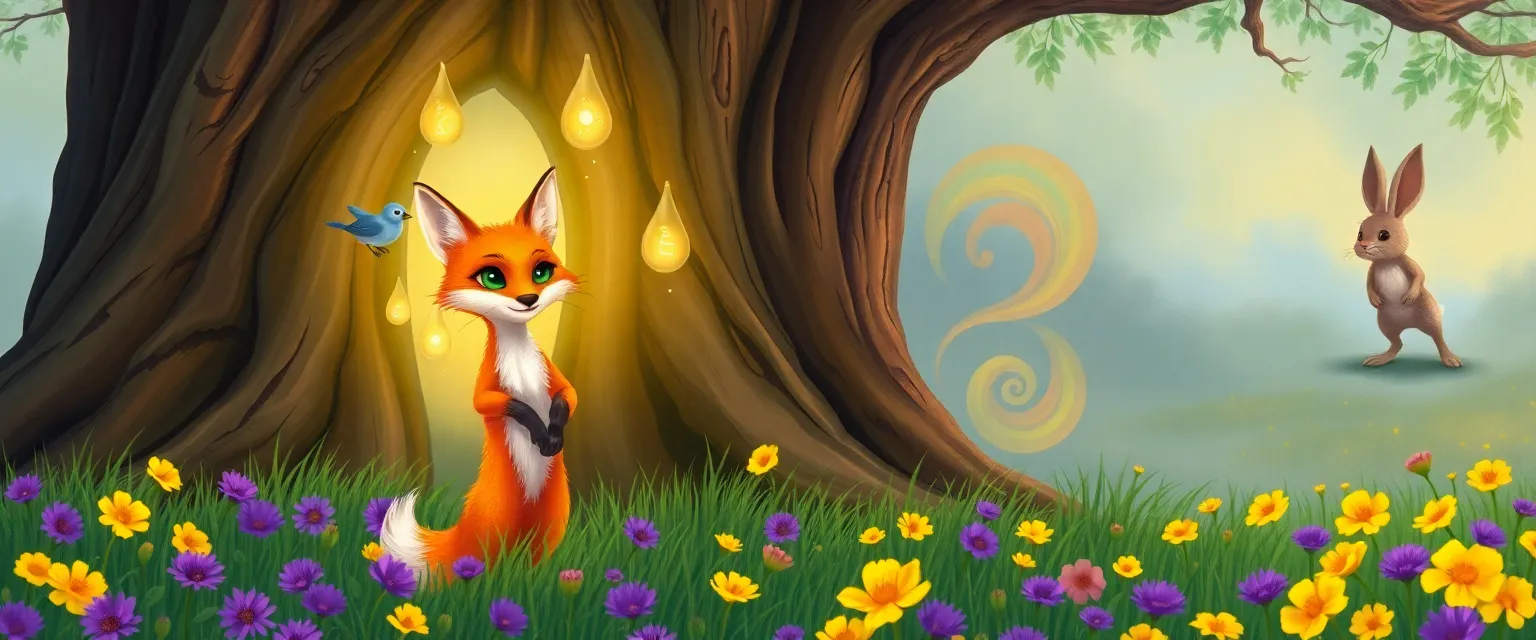
News 01-01-2026
Timmy and the Pearl of Courage
In the warm depths of the sea, among towering coral spires and gardens of sea anemones, lay the underwater town of Coral Haven. There lived a young sea turtle named Timmy. Intricate patterns decorated his shell—patterns that could delight anyone who saw them, if only they looked. The moment someone tried to talk to Timmy, he would pull himself into his shell.
More than anything, Timmy loved gathering smooth pebbles and arranging them into patterns on the sandy floor by his home. It calmed him; pebbles never asked questions or looked at him with expectations.
One morning the whole town awoke to the alarm of a conch shell. Timmy peered out of his hiding place and saw the residents of Coral Haven gathering in the main square. The protective barrier around the town, which usually shimmered with a soft golden glow, had dimmed to near transparency.
“The Pearl of Courage is fading!” announced the town crier, a large sea bass. “If its light goes out completely, predators will breach our city!”
Timmy trembled and began to tuck his head into his shell, when a bright seahorse appeared right in front of him. She spoke so quickly her words flowed together.
“You’re Timmy, right? I’m Marina, the town messenger! The Keeper of the Pearl wants to see you—right now! This is important! Come on!”
“I… but I… I—” Timmy tried to hide, but Marina had already grabbed his flipper and pulled him toward the center of town.
At the heart of Coral Haven, in a tower of mother‑of‑pearl shells, lived the Keeper—an ancient octopus with wise eyes. When Timmy shyly swam into the chamber, the Keeper greeted him with all eight tentacles waving kindly.
“Timmy,” the Keeper said in a low, gentle voice, “I see in your heart what you do not see in yourself. The Pearl of Courage is dimming because the townsfolk have forgotten what true courage is. But you can save it.”
“Me?” Timmy squeaked, his shell paling with fear. “But I’m the most timid in town!”
“Exactly why you are the one for this,” the Keeper smiled. “You must travel through three realms and perform three acts of true courage. Only then will the Pearl shine again.”
Timmy wanted to refuse, but he thought of his home, the quiet corners where he arranged pebbles, and of the neighbors he almost had but who were still part of his world. He nodded slowly.
“I’ll try.”
Marina spun happily around him.
“I’ll be your guide! The first realm is the Tangleweed Forest!”
They swam to the edge of town where a thick forest of brown seaweed began. Tall stalks swayed in the current, forming a real maze. Timmy and Marina slipped between them, but soon realized they were lost.
“We should ask for directions,” Marina said.
“No, no, we’ll find it ourselves!” Timmy panicked.
But the seaweed grew denser and they completely lost their way. In the distance Timmy spotted a school of colorful little fish.
“Marina, what if they laugh at me? Or think I’m silly?”
“What if they don’t?” Marina replied softly. “Sometimes you have to take the chance.”
Timmy took a deep breath. His shell shifted slightly, showing a faint turquoise tint. He swam up to the fish.
“Um… excuse me… could you tell us the way to the Cave of Amplified Voices?”
The fish smiled warmly and pointed the right way. One even said, “What a beautiful shell you have!”
Timmy looked at himself in surprise—the patterns on his shell shone brighter. He had passed the first test.
The second realm met them with echoes. The Cave of Amplified Voices was vast, and every sound bounced off its walls, growing louder and louder. At the cave’s entrance Timmy saw a jellyfish trembling as much as he felt.
“Hi,” Timmy said quietly. “Are you scared too?”
“I’m Ripple,” the jellyfish whispered. “I’m afraid of the dark, and this cave is so frightening. But I have to get through to get home.”
Timmy realized he wasn’t the only one with fears. Everyone had their own.
“Let’s go through together,” he offered.
Inside the cave each noise became a roar. Timmy heard his own breath magnified a hundredfold. His heart pounded so loud he thought it might jump right out. Still he kept swimming, staying close to Ripple and Marina.
At the cave’s center Timmy needed to call out so the Keeper in the city could hear and know he was succeeding. That meant everyone would hear his voice.
“I can’t,” Timmy whispered. “Everyone will hear me. What if I say the wrong thing?”
“Timmy,” Ripple said, “you helped me through the dark. You’re already brave. Just say what you feel.”
Timmy shut his eyes and shouted, “I’m scared, but I won’t give up!”
His voice rolled through the cave in thunderous echoes, and in that moment his shell flashed a bright turquoise light. He had passed the second test!
The third realm was the most frightening. The Open Current was a vast expanse with no shelter—nowhere to hide, nothing to cling to—only an endless blue around them.
“This is the last test,” Marina said. “You just have to cross the Current. Here you’ll be fully exposed. Everyone will be able to see you.”
Timmy looked out over the boundless space. Before, he would have turned and fled. But now he knew fear was natural. What mattered was what you did despite it.
He swam into the Open Current. The flow caught him and carried him forward. Timmy did not retreat into his shell. He spread his flippers and swam, feeling the water move around him from every side. His shell now glowed a vivid turquoise, the patterns shifting through all the shades of the sea.
Ahead lay the Pearl of Courage—a large, dim pearl in a crystal grotto. Timmy swam up and touched it with his flipper.
The instant he did, the Pearl erupted in blinding light. The glow spread through the whole town, restoring the protective barrier. But something else happened—Timmy saw his reflection in the Pearl, and it was not a frightened little turtle but a brave traveler with a shining shell.
“You did it,” the Keeper’s voice said. “You learned the true secret: courage is not the absence of fear, but the choice to act in spite of it.”
When Timmy returned to town, a crowd gathered to greet him. He would have hidden before, but now he simply smiled and waved his flipper. The residents of Coral Haven cheered their hero.
The Keeper gave Timmy a special gift—now the little turtle could share his courage with those who needed it. When someone was afraid, Timmy would swim over, and the glow of his shell would remind them: everyone can be brave in their own way.
Timmy still loved collecting pebbles and arranging their patterns. But now he sometimes invited others to join him. And when a small fish or crab said they were too scared to meet someone new or try something unfamiliar, Timmy told them his story.
“I was scared too,” he would say. “And you know what? I still get scared sometimes. But now I know that’s okay. The important thing is not to let fear stop you.”
The Pearl of Courage in the town center shone brighter than ever, fed not only by grand deeds but by the small acts of bravery the townsfolk showed every day. True courage lives in the heart of anyone who’s willing to take a step forward, even when they’re afraid.
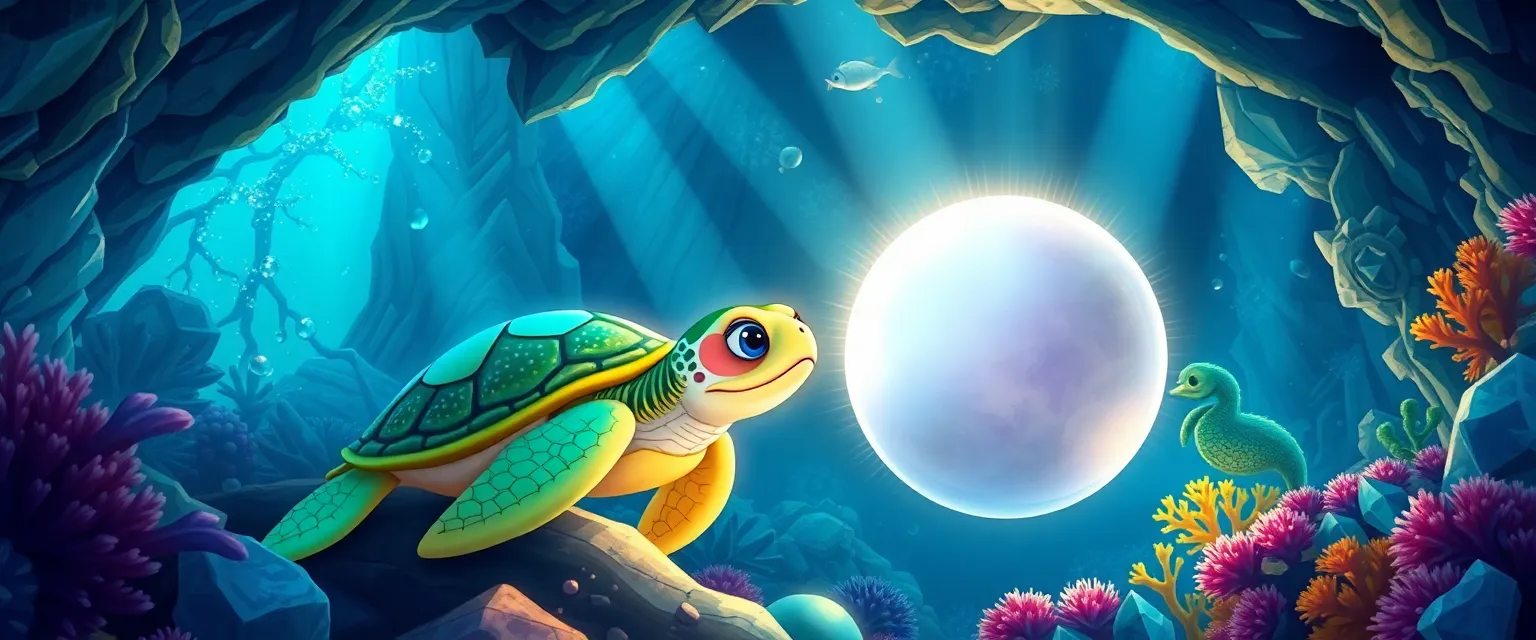
News 31-12-2025
Melody and the Coral Concert Hall
In the underwater city of Aquaria, where buildings grew from colorful shells and the streets were currents carrying residents from place to place, lived an unusual rabbit named Melody. Her long purple ears quivered when she heard feelings hidden in sounds. She also owned a small shell flute she played every morning.
One day Melody woke up to a strange silence. Normally the city buzzed with songs, laughter, and chatter, but today everyone spoke sharply and angrily. She swam to the center of town, where the Coral Concert Hall rose. It used to glow with all the colors of the rainbow, but now it looked gray and sad.
At the entrance sat a wise octopus called Maestro. He once conducted the orchestra, but now he was silent, his tentacles curled around his head.
“What's wrong?” Melody asked.
“The concert hall is losing its voice,” sighed Maestro. “The residents have stopped really listening to one another. Now everyone just argues. If we don’t restore the hall’s strength, the city will forget what kindness means.”
“How can we save it?” Melody pressed her ears.
“We must gather seven different kinds of laughter from the most unexpected friends and play a symphony no one has ever heard. But remember: laughter cannot be forced or faked. It must be true.”
Melody nodded and set off.
First on her route was Captain Shellby, a grumpy hermit crab who lived in an old teapot and muttered as he fixed his stick fence.
“Captain,” Melody said, “they say you haven’t laughed in thirty years.”
“Not going to,” he grunted. “Laughter’s a waste of time.”
“Do you like jokes at all?”
“Can’t stand them! Especially bad ones!”
Melody smiled. Her ears caught the truth: he secretly adored terrible jokes but was too shy to admit it.
“Why doesn’t the shark play cards?” she asked.
“I don’t know and don’t want to!”
“Because it’s afraid someone will call its bluff!”
Captain Shellby snorted. Then he chortled. Then he laughed so hard he nearly toppled out of his teapot. His laugh tinkled like tiny bells. Melody captured the sound in a bubble.
“Thank you,” the Captain said, wiping tears. “I’d forgotten how good that felt.”
Next was Shimmer, a shy jellyfish who changed color with music. She hid behind a rock and trembled.
“I want to perform, but I’m afraid I’ll make a mistake,” she whispered.
“What if mistakes make the music more beautiful?” Melody said. “Play with me — it doesn’t matter what happens.”
They played a duet. Shimmer lost the beat now and then, but Melody matched her, and their tune became unexpected and lovely. Shimmer glowed in every color and laughed with joy — bright and free. Her laughter was like bells in the wind.
Melody traveled through seven ocean zones. In the Chuckling Caves she helped a frightened baby octopus find a lost toy, and it giggled with relief. In the Ticklish Trenches she made a stern swordfish laugh by showing how ridiculous it looked trying to tie a bow. Each laugh was unique: some boomed like drums, others gurgled like streams.
At last, with seven bubbles of laughter, Melody returned to the Coral Hall. Maestro waited, looking unsure.
“I haven’t conducted in years,” he said. “Once I made a mistake and the concert failed. Everyone laughed at me.”
“Maestro,” Melody took a tentacle, “mistakes are part of music. Without them it would be boring. Please help me.”
Maestro drew a deep breath and nodded.
They opened the bubbles and laughter poured into the hall, turning into notes. Melody played her flute and Maestro conducted, and together they wove a symphony of genuine joy. The music was imperfect, with unexpected pauses and surprising turns, but that made it alive.
The Coral Hall shone brighter than ever. Color returned to the coral walls. Throughout the city people felt warmth and began to smile. They listened to one another again — not just to words, but to the feelings behind them.
From that day on Melody and Maestro held concerts every week. Sometimes the musicians made mistakes, sometimes they hit sour notes, but everyone listened with open hearts. Captain Shellby began sharing his awful jokes with anyone who’d listen, and the city filled with laughter.
Because real music, Melody realized, is born not from perfection but from a sincere wish to hear and understand another.
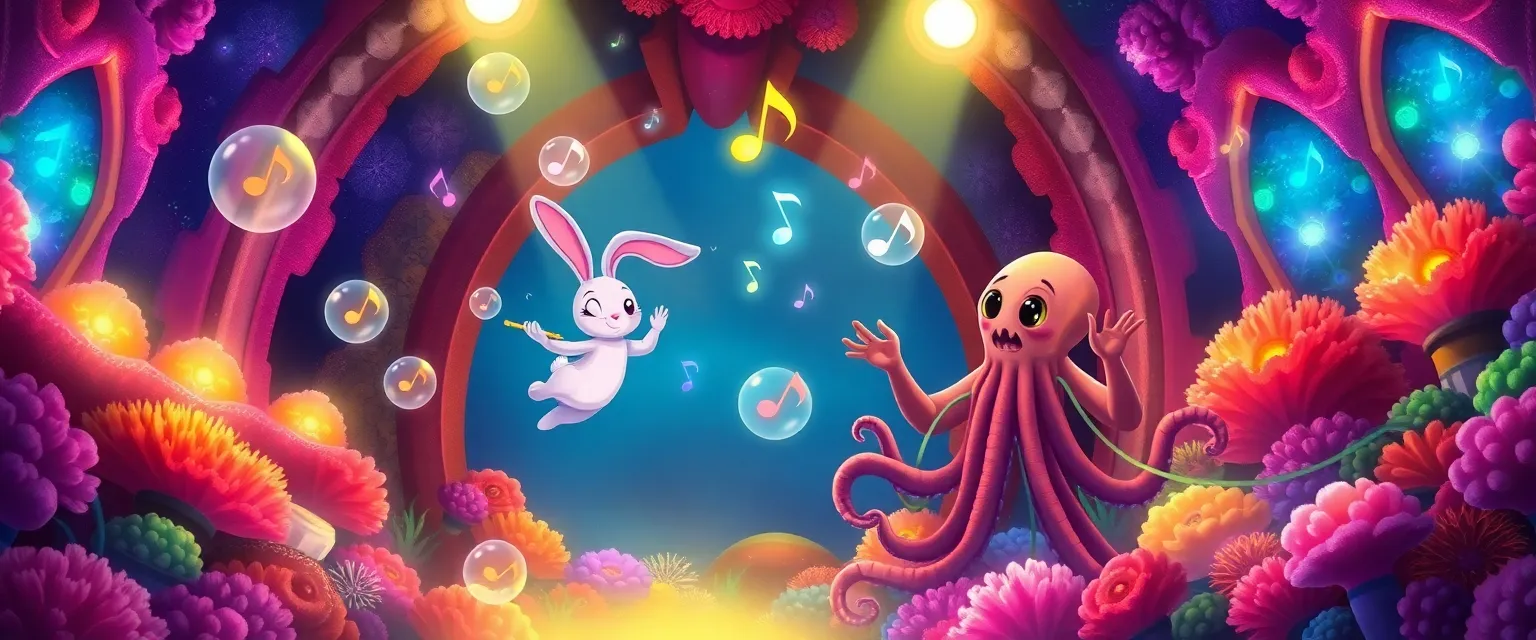
News 30-12-2025
Melody and the Symphony of Lost Voices
In an enchanted forest where the trees thumped like drums and the birds sang perfect chords, there lived a little rabbit named Melody. She carried a wooden flute she had carved herself from a willow branch. Melody loved music above all else, but she had one big problem: she was afraid to play for others. She always felt her music wasn't good enough.
One morning Melody woke to an odd silence. Usually the forest rose to the sound of birdsong, but today there was nothing to be heard. She poked her head out of her burrow and saw her neighbor, a squirrel, open its mouth and make no sound. The squirrel pressed its paws to its throat in panic.
Melody ran to the Drum Meadow, where the trees usually tapped in the wind. But even the breeze was silent today. On the Hills of Harmony the birds opened their beaks and sang silently. Only the River of Rhythm still gurgled faintly, and even its sound was growing weaker.
By the river Melody met an old tortoise named Cipher. Cipher was the guardian of ancient musical scrolls and always spoke in riddles.
“What has happened to our forest?” Melody asked.
“When sounds vanish like dew in the sun, look for the one who gathers what she fears to lose,” Cipher whispered. “The Instrument of First Songs sleeps at the heart of silence. But it can be opened by three notes: the note of courage, the note of friendship, and the note of acceptance.”
Melody didn’t fully understand the riddle, but she decided to find the Instrument of First Songs. Cipher gave her an old map that marked the path to the Silent Forest.
On the way Melody met a hedgehog named Bramble, sitting beside a broken drum and staring sadly at her paws.
“I used to be the best drummer in the forest,” Bramble said. “But I once fell and hurt my paw. Now I can’t play like I used to and my rhythm always falters.”
“Come with me,” Melody offered. “Together we’ll find a way to bring the sounds back to the forest.”
Bramble agreed, and the two set off together.
The deeper they went, the quieter the forest became. At last they reached the Silent Forest, where huge crystal webs hung between the trees. In the center of the largest web sat a spider with sad eyes.
“That’s the Weaver of Silence,” Bramble whispered.
Melody stepped forward bravely. She saw that colorful ribbons were tangled in the web—those were the forest’s sounds! Red, blue, and gold ribbons glowed faintly in the web.
“Why did you take our voices?” Melody asked.
The spider cried without sound.
“I didn’t mean to take them,” she explained with gestures. “I was so afraid the forest’s beautiful sounds would disappear that I tried to keep them in my webs. But when I began to gather them, they got stuck and I don’t know how to free them.”
Melody understood: the Weaver of Silence wasn’t wicked—she was simply afraid of losing something precious, just as Melody herself feared playing imperfectly.
“I know what to do,” Melody said. “I need to play three notes.”
She lifted her flute, but her paws trembled. What if she played badly? What if her music wasn’t good enough?
Bramble put a paw on her shoulder.
“I believe in you,” she said. “Remember how I told you about my injured paw? That was the note of acceptance. I accepted that I can’t play perfectly, but I can still play.”
Melody nodded. The first note appeared in her heart—a purple ribbon of acceptance.
Then she looked at Bramble, who had come with her despite her fear.
“You’ve become a true friend,” Melody said.
The second note shimmered—a pink ribbon of friendship.
Melody took a deep breath. For the last note she had to do the thing she feared most: play in front of others without worrying about perfection.
She put the flute to her lips and began to play. Melody was not flawless. Sometimes she missed a note; sometimes her breath faltered. But she played from her heart, pouring into the music all her love for the forest and her friends.
A golden ribbon of courage rose from the flute and twirled into the air.
The three ribbons—purple, pink, and gold—joined together and flew to the center of the crystal web. Where they touched the web something marvelous appeared: an instrument that looked like a harp, a flute, and a drum all at once. It was the Instrument of First Songs!
Melody gently took the instrument and began to play again. This time Bramble joined in, tapping a rhythm on the old drum. Her beat was uneven but sincere. Even the Weaver of Silence began to hum along softly.
Their imperfect but true music awakened the Instrument of First Songs. It shone with a brilliant light, and all the sounds trapped in the web were freed! The colorful ribbons flew across the forest, returning each creature’s voice.
The birds on the Hills of Harmony sang once more. The trees in the Drum Meadow tapped in the wind. The River of Rhythm bubbled loudly and merrily. The squirrel clicked its little feet in delight as it got its voice back.
The Weaver of Silence stopped collecting sounds in her webs. Instead she learned to weave beautiful patterns of light that decorated the forest.
And Melody was no longer afraid to play for others. She had learned that true music is not about perfect notes. True music is when you share your heart with others, even when you’re scared and even when things aren’t perfect.
From then on the forest filled with music every evening. Melody played her flute, Bramble tapped the drum, and all the animals sang along, each with their own unique voice. It was the most beautiful symphony the enchanted forest had ever heard.
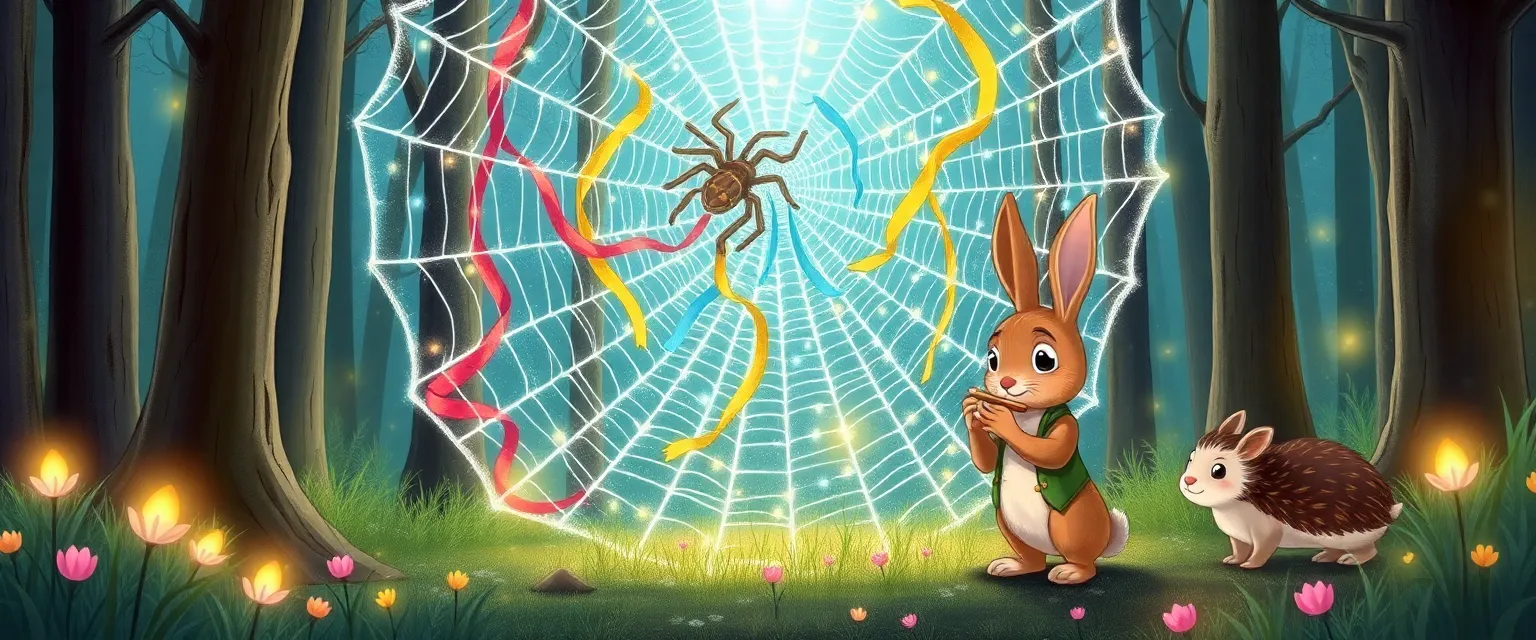
News 29-12-2025
Felix and the Upside-Down Treehouse
In the very heart of a bright jungle, where flowers sang in the mornings and waterfalls told stories, lived a curious fox named Felix. His orange fur gleamed in the sun, and his green scarf streamed behind him as he raced between the trees. Felix loved inventing funny gadgets and telling jokes to his best friend — a parrot named Pepper.
Pepper was truly special. Her rainbow feathers shimmered with every color, and her laughter chimed like little bells. She laughed at all of Felix’s jokes, even the silliest ones. But one morning something terrible happened.
“Felix!” Pepper flew to his treehouse, and her voice was very sad. “I ate a strange dark berry, and now I can’t laugh! Not at all!”
Felix tried to make her laugh with his best joke about a banana and a coconut, but Pepper didn’t even smile. Her beak stayed solemn and her eyes were full of sorrow.
“That was a Serious Berry!” gasped Felix. “I need to find a cure!”
He dashed into his workshop inside the treehouse and began flipping through an old book about magical plants. Suddenly the floor beneath his paws trembled. The whole house began to turn! Felix grabbed the table, the book flew into the air, and when everything stopped he saw something incredible.
Outside the window was another world. Trees grew roots-up, straight out of the sky! Rivers flowed from below to above, and birds flew upside-down. Felix opened the book — now resting on the ceiling — and read: “The Giggling Fruit grows only in the Upside-Down Jungle, on the floor-ceiling. It heals lost laughter.”
“I must get there!” declared Felix, and he bravely stepped through the door.
As soon as his paws touched the ground... which was the sky... he felt dizzy. Everything worked backward! Suddenly a mischievous monkey appeared, walking through the air as if it were an ordinary path.
“Hi! I’m Flip!” said the monkey, hanging upside down — though for her that was normal. “You look very lost!”
“I need the Giggling Fruit for my friend,” Felix explained.
“Oh! That’s tricky! Everything here is opposite. To arrive somewhere you must first leave. To find something you must lose it. Come on, I’ll show you the way!”
They set off through the strange world. Felix tried to walk forward but somehow ended up moving backward. When he wanted to climb a tree he had to go down. It was so confusing!
“You’re thinking too normally!” Flip laughed. “Here you must think the other way around!”
They met a friendly sloth hanging from a branch that grew down from the sky. He wore a chef’s hat.
“!doog gninrom ,ZiveT” said the sloth.
“What?” Felix didn’t understand.
“He speaks backwards,” Flip whispered. “That’s the Backwards Cook. He knows everything about the Upside-Down Jungle!”
Felix tried speaking backwards: “?tciuQ gniggiG tiurF rof m’I” (which sounded like nonsense until the sloth grinned).
The Backwards Cook beamed broadly: “!plehs uoy lliw ,kroW sdrawkcaB” — then he pointed up... or down... in short, he pointed toward the right direction.
To reach the Giggling Fruit, Felix had to solve three upside-down riddles. First he had to eat a sweet dessert so he would become hungry. Then he had to sleep, to gather energy for a journey that had already ended. And finally, he had to say goodbye to Flip before they had met.
Felix’s head was spinning, but he grasped the important thing: he had to stop thinking the usual way and accept a new way of seeing the world.
At last, on the ceiling-floor between two trees that grew toward each other, he spotted it — a golden Giggling Fruit, softly chuckling to itself. Felix carefully plucked it and hurried back to the treehouse.
When the treehouse flipped back, Felix found himself in the regular jungle again. Pepper sat sadly on a branch.
“Pepper! Open your beak!” Felix cried.
He gave her a piece of the Giggling Fruit. At first nothing happened, then the corners of her beak twitched. Then she tittered. And then... she burst out laughing so loud that all the flowers in the jungle sang even more cheerfully!
“Ha-ha-ha! Felix, you’re the best friend in the world!” Pepper laughed. “Tell me about your adventure!”
So Felix told her everything about the Upside-Down Jungle, about Flip and the Backwards Cook. And most importantly — he learned that sometimes, to solve a problem, you must look at it from a completely different angle. Even if that angle is upside-down!
From that day on, Felix and Pepper often visited the Upside-Down Jungle, where everything worked backwards, but their friendship stayed as true as ever in the ordinary world.
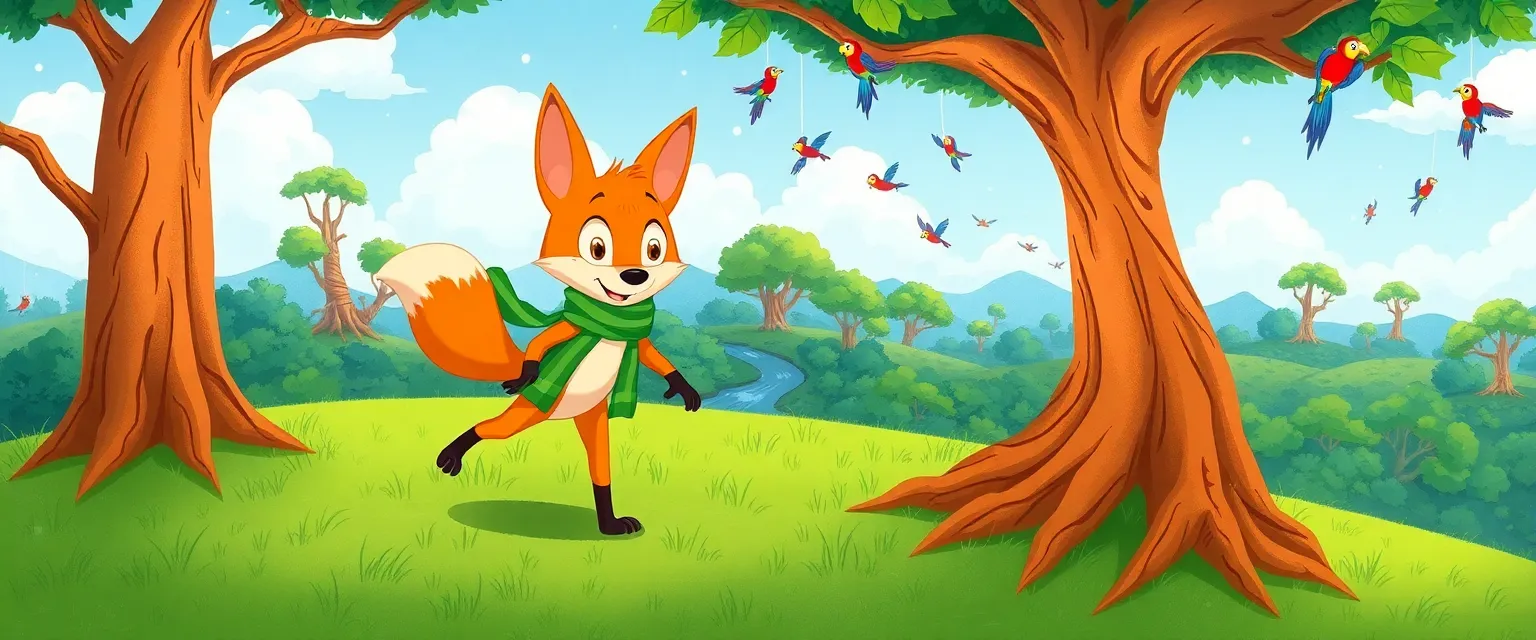
News 28-12-2025
Finn and the Jungle of Growing Dreams
High above the enchanted jungle, where the trees brushed the clouds, lived a gentle giant named Finn. His home was woven from branches that had grown just for him, twisting into a cozy cottage among the leaves. Each night Finn collected silver moonbeams in glass jars, and they glowed softly on his shelves like little stars.
Finn was lonely. He was afraid to come down into the jungle because his big hands might accidentally crush a delicate flower or frighten a tiny animal. So he stayed in his treetop house, watching the jungle from above.
But one morning Finn noticed something strange. The trees were shrinking. The bright bioluminescent flowers that usually lit the night barely flickered. The jungle seemed to be withering.
Suddenly a tiny hummingbird with iridescent feathers in every color of the rainbow darted up to his window.
“Finn the giant, help is needed,” she sang in rhyme. “My name is Pepper, trouble’s dire! Half my dream is in this bottle — without it, the jungle’s on fire!”
Clutched in her feet was a small bottle, inside which swirled a pink mist — half a dream.
“What happened?” Finn asked, carefully extending a huge palm so Pepper could land.
“Dreams are disappearing day by day,” the hummingbird explained. “Without dreams, trees won’t grow, flowers won’t bloom, and the animals forget who they are. Help me find the other half of my dream, and I’ll show you what’s wrong!”
Finn sighed. He was afraid to go down, but he could not refuse. He took a few jars of moonbeams and climbed down on vines, gingerly making his way into the jungle.
The moss under his feet was soft and left glowing footprints. Pepper fluttered ahead, leading him deeper into the forest. Soon they came to a vast tree whose roots sheltered an ancient turtle. Its shell was covered in strange patterns that moved and braided together.
“That’s Elder Turtle,” Pepper whispered. “The map of all the jungle’s dreams is on his shell. But he has forgotten how to read it.”
Finn crouched down to make himself as small as possible.
“Hello, Elder,” he said softly. “Can you help us find the stolen dreams?”
The turtle slowly raised its head. Its eyes were wise but clouded.
“Dreams…” it whispered. “I remember dreams. But the patterns on my shell no longer speak to me. The shadows took them… to a cave where day meets night.”
Finn uncorked one of his jars. A silver moonbeam slipped out and touched the turtle’s shell. The patterns flared with bright light, and the Elder closed his eyes.
“I see!” he exclaimed. “The Shadow Monkeys have gathered dreams in their cave. They want to become real, but they don’t understand they already are. Go west, where the tree has silver leaves.”
Finn and Pepper thanked the turtle and continued on. The closer they came to the cave, the quieter the jungle became. Even the birds fell silent.
At last they reached a cave mouth guarded by creatures of twilight — Shadow Monkeys. They were semi-transparent, as if woven from the evening sky.
“Go away!” one of the monkeys cried. “These dreams are ours! They will make us real!”
Inside the cave Finn saw hundreds of bottles and leaves filled with colored mist — the dreams of every jungle inhabitant. The Shadow Monkeys hugged them close, yet their bodies remained translucent.
Finn felt his heart ache with pity. He understood their fear — the fear of not being real enough, not being important.
“You are already real,” Finn said gently, dropping to his knees. “Look. When I was afraid of being too big, I felt almost invisible. But that didn’t make me not real. You exist. You feel. You matter.”
He opened his hand, and Pepper set the bottle with half her dream on his palm.
“Dreams don’t make us real,” Finn continued. “But when we share them, they make the world more beautiful. Look at what happens to the jungle without dreams.”
The Shadow Monkeys glanced at one another. The smallest of them timidly stepped forward and offered Finn a bottle of bright blue mist.
“We… we didn’t mean to harm anyone,” she whispered. “We just wanted to be like everyone else.”
“You are like everyone else,” Finn smiled. “You are part of this jungle, just as important as the trees and the flowers.”
Slowly, one by one, the Shadow Monkeys began to return the stolen dreams. Finn opened the bottles and released the colored mists. Dreams rose into the air and scattered through the jungle, finding their rightful owners.
Trees began to grow before their very eyes. Flowers burst into brilliant bloom. Birds sang, and animals remembered their names and purposes. Even the Shadow Monkeys looked brighter, more alive — not because they grew denser, but because their fear faded.
Pepper found the other half of her dream — a golden mist shaped like a tiny sun. When the two halves joined, a rainbow flew out of the bottle and wound itself around the jungle, making everything grow all the faster.
“Thank you, kind giant,” Pepper sang. “You saved us all, have no doubt! Your kindness is stronger than fear, and your heart is our home!”
Finn looked at his hands. They were still big, but now he knew they could be gentle. A Shadow Monkey perched on his palm, and he was no longer afraid to crush it.
From that day on Finn no longer sat alone in his treetop house. He came down into the jungle, helping animals, gathering dreams, and sharing them with those who had forgotten how to imagine. And the Shadow Monkeys became guardians of dreams, making sure every jungle resident could see beautiful visions.
And the jungle grew and grew, fed by the dreams of all who lived there — big and small, solid and translucent — because everyone mattered, everyone was real, and everyone had the right to dream.
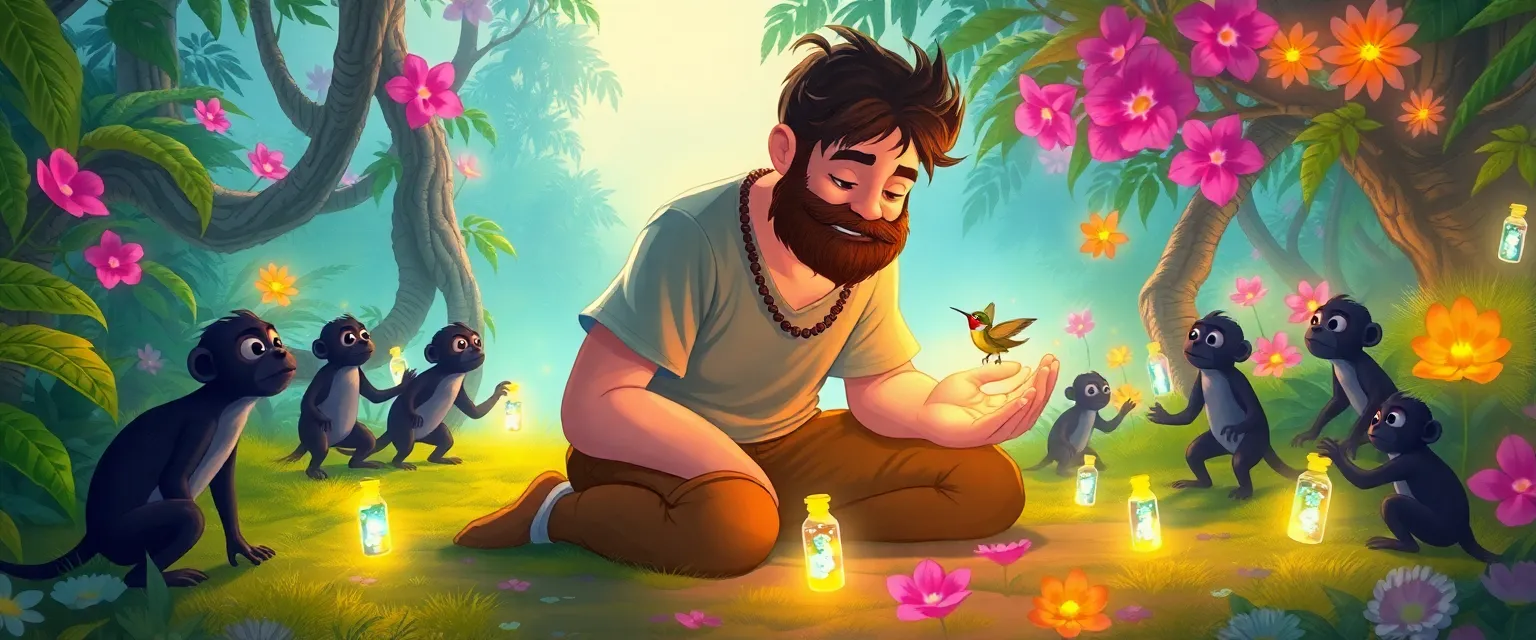
News 27-12-2025
Luna and the Star Clock of Siberia
In the Siberian town of Starry, where winter never seemed to end, ten-year-old Luna sat by her bedroom window, repairing a broken music box for the neighbor girl. Her fingers worked deftly with tiny gears while outside blue lanterns lit the streets lined with wooden houses and impossibly tall towers of ice.
“Every mechanism has a heart,” she whispered the words of her grandmother Vera, who had vanished three years before. “Find it, and everything else will work.”
Suddenly the town fell into an odd silence. Luna looked up at the sky and gasped. One of the stars had stopped twinkling. The stars above Starry were no ordinary stars — through their glow tiny gears and springs peeked out, as if the sky itself were a gigantic clockwork.
At that moment the world around her froze. A snowflake hung motionless before her nose. A sparrow hovered midwing, wings halfway through a beat. Only Luna could move.
“Finally,” said a voice behind her.
She turned and saw a boy woven from hoarfrost and starlight. He was translucent; the outlines of the room showed through him.
“Who are you?” she whispered.
“My name is Severin. I was an apprentice to the Keeper of Time, but I got stuck between seconds when the star-clock began to stall.” His voice sounded like the chime of ice. “Your grandmother was the last Keeper. She left you a message.”
Severin handed her an old journal. Luna recognized her grandmother Vera’s handwriting. On the first page it read: “My dear Luna, if you are reading this, that means the stars are stopping. You must climb the Ice Tower and wind them again. Search for the parts of the Star Bell. The melody in your heart — you’ve always known it.”
“We have seven days,” Severin said. “When the last star stops, time will freeze forever.”
Luna looked out the window at the Ice Tower in the center of town — a spiral of frozen water rising into the clouds. Somewhere up there, in the Star Chamber, all the celestial mechanisms met.
“I’ll fix them,” she said firmly. “Like I fix toys. I just need to find the heart of the mechanism.”
Over the next days Luna hunted the parts of the Star Bell throughout the town. Each piece was hidden in a frozen memory of her grandmother. Luna found them by humming fragments of the lullaby she’d known since childhood — the song her grandmother used to sing at night. Strangely, the tune itself revived the paused moments.
She freed the baker, frozen with a tray of pastries. She thawed a cat mid-pounce at a falling leaf. With every rescued moment Luna gathered another piece of the instrument.
But as she neared the Ice Tower, her path was blocked by the Ice Wolves — creatures of frozen time, silver and beautiful.
“Do not climb,” pleaded the pack’s leader. “We exist only in stopped moments. If time flows again, we will vanish.”
Luna looked into his mournful, icy eyes and realized they were not villains. They were simply afraid of change, just as she had been when her grandmother disappeared.
“I know how terrible it is to let go,” she said softly. “I miss my grandmother every day. But she wouldn’t want the world to stop. Beautiful things have to change to stay alive. Even you can become something new, instead of simply disappearing.”
The wolves opened a silent path.
The tower rose to meet her courage, growing stairways where Luna dared to step. When fear tightened around her heart, walls rose to block the way. Luna learned to breathe evenly, to think of her grandmother and her words, and to remember she was not alone.
Severin climbed beside her, growing more transparent by the minute.
“When you wind the clock, will I become real?” he asked.
“I don’t know,” Luna answered honestly. “But you’ll be free. Isn’t that more important?”
At last they reached the Star Chamber. Giant gears and pendulums filled the space beneath a glass dome through which the starry sky spun. In the center stood a pedestal for the Star Bell.
With trembling hands Luna assembled the instrument from the parts she had found. The last star in the sky held its breath, and cold crept over her skin — her own time beginning to slow.
“Play!” Severin cried.
Luna raised the bell and began to hum her grandmother’s lullaby. The instrument took up the melody, and silvery notes flowed through the Chamber. The enormous gears shuddered, creaked, and began to turn.
One by one the stars above flared to life, their mechanisms awakened. Time flowed again through the town of Starry. Snowflakes descended, the sparrow finished its wingbeat, people went about their days.
Severin began to glow brighter; his translucent form grew solid. He looked at his hands as they became real and laughed — bright and human.
Down below the Ice Wolves did not vanish. They transformed into ordinary wolves with silvery fur and ran off toward the forest, alive and free.
Luna returned home as dawn painted the sky pink. On the table lay her grandmother’s journal, open to the last page: “You did it, my clever one. You found the heart of the mechanism — it was love. Love that does not hold on, but lets go. That does not stop time, but helps it move forward. I am always with you.”
Luna pressed the journal to her chest and smiled through her tears. Outside, Starry woke up; the tower clocks read the right hour, and the stars above the town ticked steadily and faithfully, keeping time until the next dawn.

News 26-12-2025
The Garden Where Flowers Kept Secrets
Maya woke to a strange sound outside her window. It was like a whisper—so soft she could barely make it out. She went to the window of her new room in her grandmother’s house and leaned out into the garden.
The morning sun gilded the old trees with their silvery bark, and winding stone paths threaded between them—paths that, Grandma Irene liked to say, changed direction each morning. A fountain burbled in the center of the garden, and flowers of every imaginable hue grew around it in mysterious spirals.
“Grandma,” Maya called as she hurried down the stairs, “the flowers in the garden… are they whispering?”
Grandma Irene looked up from her teacup, and Maya noticed a worry in her eyes.
“They didn’t whisper before, dear. They sang. Come, I’ll show you something.”
In the garden, Grandma led Maya to a large red dahlia whose petals were duller than the others.
“This is Dahlia,” Grandma Irene said. “She used to tell the boldest stories of bravery and daring. But now…”
“I… can… hardly… remember…” Dahlia breathed in a voice barely audible.
Maya sat beside the flower and gently touched its stem.
“What happened?”
“Someone is stealing our stories,” came a melodic voice from the right. It was a white jasmine softly humming a sad tune. “I remember songs from far-off lands, but the words are vanishing one by one.”
Maya spent the whole day talking to the flowers. By evening she learned that every night someone came into the garden and took their stories, locking them in glass bottles. With each stolen tale the flowers lost a bit of color and a piece of their voice.
“We have only until the full moon,” Dahlia whispered. “When the last flower loses its voice, the garden will die.”
That night Maya decided not to sleep. She hid behind a large tree and waited. The moon climbed high when she heard a rustling above. A monkey in a patched vest with many pockets descended from the branches. In his hands he held a glass bottle that glowed with a soft blue light.
“Stop!” Maya cried, stepping out of her hiding place.
The monkey startled and nearly dropped the bottle.
“Who are you?” he asked warily.
“My name is Maya. And you?”
“Milo,” the monkey grumbled. “And it’s none of your business what I’m doing here.”
“You’re stealing the flowers’ stories! They’re dying because of you!”
Milo frowned and hugged the bottle to his chest.
“I don’t steal. I collect. I’m writing the greatest book of adventures the world has ever seen. But my own life is too dull. Who wants to read about a monkey who just lives in a garden?”
Maya looked more closely at Milo. His vest was old but neatly mended. She saw not malice in his eyes, but loneliness.
“Show me your little home,” she asked softly.
Milo blinked in surprise, then nodded. They climbed to his small treehouse, where Maya saw shelves lined with glowing bottles in every color of the rainbow. An open notebook with neat handwriting lay on the table.
Maya began to read. The story was thrilling—about a brave traveler who crossed a desert and saved a town from drought. But something was wrong, as if pieces from different puzzles had been forced together.
“See?” Milo said proudly. “This will be the best book ever.”
“But this isn’t your story,” Maya said quietly. “Milo, have you ever tried telling a story about yourself?”
“Nothing interesting ever happens to me,” Milo muttered, looking away.
“Tell me about your vest. Where did all those pockets come from?”
Reluctantly, Milo began to speak. Each pocket, he explained, he had sewn on after a different event in his life. One pocket for the day he learned to climb the tallest trees. Another for when he tasted mango for the first time and wanted to carry a seed as a keepsake. One more for the day he found this garden and decided to stay.
As Milo talked, Maya noticed the air around them shimmer with thin ribbons of color—just like those she had seen in the bottles.
“Look!” she cried. “Your own stories! They’re real, and they’re beautiful!”
Milo watched the glowing ribbons weave patterns around them, and tears sparkled in his eyes.
“But the flowers… what do I do now?” he whispered.
“We’ll give their stories back,” said Maya. “Then you’ll write your book. A real one.”
The next morning Maya and Milo carried all the bottles to the fountain. Grandma Irene taught them what to do. They opened each bottle and spoke aloud the name of the flower that owned the story. Colorful ribbons burst from the glass and rushed to their owners.
With every returned story the flowers grew brighter. Dahlia blushed like the dawn. Jasmine sang a tune that made even the stones on the path smile.
When the last bottle was empty, the garden erupted in color and song. The flowers laughed and sang and told one another the tales they had almost lost forever.
“Thank you,” Milo whispered to Maya. “I was so lonely I thought other people’s stories would make me important.”
“You were important already,” Maya said. “You just needed someone to see it.”
From that day Milo no longer hid in his treehouse. He came down to the garden every day and told the flowers about his own adventures—how he learned to sew, the first time he saw a rainbow, how he found the perfect tree for his home. The flowers listened in delight because his stories were full of honest feeling.
Maya learned to collect dew from the flowers at dawn. When she sipped those drops, she could understand the language of every growing thing—not just in her grandmother’s garden, but beyond it.
Together Maya and Milo began to write stories. Not by stealing them, but by asking and recording with permission. The flowers happily shared their memories, and Milo added his own exploits.
By the full moon the garden shone brighter than ever. Grandma Irene smiled in her rocking chair on the porch, and a light burned in the treehouse—Maya and Milo were at work on a book born of friendship, honesty, and the understanding that the best stories are those we share, not those we take.
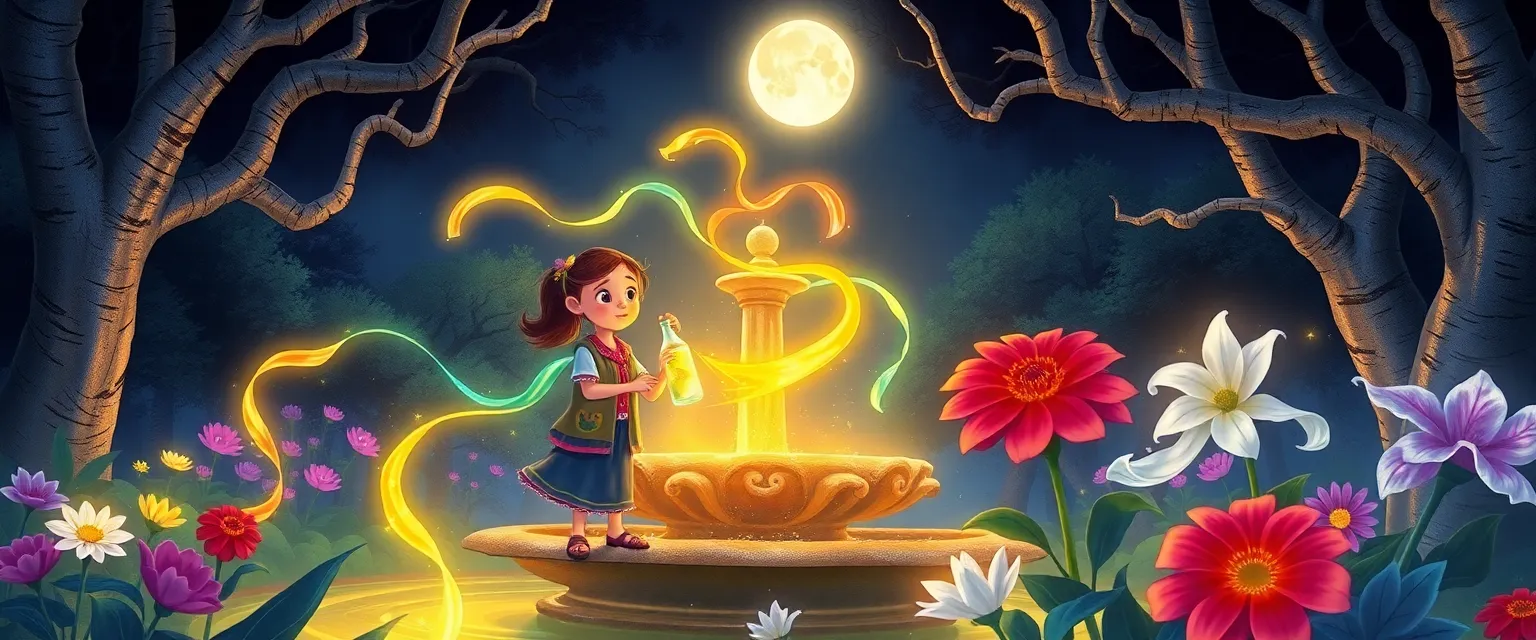
News 25-12-2025
The Winding Garden and the Girl Who Grew Backwards
In a world where dinosaurs never died out, islands drifted high above the jungles in clouds that looked like spun sugar. On one of those islands lived a ten-year-old girl named Polly. She loved tinkering with odd gadgets made from old gears and springs.
One morning Polly went to visit Professor Filin, a wise old owl who lived in a greenhouse full of marvelous mechanical plants. The flowers ticked like clocks, and their petals were made of thin glass through which tiny golden gears were visible.
“Professor Filin!” Polly called as she stepped into the greenhouse. “I brought you a new watering tool!”
But the professor had dozed in his armchair among books and blueprints. Polly didn’t wake him and instead wandered among the plants. In the very center of the greenhouse grew a special flower — all made of clear crystal, its core lit with tiny, shimmering stars.
“How beautiful!” Polly whispered and, unable to resist, touched a petal.
The moment her fingers brushed it, the flower chimed like a bell and a thousand sparks wrapped around the girl. Polly felt a gentle tingling and quickly pulled her hand back.
“What have you done, my child!” Professor Filin cried, waking at the sound. He fluttered up from his chair and hurried about Polly, flapping his wings. “That’s the Crystal Flower of Time! I made it by accident trying to preserve my youthful memories!”
“What will happen now?” Polly asked, frightened.
“You will begin to grow backward,” the professor said sadly. “Each morning you will wake one year younger. In seven days you will be a toddler and will forget who you are.”
Polly felt tears starting, but she was brave.
“How can I break the spell?” she asked.
“You must gather five parts of an ancient song,” explained the professor. “They are hidden across the floating islands. Only that song can set time right. But only dinosaurs can truly hear it — they’ve lived long enough to learn the music of time.”
The next morning Polly woke and found she had shrunk a little. Her favorite dress hung loosely. She climbed down toward the jungles, where among tall ferns lived a young brachiosaurus named Gromik.
Gromik was a special dinosaur. He couldn’t roar like the others, but he could hear the melodies hidden in stones and stars.
“Gromik, will you help me?” Polly asked. “I need to find the parts of the ancient song.”
Gromik bent his long neck and looked at the girl with gentle eyes. He nodded and lowered himself so Polly could climb onto his back.
They flew to the first island, where flowers bloomed in reverse — they withered first and then became buds. There they met the Petal-Keeper — a tiny hummingbird-dinosaur with iridescent feathers.
“To earn the first part of the song,” she chimed, “answer my riddle: what becomes larger when you give it to others?”
Polly thought. Before, she might have chased a clever answer, but now, seeing the world through a younger child’s eyes, the simple truth was clear.
“Joy!” she cried. “When you share joy, it grows!”
The Petal-Keeper smiled and gave them the first part of the song. Gromik heard it — a gentle melody like the whisper of wind.
On the second day Polly woke even younger. Now she was eight. They traveled to an island where waterfalls ran upward. There the Keeper posed another riddle:
“What can you hold without touching it with your hands?”
Polly, thinking with a child’s clarity, answered at once:
“A promise!”
Each day Polly grew younger, but she also noticed some things became easier. As a child she no longer feared leaping across deep chasms between islands. As she got tinier, she fit through a narrow tunnel to fetch the fourth piece of the song.
On the sixth day Polly was only four. She sat on Gromik’s back as they flew to the final island, where the seasons changed by the hour. It was winter now; everything was powdered with snow.
“Final riddle,” the Keeper said. “What grows downward instead of up?”
Little Polly looked at the icicles hanging from the branches of the mechanical trees.
“Icicles! And tree roots!” she shouted with delight.
The Keeper gave them the last part of the song. Gromik joined the five melodies together and began to sing. His voice, which had never been a roar, filled the sky with enchanted music. The song sounded like memories of all ages at once — first steps and first words, the boldness of youth and the wisdom of old age.
Polly felt a warm light wrap around her. Back in Professor Filin’s greenhouse the crystal flower chimed in answer to the song, and the spell unraveled.
The next morning Polly woke ten years old again. She ran to Professor Filin, and Gromik walked beside her, treading carefully on his huge feet.
“Thank you, Gromik,” Polly said, hugging one of his great legs. “I learned something important. When I was small, I saw simple solutions. When I was older, I made complicated plans. Every age gives you something special.”
Professor Filin nodded wisely.
“You’re right, my child. Growing up doesn’t mean losing the joy and courage of childhood. It means gathering the best parts of every day into your heart.”
From then on Polly often visited Gromik, and together they flew between the islands. Professor Filin put the crystal flower under a glass dome so no one would touch it by accident. But sometimes, when Polly felt she was rushing to grow up, she would go to the greenhouse, look at the flower, and remember the wondrous journey backward through time that taught her to cherish every day of her life.
And Gromik learned not only to hear the songs of time but to hum them softly as he tucked little dinosaurs to sleep under the starry sky.
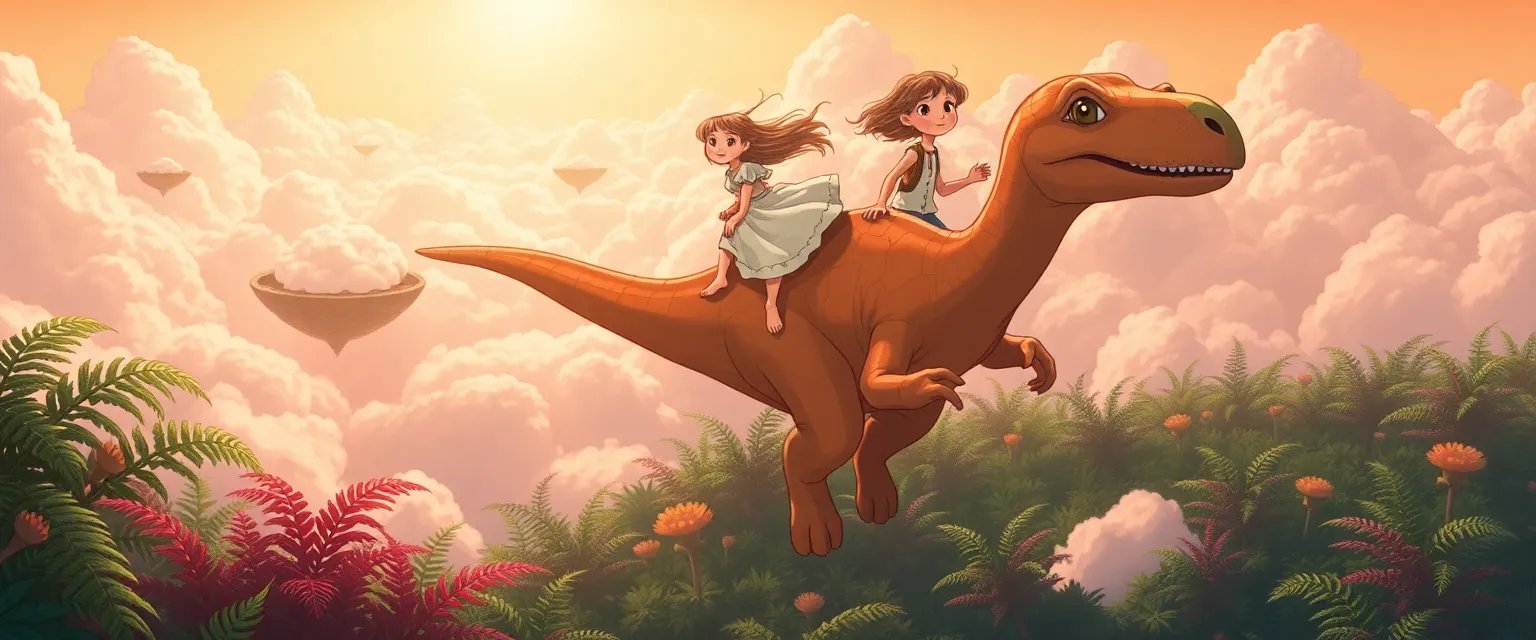
News 24-12-2025
The Girl Who Grew Backwards and the Clockwork Garden
In the Endless Summer Jungle, where the sun always shone and colorful parrots sang, lived a kind fairy named Blossom. Her wings were like a butterfly’s, pink and iridescent in the sunlight. Blossom lived in a treehouse draped with garlands of flowers, and she could make plants bloom with a single touch.
One morning, while Blossom was watering her favorite orchids, she heard a soft sobbing. Climbing down the rope ladder, the fairy found a girl sitting beneath a giant fern.
“Hi! I’m Blossom. Why are you crying?” the fairy asked.
“I’m Ivy,” the girl replied, wiping her tears. “Something strange is happening to me. Twenty days ago I was thirty, but each day I get a year younger! Today I’m only ten. What if I disappear entirely?”
Blossom’s eyes widened in surprise.
“That’s unusual magic! We must find the Clockwork Garden. They say the Timekeeper Oak there knows all answers about time.”
“But nobody knows where that garden is,” Ivy said sadly.
“My flowers know all the jungle’s secrets!” exclaimed Blossom, touching a large red blossom. It chimed like a bell and whispered, “Seek Tick-Tock at dawn. He will show the way.”
The next morning, as the first rays of sun kissed the treetops, a marvelous little bird appeared. It was made of brass and gemstones, gleaming like a piece of jewelry.
“I’m Tick-Tock, the mechanical hummingbird,” he trilled. “I’m ready to help you! But the path is not easy — three trials await.”
Tick-Tock led them deeper into the jungle. Soon they came to a high wall of thorny vines.
“The first trial is wisdom!” declared Tick-Tock. “A riddle you must solve!”
A face woven from leaves formed in the vines:
“What always runs but never tires? What can be lost but never truly found?”
Ivy thought for a moment and then smiled.
“Time! It always flows; you can lose it, but you can’t get it back.”
The vine wall parted and let them pass.
The second trial awaited at a swift river. The bridge across it was old and shaky.
“The trial of courage!” chimed Tick-Tock. “You must cross the bridge with care!”
Blossom took Ivy’s hand.
“Together we fear nothing!”
They walked slowly across. The planks creaked, but the friends supported one another. When they reached the far bank safely, applause sounded behind them — the banana palms clapped their broad leaves.
At last they came to the third trial — a huge stone blocking the path.
“The final trial is kindness of heart!” Tick-Tock said. “What will you give away without regret?”
Blossom thought and removed her favorite flower crown.
“I’ll give my crown. Friendship matters more than any adornment.”
Ivy took out her journal.
“I’ll give my journal, even though it holds everything I remember. Memories live in the heart, not just on paper.”
The stone glowed and vanished, revealing the entrance to a wondrous place.
The Clockwork Garden was more beautiful than anything they had seen! Plants spiraled and flowers opened and closed like clock faces, and in the center stood a majestic oak whose roots were made of golden gears. Its leaves chimed softly like tiny bells.
From behind the oak stepped a curious figure — the Gardener of Clocks. He was woven of vines and clockwork mechanisms.
“You have passed all the trials,” he intoned in a voice like the ticking of great clocks. “Now I will tell the truth. Ivy, twenty days ago you wished to grow younger and return to childhood when everything seemed simpler. The garden’s magic granted your wish quite literally.”
“But I don’t want to vanish!” Ivy cried. “I’ve learned every age has its own beauty!”
The Gardener nodded.
“That is the lesson. You have learned to value the present.” He held out a golden acorn from the Timekeeper Oak. “Plant this in the earth and speak your true wish.”
Ivy buried the acorn and whispered, “I want to grow in the right direction, like everyone else, and cherish every day!”
The acorn shimmered, and Ivy felt the strange spell lift from her.
“Thank you, Blossom!” she hugged the fairy. “I couldn’t have done it without your friendship!”
From then on Ivy grew the usual way — getting older with each passing day. She often visited Blossom in her treehouse, and together they tended a special sapling — the shoot from that very golden acorn. It grew in a pot on the windowsill and reminded them both that time is a gift, and every moment should be lived with joy and gratitude.
Tick-Tock would sometimes arrive at sunset and sing his tinkling songs about cherishing every minute and sharing kindness with friends.
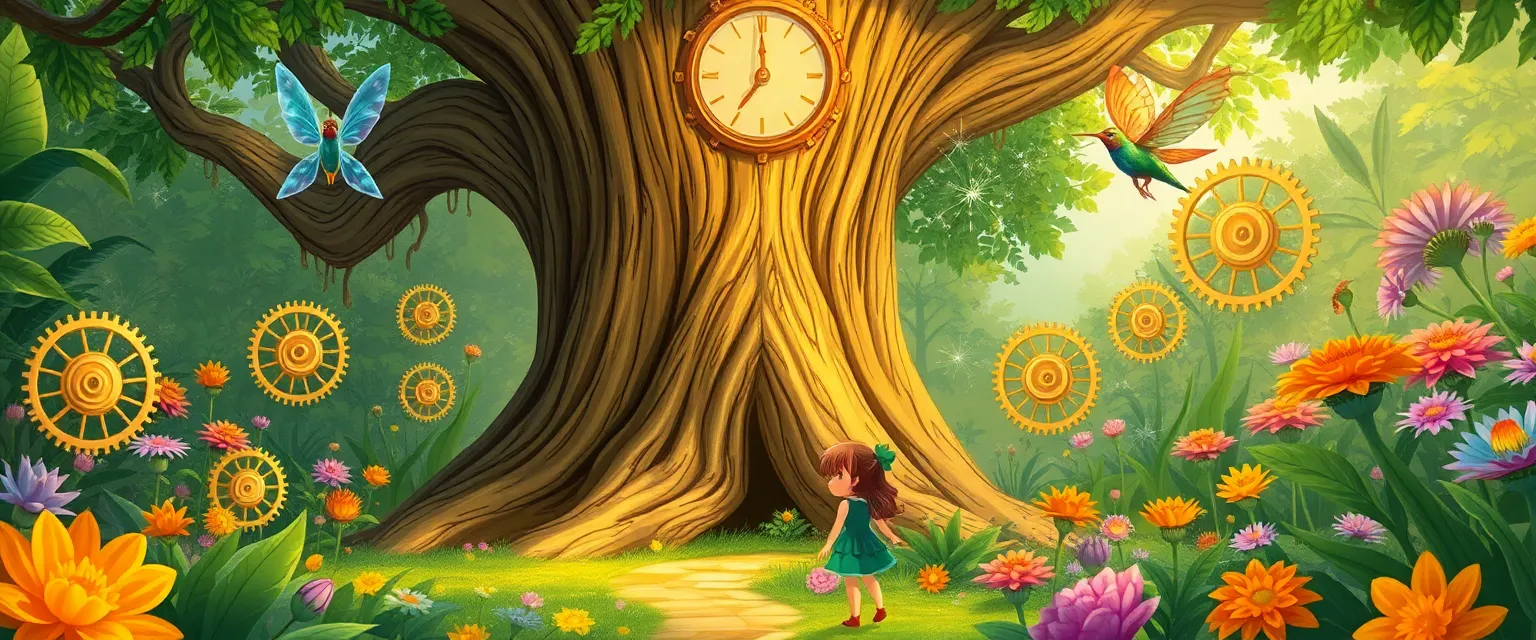
News 23-12-2025
Timo and the Library of Unfinished Dreams
In the very heart of an old forest, where the tree roots braided together like the fingers of friends holding hands, lived a little turtle named Timo. He was shy and quiet, and when he got nervous words would stick in his throat like leaves in a narrow stream. But Timo loved books. In his small leather satchel he always carried his three favorite stories, which he reread by the light of the moon.
One autumn evening, as golden leaves whirled through the air, Timo noticed a strange glow at the base of an ancient oak. The tree was so old nobody remembered when it first grew. Timo crept closer and saw a tiny door carved into the bark. His heart beat faster. Gathering all his courage, he pushed the door open.
Inside the oak was a whole other world. Spiral staircases rose and fell, disappearing into shimmering mist. Endless shelves held books—strange books! They glowed with a soft light and seemed half-transparent, as if woven from morning fog.
“Welcome to the Library of Unfinished Dreams,” said a tired voice.
Timo turned and saw an elderly badger with silver fur that twinkled like it had been dusted with starlight. She sat behind a large table strewn with open books.
“I am the Keeper of Dreams,” the badger said, and Timo noticed how weary she looked. “Each book here is a child’s unfinished dream. When children fall asleep and imagine something wonderful but do not finish their story, it appears here.”
“W-why aren’t they f-finished?” Timo stammered.
“Because children sometimes forget their dreams,” sighed the Keeper. “And when they forget for too long, Silence comes.”
She pointed to a corner of the library where a gray fog was spreading, erasing words from the nearest pages.
“I cannot protect all these stories by myself anymore,” the Keeper whispered. “I need your help, Timo. You must enter three of the most important books and help finish them before dawn. Otherwise children everywhere will lose the ability to dream and create.”
Timo was frightened. He was only a small, shy turtle. But then he thought of all the wonderful tales that had given him joy, and he nodded.
At that moment a hummingbird darted into the library, leaving a trail of rainbow droplets behind her.
“I heard everything!” she chimed. “My name is Iris, and I’m coming with you! I’m an artist—I can paint with dew. Maybe that will help!”
The Keeper smiled and handed Timo a golden thread that shone like a sunbeam.
“This is the Thread of Stories,” she explained. “You know how to feel what a tale needs. This thread will help you link ideas and find endings.”
Timo and Iris approached the first gleaming book. On its cover were the words: “The Princess Who Wanted to Be a Gardener.” They stepped inside and found themselves in an enchanted garden where a princess named Alice sat beside an empty flowerbed and cried.
“I want to grow flowers, but I don’t know how to finish this,” she sobbed. “The story is stuck!”
Timo saw golden threads stretching from the princess to the seeds, the watering can, and the sun. He understood! With trembling little feet he began to connect the threads, while Iris painted emotions with dew—patience, care, hope—making them visible as colorful streaks in the air.
“You must p-plant the seeds, w-water them every day, and b-believe that they will grow,” Timo said. “Even if it takes time.”
Alice smiled, and the garden suddenly bloomed in a thousand colors. Words filled the pages, and the friends returned to the library.
The second book was called “The Boy Who Was Looking for His Song.” Inside, a boy named Sam paced, surrounded by scraps of melody that wouldn’t fit together.
“I can’t find my special song!” he cried in despair.
Iris painted his fear—a dark purple cloud. Timo noticed the golden threads weren’t reaching for one big song, but for many small sounds: laughter, the rustle of leaves, the burble of a brook.
“Y-your song doesn’t have to s-sound like anyone else’s,” Timo said, quieter than usual but very steady. “It’s made of the things you love.”
Sam listened to the sounds around him and started humming his own, unique tune. The book glowed, complete.
The last book was the hardest: “The Town That Forgot How to Laugh.” Gray Silence had already crept across its pages, erasing smiles from the faces of the townspeople.
“We must h-hurry!” Timo said—stumbling only this once.
They stepped into the book and saw a sorrowful town where people walked with their heads bowed. Iris tried to paint joy, but her colors dimmed. Silence was too strong.
Timo thought. He remembered every story he had read and the lessons they had taught him. Then he realized: laughter doesn’t return by magic alone, but through kindness and doing things together.
“We’ll need h-help,” he said.
They invited the townspeople to gather. Timo began to tell a funny story from one of his favorite books, stumbling over the words and blushing. At first nobody smiled. Then Iris added silly dew-drawings in the air. One child giggled. Then another. Suddenly the whole town was laughing!
The golden threads braided into a shining net, Silence receded, and the book finished just before dawn.
When they returned to the library, the Keeper of Dreams looked younger and stronger. The stardust in her fur shone brighter.
“You found your voice, Timo,” she said warmly. “Not loud, but kind and brave. You helped children finish their dreams, and now they will be able to dream again.”
“And I found my best friend,” Iris added, wrapping a wing around the little turtle.
From that day on Timo visited the Library of Unfinished Dreams often. Sometimes with Iris, sometimes alone. He helped finish stories, and with each completed book his voice grew more confident.
And in the forest the trees continued to blossom with fairy-tale flowers in spring and drop leaves of new plots in autumn, because somewhere children kept dreaming, knowing their stories mattered—and that even the quietest voice can change everything.
The End.
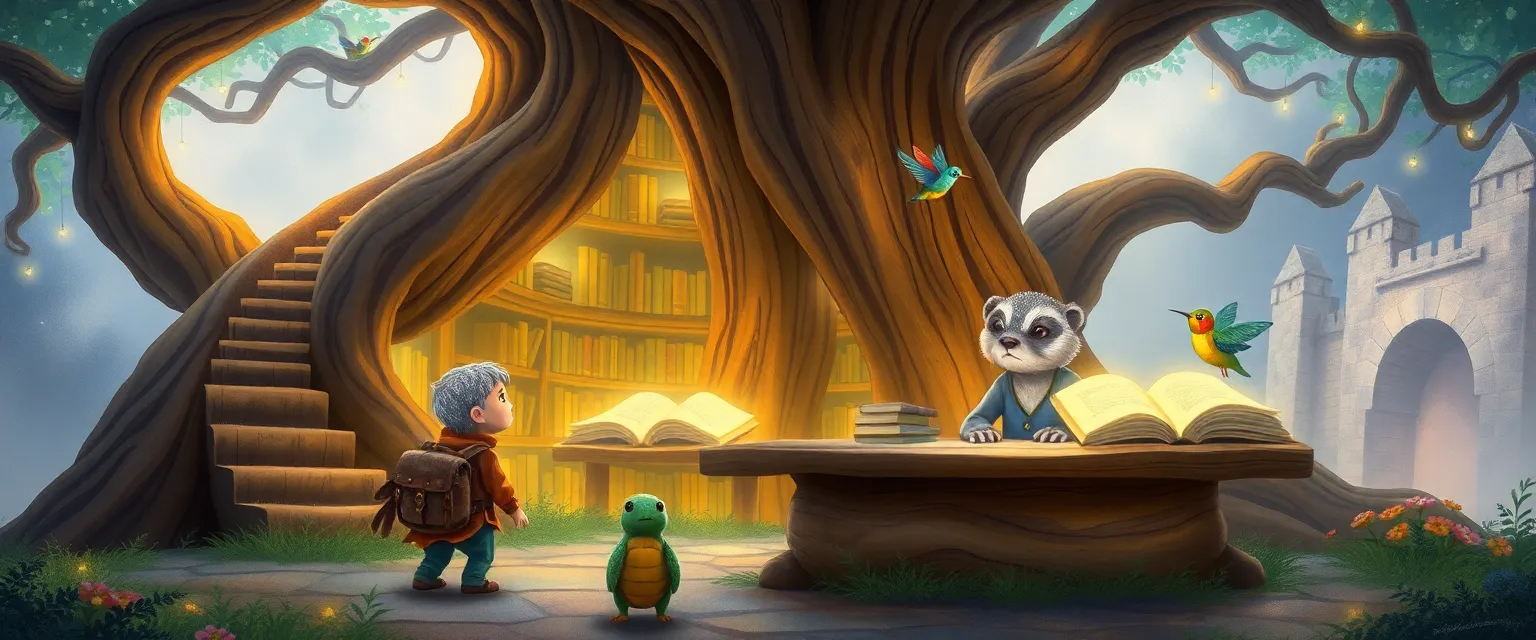
News 22-12-2025
The Clockwork Garden and the Girl Who Grew Backwards
Iris lived in a house on the edge of town where old buildings hid behind tall fences. She was ten years old and loved to make little mechanisms out of wire and gears. Her pockets were always full of screws, springs, and odd bits she found on the street.
One evening, when the sun was already touching the rooftops, Iris noticed a crack in an old wall. She was a curious girl, so she squeezed through the narrow gap and found herself in a remarkable garden.
This was no ordinary garden. Bronze flowers grew on copper stems, mechanical vines wound around trellises with a soft ticking. In one corner spring tulips were blooming, in another autumn leaves drifted down, and beyond them lay winter snow that did not melt. All the seasons existed at once.
In the center of the garden stood a strange gardener. He was made of gears and springs; his body ticked like a great clock. When he turned toward Iris, his lens-eyes focused on her.
“I am Copper,” he said in a voice like the chime of tiny bells. “For centuries I have tended this garden, but I forgot why I was made.”
Iris was not afraid. She stepped closer and saw the most beautiful bronze flower, glowing from within with a soft golden light.
“Do not touch it!” Copper warned, but it was too late.
When Iris touched a petal, something odd happened. She felt the time inside her shiver and begin to turn backward.
The next morning Iris woke up and realized she was a year younger. She was nine. Her favorite sweater hung a little loose and her thoughts felt a bit simpler. She ran back to the garden.
Waiting for her there was a tiny iridescent hummingbird whose wings ticked like clock hands.
“I am the Timekeeper,” chimed the bird. “You touched the Flower of Reversed Time. In seven days you will become a very small child and forget who you are. To break the spell, collect seven seeds of memory.”
“How do I find them?” Iris asked.
“Help seven adults remember the childhood dreams they have forgotten. But remember: each time you help someone, you will grow younger by half a day.”
Iris was brave. She decided to try.
Copper showed her a bronze mirror in the garden. In it she could see people's pasts. The first was an old cobbler whose workshop stood nearby. In the mirror Iris saw a boy who dreamed of making magical shoes that let you dance on clouds.
She went to the cobbler and told him about his forgotten dream. The old man's eyes filled with tears.
“I had completely forgotten,” he whispered. “I used to love imagining things.”
He pulled out an old sketchbook of fanciful shoes and smiled. At that very moment a tiny golden spark flew from his heart and turned into a seed of memory. Iris caught it.
But when she returned home she was already eight and a half.
Day after day it went on. Iris helped a schoolteacher remember that she once wanted to write fairy tales. She helped a doctor recall that he dreamed of mending toy bears. Each time a seed of memory appeared, but Iris grew younger and younger.
On the fifth day, when she was only six, Iris sat in the garden and began to cry. Copper settled beside her.
“I’m scared,” she admitted. “I’m getting so small. I’m forgetting so much.”
“But look at what you are doing,” said the mechanical gardener. “You are returning childhood to people. Their joy. Their dreams. That matters.”
Iris wiped her tears. One fell to the ground and the bronze flowers around her bloomed brighter.
“When I was created,” Copper continued, “I was given a task: to safeguard children's dreams. Now I remember. You helped me too.”
From his chest came a special seed—large and bright.
“That’s the sixth seed,” chimed the Timekeeper. “Only one remains.”
Iris, now a five-year-old, thought hard.
“Where will I find the last seed?”
“Look in the mirror,” Copper advised.
In the bronze mirror Iris saw herself — ten years old, pockets full of gears. She remembered how she had recently thought dreaming was for little kids, that she had to be serious.
“I forgot to cherish my own dreams,” she whispered.
At that moment the seventh seed flew out of her heart.
Iris planted all seven seeds in the center of the garden beside the bronze flower. They sprouted at once into a rainbow tree that chimed like a music box.
Time swirled around Iris. She became ten years old again, but wiser. She remembered what it felt like to be younger and understood that every age has its value.
“Thank you,” said Copper. “You restored the garden’s purpose. Now it will help people remember their dreams.”
Iris returned to the Clockwork Garden often. She brought adults who had forgotten how to dream and children who were afraid to grow up. The garden taught them all the same thing: every age has its own beauty, and true wisdom is remembering who you were and treasuring who you will become.
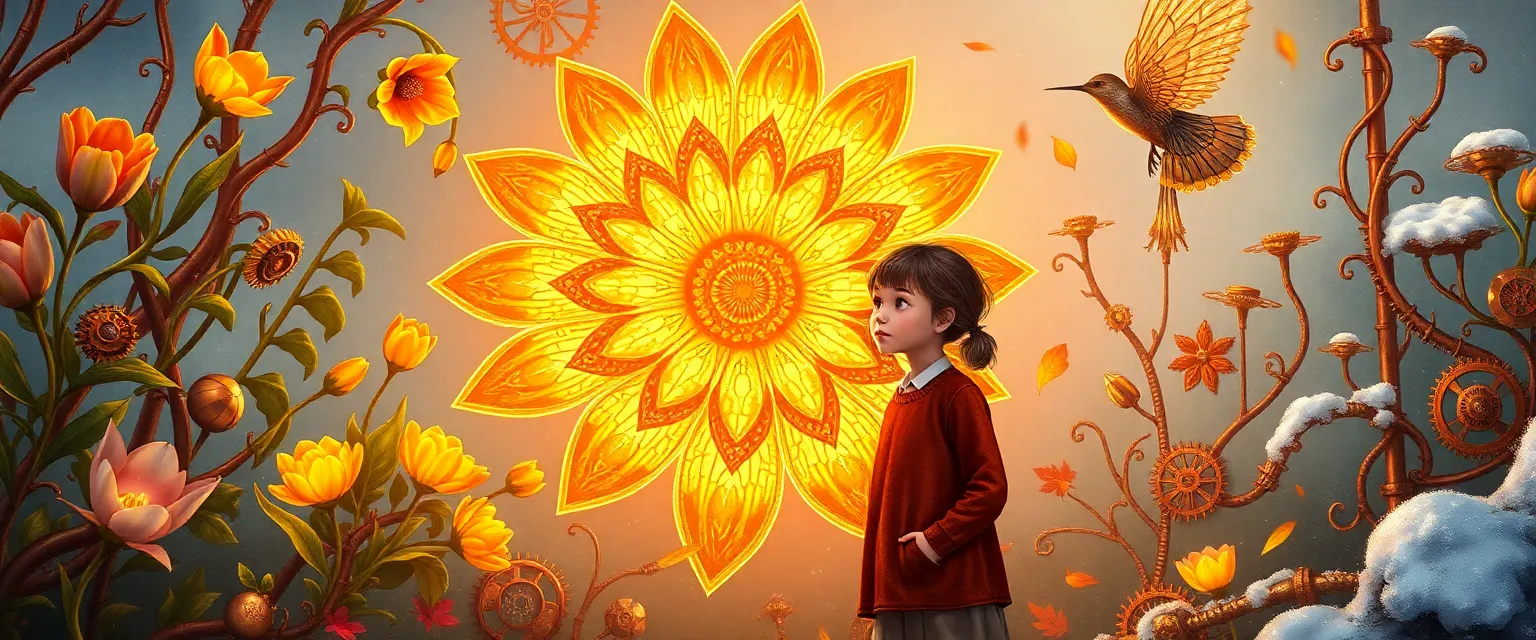
News 20-12-2025
Luna and the Castle of Living Colors
Every morning a girl named Luna built a castle from colorful wooden blocks. She believed every color held its own special feeling. Red meant courage, yellow meant joy, blue meant calm. Her castle grew day by day, getting taller and more beautiful.
But one morning Luna woke and gasped. All her blocks had turned gray! The bright colors had vanished as if someone had wiped them away with a soft cloth. The castle stood before her dull and sad.
“What happened?” whispered Luna, touching the cold gray walls.
Suddenly a tiny butterfly made of sparkling crystals fluttered out from behind a turret. Even she was nearly transparent, barely there.
“I am Prism,” the butterfly said softly. “I used to guard the colors of this castle. But I made a mistake. I was so afraid of sad feelings that I tried to hide them away. And then all the colors disappeared. All of them.”
“How do we bring them back?” Luna asked.
“You must go through seven rooms of the castle,” Prism said. “Each room holds one feeling. Only if you truly feel each of them will the colors return.”
Luna took a deep breath and stepped into the castle. As soon as she crossed the threshold, the walls opened up and the castle became huge and real!
First came the Gallery of Laughter. Soap bubbles floated everywhere and soft giggles filled the air. Luna smiled shyly at first, then laughed out loud, remembering how her little brother had tried to catch a sunbeam. Laughter filled her, and suddenly a yellow crystal gleamed in her hand.
“Onward!” urged Prism. “Quickly to the next room!”
Next was the Corridor of Courage with steep stairs disappearing into the dark. Luna felt afraid. Her legs trembled.
“Maybe we should skip this room,” Prism whispered. “Fear is unpleasant.”
But Luna shook her head. She remembered how scared she had been on her first day at school, and that she had still gone. She took a step into the dark, then another. Fear was there, but she kept going. Then a red crystal blazed in her palm.
In the Quiet Garden grew plants that purred softly. It was so peaceful there that all she wanted to do was sit and listen. Luna allowed herself to pause, and a blue crystal settled gently beside the others.
Then they entered the Ballroom of Storms. Thunder rolled and storm clouds swirled under the ceiling. Luna felt anger rise inside her — she remembered when her brother broke her favorite toy.
“No, no!” Prism squeaked. “You shouldn’t be angry! Let’s go!”
“But I was angry then,” Luna said. “And that’s okay. I am allowed to be angry when I’ve been hurt.”
She let herself feel the anger, and a purple crystal sparkled in her hand.
A cozy Library welcomed them with warmth and soft cushions. Here Luna felt tenderness and love, thinking of her mother’s hugs. A pink crystal.
The Maze of Surprises twisted with unexpected turns. Around every corner something new awaited. Luna felt scared, then joyful, then astonished. An orange crystal.
Only one room remained — the Pavilion of Stillness. Luna pushed the door and stopped. The room was gray. Completely gray. And very quiet.
“There is no color here!” Prism cried. “There’s nothing!”
From the gray shadows stepped a tall figure woven from soft twilight.
“I am the Keeper of Shadows,” the figure said in a deep but kind voice. “Everyone fears me, but I guard balance. Luna, tell me: is gray nothing but the absence of color?”
Luna looked around. The gray room felt like early morning before dawn, like a gentle rain against the window, like those moments when you simply sit and think.
“No,” she said slowly. “Gray is a color too. It’s calm. It’s when you don’t have to be happy or sad. It’s just… being.”
She placed her hand on the gray wall. The wall began to glow—not with bright colors, but with a soft silver and pearly light.
“You understand,” the Keeper of Shadows smiled. “Gray is not emptiness. It is a resting place between feelings.”
The seventh crystal, silvery-gray, fit into her hand.
Luna joined the seven crystals together and they burst into a rainbow. Light spread through the whole castle and the colors returned! Now they were even brighter, because Luna understood each one.
Prism shimmered, sparkling and bright again.
“Thank you, Luna,” Prism said. “I tried to hide the sad feelings because I was afraid of them. But you showed me that every feeling matters. Even the hard ones. Even the gray ones.”
Luna left the castle. Her blocks shone with every color of the rainbow, and now among them were gray ones too—beautiful, calm, important.
From then on Luna built even more wonderful castles. Because she knew true beauty doesn’t come from hiding difficult feelings, but from accepting them all. Each feeling is a color on life’s palette. Together they make something magical.
And when she felt sad or scared, she remembered the Keeper of Shadows’ words: being brave means truly feeling, even when it’s hard. Then even gray days felt a little bit magical.

News 18-12-2025
Professor Hoot and the Carousel of Lost Voices
On the night the stars burned especially bright, Professor Hoot’s colorful van rolled into the village of Bright Brook. A wise owl in tiny spectacles and a purple waistcoat with countless pockets immediately sensed that something was wrong. The village was too quiet. Too sorrowful.
“Chirp,” called the professor to his mechanical bird, “something isn’t right here.”
Chirp tilted his metal head, his little gears whirring softly. Nothing came from his beak — and normally he recorded children's laughter, birdsong, the rustle of leaves.
The next morning the professor learned the terrible truth. The village children could no longer sing, laugh, or tell stories. Their voices had simply vanished, as if someone had wiped them away like chalk from a board.
Among those children was ten‑year‑old Melody. She could hum tunes but could not speak words. When Professor Hoot parked his van outside her house, the girl emerged holding a sketchbook. She drew a carousel surrounded by trees and pointed toward the woods.
“The Whispering Wood,” the professor whispered, adjusting his glasses. “That’s where the answer lies.”
Melody nodded resolutely and climbed into the van. Professor Hoot did not stop her. He saw in her eyes the same courage that had once shone in the heroes from his books.
The van rolled down a winding lane, and the deeper they went into the Whispering Wood, the more the air filled with strange music — echoes of laughter, fragments of songs, whispering stories. Chirp began to record those sounds; his mechanical heart beat faster and faster.
Finally they emerged into a clearing and were met by a sight that took their breath away. An old carnival stood frozen in time. Tents with faded stripes, rusted game stalls, a Ferris wheel wrapped in ivy. At the center of it all rose a carousel — a work of art with carved creatures that seemed almost alive.
Most astonishing were the glass globes attached to each animal. They glowed with a soft light, and inside them danced voices — children’s laughter, lullabies, cheerful tales.
“How beautiful,” someone whispered behind them.
They turned to see a woman with silver hair in an old‑fashioned carnival dress. Her eyes were sad but kind.
“I am the Caretaker,” she said quietly. “Once I was the star of this carnival. People traveled from far and wide to see our shows. But then the carnival closed, everyone left, and I was left alone. Alone with a silence that drove me nearly mad.”
She stepped up to the carousel and gently ran her hand along one of the globes.
“I didn’t mean to cause harm. I just… I could not bear the quiet any longer. When I discovered I could gather voices, I thought it would help me. That the carnival might come alive again, even if only for a moment.”
Melody opened her sketchbook and quickly drew a picture: a crowd of people holding hands around the carousel. Then she began to hum — a quiet, sorrowful tune full of understanding and compassion.
Something magical happened. The carved animals on the carousel stirred. The wooden unicorn turned its head toward Melody. The stone dragon unfurled its wings. They heard her — music speaking where words could not.
“Professor Hoot,” the Caretaker said, and for the first time there was hope in her voice, “I will return the voices. I will return them all. But what will become of me? How am I to live with this silence?”
Professor Hoot reached into one of his countless pockets and produced a small book. The pages fell open to the right spot, as they always did when an answer was needed.
“My dear Caretaker,” he said gently, “you gathered voices to fill the emptiness. But what if instead you share what you have? This carnival can sing again — not by stolen voices, but by real, living people who come here.”
“But who would come to a place so forgotten?” the Caretaker whispered.
Chirp suddenly clicked and began to play back the sounds he had recorded — children’s laughter from the villages, birdsong, the rustle of leaves. Then he played Melody’s tune, full of hope and kindness.
“We will tell them,” Professor Hoot said. “We will tell every village about the wondrous carnival in the Whispering Wood, about its kindly Caretaker and the magical carousel where carved creatures come alive. Children will come not because they are forced, but because they want to. And you will never be alone again.”
Tears slipped down the Caretaker’s cheeks. She lifted her hands, and silver threads streamed from her fingers. The carousel began to turn, faster and faster, and one by one the glass globes opened, releasing the captured voices. They rose into the sky like glowing birds and flew back to their owners.
Melody felt a warmth in her throat and suddenly—
“Thank you,” she whispered, and it was the most beautiful word she had ever spoken.
A week later Professor Hoot’s van was driving from village to village with astonishing news. Children listened with delight to tales of the abandoned carnival, the kind Caretaker, and the enchanted carousel where carved beasts danced to song.
On the first Saturday three families came. Then five. Then twenty. The Caretaker taught the children the old carnival games. Professor Hoot read stories under a striped marquee. Melody conducted a choir of carved animals that could now move and dance to her songs.
The carousel no longer collected voices. It created them — new laughter, new songs, new stories. And every evening, as the last guests departed, the Caretaker was no longer left in silence. She heard the echo of joy that filled her carnival and knew it would return the next day.
Professor Hoot and Melody? They returned often. The professor’s van always seemed to know where it was needed most. Sometimes that place was where sadness needed fixing; sometimes it was where joy was being born.
Chirp recorded it all — laughter, music, stories. But now he did it not to preserve what might vanish, but to remember what would last.
True magic is not in keeping and collecting. True magic is in sharing and giving.
And every time the carousel turned beneath the stars, its wooden animals whispered that truth to anyone who wished to listen.

Luna and the Keeper of the Web of Dreams
Under the silvery light of the full moon, ten-year-old Luna sat by her bedroom window and wrote observations in her battered journal. Her chestnut hair was tousled, as always, and her eyes followed the patterns of shadows on the wall. But tonight something was wrong.
Her younger brother Misha hadn’t drawn for three days. His sketchbook lay untouched, and when Luna asked why, he just shrugged and said, “I don’t know. I just don’t feel like it.” Her best friend Sonya stopped making up stories. And Luna herself noticed that her favorite pastime—finding patterns in nature—no longer brought her joy.
Something was stealing children’s dreams.
That night Luna couldn’t sleep. She looked out the window at the forest that began right behind their house. The trees there grew oddly, spiraling, and the flowers glowed in the dark in impossible shades of violet and blue. Adults said the forest was enchanted, but Luna always felt it was more friendly than frightening.
Suddenly something luminous settled on the windowsill. Luna gasped. A spider the size of a cat sat before her, but it was no ordinary spider. Its body was made of pure starlight, and its eight legs shimmered with lunar gleams. The creature tilted its head as if studying the girl, and gently touched her hand with one leg.
In that moment Luna saw a vision: a vast web stretched beneath the vaults of a crystal cave, sparkling in all the colors of the rainbow. But holes gaped in the web, and a dark shadow in the shape of a moth was devouring the threads one by one. With each eaten thread the world grew a little dimmer.
“Do you want me to come with you?” Luna whispered.
The spider of starlight—Luna decided to call her Iskrinka—nodded and jumped to the floor, heading for the door.
Luna knew she had to be careful. She had always been careful—too careful, other children said. But her brother had stopped dreaming. Her friends were losing their imagination. And if the vision was true, soon all the children in the world would wake up hollow inside.
She put on a warm sweater, took a flashlight and her journal, and slipped quietly out of the house.
The forest greeted her with the whisper of leaves. Iskrinka led Luna along a path the girl had never noticed before. The trees seemed to part for them, creating a way where there had been none a minute earlier. Flowers opened as they approached, lighting the way with a soft glow.
“The forest is helping us,” Luna realized, writing the observation in her journal. It comforted her. Maybe she wasn’t as brave as the heroes in books, but she knew how to notice important details.
They walked all night. Luna grew tired, but Iskrinka sometimes spun tiny webs between branches, and when Luna looked at them she glimpsed what lay ahead: the crystal cave, a silver-haired woman at a loom, and the same dark shadow devouring dreams.
Finally, when the sky began to lighten, they came out onto a clearing. In the center of the clearing yawned the entrance to a cave, from which poured a soft, iridescent light like the northern lights.
Luna stepped inside and froze in amazement.
The cave was enormous, and its ceiling was covered with the most beautiful and most sorrowful thing Luna had ever seen. A web the size of the sky stretched from wall to wall, and each of its threads pulsed with its own light. Yet holes gaped everywhere, and in a distant corner a dark shadow in the shape of a huge moth was slowly consuming another section of the web.
“At last,” a tired voice said.
At a loom in the middle of the cave sat a woman with long silver hair that moved like silk threads in the wind. Her face was beautiful but weary, and her eyes held the wisdom of ages.
“Are you the Keeper of the Web of Dreams?” Luna asked.
“My name is Silvana,” the woman nodded. “And I can no longer do this work alone. For centuries I have woven protective dreams for all the children of the world, but my strength is failing. And the Moth of the Void grows, feeding on imagination and dreams.”
“How can I help?” Luna stepped closer, though her hands trembled.
“The Web of Dreams is woven from the qualities of the human heart,” Silvana explained, pointing to the multicolored threads. “Golden threads are joy. Pink—hope. Green—creativity. Blue—wonder. And the red… the red threads are courage. Those are the ones we lack the most. The Moth of the Void is afraid of courage and cannot devour those threads, but I cannot make them anymore. I am too tired to be brave.”
Luna looked at the web, then at her hands.
“But I’m not brave,” she whispered. “I’m always careful. Other children say I’m too afraid to take risks.”
Silvana smiled sadly.
“Courage is not the absence of fear, child. You were afraid, but you still came here, didn’t you? You noticed what others could not. You trusted Iskrinka even though you didn’t know where she would lead you. Your carefulness is not a weakness. It’s another kind of bravery—wise bravery that thinks before acting.”
Luna thought of her brother, of Sonya, of all the children waking up empty. She thought of a world without imagination, without dreams, without stories.
“Teach me to weave,” she said firmly.
Silvana led her to the loom. It was made of moonlight and crystal, and when Luna touched it she felt warmth.
“Close your eyes,” Silvana said. “Find inside yourself a moment when you were brave. Any moment, even the smallest. Feel it. Now reach your hand toward the moonlight.”
Luna closed her eyes. She remembered leaving the house tonight, not knowing what awaited her. She remembered entering the forest full of the unknown. She remembered every step of the journey, every moment she wanted to turn back but kept going.
Her hand touched a beam of light pouring through a hole in the cave ceiling. The light solidified. From her palm a scarlet thread stretched out, bright and strong, woven from her own quiet courage.
“Wonderful,” Silvana whispered. “Now we weave together.”
They worked side by side. Luna created threads of courage, and Silvana wove them into the web. But the Moth of the Void noticed them. The huge shadow turned and flew toward them, leaving a trail of desolation.
“He’s coming!” Luna cried.
“Keep weaving!” Silvana shouted. “Iskrinka, protect us!”
The little starry spider grew, becoming bigger and brighter. She spun a protective web of pure light between them and the Moth. The creature slammed into it and recoiled, but Iskrinka’s web began to crack.
Luna wove faster; her fingers flew over the loom. She thought not only of her own courage but of the bravery of all children—of the courage to try something new, to draw the first picture, to tell a story, to ask a question, to admit a mistake, to stand up for a friend.
Scarlet threads poured from her hands in a stream. Silvana wove them into the web so fast her hands became a blur. The Web of Dreams began to mend, holes closing, colors growing brighter.
The Moth of the Void broke through Iskrinka’s shield and hurtled straight at Luna. Its wings were woven from forgotten dreams and lost hopes, its eyes empty chasms.
Luna did not retreat. She reached out with the last, brightest thread of courage—the thread spun from the decision not to give up even when afraid.
The thread wrapped around the Moth. It screeched—a sound that made Luna cover her ears—and began to shrink. The red thread of courage burned it, because courage is the opposite of void. Where there is bravery, there is hope. Where there is hope, there are dreams.
The Moth shrank smaller and smaller until it became a tiny speck of shadow that Silvana trapped in a crystal vial.
“He will not disappear forever,” the Keeper said, sealing the vial. “Void is part of the world. But now he is too weak to do harm. And the Web of Dreams is whole again.”
Luna looked up. The web shone brighter than ever. The red threads of courage intertwined with all the other colors, creating a pattern of incredible beauty. And Luna suddenly realized—she had seen this pattern before. In the spirals of the trees in the forest. In the petals of flowers. In the clouds in the sky. The Web of Dreams was everywhere, connecting all living things.
“What happens now?” Luna asked. “Will you weave alone again?”
Silvana shook her head.
“No. You taught me that I don’t have to do it alone. Every child who chooses to be brave—in their own way, quietly or loudly—adds a thread to the web. My job is simply to watch the pattern and help when needed.”
She laid her hand on Luna’s shoulder.
“You will always be a part of this web now. When other children need courage, they will find your threads in their dreams.”
Iskrinka, once small again, climbed onto Luna’s hand. She was warm despite being made of light.
“It’s time to go home,” Silvana said. “Your family will wake soon.”
Luna left the cave. The sun rose over the forest, painting the sky in pink and gold. Iskrinka showed her the way back, and this time the path was shorter, as if the forest were thanking her for the help.
When Luna returned home and quietly crept back into her room, she heard her brother’s voice from the next room:
“Mom! I had the most amazing dream! About flying ships and islands in the sky! Can I draw it?”
Luna smiled and opened her journal. She wrote down everything that had happened, every detail, every pattern, every discovery. And on the last page she drew a web — red

News 17-12-2025
Professor Owl and the Keeper of the Constellations
In a Siberian town where winter nights stretched endlessly and the stars burned so brightly it seemed you could reach out and touch them, there lived a girl named Anya. She loved to watch the sky and ask questions that even adults did not always know the answers to.
One frosty evening, when the polar night had wrapped the town in darkness, Anya noticed something strange. People around her had become sad and distracted. Her mother forgot the dreams she had as a child. The teacher stopped telling captivating stories. Even the toddlers at daycare no longer invented magical games.
Anya looked up at the sky and gasped. The stars were twinkling more faintly than usual, as if going out one by one.
That same night she went to the old observatory on the hill, surrounded by snow-covered birches. People said a wise owl lived there, though few had seen him. Anya climbed the creaky ladder of the tower and knocked on the door.
“Come in, come in, young seeker of answers,” a melodious voice said.
Inside, on an antique chair, sat a huge owl wearing tiny glasses. His feathers shimmered like silver, and his eyes glowed like two small moons.
“I am Professor Owl,” he introduced himself, bowing his head. “I have been called the Keeper of the Constellations for three hundred years. But the threads have grown tired, and the lights above are fading.”
“Threads?” Anya asked. “What threads?”
Professor Owl handed her his glasses. When Anya put them on, she saw the incredible: thousands of glowing threads stretched from the earth to the sky, like the northern lights. But many of them were torn, and some were unraveling right before her eyes.
“These are the Star Threads,” the professor explained. “They carry dreams, stories, and wonders from people to the constellations. When the threads are whole, the stars give people inspiration. But now the threads are breaking, and people are forgetting how to dream.”
Suddenly a little snow fairy with sparkling wings fluttered out from behind a telescope. She lowered her head guiltily.
“It’s me, it’s my fault!” she exclaimed. “My name is Blizzard. I was playing among the threads and accidentally tore them. I didn’t mean to!”
Blizzard sobbed, and tiny snowflakes fell from her eyes.
“What can we do?” Anya asked. “How do we fix the threads?”
Professor Owl flapped his wing, and a secret door appeared before Anya. Behind it was a hall where the Star Threads converged into a radiant pattern, like a giant web of light.
“To restore the threads, three treasures are needed,” the owl said. “Crystals of Courage are born from brave deeds. Sparks of Laughter appear from genuine joy. And Dust of Wonder gathers from the questions you dare to ask. But there is little time — only three days remain until the winter solstice.”
Anya nodded resolutely. She did not know how to find those treasures, but she was ready to try.
The next day Anya went to see the neighbor boy Misha, who was afraid of the dark. She took his hand and led him to look at the stars.
“Don’t be afraid,” she said. “The darkness is just a canvas for the stars. Look how beautiful they are!”
Misha looked up and smiled. At that moment a small transparent crystal — a Crystal of Courage — began to glow in Anya’s hand.
For the Sparks of Laughter, Anya put on a show in the yard. Together with Blizzard they performed snowflake tricks and told funny stories. Even the sad adults began to smile and laugh. Golden sparks rained down from the sky, and Anya gathered them in a small pouch.
The hardest was the Dust of Wonder. Anya had to ask questions she did not know the answers to, without being afraid of seeming foolish.
“Why don’t the stars fall? Where do dreams come from? Can kindness be magic?” she asked everyone she met.
With each question a shimmering dust appeared around her, which she carefully collected.
On the night of the winter solstice Anya returned to the observatory. Professor Owl taught her a special weaving technique. Anya took a Star Thread, added a Crystal of Courage, a Spark of Laughter and a pinch of Dust of Wonder, then wove the thread back toward the constellations.
Blizzard helped, gently supporting the threads with her tiny hands. She no longer played carelessly but diligently made amends for her mistake.
When the last thread was restored, the sky erupted in dazzling light. The constellations shone brighter than ever. Ursa Major radiated strength, Cygnus — grace, and Draco — the power to change and grow.
In the town people began to wake up as if from a long sleep. Anya’s mother remembered her childhood dream of becoming an artist and picked up a paintbrush. The teacher once again told magical stories. The children invented incredible games.
“You did it, young Anya,” Professor Owl said, and pride rang in his voice. “You understood the main thing: wisdom is not in knowing all the answers, but in asking the right questions. Wonder lives in curiosity and kindness.”
“And what will happen to the threads now?” Anya asked.
“Now you will become my apprentice,” the owl replied. “I will teach you the art of the Keeper of the Constellations. One day you will continue this work.”
Three glowing figures woven from stardust appeared — the Weavers of the Nebula, ancient beings who once taught Professor Owl himself.
“We welcome the new apprentice,” they whispered. “May your curiosity never fade, for it is the light that kindles the stars.”
From then on, every night Anya climbed to the observatory where, together with Professor Owl and Blizzard, she cared for the Star Threads. She realized that wonder is not something distant and unattainable. It lives in the questions we ask, in the laughter we share, and in the courage to help others.
And in the sky above the Siberian town the stars shone brighter than anywhere else, keeping the stories of the little girl who restored people’s ability to dream.
