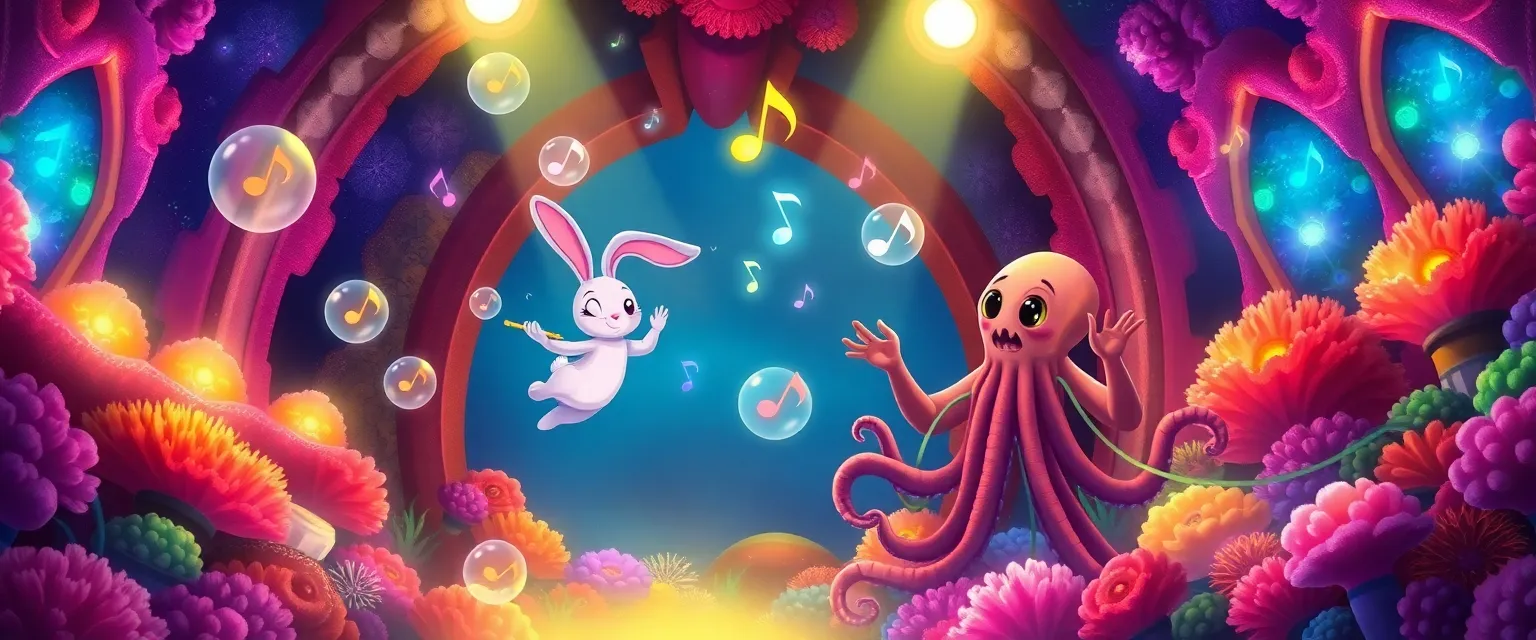
In the underwater city of Aquaria, where buildings grew from colorful shells and the streets were currents carrying residents from place to place, lived an unusual rabbit named Melody. Her long purple ears quivered when she heard feelings hidden in sounds. She also owned a small shell flute she played every morning.
One day Melody woke up to a strange silence. Normally the city buzzed with songs, laughter, and chatter, but today everyone spoke sharply and angrily. She swam to the center of town, where the Coral Concert Hall rose. It used to glow with all the colors of the rainbow, but now it looked gray and sad.
At the entrance sat a wise octopus called Maestro. He once conducted the orchestra, but now he was silent, his tentacles curled around his head.
“What's wrong?” Melody asked.
“The concert hall is losing its voice,” sighed Maestro. “The residents have stopped really listening to one another. Now everyone just argues. If we don’t restore the hall’s strength, the city will forget what kindness means.”
“How can we save it?” Melody pressed her ears.
“We must gather seven different kinds of laughter from the most unexpected friends and play a symphony no one has ever heard. But remember: laughter cannot be forced or faked. It must be true.”
Melody nodded and set off.
First on her route was Captain Shellby, a grumpy hermit crab who lived in an old teapot and muttered as he fixed his stick fence.
“Captain,” Melody said, “they say you haven’t laughed in thirty years.”
“Not going to,” he grunted. “Laughter’s a waste of time.”
“Do you like jokes at all?”
“Can’t stand them! Especially bad ones!”
Melody smiled. Her ears caught the truth: he secretly adored terrible jokes but was too shy to admit it.
“Why doesn’t the shark play cards?” she asked.
“I don’t know and don’t want to!”
“Because it’s afraid someone will call its bluff!”
Captain Shellby snorted. Then he chortled. Then he laughed so hard he nearly toppled out of his teapot. His laugh tinkled like tiny bells. Melody captured the sound in a bubble.
“Thank you,” the Captain said, wiping tears. “I’d forgotten how good that felt.”
Next was Shimmer, a shy jellyfish who changed color with music. She hid behind a rock and trembled.
“I want to perform, but I’m afraid I’ll make a mistake,” she whispered.
“What if mistakes make the music more beautiful?” Melody said. “Play with me — it doesn’t matter what happens.”
They played a duet. Shimmer lost the beat now and then, but Melody matched her, and their tune became unexpected and lovely. Shimmer glowed in every color and laughed with joy — bright and free. Her laughter was like bells in the wind.
Melody traveled through seven ocean zones. In the Chuckling Caves she helped a frightened baby octopus find a lost toy, and it giggled with relief. In the Ticklish Trenches she made a stern swordfish laugh by showing how ridiculous it looked trying to tie a bow. Each laugh was unique: some boomed like drums, others gurgled like streams.
At last, with seven bubbles of laughter, Melody returned to the Coral Hall. Maestro waited, looking unsure.
“I haven’t conducted in years,” he said. “Once I made a mistake and the concert failed. Everyone laughed at me.”
“Maestro,” Melody took a tentacle, “mistakes are part of music. Without them it would be boring. Please help me.”
Maestro drew a deep breath and nodded.
They opened the bubbles and laughter poured into the hall, turning into notes. Melody played her flute and Maestro conducted, and together they wove a symphony of genuine joy. The music was imperfect, with unexpected pauses and surprising turns, but that made it alive.
The Coral Hall shone brighter than ever. Color returned to the coral walls. Throughout the city people felt warmth and began to smile. They listened to one another again — not just to words, but to the feelings behind them.
From that day on Melody and Maestro held concerts every week. Sometimes the musicians made mistakes, sometimes they hit sour notes, but everyone listened with open hearts. Captain Shellby began sharing his awful jokes with anyone who’d listen, and the city filled with laughter.
Because real music, Melody realized, is born not from perfection but from a sincere wish to hear and understand another.