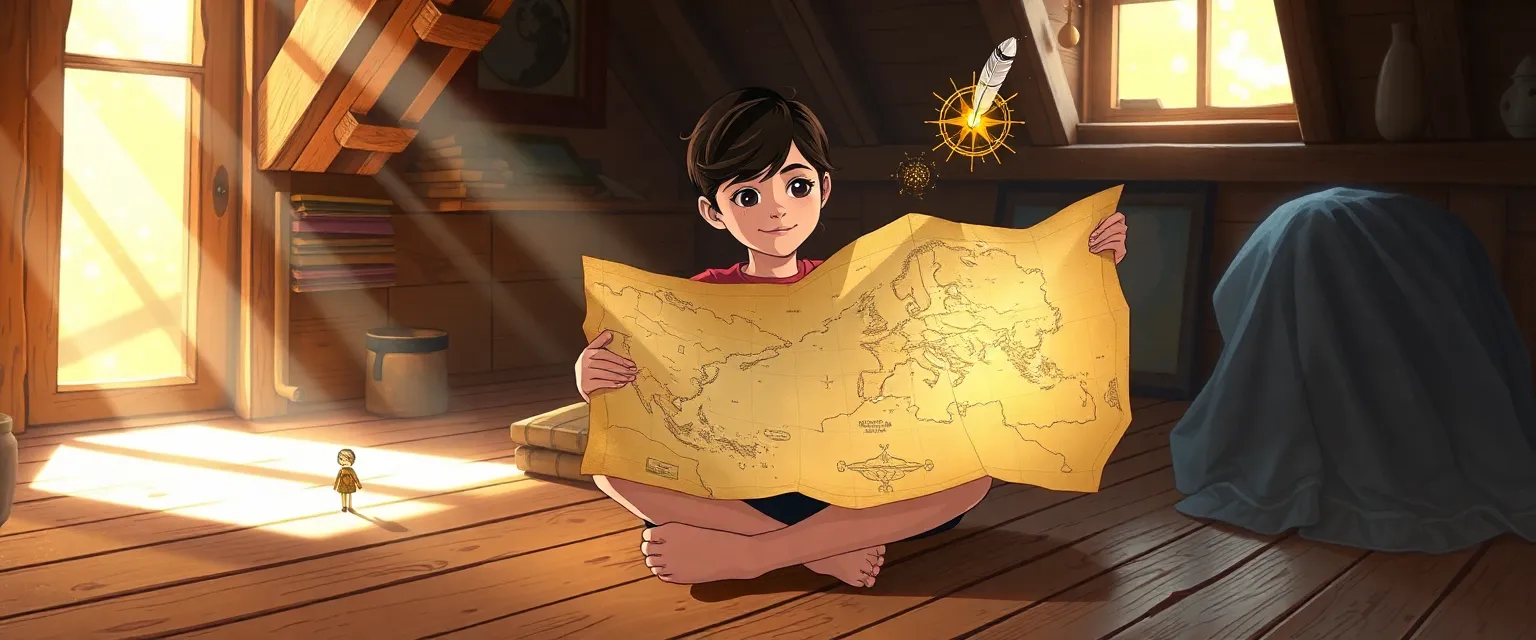
Ten-year-old Mira sat in her grandmother’s attic, surrounded by dusty trunks and old books. In her hands she held Grandma Vera’s last map — a large parchment that smelled of lavender and adventure. But something was wrong. The lines on the map were slowly fading, as if an invisible hand were erasing them.
“Grandma always said maps are alive,” Mira whispered, tracing a disappearing outline of a forest with her finger. “I thought she was joking.”
She pulled on Grandma’s worn traveling boots — they were too big, but they felt a little magical. Then she opened a strange compass, its needle spinning the wrong way. The moment Mira flipped it open, the needle sprang to life and became a tiny glowing figure.
“Finally!” the figure cried in a clear, chiming voice. “I am the Compass Rose, and I have waited centuries for a new cartographer. Your grandmother promised you would come.”
“Me?” Mira glanced at the map, uncertain. “But I don’t know how to draw maps. I even got lost at school last week.”
“Getting lost is the beginning of every discovery,” the Compass Rose said mysteriously. “Look! The map is fading because it is unfinished. Your grandmother left you her final lesson.”
Mira studied the map. Indeed, some places were only half-drawn. In the corner she found her grandmother’s handwriting: “Dear Mira, some places exist only when we are brave enough to imagine them. Finish what I began. With love, Grandma Vera.”
Suddenly the map glowed, and Mira felt the floor vanish beneath her. She fell and fell… and landed on soft grass.
She found herself in a peculiar forest. The trees were sketched in pencil — thin gray lines instead of solid trunks. When Mira touched one, it smudged a little.
“This is the Forest of Sketches,” the Compass Rose explained, circling above Mira’s head. “Everything here hasn’t decided what it wants to be yet. Ask a question!”
“A question?” Mira looked around. “What kind of question?”
“A true question. One you really want the answer to.”
Mira thought. Then she asked, “Why did Grandma love this place?”
At once the trees sharpened. Leaves appeared, and a path formed between the trunks. Mira followed it and found a little cottage. On the door was a note in her grandmother’s handwriting: “Here I first understood that maps are more than lines. They are stories.”
Mira smiled and took Grandma’s tools from her pocket: a ruler, a protractor, and a vial of ink. But when she tried simply to trace the fading lines on the map, they faded even faster.
“No, no!” cried the Compass Rose. “You don’t understand! You can’t just copy. You must understand!”
From between the trees came a strange figure made of moving cartographic symbols — arrows, dots, and flourishes. It was the Keeper of Ink.
“Who dares enter drawn worlds?” his voice rustled like old charts. “Do you know the rules? You may only draw what is true.”
“I want to finish my grandmother’s map,” Mira said, trying to sound brave though her knees trembled.
“Then you must go further. Through the Paper Mountains to the City of Legends. Only there will you learn Vera’s final lesson.”
Mira kept going. She crossed mountains that folded and unfolded, changing their peaks. She crossed a river of ink that flowed upward toward the sky. Each time she asked a true question about a place — “Why does this matter?” “What did Grandma feel here?” — the map grew a little clearer.
At last she reached the City of Legends. The street signs didn’t point directions but feelings: “To Joy — three steps,” “To Courage — turn right,” “To Love — follow your heart.”
In the center of the city Mira found her grandmother’s last note tucked into a fold of the map: “Dear Mira, the most important places on a map are not cities or mountains. They are the ties between people. Friendship that links distant homes. Love that makes a place a home. Memories that make an ordinary place sacred. Use my tools wisely.”
Mira looked at the tools. The ruler was labeled: “Measures friendship, not distance.” The protractor: “Calculates angles of courage.” The ink: “Draws only truth.”
She understood. Grandma hadn’t wanted her simply to copy lines. She wanted Mira to add her own discoveries, her own stories to the map.
Mira held the ruler and measured an invisible line between Grandma’s house and the spot where they used to drink tea every Sunday. A golden line appeared on the map. She used the protractor to mark the angle of courage — the moment Grandma taught her not to fear getting lost. She dipped the pen into ink made from pressed petals and drew a new place on the map: the Garden of Memories, where every flower her grandmother loved grew.
The map brightened. All the fading lines snapped into clarity. But now the map held more than Grandma had drawn. It held Mira’s stories too.
“You understand,” the Compass Rose whispered. “Maps live when each new generation adds its discoveries.”
The Keeper of Ink reappeared, and this time his symbols arranged into a smile. “You passed the test. The map is finished, but not finished. It will grow with you.”
Mira returned to the attic, map in hand. She now knew Grandma would not vanish as long as Mira remembered their stories and made new ones. Every place they loved together would stay on the map forever. And when Mira grew up she would add her own places, her own stories.
She hung the map on the wall and smiled. In the corner, in her grandmother’s handwriting, new words appeared: “I always knew you would find your way. Keep exploring, my brave cartographer. With love, Grandma Vera.”
Mira put on Grandma’s traveling boots. They were still a bit big, but that no longer mattered. She knew she would grow into them. For now she had a whole map of places to discover and a lifetime of stories to chart.