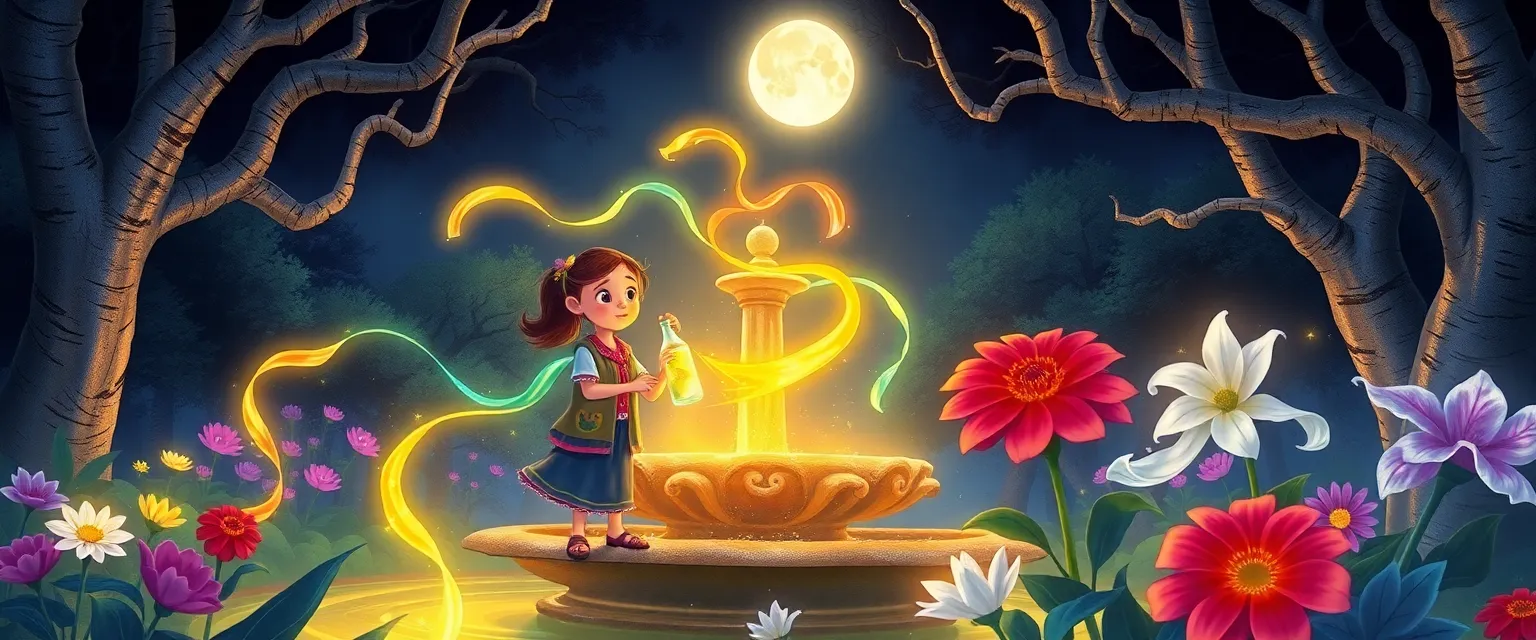
Maya woke to a strange sound outside her window. It was like a whisper—so soft she could barely make it out. She went to the window of her new room in her grandmother’s house and leaned out into the garden.
The morning sun gilded the old trees with their silvery bark, and winding stone paths threaded between them—paths that, Grandma Irene liked to say, changed direction each morning. A fountain burbled in the center of the garden, and flowers of every imaginable hue grew around it in mysterious spirals.
“Grandma,” Maya called as she hurried down the stairs, “the flowers in the garden… are they whispering?”
Grandma Irene looked up from her teacup, and Maya noticed a worry in her eyes.
“They didn’t whisper before, dear. They sang. Come, I’ll show you something.”
In the garden, Grandma led Maya to a large red dahlia whose petals were duller than the others.
“This is Dahlia,” Grandma Irene said. “She used to tell the boldest stories of bravery and daring. But now…”
“I… can… hardly… remember…” Dahlia breathed in a voice barely audible.
Maya sat beside the flower and gently touched its stem.
“What happened?”
“Someone is stealing our stories,” came a melodic voice from the right. It was a white jasmine softly humming a sad tune. “I remember songs from far-off lands, but the words are vanishing one by one.”
Maya spent the whole day talking to the flowers. By evening she learned that every night someone came into the garden and took their stories, locking them in glass bottles. With each stolen tale the flowers lost a bit of color and a piece of their voice.
“We have only until the full moon,” Dahlia whispered. “When the last flower loses its voice, the garden will die.”
That night Maya decided not to sleep. She hid behind a large tree and waited. The moon climbed high when she heard a rustling above. A monkey in a patched vest with many pockets descended from the branches. In his hands he held a glass bottle that glowed with a soft blue light.
“Stop!” Maya cried, stepping out of her hiding place.
The monkey startled and nearly dropped the bottle.
“Who are you?” he asked warily.
“My name is Maya. And you?”
“Milo,” the monkey grumbled. “And it’s none of your business what I’m doing here.”
“You’re stealing the flowers’ stories! They’re dying because of you!”
Milo frowned and hugged the bottle to his chest.
“I don’t steal. I collect. I’m writing the greatest book of adventures the world has ever seen. But my own life is too dull. Who wants to read about a monkey who just lives in a garden?”
Maya looked more closely at Milo. His vest was old but neatly mended. She saw not malice in his eyes, but loneliness.
“Show me your little home,” she asked softly.
Milo blinked in surprise, then nodded. They climbed to his small treehouse, where Maya saw shelves lined with glowing bottles in every color of the rainbow. An open notebook with neat handwriting lay on the table.
Maya began to read. The story was thrilling—about a brave traveler who crossed a desert and saved a town from drought. But something was wrong, as if pieces from different puzzles had been forced together.
“See?” Milo said proudly. “This will be the best book ever.”
“But this isn’t your story,” Maya said quietly. “Milo, have you ever tried telling a story about yourself?”
“Nothing interesting ever happens to me,” Milo muttered, looking away.
“Tell me about your vest. Where did all those pockets come from?”
Reluctantly, Milo began to speak. Each pocket, he explained, he had sewn on after a different event in his life. One pocket for the day he learned to climb the tallest trees. Another for when he tasted mango for the first time and wanted to carry a seed as a keepsake. One more for the day he found this garden and decided to stay.
As Milo talked, Maya noticed the air around them shimmer with thin ribbons of color—just like those she had seen in the bottles.
“Look!” she cried. “Your own stories! They’re real, and they’re beautiful!”
Milo watched the glowing ribbons weave patterns around them, and tears sparkled in his eyes.
“But the flowers… what do I do now?” he whispered.
“We’ll give their stories back,” said Maya. “Then you’ll write your book. A real one.”
The next morning Maya and Milo carried all the bottles to the fountain. Grandma Irene taught them what to do. They opened each bottle and spoke aloud the name of the flower that owned the story. Colorful ribbons burst from the glass and rushed to their owners.
With every returned story the flowers grew brighter. Dahlia blushed like the dawn. Jasmine sang a tune that made even the stones on the path smile.
When the last bottle was empty, the garden erupted in color and song. The flowers laughed and sang and told one another the tales they had almost lost forever.
“Thank you,” Milo whispered to Maya. “I was so lonely I thought other people’s stories would make me important.”
“You were important already,” Maya said. “You just needed someone to see it.”
From that day Milo no longer hid in his treehouse. He came down to the garden every day and told the flowers about his own adventures—how he learned to sew, the first time he saw a rainbow, how he found the perfect tree for his home. The flowers listened in delight because his stories were full of honest feeling.
Maya learned to collect dew from the flowers at dawn. When she sipped those drops, she could understand the language of every growing thing—not just in her grandmother’s garden, but beyond it.
Together Maya and Milo began to write stories. Not by stealing them, but by asking and recording with permission. The flowers happily shared their memories, and Milo added his own exploits.
By the full moon the garden shone brighter than ever. Grandma Irene smiled in her rocking chair on the porch, and a light burned in the treehouse—Maya and Milo were at work on a book born of friendship, honesty, and the understanding that the best stories are those we share, not those we take.