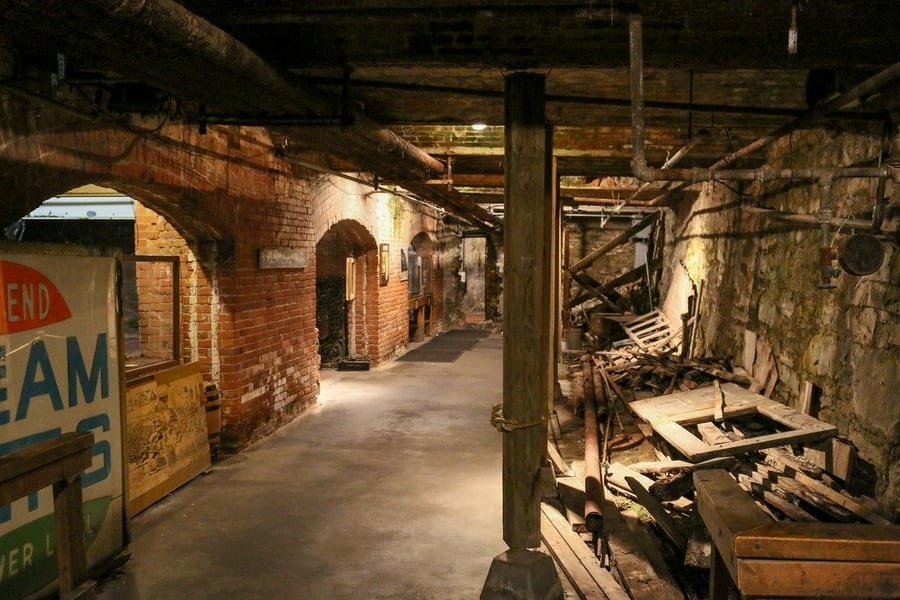
Imagine that one morning you step out of your house and your street is two stories lower than it was yesterday. To get to school you have to go down a tall staircase, walk along an old road, and then climb back up. The shop where you used to buy sweets is now in a basement, though it used to be on the street. Sounds like a strange dream? But for children and adults in 1890s Seattle, this was real life.
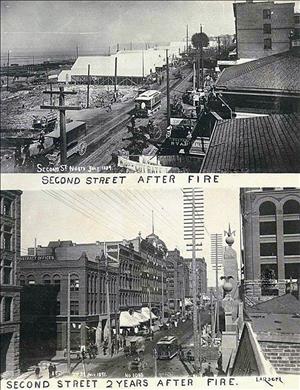
After the Great Fire of 1889, which destroyed 25 blocks of downtown Seattle, the city made a surprising decision: raise all the streets one to two stories higher. But the process took almost ten years, and during that time people lived in a city that existed on two levels at once. Historians often tell the story of the fire itself and the new brick buildings that sprang up afterward. But they rarely talk about how ordinary families — especially women and children — coped with life in this odd, split city.
A city that needed stairs instead of sidewalks
When Seattle officials decided to raise the streets, they didn’t shut the city down for repairs. People continued to live, work, and go to school while a new level of the city was being built around them. First, workers built tall walls along the streets — these became the new “sidewalks,” one to two stories above the old roads. Between those walls remained the old streets, where wagons still traveled and people still walked.
To get from one level to the other, wooden staircases were installed throughout downtown. There were more than a hundred of them! Some were steep and narrow, others long and wobbly. Children climbed up and down these stairs several times every day: in the morning to school, at midday home for lunch, in the evening back home. One girl, who later became a teacher, remembered counting the steps on her way to school and tallying 247 steps in one direction.
Mothers with small children had it especially hard. Imagine your mother having to go down a tall staircase holding an infant and carrying shopping bags! Many women helped one another: one would hold the children at the top while another went down to fetch groceries. Local newspapers of the time reported “stair accidents” — people falling, especially in rainy weather when the wooden steps became slippery.
Basement shops and underground shoppers
While the city built new streets above, old shops and houses ended up below. Many business owners — including quite a few women — couldn’t afford to close for years of construction. They kept working in their “basement” shops while the new city rose over their heads.
Mrs. Emma Fry ran a small shop selling fabrics and buttons. After the street was raised, her display window was at ankle level for passersby above. But she didn’t close. Emma put up a large arrow pointing to the stairs down and wrote: “The best fabrics now in the basement!” Her customers went down the stairs, shopped by the light of kerosene lamps (sunlight rarely reached below), and then climbed back up.
Children who helped their parents in the shops learned special tricks. They carried goods up and down the stairs using ropes and baskets. One boy invented a system of rope and pulley to hoist heavy sacks of flour from his father’s basement shop to the upper level. Neighborhood kids began to copy his invention.
But life in the “lower city” was not just inconvenient — it was dangerous. When it rained, the old streets flooded. Sewer systems were poor, and the basements were often damp and muddy. Doctors warned that it was easy to get sick in the lower rooms. Many mothers forbade their children from playing on the lower level, but children didn’t always listen.
Children as explorers of a two-story city
For Seattle’s children at the time, the city was a huge playground — dangerous, but extraordinarily intriguing. While adults complained about the inconveniences, kids explored the maze of stairways, alleys, and two-level streets.
Schoolchildren invented games that used the city’s features. One popular game was called “Up-Down”: one child stood on the upper level of the street, another on the lower, and they tried to shout to each other. Another game was like hide-and-seek, but with hiding possible on two levels at once — finding someone was nearly impossible!
But parents’ worries were justified. Newspapers regularly reported children falling from stairs or collapsing into gaps between levels. Some staircases lacked railings, and it was easy to lose your footing in the dark. One ten-year-old boy broke his arm after falling from a staircase while carrying a basket of bread for his mother.
One story that stuck with people was about a girl named Mary Dawson. She was nine and walked across the entire “two-story” downtown every day to bring lunch to her father, who worked at the waterfront. Mary knew every stair, every shortcut, every dangerous spot. One winter evening she helped a lost elderly woman who couldn’t find her way home in the maze of stairs. Mary guided her across the city, and the local paper wrote about a “little heroine who knows two Seattles better than adults know one.”
Voices that nearly faded away
When construction finally ended in the late 1890s, most of the entrances to the lower level were closed. The old streets became what is today called “Underground Seattle” — a tourist attraction. But history textbooks rarely mention the years when the city was two-leveled, and even more rarely do they speak of the people who lived through that strange time.
Historians usually write about major decisions by city officials, new construction technologies, and the wealthy businessmen who built new buildings. Those are important stories. But what about Emma Fry, who kept selling fabrics from a basement? What about the mothers who carried children and groceries up and down staircases every day? What about Mary Dawson and other children who turned hardship into adventure?
These “ordinary” people didn’t make grand decisions about the city’s future. But they were the ones living in that future while it was being built. They invented everyday solutions, helped one another, and adapted to incredible conditions. Their ingenuity and persistence were as important to Seattle’s recovery as the architects’ plans.
Today, when tourists walk down into Underground Seattle, they see old storefronts and sidewalks. But few know that children once walked these routes to school, women ran businesses, and families led ordinary lives in the most extraordinary circumstances. Their voices have nearly been lost in history, drowned out by tales of great fires and great constructions.
Why remembering the stairs matters
The story of Seattle’s Great Fire usually ends with triumph: the city rose from the ashes, bigger and better. That’s true. But between the fire and the triumph were years of chaos, inconvenience, and danger. And it was ordinary people — especially those rarely written about in books — who lived through those years and made that triumph possible.
When we forget these people, we lose an important part of history. We start to think that big changes happen only because of decisions by important people. In reality, any large change requires thousands of ordinary people to adapt, survive, invent solutions, and help each other.
The children who counted steps on their way to school. The mothers who figured out how to safely go down with an infant in their arms. The girl who knew all the secret routes of a two-story city. The woman who turned her basement shop into a successful business. They are all part of Seattle’s history, as important as the fire itself.
Today, when you see historical photos or read about the past, try asking: what did ordinary people do during this time? How did children get to school? How did mothers buy food? How did families manage everyday tasks? The answers to these questions are often the most interesting stories — stories about real people, their resourcefulness, and their persistence.
And who knows? Maybe someday you yourself will be part of history. You don’t have to do anything “great.” Sometimes the most important stories are about how ordinary people live their lives during major changes, help one another, and don’t give up — even when they have to climb 247 steps every day.