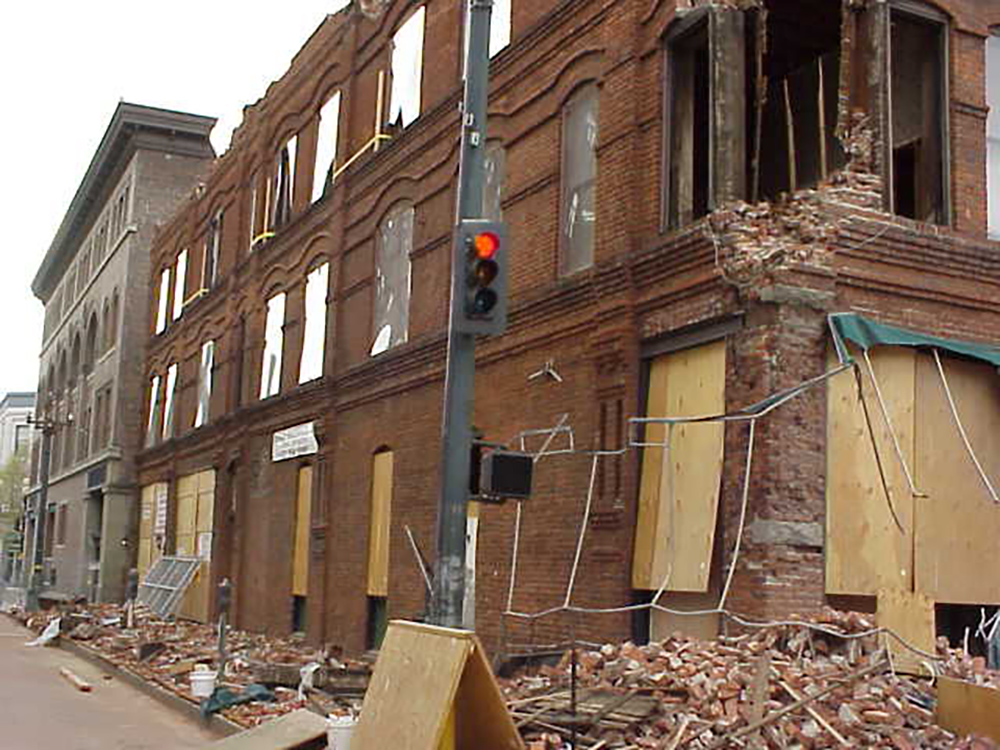
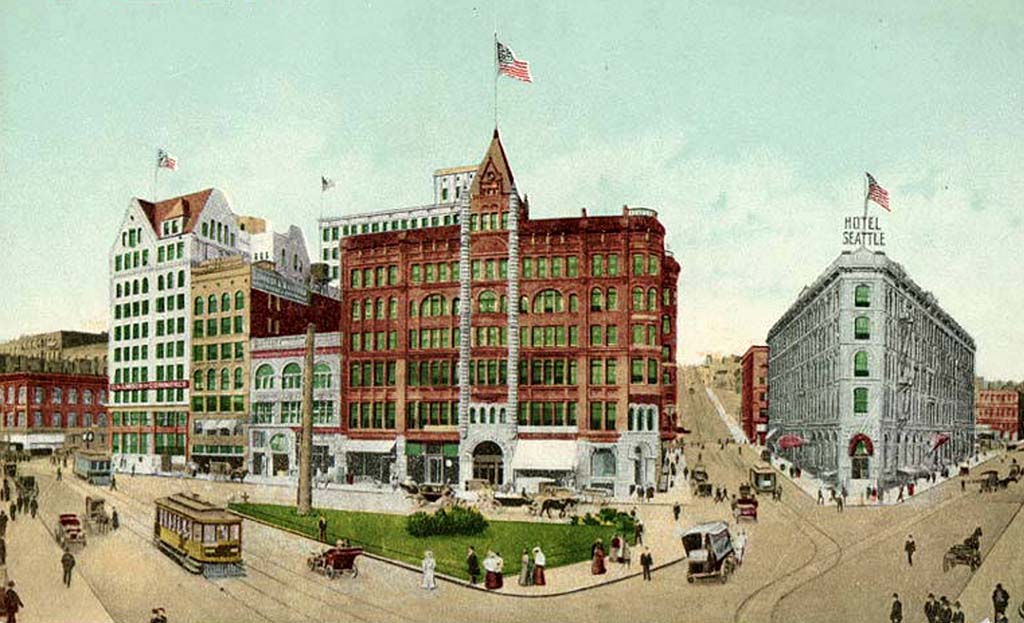
Imagine your favorite house suddenly starting to sway like a ship on the waves. That’s what happened to the children of Seattle on February 28, 2001, when the ground beneath the city trembled for a full 45 seconds. Ten-year-old Emily was sitting in her room in an old brick building in Pioneer Square — the oldest part of the city. Books fell off shelves, and a thin crack like a lightning bolt appeared in the wall. After that day, adults realized: Seattle’s beautiful old buildings, some more than a hundred years old, could be dangerous. But instead of tearing them down, the city figured out how to teach old bricks to “dance” during earthquakes — and that story changed not only buildings but whole families’ lives.
When the earth revealed its secrets
The Nisqually earthquake, magnitude 6.8, wasn’t the largest in history, but it revealed a secret adults had preferred to ignore. Seattle had about 1,100 unreinforced masonry (URM) buildings — built long before anyone knew how to protect structures from earthquakes. These buildings stood in some of the city’s most beloved areas: Pioneer Square, where Seattle began; the International District, home to Chinese and Japanese families; and Fremont with its quirky shops.
After the quake, engineers — the specialists who understand how buildings work — discovered a frightening fact. The brick walls in the old buildings weren’t tied to the wooden floors and ceilings inside. It was like building a tower of blocks where each floor just sits on the one below, not fastened together. When the ground moves, such a tower can collapse. Buildings taller than three stories were especially dangerous.
Emily’s family, like hundreds of others, received a letter from the city. It said their building might be unsafe. Her parents owned a small bookstore on the ground floor — they had lived and worked in that building for fifteen years. What were they to do now?
Choosing between the past and safety
The city faced a difficult choice. Officials could simply demolish all dangerous buildings and replace them with new, sturdy structures. But that would erase Seattle’s history. Those old brick buildings housed shops where grandparents had bought groceries as children. Family-run restaurants cooked from recipes brought from distant homelands. Hand-painted signs from a century ago hung on the walls.
Building owners — often ordinary families, not wealthy companies — were frightened. Making a building safe required enormous sums. Imagine needing to buy not one toy, but a thousand at once! Some families had owned their shops and buildings for three or four generations. Grandpa passed the building to the father, the father to the son. And now they were told: “Pay $200,000 or $300,000, or you’ll have to leave.”
Heated debates erupted across the city. Some argued, “Safety is more important than history!” Others protested, “If we tear down these buildings, we lose the soul of the city!” Children drew pictures of their favorite houses and brought them to meetings. Emily drew her home with the bookstore and wrote: “This is where I learned to read. Please don’t tear it down.”
Engineer-wizards and their clever solutions
Then engineers arrived with surprising ideas. They figured out how to make old buildings strong without destroying their beauty. It was like a doctor treating a sick person without changing who they are.
The main trick was called seismic retrofitting — teaching a building to move with the earth instead of breaking apart. Engineers devised several clever measures. First: they ran long steel rods through the building, as if threading a string through beads. These rods tied the brick walls to the wooden floors and ceilings inside. Now, when the ground moved, the whole building moved together as one unit.
The second trick: steel frames were attached to the interiors of the walls. Imagine putting a tough protective suit on a fragile porcelain doll. The doll still looked the same on the outside, but it was much harder to break. That’s how engineers protected the brick walls.
The third trick was the most surprising: some buildings received special dampers — devices that absorb vibrations. They work like shock absorbers on a bicycle: when the wheel hits a bump, the shock absorber cushions the impact. Dampers in a building “eat up” the jolts of an earthquake.
Emily’s family decided to retrofit their building. Work took four months. During that time the bookstore had to close, and the family worried — they were losing income every day. But the city helped: authorities offered a low-interest special loan that could be repaid slowly over twenty years. It was like being allowed to pay for a large toy little by little from your pocket money.
How retrofitted buildings changed city life
More than twenty years have passed since that earthquake, and now you can see how the decision to strengthen old buildings changed Seattle. It affected not only safety but how people live and property values.
Emily’s family bookstore not only survived — it became more popular! People came specifically to see “the building that learned to dance.” Emily’s parents hung photos in the shop showing how the building was reinforced. Tourists took pictures in front of the old bricks, knowing modern protection lay hidden behind them. The store’s income rose by 30% in the five years after the retrofit.
But not everyone was so lucky. Some owners couldn’t find the money to retrofit. Their buildings were sold. Sometimes wealthy companies bought them, renovated, and raised rents. Families who had lived there for decades could no longer afford to stay. That was the sad part of the story.
Still, Pioneer Square, where Emily lived, became one of the city’s pricier neighborhoods. An apartment that cost $150,000 in 2001 had risen to $500,000 by 2020. Why? Because people wanted to live in historic buildings that were both beautiful and safe. It was like owning an old book that didn’t fall apart when you read it.
The city benefited too. Tourists continued to come to see historic Seattle. They spent money in shops, restaurants, and museums. If the old buildings had been demolished, tourism would have declined. Economists estimated that preserving historic districts brings the city about $200 million a year in tourism revenue.
When caring for the old becomes caring for the future
Today Emily is grown and has a daughter of her own. The bookstore still operates in the same retrofitted building. When small earthquakes occur — and they happen in Seattle almost every year — the building sways slightly, but no new cracks appear. The old bricks truly learned to “dance.”
Seattle’s story shows an important lesson: sometimes the smartest choice isn’t picking between old and new, but finding a way to join them. The city didn’t abandon its history or sacrifice people’s safety. Instead, engineers and architects figured out how the past and the future could live together.
Of course, it was expensive and difficult. Some families lost their homes, and that was unfair. But many others were able to stay, and their children and grandchildren will live within the same walls where their parents grew up. And every time the ground under Seattle shudders — as it inevitably will, because the city sits in a hazardous spot — the retrofitted buildings will sway like trees in the wind, but they will not fall.
This story teaches us to value what people before us created, while using new knowledge to make that legacy safe. Seattle’s old bricks now hold not only memories of the past but also hope for the future — a future where beauty and safety go hand in hand.