Across all three news items, despite differences in scale and context, one theme emerges: how state structures respond to crises and potentially dangerous situations, and where the line lies between necessary security measures and excessive use of force. A barricaded woman in Florida, a large fire at a residential complex in San Antonio, and a court ban on aggressive actions by federal agents against peaceful protesters in Minnesota show how heavily modern services—from police to fire departments to federal tactical units—depend on procedures, technology and public oversight. They also illustrate how easily the balance between “protection” and “infringement of rights” can be upset, and how media coverage and courts become key feedback and corrective mechanisms.
The Gulf Coast News piece about the incident in Bonita Springs, Florida, describes an intense police operation with tactics characteristic of a “barricaded” suspect scenario. According to Gulf Coast News, it began with a “disturbance” — a conflict involving a woman at Leo’s Pizzeria at the intersection of Bonita Beach Road and Imperial River Road. The term disturbance in police summaries usually denotes an incident involving a breach of public order: a loud altercation, threats, possible violence. The situation escalated to the point where the woman ended up in a nearby house and, according to the Lee County Sheriff’s Office, “barricaded herself” inside. Calls reported shots fired; the area was cordoned off, neighbors were evacuated under police escort, and a full complement of resources was deployed: a mobile command post, a crime scene van, several unmarked cars, drones and a helicopter overhead.
The reporter describes how, in front of journalists’ eyes, the crime-scene tape was repositioned and how investigators “with various instruments and light sources” entered the house trying to reconstruct what had happened. That already indicates a typical transition from the “hot phase” of an incident to the documentation and investigation phase. An important detail is the use of tear gas: the film crew heard a loud sound and then felt the burning sensation from tear gas in the air and were forced to move back. In other words, less‑lethal coercive means appear to have been used to end the standoff, which ultimately ended with the woman’s arrest. Meanwhile the scene was a regular residential neighborhood—neighbors peeking from houses and approaching journalists to ask what was happening: a characteristic example of how police tactics designed for extreme threats coexist with everyday life.
The Florida case shows how law enforcement treats a potentially armed and unstable person in a residential area as justification for deploying maximal tactical capabilities. From a safety standpoint that makes sense: shots fired, refusal to leave a house, need to protect surrounding residents. But it also raises the question of proportionality. The use of tear gas (a chemical irritant used to disorient and drive people out of a room or crowd) in close proximity to neighbors and reporters demonstrates how such tactics can be “wide‑ranging,” affecting those who are not the target of the operation. The report emphasizes that journalists themselves experienced the gas’s effects, immediately turning the operation into a public discussion point: how well were perimeters organized, how was the public informed, what restrictions were placed on the press?
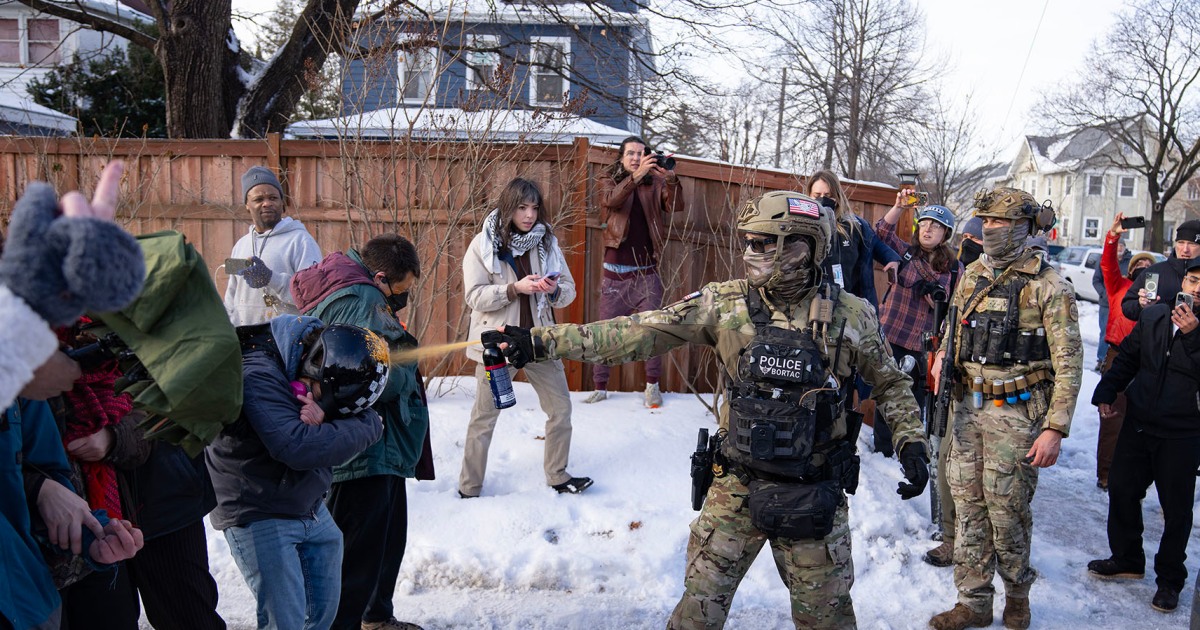
At the opposite end of the spectrum is the federal judge’s decision in Minnesota, which directly concerns the permissible bounds of agents’ behavior toward citizens who do not pose an immediate threat. NBC News’s coverage of Judge Kathryn Menendez’s ruling details the “Operation Metro Surge” federal immigration enforcement campaign launched by the Trump administration in Minnesota on Dec. 4, described as part of a broader strategy of mass arrests of migrants. The judge issued a preliminary injunction — a temporary court order prohibiting certain actions until the case is decided on the merits. The injunction is directed at federal agents and officers involved in the operation and explicitly bars them from spraying pepper spray, detaining, stopping vehicles or otherwise acting against peaceful and “non‑obstructive” protesters.
The core of the lawsuit, filed by the ACLU on behalf of six participants and observers, is that federal agents violated their constitutional rights — freedom of speech and protection from unreasonable searches and seizures. In the ruling, referenced by NBC News, the judge notes that the plaintiffs were engaged in “protected activity” and were subject to “retaliatory action” — punitive responses precisely because of that activity. The injunction instructs agents not to detain or arrest law‑abiding protesters, not to use pepper spray to disperse them, and not to stop vehicles without reasonable suspicion that passengers are interfering with immigration enforcement activities.
It is important to explain that pepper spray is an aerosol based on capsaicin that causes intense burning of eyes and airways. It is considered a “less‑lethal” tool, but its use—especially in crowds—can have serious health consequences and functions as collective punishment, affecting people who have committed no wrongdoing. The judge essentially says: a tough immigration enforcement policy does not justify the use of force against those merely observing or expressing dissent.
In response, the Department of Homeland Security (DHS), through spokesperson Tricia McAloon in NBC’s reporting, argues that agents have “exercised restraint” amid “riotous protests” and that “rioters and terrorists” attacked personnel, launched fireworks at them and damaged vehicles and property. It’s important to distinguish the rhetoric of the parties: the federal agency uses language of threat and chaos (rioters, terrorists), emphasizing that a “minimum necessary level of force” is applied to protect staff and property. The court, however, after examining specific episodes of detentions, vehicle stops and sprayings, found that in some cases the actions were retaliatory for observation and protest rather than responses to real danger.
The context makes this decision even more consequential. Operation Metro Surge was accompanied by two high‑profile instances of firearms use: on Jan. 7 an ICE officer shot and killed Rene Nicole Good, a 37‑year‑old woman, in her SUV near a federal services building. The official account is self‑defense, claiming she tried to run down an officer with her vehicle. But as NBC News notes, Minneapolis Mayor Jacob Frey and others expressed doubts about that version, and witness statements and video footage call into question whether the vehicle posed an immediate threat. Then, on Jan. 15 a federal officer shot a Venezuelan man in the leg during an attempted vehicle stop; DHS’s version states that three men allegedly attacked the officer with a shovel and a broom after trying to flee. After both incidents protesters gathered in the area; there were reports of shouting and snowball‑throwing, and law enforcement responded with flash‑bang devices and “chemical irritants,” again tear gas or pepper spray.
This creates a kind of vicious circle: federal agents acting in a militarized enforcement mode raise tensions by their presence and actions; protests escalate and sometimes turn aggressive, and the government’s response becomes still harsher. In this context, Donald Trump’s threat on Truth Social to invoke the Insurrection Act — the 1807 law that permits the president to deploy military forces within the United States without Congress’s approval to suppress insurrections or mass unrest — is especially significant. Actual use of the military in domestic civil conflicts is an extreme measure that heightens fears of militarization of law enforcement functions. Judge Menendez, by refusing to stay her order and by explicitly balancing the ongoing irreparable harm to the plaintiffs against potential harm to defendants from restricting their actions, effectively becomes one of the few counterweights to this trend.
The third episode, described in KSAT’s report about the fire at a San Antonio apartment complex, concerns fire response rather than policing, but the logic of emergency services’ actions links it to the first two cases. According to KSAT, on Saturday evening a large fire broke out at the Tower Point Condominiums on the northwest side: the blaze reached the roof and at least 30 firefighting units responded. By 10:30 p.m. local time there were no reports of injuries; the story is developing and details are still emerging. Even in this concise report several key elements stand out: massive resource mobilization (30 units for a single structure), priority on saving lives (no injuries reported despite a heavily burning building) and transparency: media immediately inform the public that this is a “developing story” and invite readers to check back for updates.
A fire, devoid of political subtext, nevertheless follows the same model: strong, centralized response units, the need for rapid and potentially radical decisions (dispatch dozens of vehicles to one block, possibly evacuate residents), while society expects minimizing loss of life and effective risk management. Unlike police operations, there is no question of protesters’ rights or the lawfulness of force; instead the focus is on preparedness — whether infrastructure and services are ready for such emergencies. If in Minnesota and Florida the question is the permissibility of certain coercive tools (firearms, pepper spray, tear gas, surround-and-pressure tactics), then in San Antonio the principal tools are coordinated personnel and equipment deployment to prevent casualties and destruction.
A common thread across all three stories is trust in institutions and oversight of them. In Bonita Springs neighbors, according to the Gulf Coast News reporter, came to journalists to find out what was happening in their own neighborhood: they received information through the press rather than directly from police. This amplifies the media’s role as an intermediary between security forces and the public and makes it important how journalists describe events: do they record the intensity of force used, do they note perceived effects (as with tear gas)?
In Minnesota, media such as NBC News do more than relay positions; they compare official statements with video evidence and witness testimony, creating a space for public debate and judicial review. It is precisely through such coverage and detailed lawsuits like the ACLU’s that courts can assess concrete episodes — stopping cars without stated violations, spraying pepper spray into the faces of peaceful observers, pointing guns at people who did not attack — rather than speak only abstractly about “balancing security and rights.” The court injunction becomes a tool to compel the state to observe its constitutional limits, not merely to maintain “public order.”
In San Antonio, even without dramatic narratives of rights violations, KSAT’s format — a prompt report naming time, place and current status of casualties — serves transparency: residents reading a line like “roof on fire, no injuries reported” can reconcile their fears with reality, adjust their behavior and evaluate their local fire department’s effectiveness.
If we try to single out key trends and conclusions, several stand out. First, on the tactical level law enforcement increasingly relies on escalating control measures: from perimeters and command posts to tear gas and pepper spray and up to firearms. The incidents in Bonita Springs and Minnesota show how these tools are often used not only in response to overt violence but in complex, ambiguous situations where a threat may be exaggerated or misinterpreted.
Second, the judiciary’s role as arbiter in disputes about permissible force is growing. Judge Menendez’s order does more than restrict agents in Minnesota; it sets a precedent: even during large federal operations and under political pressure (threats to invoke the Insurrection Act), legal red lines exist and crossing them leads to immediate limits.
Third, amid constant “developing stories” — ongoing investigations, smoldering fires, unfinished court processes — the media become chroniclers and moderators of public perception of risk and rights. The form of coverage — from a reporter standing amid police cars and tape to links to video of shooting incidents and terse updates on a fire’s status — shapes whether the public sees security forces as protectors or potential threats.
Finally, these cases raise the broader question of what security means in modern urban space. Security is not just the number of vehicles dispatched, the intensity of special measures, or even the crime clearance rate. It is residents’ trust that, in a conflict with a barricaded neighbor, a mass immigration enforcement action, or a fire on their roof, law enforcement and emergency services will act proportionally to the threat, transparently, accountably and with priority given to human life and rights. When a court must bar federal agents from spraying gas into the faces of peaceful observers, and when reporters at a police scene themselves get caught in a cloud of tear gas, it signals that the search for this balance is far from over and will remain the subject of intense public and legal debate.