A whole political drama has formed around Donald Trump's speeches at the World Economic Forum in Davos: from his persistent claims of a "rigged" US election to threats of tariffs on the European Union over Greenland, from a frozen trade deal to American flags being burned on the streets of Swiss cities. All three storylines — his domestic rhetoric, the trade war with the EU, and street protests — converge on one thing: Trump frames the world as a stage for confrontation and pressure rather than cooperation. This logic is consistently evident in what he says, what he does, and how U.S. allies and adversaries respond.
In his Davos address Trump returned once again to the topic of the 2020 election, saying it was a "rigged" campaign and hinting at future criminal prosecutions of some "participants." He called it "breaking news," although, as noted in the Yahoo/Mediaite piece, his claims of a "rigged" and "stolen" election have long been repeatedly debunked: results were certified by Republican officials in the states and by dozens of court rulings. Nevertheless, in Davos Trump said: "This is a war that should never have been started, and it wouldn't have been if the 2020 election hadn't been rigged… Everyone knows it now… People will soon be held accountable for what they did." Here he not only continues to delegitimize Joe Biden's victory, but broadens the frame: by calling it a "war" he refers to a wider crisis (primarily the war in Ukraine), linking a global conflict to an allegedly "unfair" outcome of U.S. elections.
This statement illustrates an important technique: a domestic political narrative is used to explain international problems. In Trump's logic, if he had stayed in power, "the war would not have started"; therefore any global instability can be blamed on "stolen elections." At the same time he attacks the media, calling them "very corrupt, very biased" and asserting that despite his supposed "huge victory" in all seven swing states and in the national vote, he receives only negative coverage — therefore the media have "lost credibility." For a Russian audience it is worth explaining that in the American system, the independence and verifiability of elections are a core element of governmental legitimacy; contesting elections without evidence undermines trust not only in a particular result but in institutions generally. That is why the persistent repetition of the "rigged election" thesis is seen in the U.S. as a threat to the democratic order.
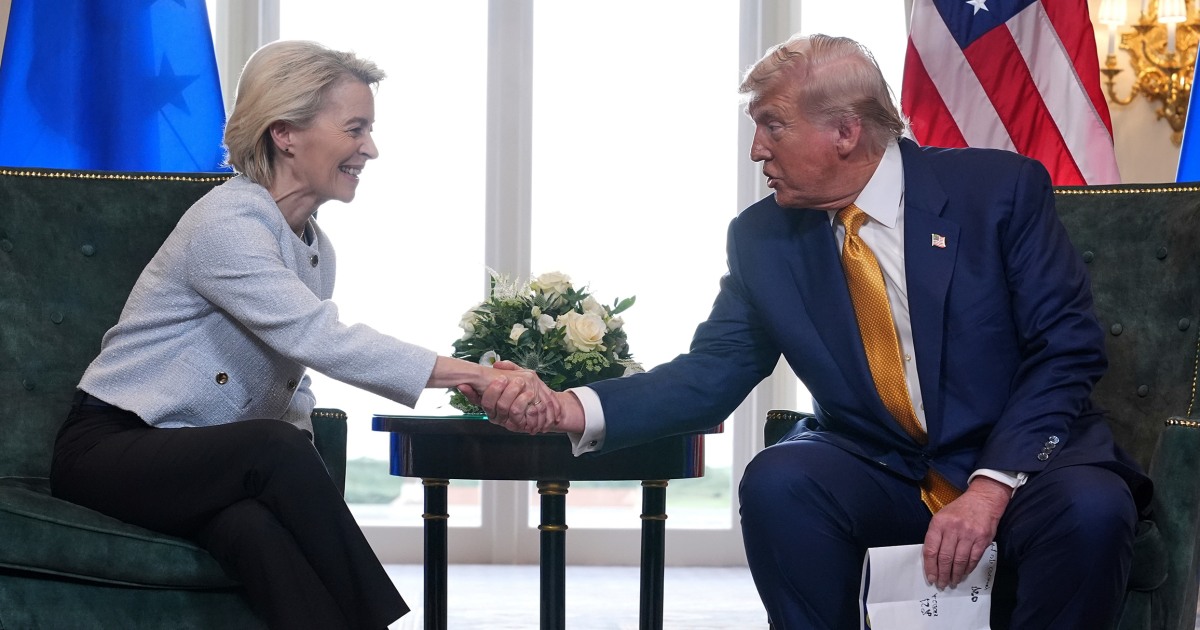
The same confrontational — not compromise-oriented — logic applies to his economic agenda. The NBC News piece discusses how the European Union suspended the process of approving and implementing a trade deal reached last summer with Trump in Turnberry, Scotland. The so-called Turnberry deal meant the U.S. would cap tariffs on most European goods at 15% — one of the lowest rates for partners — and abolish tariffs entirely for some categories, like generic medicines. In return the EU would lower duties on some American exports, which was supposed to help U.S. farmers and industry access the 27-country EU market. By 2024 trade between the U.S. and the EU amounted to $1.5 trillion, of which more than $600 billion was U.S. imports from the EU and over $360 billion was EU imports from the U.S.
The European Commission initially welcomed the deal, saying it "restores stability and predictability." However, that whole logic of "stability" collapsed when Trump, speaking against the backdrop of his persistent idea of "control over Greenland," threatened to impose 10% tariffs from February 1 on seven EU countries and the U.K. if they did not agree to American control of the island. Bernd Lange, chair of the European Parliament's trade committee, said that because of "ongoing and growing threats, including tariff threats, against Greenland and Denmark, and their European allies," the European Parliament had to stop work on ratifying the deal. Lange's quote "business as usual impossible" shows that for the EU the Greenland question is primarily seen as one of sovereignty and territorial integrity, not as a bargaining chip.
It's important to explain the construct itself. Greenland is an autonomous territory of the Kingdom of Denmark, strategically important for Arctic routes, military infrastructure, and natural resources. The U.S. has long had a military presence there (for example, the Thule Air Base), but it was Trump who made the question of de facto control—or even purchasing the island—a public topic. Threats of tariffs are a typical tool of economic coercion: country A uses its market power to force country B to accept a political decision that B would not normally agree to. It is precisely to counter such tactics that the EU developed the so-called Anti-Coercion Instrument (ACI), which the article analogically calls the EU's "trade bazooka."
As NBC News explains, the ACI allows the European Commission, in response to economic pressure, to apply a wide range of restrictions on goods and services from the coercing country: from investment limits and loss of intellectual property protections to de facto bans on market access. It was originally conceived in 2021 to deter possible pressure from China, but now Lange openly says he supports using the "bazooka" against the U.S. Notably, the EU is considering both a classic package of retaliatory tariffs worth about $110 billion (hitting Boeing, soy, bourbon, etc.) and the more radical ACI measures. This is no longer a routine trade dispute but an escalation toward systemic economic confrontation between the U.S. and its largest ally.
At the same time, Trump, speaking at the same Davos forum, claims the U.S. will not use force to seize Greenland, but does not renounce the tariff threat. A pattern is visible here: a refusal of "hard force" is accompanied by an increase in "hard economics." The EU, for its part, signals that if Washington chooses the path of coercion, Brussels will respond symmetrically (with tariffs) and asymmetrically (via the ACI). This changes the character of the transatlantic partnership — from cooperation to managed conflict, where both sides prepare tools to "punish" each other in advance.
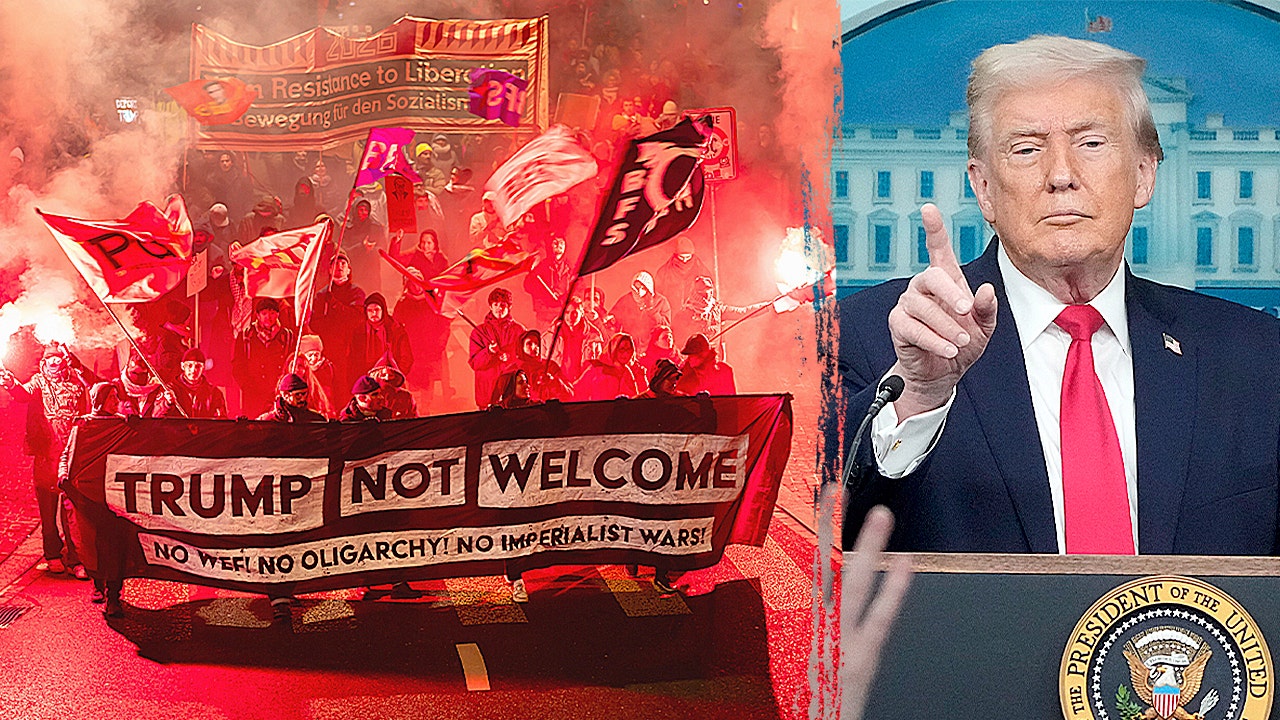
Against that background of confrontational policy, it is unsurprising that Trump's presence provokes not only cabinet-level tension but street protests. The Fox News piece describes demonstrations in Switzerland ahead of his forum visit. In several cities, including Davos, Zurich, and Bern, marches took place under slogans like "Trump not welcome" and signs such as "Put the Trumpster in the dumpster." Radical participants burned American flags and smashed shop windows; police responded with water cannons, chemical irritants, and rubber bullets. According to the Swiss portal Swissinfo, cited by Fox News, police reported paint-filled packets thrown at windows, broken shopfronts, and two officers hit by stones.
Protesters criticized not only Trump himself but also Swiss authorities, who, in their view, "legitimize authoritarian and plutocratic politics" by inviting him. The term "plutocracy" means rule by the wealthy — a situation where big capital determines state policy. NGO activists Campax even projected a caricature of Trump as the "spirit of plutocracy" onto a ski slope near Davos. This image sharply underscores how his style — a blend of aggressive nationalism, economic coercion, and support for ultra-wealthy elites — is perceived by critics.
Notably, protests in Switzerland and in Greenland against U.S. attempts to take control of the island, referenced by Fox News, are directly linked to Trump's rhetoric about "national security." He writes on social media: "Greenland is imperative for National and World Security. There can be no going back." This is a classic example of how the concept of "national security" is used to justify expanding influence and control over territories whose residents — both in Greenland and in Europe — do not wish to "exchange" their autonomy for preferential trade terms or U.S. patronage.
Looking at the whole picture, a coherent, albeit confrontational, narrative emerges. Domestically in the U.S. Trump claims the election was "stolen," meaning the current government is illegitimate and responsible for "unnecessary wars" and global crises. Internationally he issues ultimatums to allies — whether over Greenland or tariffs on the EU and the U.K. Where formulas of "long-term partnership" and "shared values" once applied, he offers a simple scheme: "either you do what benefits the U.S. (and him personally), or you face economic sanctions."
This logic gives rise to several trends and consequences. First, international legal and political pushback against unilateral U.S. actions intensifies: the EU not only freezes a mutually beneficial agreement but is prepared to use the Anti-Coercion Instrument against the American economy for the first time. That's an important signal: tools originally created to deter China are now being turned toward Washington. Second, domestic delegitimization of U.S. elections undermines allies' trust in the predictability of American policy. If in one political cycle Washington negotiates and in the next it threatens tariffs and "trade wars," partners will begin building long-term strategies to reduce dependence on the U.S.
Third, the likelihood of systemic fragmentation of the Western camp increases. Trade wars, disputes over Greenland's sovereignty, and a crisis of confidence in American democracy all make common fronts (for example, on China or Russia) less cohesive. Fourth, political polarization grows not only within the U.S. but also in Europe, where some forces favor a tougher response to Washington while others fear a final rupture of transatlantic ties.
Finally, do not underestimate the symbolic effect. Burning American flags on Swiss streets, "Trump not welcome" posters and the "spirit of plutocracy" projected on Davos slopes, rhetoric about a "rigged election" at the same forum where leaders discuss the resilience of democracies and global trade — all this creates an image of a world in which the once-main guarantor of the liberal order has become a source of instability.
The key conclusion from comparing the Yahoo/Mediaite, NBC News, and Fox News pieces is that Trump is building a consistent style — from domestic politics to international negotiations. It is a style of conflict, coercion, and delegitimization of opponents that, on the one hand, mobilizes his base, and on the other, pushes allies toward strong countermeasures and provokes protests. In this sense, Davos becomes not a place of elite consensus but an arena demonstrating how divided the West is today and how contested the ideas about what global politics should look like.