All three pieces, at first glance, are about completely different things: Donald Trump’s speech in Davos and his conflict with NATO allies, a local incident with smoke at an ice arena in Ohio, and the seizure of a sanctioned tanker in the Caribbean. But a common thread running through each story is the relation to security — national, international, economic, and everyday — and how power and institutions attempt to provide it, simultaneously expanding their powers and confronting questions of legitimacy and trust.
The ABC News piece on Trump’s arrival in Switzerland to speak at the World Economic Forum in Davos highlights several lines of his political agenda: a push for “American dominance,” aggressive rhetoric about a possible forcible seizure of Greenland, trade pressure on NATO allies, and a concurrent effort to create a new global institution — the Board of Peace — which could become a rival to the UN (ABC News). This is a concentrated example of how, in Trump’s logic, security — primarily American security — justifies nearly any expansion of power, from potential redrawing of borders to reconfiguring the architecture of international organizations.
His desire to take control of Greenland is presented as a necessity for “national security and even global security,” with deliberately vague wording. The thesis that Greenland is a critically important asset for the United States is not new: the island is a key element in Arctic geopolitics, home to the American Thule Air Base, increasingly important for the Northern Sea Route, and rich in natural resources. But the novelty now is that rhetoric has shifted from the idea of purchasing the island (discussed during his first term) to open hints of a possible forcible scenario. When asked how far he would go to seize territory of Denmark, a NATO member, Trump replies, “You’ll find out” — essentially a conscious use of strategic ambiguity: a deliberate refusal to mark “red lines” to preserve room for coercion.
Notably, when ABC News directly asked him about many Greenland residents’ strong opposition to American control, Trump confidently said that “once he talks to them, they’ll be thrilled.” This reflects a hallmark of populist leadership: substituting actual public sentiment with an imagined mandate — the leader acting as if he knows better what people “really” want, including foreigners. The factual sovereignty of Greenland and Denmark, their right to control their own territory, yields to the argument of a “higher” American security in this logic.
The same logic appears in another piece, this time from Fox News, which reports on U.S. forces seizing a sanctioned tanker in the Caribbean as part of a campaign against illicit oil shipments from Venezuela (Fox News). The Pentagon (referred to in the text as the Department of War, which is itself symbolic and reflects a bellicose discourse) emphasizes that the seizure of the vessel Sagitta demonstrates U.S. resolve to ensure that “the only oil leaving Venezuela is properly and legally authorized” under the quarantine of sanctioned vessels announced by Trump.
It’s important to explain some terms that may be unfamiliar. Sanctions are restrictive measures (economic, financial, visa-related) that one country or group of countries imposes on another country, companies, or individuals to change their behavior. The “shadow fleet,” which Fox News writes about, is a network of vessels that typically turn off identification systems, use forged paperwork or flag changes to evade sanctions and continue exporting oil from sanctioned countries such as Iran, Russia, or Venezuela. It is, in effect, a semi-criminal infrastructure of the global energy system.
Operation #OpSouthernSpear, led by U.S. Southern Command together with the Coast Guard and other agencies, becomes an instrument of coercive control over oil flows in the Western Hemisphere. Here, as in the Greenland story, security is interpreted extremely broadly: under the slogan of “the security of the American people,” U.S. forces are de facto establishing a maritime blockade regime for certain types of cargo. The phrase “only legally authorized exports” essentially means: only those that pass through the sanctions filter set by Washington. Again, national security becomes an instrument of economic pressure and geopolitical control, this time over resources (oil) and the Venezuelan regime.
This line resonates with ABC News’s mention of capturing Nicolás Maduro and seizing Venezuelan oil: energy resources and their routes become the battleground where legal and international norms give way to logic of force and interests. From the perspective of international law, U.S. actions — whether a possible forcible seizure of an ally’s territory or a unilateral “quarantine” of ships in the Caribbean — raise many questions. But politically, they are presented as a natural extension of U.S. responsibility for “its” and “global” security.
It is notable that Trump comes to Davos with this particular set of messages. The World Economic Forum traditionally presents itself as a platform for “dialogue to improve the state of the world,” where elites discuss sustainable development, climate, and inequality. This year, according to ABC News, the forum emphasizes “the spirit of dialogue,” but Trump uses this global podium to showcase strength, criticize European leaders, threaten tariffs on eight NATO countries, and promote his own economic success story. His Board of Peace, formally presented as a mechanism to rebuild Gaza after the Israel–Hamas war, in its updated charter already declares much broader aims: “to enable sustainable peace in areas affected by or at risk of conflict” and to become “a more flexible and effective international peacebuilding body.” This is effectively a bid to offer an alternative to the UN, which many leaders and critics, ABC reports, see as undermining the existing international order.
It’s important to explain the essential difference. The UN is a multilateral organization founded on the sovereign equality of states, where, despite imbalances in the Security Council, there are procedures, formal obligations, and international law. The Board of Peace, judging by the description, would be much more an instrument of those who establish and finance it, primarily Washington. Under the slogan of a “more flexible” structure often hides the weakening of common norms in favor of the political expediency of individual actors. Thus, under the cover of the ideal of peace and security, an institutional architecture is being advanced in which the U.S. would have even more freedom to act around inconvenient constraints.
At the same time, Trump uses Davos as a platform for domestic policy — promising “the most aggressive housing reforms in U.S. history,” including a ban on institutional investors buying single-family homes and a $200 billion government buyback of mortgage-backed securities. This is another facet of “security” — economic and social. He seeks to show that the state under his leadership can protect American households from market pressures and large players. In the White House rhetoric described by ABC News, the U.S. economy is “the most successful in the world,” prices are falling, growth is accelerating, and any voter complaints about the cost of living are blamed on the Biden administration’s legacy. Trump calls his work a “miracle,” underscoring how tightly he ties security to the image of his leadership: without him, things, he claims, would fall apart.
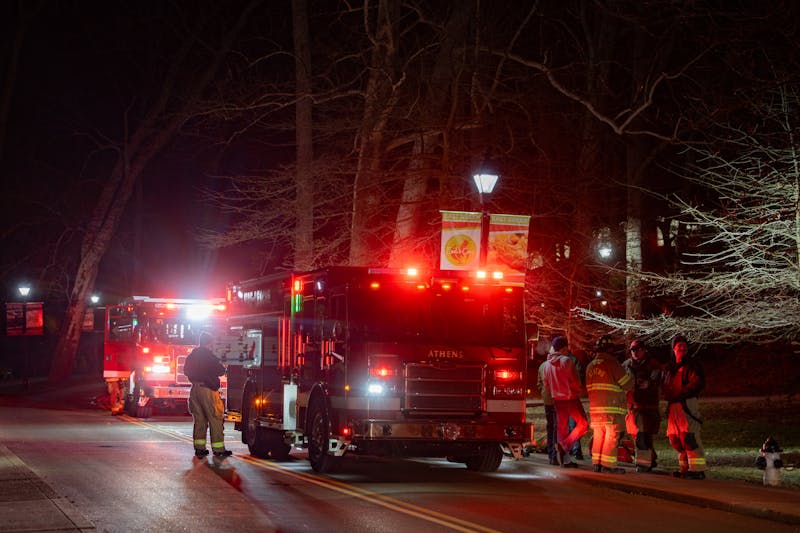
Against this backdrop, the third story — a local report from the student newspaper The Post Athens about smoke in the locker rooms of Bird Ice Arena in Ohio — is particularly revealing (The Post Athens). Here we see how the security system functions at the micro level in everyday life. At 10 p.m., a report of smoke comes in; the university facilities service, fire departments from multiple counties, and police quickly arrive. The source of the smoke is a crack in the furnace heat exchanger; it is taken out of service and the building is ventilated. It’s important to explain the term: a heat exchanger is a component of heating equipment through which heat from gas or another fuel transfers to air or water; its damage can cause incomplete combustion and the release of smoke or carbon monoxide into a room. In other words, this is a real potential threat to people’s health.
Standard safety procedures then take effect: events at the arena the next day are canceled, the university posts information stressing that there are no injuries, and it thanks the fire departments for their prompt response. The piece reminds readers that the arena was already closed in 2024 for unexpected repairs for nearly a year, which severely affected university hockey teams and student organizations that rely on the space. Security here is no longer a geopolitical instrument but a matter of infrastructure, accident prevention, and trust in local services. It is also interesting that here the issue is about balance: the building is necessary for the campus’s sporting and social life, yet any risk of fire or poisoning people is unacceptable.
This juxtaposition of micro- and macro-level security helps reveal structural trends. At the college-town level, security is functioning regulations, quick dispatch of fire trucks, no casualties, and transparent communication with the community. At the level of global politics, as ABC and Fox News show, security becomes a rhetorical frame used to justify expanding control over territories, resources, and institutions. In the Greenland and Board of Peace cases, the U.S. claims the right to redraw maps — both geographic and institutional. In the Caribbean, it claims a monopoly on deciding which oil is allowed to leave Venezuela and under what conditions. Both Fox News and ABC frame these actions as self-evident measures to protect Americans, though to allies and adversaries they appear as moves that undermine the existing international order.
The key trend uniting all three stories is the growing fragmentation of the concept of “security” and the strengthening of executive power under its banner. In global politics this leads to institutional competition (Board of Peace versus the UN), strained military alliances (the threat to NATO cohesion in the Greenland scenario, tariff pressure on allies), and the militarization of economic tools (ship quarantines, control over oil exports). Domestically, security takes the form of protecting consumers from markets (housing) and protecting citizens from everyday risks (fire safety, infrastructure).
A practical takeaway for observers and citizens is that any expansive discourse about security requires a dual lens. On the one hand, threats are real: instability in Venezuela, a shadow fleet, rising military competition in the Arctic, faulty heating systems in university buildings. On the other hand, under the cover of combating these threats, power — whether a global superpower or a university administration — inevitably seeks to expand authority and reallocate responsibility. It is important to watch carefully where, as in the Bird Ice Arena case, this leads to better protection of people, and where, as with statements about Greenland and a “quarantine” of ships, it leads to erosion of international norms and the strengthening of the logic of “might makes right.”
The stories told in the reports by ABC News, The Post Athens, and Fox News together show that security is becoming not only a goal but the main political language of our time. It is in this language that international alliances, energy markets, and urban infrastructure are being reshaped today. Whether security remains a genuine public good or becomes a universal justification for power depends on how critically society can respond to these appeals to security.