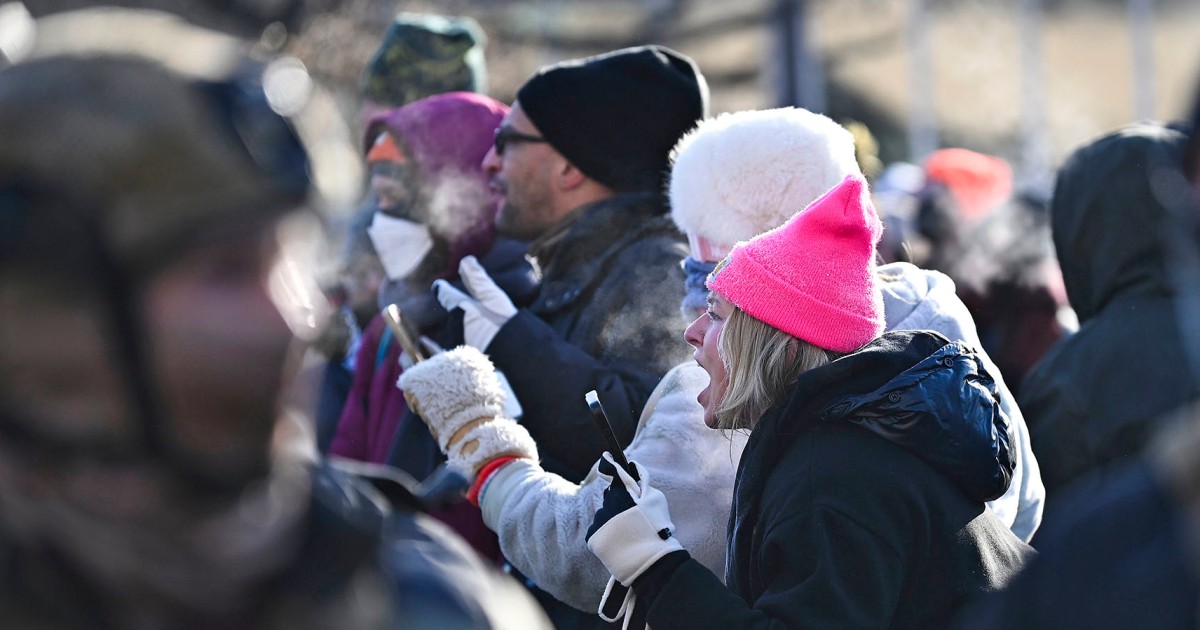
The story of Alex Pretti’s death in Minneapolis is not simply an emotional tragedy about one person. It clearly reveals a clash of two logics: aggressive federal immigration policy and local authorities’ attempts to protect their residents and preserve basic legal standards. At the center is the question of what happens when enforcement operations are built around an image of “the enemy” and “crisis” rather than de‑escalation and accountability. NBC News and ABC News materials show how one episode — a federal agent’s gunshot — becomes the focal point for debates about constitutional rights, the role of courts, political rhetoric, and how the state views its citizens.
The death of 37‑year‑old ICU nurse Alex Pretti occurred amid a federal operation to step up immigration enforcement in Minnesota known as Operation Metro Surge. As NBC News reports in coverage of the state’s lawsuit against the Trump administration over the operation, Minnesota Attorney General Liz Kramer and Minneapolis city officials essentially sounded the alarm in a filing to federal judge Kate Menendez. They write that communities are “in desperate need of a court‑ordered reprieve” from the “irreparable harms” the operation, they say, is inflicting on the health, safety, education and welfare of residents of Minneapolis, St. Paul and the state as a whole. In legal terms, “irreparable harm” means damage that cannot be remedied later with money or apologies — in this case explicitly including human lives.
Kramer and her colleagues ask the court to “return the parties to the position they were in before the Surge began,” in other words effectively to suspend the operation. They emphasize that the facts already presented to the court are enough to immediately protect residents’ constitutional rights, and that each day of delay “exacerbates these injuries and undermines the very rights this court is charged to protect” (NBC News, live blog). Against that wording, the phrase from their filing — “stop the Surge before another resident is killed because of Operation Metro Surge” — takes on an almost literal, rather than hypothetical, meaning after Pretti’s killing.
The official version from the Department of Homeland Security (DHS), presented in ABC News reporting, follows a classic self‑defense narrative. The agency says Pretti, who had a 9mm handgun, “approached agents” and “fiercely resisted” during an attempt to disarm him, after which one of the agents fired, allegedly to protect his own life (ABC News). Descriptions like “armed, aggressive, fiercely resisted” have become a recognizable template in official statements about contested uses of force: they pre‑shape public perception toward seeing a potential “perpetrator” rather than a victim.
However, a range of details gathered by journalists and local officials cast doubt on that account. Minneapolis Chief of Police Brian O’Hara, quoted by both ABC News and NBC News, emphasizes that Pretti was a lawful gun owner with a permit to carry and, according to police records, had no criminal history. Minnesota law allows open carry of a pistol with a valid license — so the mere fact of possessing a weapon, which DHS stresses, does not make his actions illegal and does not automatically explain why the shooting occurred.
Videos that circulated in real time via media and social networks show a different picture. NBC News’s profile of Pretti and the timeline of events describes footage obtained by the outlet showing him approaching to check on a protester who had been shoved by federal officers, after which a confrontation with agents ensued, he is taken to the ground and surrounded, then a series of shots are heard; agents step away from the body afterward (NBC News, biography and circumstances). Pretti’s parents, in a statement distributed through the Minnesota Democratic–Farmer–Labor Party (DFL), say that in the moments before the shots their son was not holding a gun: one hand had a phone and the other was raised above his head “while he was trying to protect the woman ICE had just pushed to the ground and was simultaneously being sprayed with pepper spray.” They call federal officials’ claims about their son’s allegedly dangerous behavior “false and repulsive” and ask: “Please, tell the truth about our son. He was a good person” (NBC News).
Governor Tim Walz and Minneapolis Mayor Jacob Frey have taken a similar line, criticizing federal agencies for rushing to accuse Pretti before a full investigation is complete, according to ABC News. The dispute is not only about who used force first but also about the right of local and state authorities to make their own assessment of what is happening on their territory, as opposed to a one‑sided narrative from Washington.
Against this backdrop, who Alex Pretti was in everyday life is especially telling — his biography and reputation sharply contrast with the image of a potential threat preferred by federal law enforcement. ABC News reports that Pretti worked as an ICU nurse in the Minneapolis VA Health Care System, earned his Minnesota nursing license in 2021 (valid through March 2026), was previously a junior scientist at the University of Minnesota Medical School, and had no criminal convictions (ABC News). Colleagues and patients describe him as someone who “always tried to help,” with a light humor that quickly put people at ease. Dr. Dmitriy Drekonya, who worked with Pretti, tells ABC News that for those who knew him, it is “infuriating and enraging” to hear him portrayed by federal officials in that way: “He was the person you wanted around, and the idea that this smiling, joking guy is called a terrorist is just outrageous.”
Neighbors and friends quoted by NBC News offer similar descriptions: “a gentle, kind person,” “everything you’d want to see in coworkers and friends.” One neighbor says he was shocked to learn Pretti even had a gun, so uncharacteristic did an image of an aggressive person seem (NBC News). A separate emotional thread comes from stories by veterans and their families. Mac Randolph recalled on Facebook how Pretti cared for his father, an Air Force veteran, in his final hours at the VA clinic, easing pain with morphine and guiding the family gently through the farewell process. In a video Randolph posted, Pretti reads a “final salute” after the veteran’s death in 2024, saying that “freedom is not free” and that it must be “actively defended, sometimes at a cost” (ABC News; NBC News).
That phrase — about the price of freedom — takes on a bitter tone in the context of his death. The paradox is that a man who devoted himself to serving veterans and spoke about the need to “defend freedom” is killed by representatives of the same government under the banner of “national security” and “law and order.” Notably, the AFGE Professional Local 3669 union representing VA employees, quoted by both ABC News and NBC News, underscores that Pretti “devoted his life to serving American veterans” and that what happened “did not occur in a vacuum.” AFGE President Everett Kelley directly ties the tragedy to the political context: in his view, it is “the direct result of an administration that chose reckless policy, stoking rhetoric and a manufactured crisis instead of responsible leadership and de‑escalation” (ABC News).
The term “manufactured crisis” is key: it points to the idea that the immigration situation, including in Minneapolis, is largely constructed politically through language and imagery as much as by real threats. When federal authorities announce major operations like Operation Metro Surge, the rhetoric often frames the situation in terms of “invasion,” “a border crisis,” and “threats to public safety.” In that atmosphere, any tense situation on the ground can be interpreted by operatives as a potential attack, and an armed (even legally) citizen becomes, by default, a figure of threat.
Minnesota’s position in the lawsuit against the Trump administration is aimed precisely at that logic: state authorities argue that, under the banner of security, policies are being implemented on their territory that systematically violate residents’ rights and undermine their ability to protect public health and welfare. Kramer’s filing to Judge Menendez stresses that the court should “preserve the status quo,” meaning freeze the operation’s implementation so it can calmly assess whether it complies with the Constitution and whether it inflicts disproportionate harm. In legal terms this is an emergency equitable remedy or temporary restraining order — a tool used when delay risks damage that cannot later be remedied.
Pretti’s story thus becomes not a peripheral episode in that lawsuit but a living illustration of what the state calls “irreparable harm.” It shows how rhetoric about “stepping up enforcement” and a political focus on tough immigration measures almost inevitably increase street‑level violence, especially where federal agents who are less integrated into local communities and accountable to a different chain of command operate. It is important that the investigation unfolds amid a sharp conflict of interpretations: DHS limits itself to calling the incident a “developing situation” and promises that “facts will be determined later,” while local politicians and witnesses are already openly pointing out discrepancies among the video, testimony and the federal account.
Viewed in broader trends, the intersection of these stories reveals several important developments and consequences. First, the clash between states and the federal center over immigration enforcement is intensifying. By going to court and seeking to halt Operation Metro Surge, Minnesota shows its willingness to use the judicial system as a barrier against what it considers destructive intervention. This fits a wider trend in recent years in which states — both conservative and liberal — increasingly sue Washington on matters from health policy to immigration, making federal courts an arena for political conflict.
Second, the role of visual evidence and public narratives in evaluating uses of force is growing. Videos of the incident with Pretti, referenced by both ABC News and NBC News, are already shaping public understanding before official reports are released. Where a decade ago law enforcement’s word might have dominated, multiple amateur recordings now sit at the center and can either corroborate or sharply contradict official versions.
Third, the Pretti case illustrates how quickly crisis‑and‑threat rhetoric can dehumanize real people, turning them into abstract figures in a security narrative. The gap between the image of Alex in DHS statements and how relatives, colleagues and patients describe him is striking. For many in Minneapolis and beyond, this is not just a dispute over facts but a clash of values: is it possible for a state that claims to protect freedom and security to so readily destroy the reputation and life of a person who devoted himself to serving veterans?
Finally, in terms of policy and law, the Pretti story is likely to become an argument for stricter oversight of federal enforcement operations inside the country, mandatory de‑escalation protocols, greater transparency and accountability, and an enhanced role for courts as arbiters between state and federal power. The American Nurses Association, cited by NBC News, is already demanding a “full, unfettered investigation.” If Judge Menendez grants Minnesota’s request and suspends Operation Metro Surge, it would set a precedent: human tragedy captured on video and affirmed by local community voices could stop a major federal initiative built around hardline rhetoric and a narrative of a “manufactured crisis.”
Taken together, sources — from court filings described in NBC’s live report to the personal stories and assessments in ABC News and NBC’s reporting on Pretti — form a single narrative: stepped‑up immigration enforcement, fueled by political rhetoric and carried out with minimal regard for local realities, creates not abstract “risks” but concrete, irreversible losses. And the question now facing courts, lawmakers and society is not only: who is to blame for Alex Pretti’s death? It is much broader: what price is American society willing to pay for a policy built on fear and force, and where is the line between protecting borders and destroying citizens’ civil liberties.