
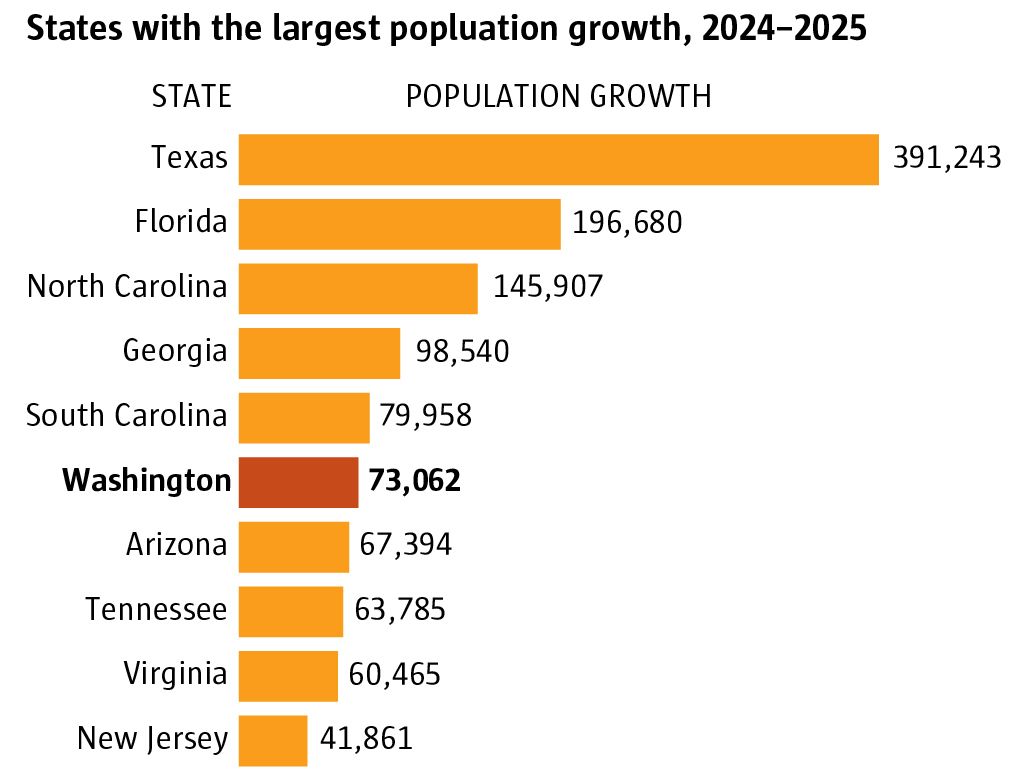
According to the latest estimates from the U.S. Census Bureau, the state of Washington has reached a significant demographic milestone: by July 1, 2025, its population exceeded 8 million people for the first time, totaling 8,001,020 residents. That result allowed the state to retain its 13th-place ranking by population in the country. The increase came from a population gain of roughly 73,000 people (nearly 1%) over the year.
By annual growth rate (about 1%), Washington ranked seventh among all states, behind the leader, South Carolina (1.5%). By absolute population increase (the same roughly 73,000 people), the state ranked sixth, trailing several fast-growing states in the South and Southwest such as Texas and Florida.
Notably, Washington’s population growth last year was driven by all three main components: natural increase (the difference between births and deaths), domestic migration (moves from other U.S. states), and international migration. This multi-faceted growth sets the state apart against a backdrop in which some states, for example California, are losing population.
Natural increase added about 17,000 people to the state’s population, the highest figure in the current decade. About 83,000 children were born in Washington over the year, while roughly 66,000 people died. Thus, the state was among 33 states where births exceeded deaths.
Domestic migration (moves from other states) played a smaller role, adding about 9,000 new residents. Although not a large number (16th in the country), it marks a sharp turnaround after several years of outflow driven by high housing costs in major cities, the shift to remote work, and social issues. Last year’s modest inflow is tied to employees returning to offices at tech companies and a stabilizing labor market. The largest contributions to population growth came from King County (home to Seattle), Snohomish, and Pierce counties, directly linked to the tech sector — companies like Amazon and Microsoft attract specialists — and to the growth of related industries such as biopharma and logistics. For example, growth in Bellevue and Redmond (Seattle suburbs) is driven by the IT cluster.
The primary driver of growth was international migration, which accounted for more than half of the total increase — about 46,000 new residents from abroad. By this measure, Washington ranked seventh in the U.S. Most international migrants arrive from India, China, the Philippines, and Mexico. Indian and Chinese professionals often work in the tech sector (software developers, engineers) on H-1B visas; Filipinos and Mexicans often work in health care (nurses), agriculture, and service industries. However, there is a paradox: compared with the previous year, the volume of international migration into the state and across the country fell sharply. Experts link this historic decline to reduced immigration to the U.S. and increased emigration from the country amid tighter immigration policies.
Over the long term, from 2020 to 2025, international migration remained the main source of Washington’s population growth, while the contribution from domestic migration was small and natural increase gradually weakened. At the national level, the U.S. population grew by 1.78 million over the year, approaching 342 million people.

Based on: WA population hit 8M in 2025, while migration to the U.S. fell