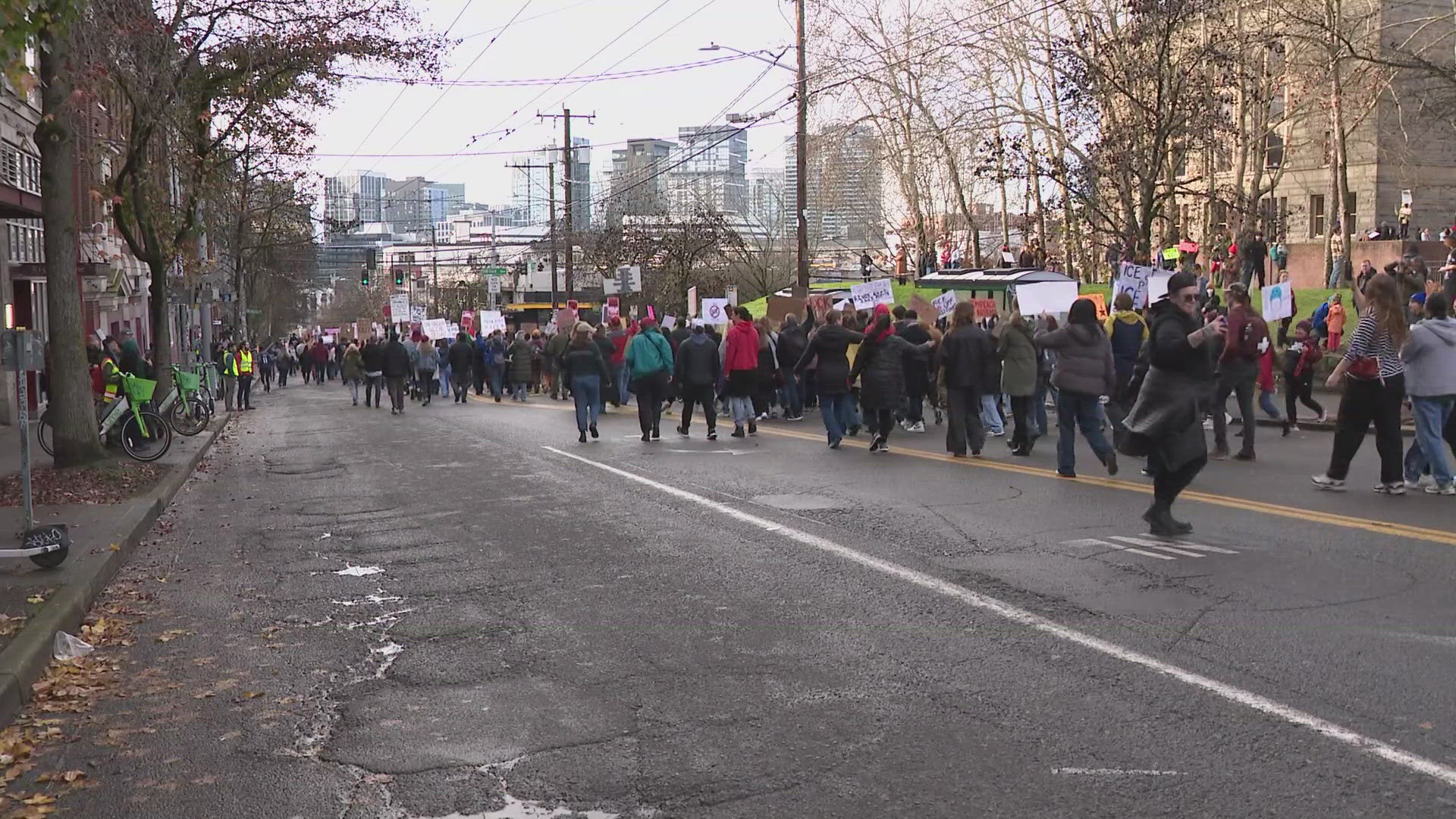
Sale of the Seattle Seahawks: rumors of a post-Super Bowl deal meet denials, but the sale is dictated by Paul Allen’s will. Meanwhile, the city saw a large protest that blocked streets and demanded the abolition of ICE.
Sale of the Seattle Seahawks: what’s behind reports of a deal after the Super Bowl
In the world of professional sports, where teams often become family legacies or investment assets, the fate of the NFL’s Seattle Seahawks has come into focus. According to an ESPN report published by Seth Wickersham and Brady Henderson, the team could be put up for sale immediately after Super Bowl 60, where the Seahawks will face the New England Patriots. This information, based on anonymous sources within the league and among owners, conflicts with official statements, creating an air of uncertainty around one of the sport’s most valuable assets.
The Seahawks’ ownership history is inseparable from the name of Paul Allen, the Microsoft co-founder who bought the team in 1997. After his death in 2018, control passed to his sister Jody Allen as trustee of the estate. According to Paul’s will, both the Seahawks and the NBA’s Portland Trail Blazers are to be sold, with proceeds directed to charity. The sale process has already begun for the Blazers: in September an agreement was reached to sell to an investor group led by Tom Dundon. However, the football club’s situation appears less straightforward. A representative of Paul Allen’s estate responded to the rumors bluntly: “The team is not for sale. We’ve already said that at some point this will change in accordance with Paul’s wishes, but I have no news. Right now our focus is on winning the Super Bowl.” That statement suggests the sale is a matter of time, but the timetable remains uncertain.
Notably, according to sports columnist John Canzano, Jody Allen may be interested in retaining a stake in the team, which could explain the delay in selling the Seahawks. There are also complex legal and financial circumstances. As former Seahawks player Brock Huard explained, the Lumen Field stadium agreement—built with significant public funding—included a so-called “poison pill” clause prohibiting the sale of the team until 2025–2026 without substantial financial penalties. That provision was likely designed to ensure the team would remain in Seattle after receiving public funds for the stadium. ESPN’s report also notes that a deadline after which a sale would not require a 10% payment to the state of Washington has already passed, potentially simplifying a transaction.
The Seahawks’ on-field achievements underscore the franchise’s value. Under Paul Allen the team reached the Super Bowl for the first time in 2005, won the championship in 2013, and returned to the final the following year. Now, under Jody Allen’s stewardship, the club is back in the season’s biggest game after an 11-year gap, having posted a franchise-record 14 regular-season wins. This success, achieved after the departure of legendary coach Pete Carroll and the arrival of Mike Macdonald, only increases the team’s appeal to potential buyers. The valuation of an NFL franchise at this level can run into the billions, making this transaction one of the most significant in sports business history.
Thus, reports of a possible sale of the Seattle Seahawks after the Super Bowl appear to be a logical development, predetermined by Paul Allen’s will. However, conflicting signals from the ownership camp and complex legal conditions suggest the process may not be as swift as rumors imply. The stated focus on winning the Super Bowl could be a sincere pursuit or a tactical move to boost the franchise’s value before a sale. For fans, the key concerns remain preserving Paul Allen’s legacy and the team’s stability, which have become integral to Seattle’s identity. Whatever the outcome, the coming months will determine the future of one of the NFL’s most decorated and financially robust clubs.
Sale of the Seattle Seahawks: rumors, denials, and Paul Allen’s legacy
In professional sports, where rumors often outpace official statements, news of a possible sale of the NFL’s Seattle Seahawks after Super Bowl LX caused a sensation. But the situation turned out to be more nuanced, met with categorical denial from the heirs of the late owner. This story is not just about a potential multibillion-dollar deal, but a complex tangle of the deceased magnate’s wishes, philanthropic ambitions, and current sporting triumphs.
According to an ESPN report, an anonymous club executive suggested the Seahawks, who are preparing for the Super Bowl against the New England Patriots on February 8, would be put up for sale immediately after the game. The franchise’s estimated value, by various accounts, could exceed $7 billion, which would top the NFL record of $6.05 billion paid for the Washington Commanders in 2023. For comparison, in fall 2025 Sportico valued the club at $6.59 billion. But a representative of Paul Allen’s estate quickly responded to the rumors, saying via Ian Rapoport of NFL Network: “We don’t comment on rumors or speculation, and the team is not for sale. We have already said that at some point this will change in accordance with Paul’s wishes, but I don’t have news to share. Right now our attention is on winning the Super Bowl and completing the sale of the Portland Trail Blazers in the coming months.” This is key: Allen’s estate is already handling the sale of the Trail Blazers to a group led by Carolina Hurricanes owner Tom Dundon for more than $4 billion.
To understand what’s happening, you need to look at the history. Paul Allen bought the Seahawks in 1997 for $200 million, saving the team from a potential move to Los Angeles under the previous owner. After his death in 2018, control of both the Seahawks and the Trail Blazers passed to his sister Jody Allen as trustee. She became the franchise’s public face, raising the famous “12th Flag” (symbolizing the fans’ support, the team’s “12th man”) before games and accepting the trophy after the NFC championship win. Head coach Mike Macdonald notes they speak with Jody every week after games and that she asks “insightful questions.” Jody Allen has repeatedly said the team is not for sale but has acknowledged long-term plans. In a 2022 statement cited by the Seattle Times, she explained: “Time will change things, given Paul’s plans to direct the overwhelming portion of his estate to philanthropy. But estates of this size and complexity can take 10 to 20 years to settle. There is no predetermined schedule by which teams must be sold.” That is the essence: the ultimate goal of any sale is not to enrich heirs but to fund large-scale philanthropy, as Paul Allen intended.
Therefore, current rumors of a sale after the Super Bowl, though denied, point to an eventual inevitability. If a sale were to occur imminently, it would be the first instance in Super Bowl era history of a franchise being put on the market immediately after the season’s biggest game. The new owner would be only the fourth in the club’s history, founded by the Nordstrom family. For now, Allen’s estate’s official position remains steadfast: all attention is on the upcoming Super Bowl LX. Regardless of the game’s outcome, the Seahawks’ long-term fate is guided by the wishes of their late savior and owner, who steered the team toward philanthropy.
Massive protest in Seattle: march to Federal Building and street blockages
On Saturday the center of Seattle became the scene of a large protest that caused serious traffic disruptions. Demonstrators blocked key intersections in the Capitol Hill area, then marched to the Henry M. Jackson Federal Building downtown, gathering at least a thousand people, according to reporters on the ground.
The action began on Capitol Hill, where protesters completely shut down traffic at the intersection of Broadway and East Pine Street. The Seattle Department of Transportation (SDOT) promptly advised drivers to avoid the area and seek alternate routes, as a large crowd moved west along East Pine Street. KING 5 reports that about a thousand people initially gathered at that intersection. The column then marched along Pine Street, passed Ninth Avenue—blocking traffic in both directions—and turned south on Second Avenue, disrupting the southbound lane near University Street.
The march culminated at the plaza in front of the Henry M. Jackson Federal Building in downtown Seattle. By 3:30 p.m., KING 5’s correspondent estimated at least a thousand protesters were gathered there. It’s worth noting that this building houses several federal agencies, which likely explains its selection as the march’s endpoint. Authorities had initially expected a smaller demonstration related to educators’ activities, but several groups joined forces to create a larger protest. Signs in the crowd predominantly called for abolishing the Immigration and Customs Enforcement (ICE)—the powerful federal agency responsible for enforcing immigration laws, whose activities are often criticized by human rights advocates. By 5:00 p.m. most people had dispersed, and SDOT announced that traffic on Second Avenue and Pine Street had been fully restored.
This action was another expression of active civic engagement in Seattle, a city with a long tradition of public protests. Blocking major traffic arteries like Broadway and Pine Street is a tactic aimed at drawing maximum attention to protesters’ demands. While the organizers and full list of demands were not detailed in the brief news report, the clear anti-ICE rhetoric (slogans against ICE) indicates the protest was likely tied to immigrant rights and U.S. immigration policy issues. Such actions are, on the one hand, a lawful way to express opinion protected by the First Amendment, but on the other hand they create significant inconveniences for residents and pose a challenge for authorities to balance the right to assemble with the uninterrupted functioning of city infrastructure.