Global commentary on the United States now largely revolves around a single storyline: Donald Trump’s return to the White House and how American foreign and economic policy will change for the rest of the world. In Japan this is discussed through the prism of security and risks to alliance commitments. In India the focus shifts to trade, technological partnership and balancing Washington, Moscow and Brussels. In Russia, talk about the U.S. remains part of a broader discussion about sanctions, war and the “decline of American hegemony.” Against this background each country has its own anxieties and hopes, which are often invisible in American media.
The main common theme is Trump’s second administration and the fate of American leadership. In Japanese expert circles the very phrase トランプ新政権 — “the new Trump administration” — has already become an object of analysis. The research institute RIETI devoted an entire seminar to “the foreign and defense policy of the new Trump and Japan’s strategy,” where Tsuneo Watanabe, senior fellow at the Sasakawa Peace Foundation, explained that Trump’s victory became possible amid economic discontent and American fatigue with their country’s global role, and that Tokyo must now prepare for a “more transactional” alliance, where Washington will be more demanding of its allies on defense spending and trade concessions. The event’s abstract explicitly states that the key question for Japan is “what influence Trump’s second term will have and what strategic response Tokyo needs to develop”; the presence of a senior METI official as a commentator underlines that this is not an abstract academic discussion but a matter of real policy. This is not just fear of an “unpredictable Trump,” but a more pragmatic question: how to preserve security guarantees while avoiding becoming a target of his protectionist tariffs. (rieti.go.jp)
The Japanese press, including business outlets, actively compares possible courses under Trump and his Democratic rivals, discussing the dichotomy not in terms of “pro-” and “anti-” Japan policy, but in the logic of which scenario creates more manageable risks. Political scientist Taiki Wada, in a detailed analysis for Asahi Shimbun’s “Tsugino jidai” platform during the height of the campaign, posed the question: “If the next president is Trump or Harris, how will U.S. policy toward Japan, China, Taiwan and Europe change?” The author concludes that a policy of containing China will most likely remain regardless of the president’s identity, and the basic parameters of the alliance with Japan will continue. But regarding Europe, Ukraine and climate policy, the Trump scenario is seen as much more turbulent, which indirectly affects Tokyo as it will have to navigate between its American ally and European partners. Japanese pieces often emphasize that for Taiwan and Northeast Asia the U.S. president is not an abstract question of values but one of physical security. (smbiz.asahi.com)
A separate body of Japanese material is devoted to the economy: business associations and sector experts recall the first Trump administration, his tariffs and withdrawal from climate agreements. In an analytical review, JETRO reminds readers that protectionist measures and rejection of multilateral economic regimes in 2017–2020 were the main source of concern for Japanese companies, and that in a second term this vector could become “even more varied and aggressive.” It also notes that corporate surveys in Japan register primarily fear of possible new tariffs and a rollback of climate policy, rather than cultural or immigration aspects that often dominate American media coverage. This is a typical example of “local optics”: for Tokyo, Trump is first and foremost a variable in the equation “trade + security,” not a symbol of culture wars. (jetro.go.jp)
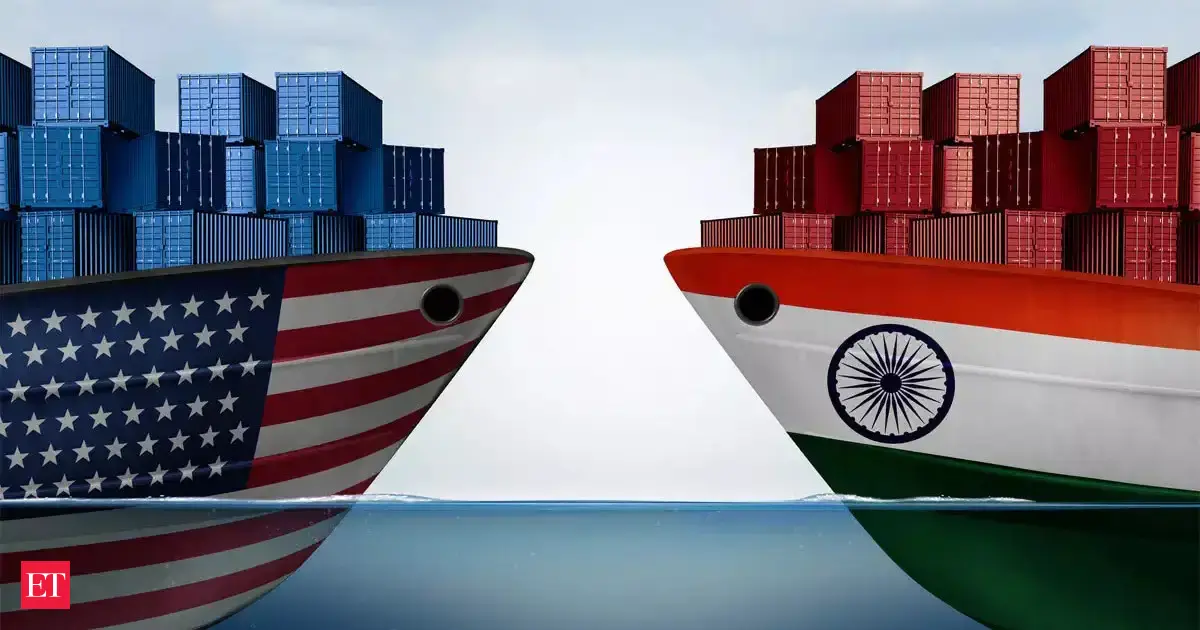
In India the tone of public conversation about the U.S. is noticeably less alarmed and much more pragmatic. The main focus there has become the prospect of a bilateral trade agreement and how the new Washington administration will affect the economic agenda. Presented in New Delhi, the Economic Survey for 2025–2026 explicitly states that trade negotiations with the U.S. could conclude during this year and that concluding a deal would “reduce external uncertainty and strengthen India’s trade environment.” Both Economic Times and Times of India frame this as a strategic goal: to convert the political rapprochement of recent years — from the QUAD to defense procurements — into a durable architecture of access to the U.S. market, especially in services and the digital economy. (m.economictimes.com)
Indian commentators emphasize the ambivalence of American policy. At the level of official ritual, relations with the U.S. are portrayed almost as a success story of two democracies: Washington’s congratulations to India on its 77th Republic Day were described in Indian news with phrases about “historic ties” and “close cooperation,” and the U.S. message stressed an “expanding partnership” in defense, technology and security. But at the same time there is a harsher conversation about tariffs, sanctions and American attempts to limit India’s ties with Russia. In Indian discussion this is often framed as a need to “diversify pillars”: alongside the U.S., deepen ties with the European Union as an “alternative to American dominance.” A characteristic example is a column in France’s Le Monde, cited and discussed by Indian media: it describes strengthening EU–India ties as a demonstration to the world that “alternatives to the U.S. exist,” especially against the backdrop of Trump’s protectionism and high U.S. tariffs on Indian goods. (timesofindia.indiatimes.com)
Notably, Indian debates rarely raise the question of the “reliability” of American security guarantees in the tone heard in Japan or Europe. India is not a treaty ally, possesses its own nuclear triad and seeks to maintain a status of “strategic autonomy.” Thus local analysts view the U.S. as one of several partners with whom they must negotiate hard. Where Japanese texts speak of the need to “minimize potential chaos” from a change in the American administration, Indian ones discuss how to exploit internal contradictions in American policy to extract the best terms in trade, technology and defense. And if European commentators in Le Monde fear that Washington under Trump may revert to protectionism and populism, some Indian authors see an opening: a U.S. preoccupied by domestic polarization will be willing to delegate part of the responsibility for regional security to India in exchange for a closer economic partnership.
The Russian picture in the public space is predictably different: in Russia the U.S. is discussed almost exclusively in the context of Ukraine, sanctions and the struggle for a multipolar world. Russian commentators in state media and Kremlin‑aligned think tanks interpret Trump’s return as a symptom of a “crisis in the American political system” and “loss of trust in the elites.” This is usually accompanied by the thesis that regardless of who sits in the Oval Office, Washington’s “anti‑Russian course” will remain, but American turbulence is allegedly beneficial to Moscow because it limits Washington’s ability to pursue a long and costly confrontation.
At the same time, in more professional discussions, including economic circles, one can see sober assessments: the future of sanctions, oil price caps and export controls on technologies is still largely determined by the position of the U.S. and its coalition. Some economists and entrepreneurs speaking in Russian media cautiously note that the tough U.S. export control regime rolled out under Biden may even intensify under Trump due to his focus on an “economic war” with China, under which Russia—being a partner of Beijing—would automatically fall. In that sense Russian “pragmatism” is the mirror opposite of Japanese and Indian approaches: while Tokyo and New Delhi look for ways to fit into the American economic architecture, Moscow discusses how to exit it permanently or at least minimize dependence.
It is interesting that different countries perceive the idea of “alternatives to the U.S.” differently. Japanese papers on the future Indo‑Pacific strategy often emphasize that the concept of a “free and open Indo‑Pacific” was born under the first Trump administration and was then reinforced by Biden. CSIS experts interviewed by JETRO after the election note that under both Trump and his Democratic opponents the QUAD and the Indo‑Pacific framework will remain important, although style and rhetoric may differ significantly. So in Japanese optics “alternatives to the U.S.” is more a matter of diversification within a persisting American axis than a full departure from Washington’s orbit. (jetro.go.jp)
In Indian discourse the thesis about alternatives sounds bolder. The EU–India rapprochement, actively described in European press as an attempt to show the world other centers of power besides the U.S., is perceived in New Delhi as a complement to the existing triangle “India–U.S.–Russia.” An important detail emphasized by both European and Indian analysts: despite Western pressure over Ukraine, India does not sever military and energy ties with Moscow. For many Indian authors this is the practical definition of strategic autonomy: cooperate with Washington where it is beneficial, with the EU where it strengthens bargaining power, and maintain an independent line with Russia even if it irritates the U.S.
The Russian view of these same processes is ironic and suspicious: in Moscow discourse closer India–EU or India–U.S. ties are often described as a Western attempt to “tear” New Delhi away from Moscow, whereas Indian commentators talk about expanding maneuvering space, not switching camps. This contrast makes starting assumptions starkly different: Russia sees the world through the prism of camps and “blocs,” while India and Japan see it more as intersecting architectures and networks.
Finally, almost all three countries raise themes that in the U.S. often remain peripheral. In Japan much is written about how American domestic polarization and violence—from the Capitol riot to the assassination attempt on Trump during the campaign—undermine the image of the U.S. as a model of stable democracy. But even these worries are framed pragmatically: how reliable is a partner whose internal struggles can block budgets or military aid to allies? In India, by contrast, criticism of American democracy often serves as a mirror for domestic debate: liberal commentators compare the rise of populism and religious polarization in the U.S. to developments at home, while nationalist authors use American problems to argue against “Western moralizing.” In Russia the topic of American democracy is almost always instrumentalized by propaganda as evidence of Western “hypocrisy,” but behind this noise lies a more serious question Russian elites seem to ask themselves: how many more years can the U.S. sustain its current level of external confrontation if its society is so divided?
If one attempts to gather these disparate voices into a single picture, an ambiguous but important conclusion emerges. For Japan the U.S. remains an indispensable security guarantor but an increasingly unpredictable partner whose whims require adapting trade and defense policy. For India the U.S. is one of the key but not sole pillars of foreign strategy, to be negotiated with pragmatism while balancing Washington, Brussels and Moscow. For Russia the U.S. is both the main rival and the main structuring factor of its foreign policy: its internal weakness is interpreted as a chance for a multipolar world, but its economic and technological power still sets the bounds of the possible.
These differences are rarely visible in American media: U.S. domestic debate tends to view foreign policy as a continuation of internal disputes, measuring everything through “pro‑Trump” and “anti‑Trump,” “liberals” and “conservatives.” But looking from Tokyo, New Delhi or Moscow, the U.S. appears less as an arena of culture wars and more as a variable in a complex equation of security, trade and strategic autonomy. And it is these foreign equations, not only the American domestic dispute, that will determine the real impact of the new administration in Washington on the world in the coming years.