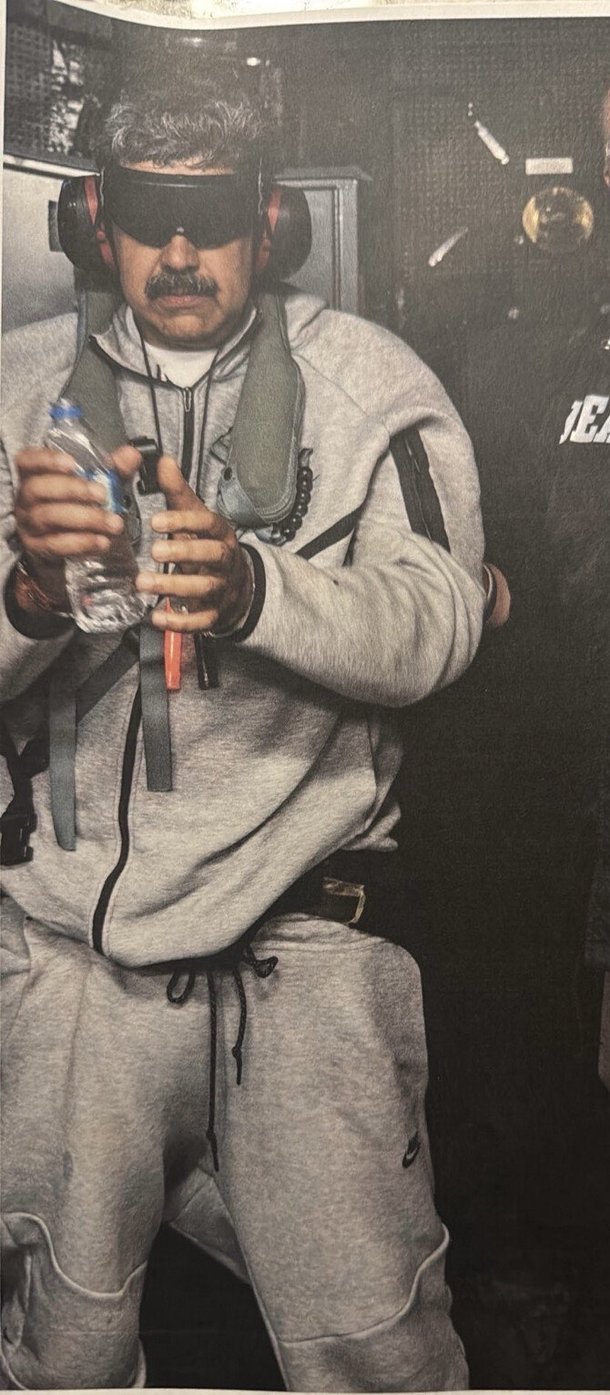
At the start of 2026, what is called the "American question" unexpectedly narrowed in France, South Korea and Australia to a single episode that became the nerve center of several debates: a lightning-fast US operation to seize Venezuelan President Nicolás Maduro and fly him to New York. Adding to this are the lingering shadow of the Iranian protests and the role of Donald Trump, as well as broader reflections on how the international order changes if Washington increasingly places "force and interest" above rules. From afar this may look like another peripheral crisis, but in Paris, Seoul and Canberra it is seen as a test: how far are the United States willing to go — and what does that mean specifically for them.
A central theme running through editorials and columns in the three countries is the legitimacy of American "justice without borders." Another is the return of raw "politics of force" and the question of who can and will stop it. A third is a very practical fear: might the Venezuelan precedent become a model for other great powers, and might an American ally become the next arena for such a force experiment.
In South Korea the problem is formulated exactly that way. In an editorial in Seoul Shinmun titled "'Force for Interest' openly exposed in the overthrow of Maduro," the authors write that the swift detention of the Venezuelan leader showed how accelerated the era has become in which the international order is determined not by law but by naked power, and they directly link this to the need to "seek the best option to protect the national interests of the Republic of Korea between the US and China." In the phrase 힘과 국익의 시대 — "the era of force and national interest" — both skepticism and recognition of reality are audible. The paper simultaneously reminds readers of the real crimes of the Venezuelan regime and of the International Criminal Court investigation into Maduro, but it draws a clear red line: even a dictator, the editors write, cannot be overthrown "whenever one wants" based on a superpower's conveniences, otherwise China and Russia will tomorrow invoke the same arguments regarding Taiwan or Ukraine. (seoul.co.kr)
French publications, more cautious in their wording but no less sharp in substance, have also seized on the legal and political precedent. In the French debate the key refrain is "atteinte à la souveraineté" and "violation du droit international" — violation of sovereignty and international law. Analyses cited by the Korean press note that the French government condemned the operation as inconsistent with principles of international law, while not entertaining illusions about the nature of the regime in Caracas. In one South Korean roundup Seoul Shinmun emphasizes: "France believes the US violated principles based on international law," thus showing that even a traditional ally is not prepared to quietly accept the logic of an American "arrest operation." (seoul.co.kr)
This duality of the French view is especially noticeable in comparison: while Chinese and Russian diplomats at the UN Security Council meeting spoke of an "imperialist invasion" and a "blatant trampling of international law," Paris and London, according to the South Korean Chosun Ilbo, tried to reconcile "humanitarian intervention" with criticism of the operation's legal form. In a piece aptly titled "The US kidnapped Maduro in six hours... next — Kim Jong Un?" the author notes that France and the UK at an emergency Security Council session characterized US actions as a "humanitarian-motivated intervention," whereas Moscow and Beijing spoke of a "breach of international law" and a "colonial attack." (mk.co.kr) This is very French: acknowledging that the Maduro case can fit into human rights rhetoric, Paris nonetheless insists that the final arbiter should not be the American administration but collective mechanisms — whether the UN or international courts.
In Australia the reaction is much more divided, which is clearly visible in the public broadcaster ABC. In a column by international editor Laura Tingle, "Strike on Venezuela sets a new low for the world order — even by Donald Trump standards," she emphasizes Washington's "egregious disregard" for international law and allies' alarm: even those who dislike Maduro were "stunned" by the scale and unilateralism of the operation. Tingle writes that the operation to kidnap a sitting head of state became "one of the most spectacular displays of American power" and at the same time the most dangerous, because it destroys the post‑1945 taboo on such actions. (abc.net.au)
But in an ABC piece about Asian reactions a very different tone emerges — the cautious pragmatism of the Australian government. In coverage of reactions from Indonesia, Singapore and Malaysia, which expressed "deep concern" and called the capture of Maduro "a clear violation of international law" and "a dangerous precedent," it is noted that Australian Prime Minister Anthony Albanese took a more restrained position, limiting his response to calls for "dialogue and de‑escalation." (abc.net.au) In Canberra they see that neighbors are alarmed by a new American mode of action, but are not ready to openly oppose Washington: the US strategic umbrella remains more important for Australia than legal niceties.
South Korean editorials add a geopolitical dimension to the legal one. In its leading article "Venezuela crisis: prepare for its impact on the Korean Peninsula," Hankyoreh directly asks what would happen if the White House decides to apply the same logic to North Korea. The paper quotes Secretary of State Marco Rubio, who in an interview with American ABC claimed that Maduro "was not a legally elected president" and that the operation in Caracas was not an "invasion" but "the arrest of a drug criminal charged in the US." Such language, the editorial warns, can be applied with almost no change to North Korea, where the regime is also accused of crimes and violations. (v.daum.net)
Conservative South Korean outlets go even further in dramatization. In a Chosun Ilbo analysis structured almost like a script, the author asks: "Next — Kim Jong Un?" and stresses that "Trumpist diplomacy of force" could make North Korea the next target not only rhetorically but in operational planning. The same piece concedes that Washington's motives are far from solely "fighting a dictatorship": it's also about "recovering seized oil" and mobilizing the electorate ahead of US midterm elections. (v.daum.net)
For the Korean public these are not abstract musings: these articles are read through the prism of their own history and the constant threat of war on the peninsula. In an editorial Seoul Shinmun emphasizes that the US "has in effect shown its readiness to use military force to change regimes of hostile countries," and therefore for Seoul the open question arises: what to do if the logic of "force and interest" tomorrow outweighs all caveats about a "limited operation" or an "arrest of a criminal" and is applied to its northern neighbor.
Interestingly, both Australian and Korean authors actively discuss not only the fact of the operation itself but also the reactions of other states, which is especially noticeable in regional analysis. In an Australian ABC piece on the plunge in oil prices after strikes on Venezuela, it was noted how markets assess the risk of escalation and how ready the US now is to "intervene in the economies of its opponents" without regard to consequences. (abc.net.au) South Korean business press, such as Maeil Business, describes in detail the split in the UN Security Council, where "the US, Britain and France" insist that Maduro is "not the legitimate head of state," while China and Russia speak of "trampling sovereignty" and "a victim for natural resources." (mk.co.kr) There is a palpable worry: if standards that upheld decades of diplomacy break down so quickly in New York, small and medium states will have even fewer tools of protection.
This shift is articulated especially clearly by South Korean editors, speaking of "an acceleration of an international order where the logic of force is paramount." In the Seoul Shinmun version quoted on Nate, it is stated plainly: "The US declares realism in its foreign policy, but if 'Maduro 2.0' lasts another six months supported by his people, a bet on force is unlikely to look realistic." This is a nod to American realists, but delivered with Asian irony: even those who verbally reject moral constraints sometimes lose out by underestimating the complexity of the world. (news.nate.com)
Against this background, the French conversation about America in early 2026 goes beyond a single crisis and turns into a debate about the very nature of Western leadership. French columnists and experts, cited by Korean and Russian sources, insist that if the US continues to behave as "the sole superpower not bound by the details of international law," as The Guardian put it in a piece rehashed by the Korean Korea Daily, then they are gradually turning from "the world's policeman" into a "pariah state" in the eyes of the Global South. (koreadaily.com) In the French context such formulations are particularly sensitive: Paris traditionally claims a role as defender of multilateralism, and now must navigate between allied solidarity and growing irritation at an ally that acts without consultation.
In the Australian debate Trump is not just the initiator of one risky operation but a symbol of a broader shift. In an ABC piece on moderation policy changes at Meta after his election victory, Australians discussed how Trump's return to power in the US becomes a "cultural tipping point" toward "freer" — in Mark Zuckerberg's words — speech, but also a more toxic digital environment where disinformation can directly fuel aggressive foreign policy moves. (abc.net.au) For Australian commentators these are links in the same chain: the weakening of internal restraints in the American system — from media platforms to a Congress bypassed in the decision on the Venezuela operation — increases the likelihood of abrupt external moves.
South Korean editors in other pieces draw another worrying parallel: between the Venezuelan and Iranian cases. In analysis relayed by local media, political scientist Rahan Menon in a Guardian column warns that success in Caracas may push Trump toward attempts at more direct intervention in Iran, where bloody protests are already underway. (koreadaily.com) In an ABC article about remarks by Iran’s Supreme Leader Ali Khamenei, who called Trump "a criminal" allegedly inciting protesters and responsible for "thousands dead," the Australian audience sees yet another mirror: if the US is willing in one region to arrest the head of state and bring him to New York, is Washington prepared to go for a harsher scenario in Iran — and how will regional powers from Israel to Saudi Arabia react? (abc.net.au)
Finally, all three countries read a fundamental signal from the Venezuelan episode: the era when the United States was both the most powerful actor and the main guarantor of rules may be rapidly ending. In Seoul they ask how to craft policy in a world where both the US and China think in terms of "force and interest." In Paris there is fear that if Washington finally abandons the language of law, Europeans will shoulder a disproportionate burden of preserving norms that the other pole — Russia and China — is already contesting. In Canberra, closely reading the moods of Indonesia and Malaysia, they understand that the alliance with the US remains indispensable, but its cost in neighbors' eyes is rising.
These debates rarely reach English-speaking audiences in an intact form; all the more important, then, is that in Australia, South Korea and France today people are arguing not simply about whether Trump is right or wrong. They are arguing about what America should be in a world where "the law of the strong" has once again become a political slogan, and how to live next to such an America for those who cannot afford the luxury of either a complete break or blind loyalty.
![UN Security Council members discuss the arrest of Venezuelan President Nicolás Maduro and his wife Cilia Flores at an emergency meeting at UN Headquarters in New York on the 5th (local time). [Reuters/Yonhap]](https://wimg.mk.co.kr/news/cms/202601/06/news-p.v1.20260106.231f4c37c673424286bc68bda4c534d6_P1.png)
![Maduro in US court: 'I am innocent' — Sketch of former Venezuelan President Nicolás Maduro and his wife Cilia Flores appearing at the first hearing at the US District Court for the Southern District of New York on the 5th (local time). [Reuters/Yonhap]](https://wimg.mk.co.kr/news/cms/202601/06/news-p.v1.20260106.cfff5906326c4659afb923247aad1260_P1.png)
![US President Donald Trump watches the progress of the 'Resolute Resolve' operation to arrest Nicolás Maduro on the 3rd (local time) with his advisers. [Trump Truth Social]](https://wimg.mk.co.kr/news/cms/202601/06/news-p.v1.20260106.fc4f8d63717f4649b727f2e9fa88b90b_P1.png)