Imagine you and your best friend found a clearing full of apple trees. You think, "Let's pick as many apples each year as we need and share with the neighbors!" Your friend says, "Let's cut down all the trees, sell the timber and the apples, buy something of our own with that money, and build a house here just for ourselves!" Who is right? It's not a simple question, is it? Now imagine that such an argument sparked a real battle. That's what happened in Seattle in 1856, and the consequences are still visible today, almost 170 years later.
When wealth meant "enough for everyone"
Long before 1856, the Duwamish people lived along the shores of Puget Sound. For them, "being rich" meant something very different from what we usually think today. Their main wealth was salmon — huge silvery fish that returned to the rivers by the millions each year. But the Duwamish never caught all the fish. They took exactly what their families needed, smoked it for the winter, and shared with neighboring tribes.
Their second treasure was the giant cedar trees — so large that a single tree could provide material for a longhouse for several families! The Duwamish carefully peeled bark from living trees (the tree could continue growing), using it to make baskets, clothing, and ropes. They only cut down old trees, and even then rarely. Why? Because for them true wealth meant that their children and grandchildren would also have cedars and salmon.
Most interestingly: the Duwamish practiced a tradition called potlatch. This was a feast where the most respected person was not the one who had accumulated the most things, but the one who gave away the most gifts! The more you gave, the "richer" you were considered. Sounds strange to us, right? But for the Duwamish it made sense: wealth is when the whole community is doing well.
When wealth meant "mine and only mine"
Then, in 1851, the first American settlers arrived. They looked at the same cedar forests and salmon rivers, but they saw something entirely different. They saw money. Lots of it.
The settlers brought with them an idea sweeping America at the time: private property and profit. For them, "being rich" meant owning land (not sharing it, but owning it so no one else could use it), cutting down as many trees as possible to sell the lumber, catching as much salmon as possible to send to other towns for sale.
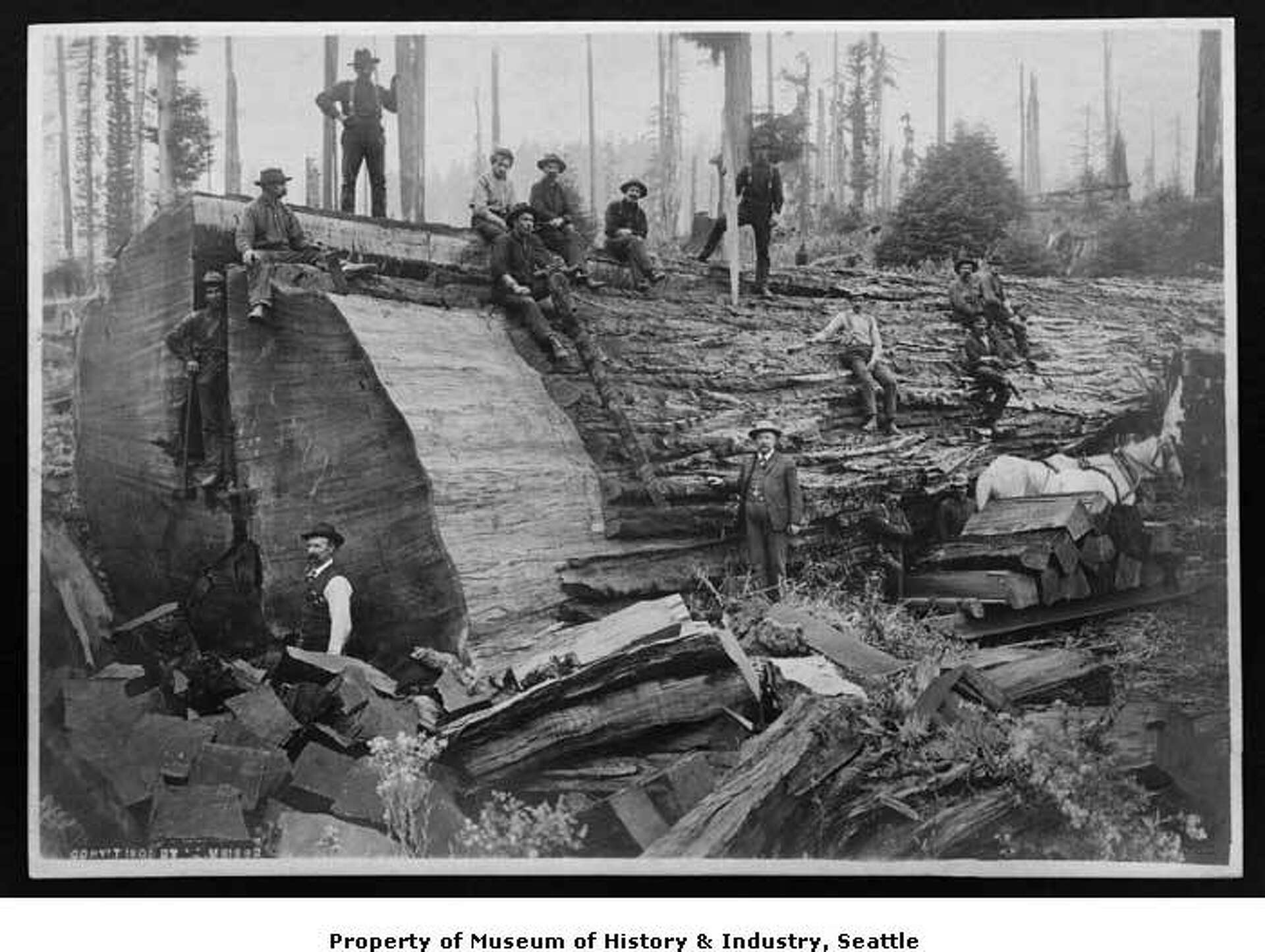
One settler, Henry Yesler, built Seattle’s first sawmill in 1853. His idea was simple: fell the giant cedars, saw them into boards, and sell them. In three years his mill processed thousands of trees that had grown for centuries. Yesler became one of the city’s wealthiest men. For him and other settlers it was a success! They turned what they thought was "useless" forest into real money.
Settlers also began fencing land, putting up signs, declaring: "This is mine, do not enter." For the Duwamish it was a shock. How can you "own" a river? How can you forbid people from gathering berries in a forest where their ancestors had gathered for thousands of years?
When two worlds collided
By 1855 tensions reached a breaking point. The Duwamish watched their forests disappear, rivers clouded by sawmills, and traditional fishing sites fenced off. The U.S. government offered them a treaty: move to reservations (designated territories) and receive money in return. Many Duwamish refused. Chief Seattle (after whom the city is named) tried to find a peaceful solution, but other leaders, including his nephew Leschi, believed they had to defend their land and way of life.
On January 26, 1856, battle broke out. A group of warriors from several tribes attacked the settlement. The fight lasted one day; several people on both sides were killed. The settlers prevailed — they had cannons on the ship Decatur anchored in the bay. But the real battle was not a single day's fight — it was a clash of two economic systems, two ideas about how people should live with nature and each other.
What happened next: 170 years of economic consequences
After the battle, the settlers accelerated what they were already doing. Here’s how Seattle’s economy changed:
1856–1890s: The era of logging. Giant cedars were nearly wiped out. Seattle lumber built homes across the West Coast. The city grew wealthy, while the Duwamish lost the basis of their economy. They were moved to reservations lacking cedars and good fishing sites.
1897–1910s: The Alaska gold rush. Seattle became the "gateway to Alaska" — thousands of prospectors departed from here. Again the same idea: find as much gold as possible, get individually rich. The city expanded rapidly.
1916–1960s: The Boeing era. The aviation company made Seattle an industrial center. Well-paid jobs, a growing middle class, labor unions. But the Duwamish still weren’t officially recognized as a tribe — they had even lost legal rights to their identity.
1990s–today: The tech era. Microsoft, Amazon, thousands of startups. Seattle became one of America's most expensive cities. Some people became billionaires. But a huge problem emerged: ordinary people can’t afford housing. Homelessness grew into a crisis.
And here’s the striking thing: today in Seattle people are again arguing the same questions as in 1856 — just in new forms. Should tech companies pay higher taxes to help the whole city (echoing the Duwamish idea of common good)? Or have they earned their money and the right to spend it as they wish (reflecting the settlers’ idea of private property)? Should we protect the remaining salmon and forests even if it slows economic growth?
The cost of two ideas of wealth
What I find most sad and most important in this story is this: both sides wanted a good life for their families, but they understood "a good life" differently. The more powerful side (settlers with their guns and laws) imposed its idea.
Today the Duwamish tribe still fights for official recognition from the U.S. government. They still live in the Seattle area, but they have no reservation, no land, no rights that other federally recognized tribes have. Their economic system has almost completely vanished. The last wild salmon in Seattle’s rivers are threatened with extinction. The giant cedars that once covered the hills can only be seen in a few preserves.
But here’s an interesting turn: many Seattle residents are beginning to realize that the Duwamish idea of wealth might not have been so strange. When a city becomes so expensive that teachers and nurses can’t afford to live there, people ask: what is true wealth? When rivers are so polluted you can’t swim in them, people remember: maybe nature is also a kind of value that can’t be measured in dollars.
The Battle of Seattle in 1856 ended in one day. But the economic battle between two ideas of what it means to live well and be wealthy continues to this day. And the most important lesson we can take from it: when we decide what is valuable and what is not, we create a future not only for ourselves but for our children, grandchildren, and great-grandchildren. Perhaps true wisdom is finding a way to combine both ideas: personal success and care that everyone has enough.