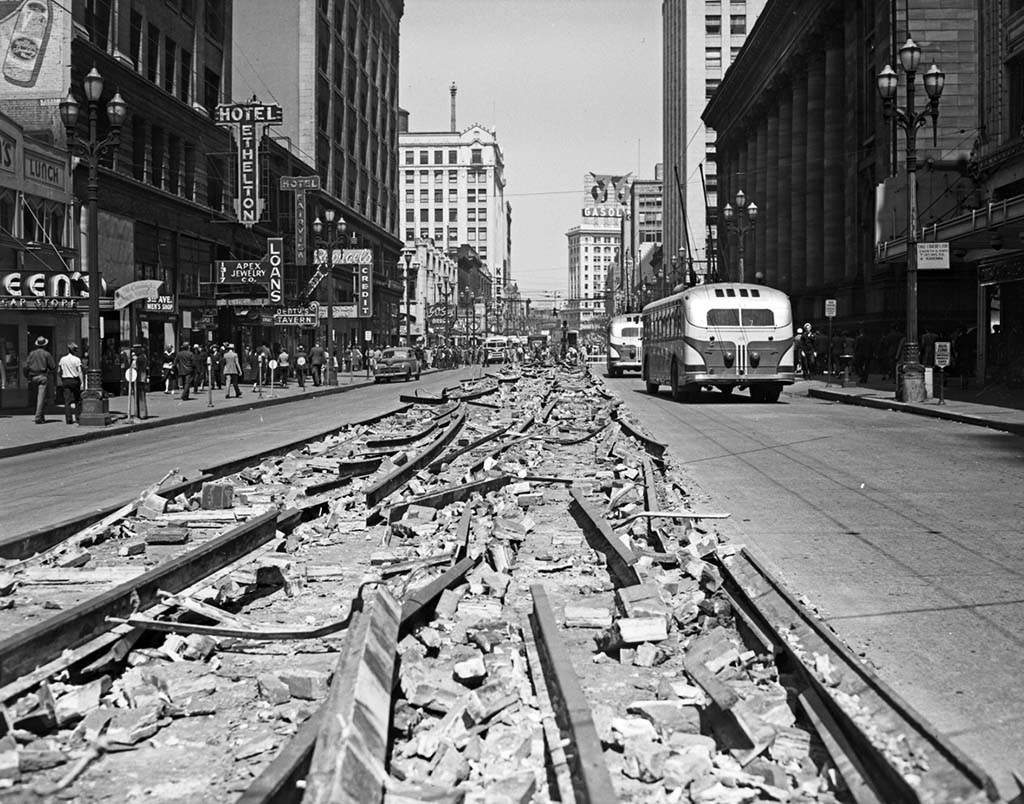
Imagine that one morning you step outside and see, right there on the street, a red railcar rolling along—jingling and catching the light. It stops at every corner, the doors open, and everyone gets on: fishermen after a night shift, schoolgirls with backpacks, grandmothers with baskets, workers in grimy jackets. The fare is almost nothing—just a few cents. Nobody is left on the street. The tram carries everyone. That’s what Seattle looked like a hundred years ago. And then the tram disappeared. Even more astonishingly, its tracks didn’t go anywhere. They’re still right under the asphalt you walk on.
An Electric City on the Bay
In the early twentieth century, Seattle was one of America’s most “electric” cities. Not because there were lots of lightbulbs—but because its streetcars ran on electricity. Real, clean electricity generated by rivers and waterfalls around the city. No smoke, no soot—just a quiet hum and sparks on the overhead wires.
A network of streetcar lines spread through the city like a spiderweb. Cars ran north and south, climbed the hills and descended to the water. They connected neighborhoods that otherwise would have been far apart: Chinatown, where families from China and Japan lived; the working-class districts in the south; the fish markets by the bay; and small wooden houses on the outskirts. The tram was like a shared thread holding the whole city together.
For many people, the streetcar was the only way to get to work. Not everyone had a horse. Not everyone had a car. But everyone had a few cents for a ticket—and a streetcar. That made it special: it belonged to everyone at once.
Who Rode the Streetcar—and Why That Matters
Here’s the interesting part: the streetcar was an honest form of transport. It didn’t pick and choose passengers. In the same car you might find a wealthy merchant and a cleaning woman who mopped the floors in his shop. A Japanese family and an Irish dockworker. A girl heading to school and an old man heading to the market to sell fish.
That might sound simple, but it’s actually very important. Back then in Seattle—like in many American cities—life was arranged unfairly. Some neighborhoods were rich, others poor. Some people had many opportunities, others almost none. But the streetcar didn’t know those differences. It ran on the same tracks for everyone.
The streetcar was especially important for women. In those years many women worked—as servants, seamstresses, shop clerks—and they needed to cross the entire city every day. The streetcar gave them that chance. Without it, many simply wouldn’t have been able to work at all.
When the streetcar disappeared, those people were trapped. Cars were expensive. Buses ran less often and didn’t go everywhere. Those who lived far from downtown suddenly found themselves cut off from the rest of the city—as if someone had pulled out the very thread that held everything together.
Why the Streetcar Disappeared—and Who’s to Blame
This is probably the saddest part of the story. The streetcar didn’t break down. It wasn’t outdated. It was taken away—intentionally.
In the 1930s and 1940s something strange was happening across America. Companies that made cars, tires, and gasoline really wanted people to buy their products. But as long as cities still had streetcars, many people simply didn’t need cars. Why buy a car if the streetcar can take you anywhere for five cents?
And then these companies started buying up streetcar systems around the country—and shutting them down. Instead of streetcars, they offered buses: the same buses that ran on their gasoline and rolled on their tires. That was good for business. But not for the city.
Seattle lost its last major streetcar lines around 1941. In some places, the tracks were dug up. But many were simply covered over with new asphalt—too costly to remove. That’s why they still lie there to this day. Sometimes, when workers repair a road and break up the asphalt, old tracks suddenly appear from underneath—like a greeting from the past.
A city that could ride clean electric transport traded it for smoky buses and private cars. The air got worse. Traffic jams increased. And those without money for a car ended up in the worst possible position.
The Tracks Come Back
But the story doesn’t end sadly—because Seattle remembers.
In 2007, a new streetcar line opened in the city—the South Lake Union Streetcar—which connected several neighborhoods in the center. In 2016, another line appeared—First Hill Streetcar. They’re electric again. Quiet again. For everyone again.
Of course, these are still small pieces of what existed before. The old network was huge, while the new lines are short. But this is a start. And many residents say: we need more. We need to get back what we lost.
There’s something very important in all of this: sometimes progress isn’t moving forward—it’s recognizing an old mistake and correcting it. Seattle once had clean, fair, convenient transport. Then it abandoned it in favor of cars. And now it’s pulling tracks again—and maybe, someday, they’ll reach every corner of the city once more.
And somewhere under the asphalt, the old tracks are patiently waiting. They didn’t go anywhere. They’re just sleeping.