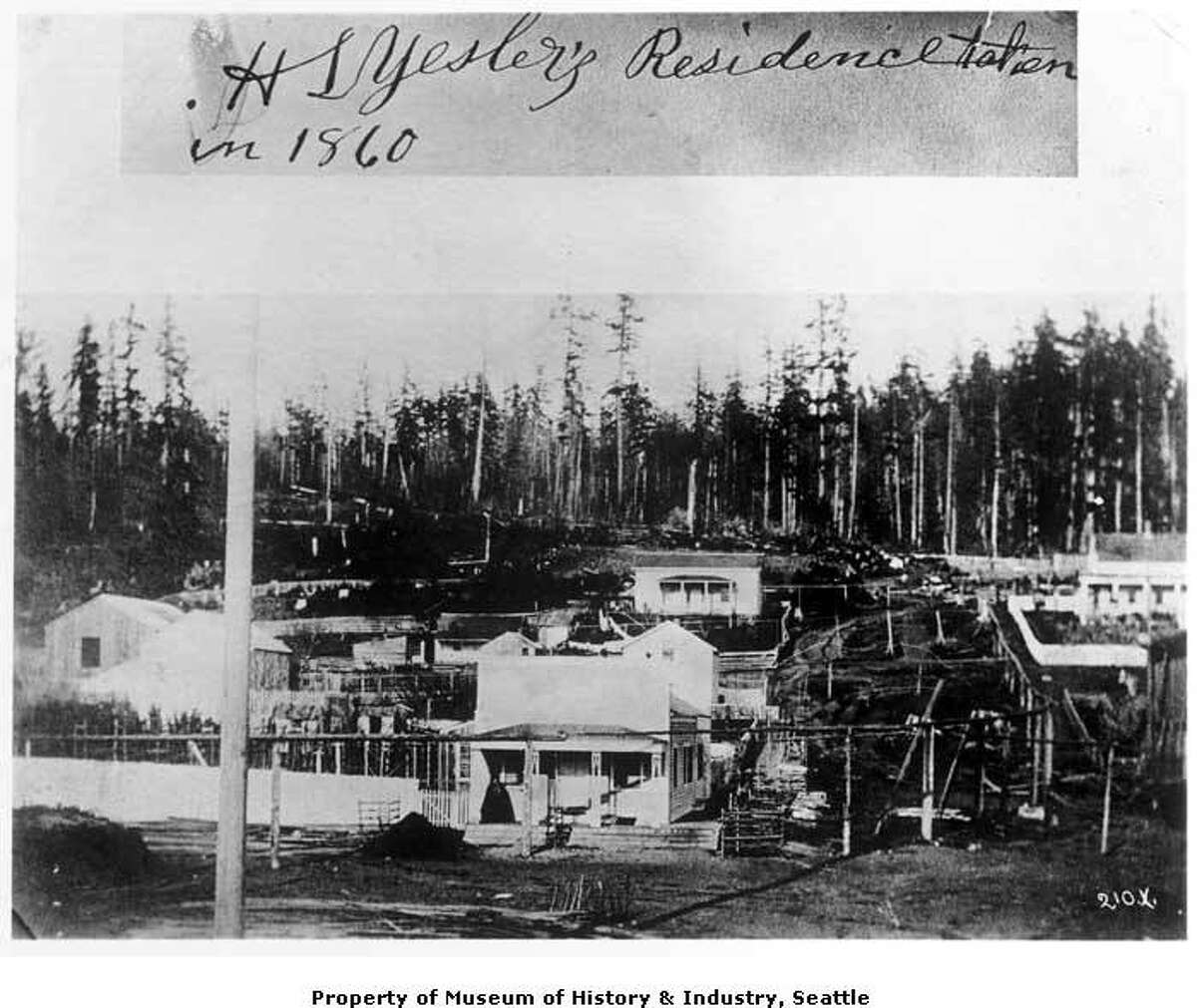
Imagine a huge tree sliding down a hillside, leaving a shiny trail of grease. It moves faster and faster, crashing and creaking, and at the bottom a sawmill is already waiting. This is not an amusement or an accident — it’s work. This is how, in 1852, the first real road in Seattle appeared, giving its name to an entire neighborhood and a way of life. But few know that this road might have been very different if not for a stubborn woman who wasn’t afraid to argue with the city’s founding men.
The road the trees rolled down
When Henry Yesler built the first steam-powered sawmill in Seattle in 1852, he faced a problem: how to get massive logs down from the forested hills to Elliott Bay, where his mill stood? Roads in the usual sense didn’t yet exist — only dense forest, mud, and steep slopes. Yesler came up with a brilliant solution: he built a skid road — a special road made of small logs laid crosswise on the slope, like the steps of a ladder.
Workers greased these logs with fish oil or pitch, and the huge trunks slid down under their own weight, guided by experienced lumbermen with peaveys. It was dangerous work: one wrong move and a multi-ton log could knock a person down or crush them. But it worked. Day after day logs descended that road, became planks, and those planks built a new town.
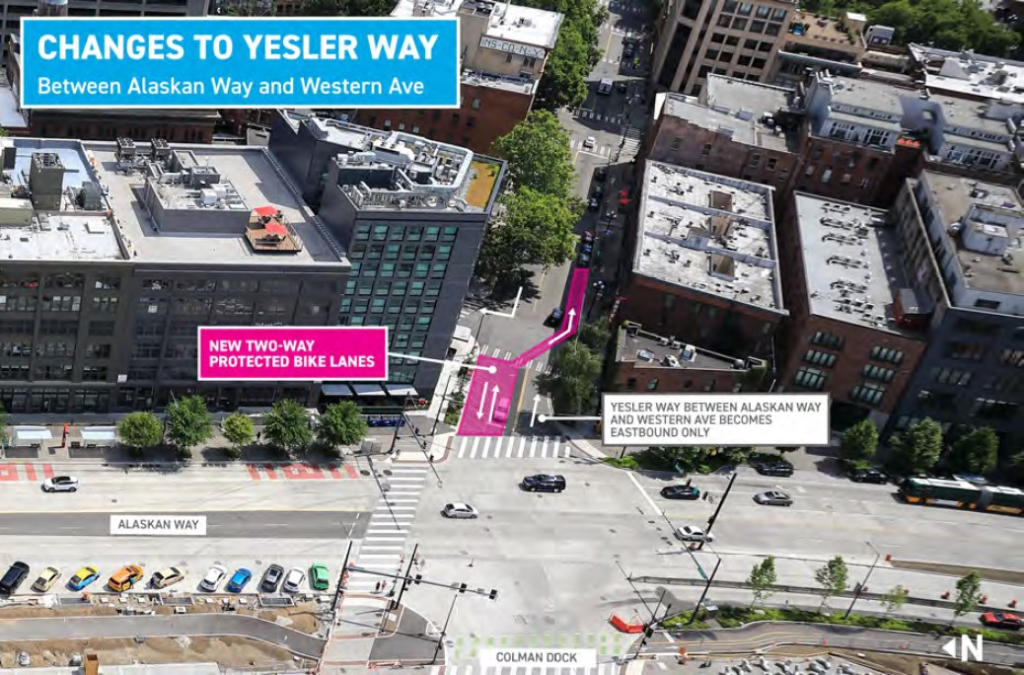
The road itself ran roughly where Yesler Way runs now — one of the few downtown Seattle streets that cuts diagonally, ignoring the strict grid of other streets. That diagonal is the trace of the slope the logs once rolled down.
Catherine, who saw the future
In 1852 Catherine Maynard arrived in Seattle with her husband, Dr. David Maynard, one of the city’s founders. Catherine was about forty — a considerable age for the time — and she had seen a lot in life. She was not a quiet wife who stayed home and tended the household. Catherine had her own opinions and wasn’t afraid to voice them, which in the 1850s was quite uncommon.
When Seattle’s founders began to plan the town — deciding where streets would go and how wide they should be — Catherine entered the discussion. Henry Yesler and the other men wanted narrow streets: eight meters wide. Their logic was simple: the narrower the streets, the more land plots remained to sell. More plots — more money. Simple.
But Catherine disagreed. She insisted the streets be much wider — at least twenty meters. The men laughed at her: why so wide in a small forest settlement of only a few dozen people? Catherine explained: the town will grow. Wagons and carts, and perhaps someday things they couldn’t yet imagine, would travel these streets. There must be room for two-way traffic, for pedestrians, for the future.
The argument lasted months. Yesler was adamantly opposed — he lost money with every extra meter of street width. But Catherine didn’t give up. She cited examples from other towns where narrow streets caused problems. She spoke of safety, and that wide streets would help if a fire broke out (a frequent danger in wooden towns). In the end, her persistence partially won out.
A compromise that changed the city
The result was an odd compromise that can still be seen on a map of Seattle. Streets running north–south (perpendicular to the bay) were made wide — as Catherine wanted. Streets running west–east (parallel to the bay) were left narrow — as Yesler wanted. If you look at downtown Seattle today, you can see the difference: some streets are spacious, with wide sidewalks, while others are narrow, where two cars can barely pass each other.
But Catherine’s victory was more significant than it seems. The wide streets she fought for became the city’s main arteries. When Seattle began to grow — and it grew very quickly, especially during the Alaska Gold Rush of 1897 — those wide streets could handle the flow of people, wagons, streetcars, and later automobiles.
The narrow streets Yesler defended created problems. When the Great Seattle Fire of 1889 destroyed the downtown, firefighters couldn’t move quickly along narrow streets. After the fire the city was rebuilt, and many narrow streets had to be widened — precisely what Catherine had proposed thirty-seven years earlier.
The people who built the road
The skid road was not built only by white settlers. Members of the Duwamish tribe — the indigenous people who had lived on this land for thousands of years before Europeans arrived — also worked on it. They knew the forest better than anyone, understood how trees moved, which slopes were dangerous, and where the soil would hold the weight of huge logs.
One key worker was a Duwamish man named Jim, who worked at Yesler’s mill and helped lay out the road. He showed settlers which trees were best for the crosswise logs (they needed to be strong but smooth), and how to place them so the road wouldn’t collapse under weight.
Sadly, most builders’ names have not been preserved in history. We know the founders’ names — Yesler, Maynard, Denny — but not the dozens of people who felled trees, hauled logs, and built the road in mud and rain. Among them were Chinese immigrants, Scandinavian sailors, Native Americans, and former California prospectors.
How the road became a symbol
Over time the word “skid road” changed meaning. The neighborhood around the original road became a place where lumbermen stayed between seasons, sailors between voyages, and people without steady homes or jobs. Cheap hotels, saloons, and gambling houses appeared. The area became poor and dangerous. “Skid road” came to mean “a place where people fall to the bottom,” and later transformed into “skid row” — a term still used in America for a city’s poor district.
But the original road symbolized something else entirely — ingenuity, cooperation, and building the future. The logs that slid down it became houses, shops, churches, and schools. That road was the first artery of the town through which its life flowed.
Why it’s important to remember
The story of the skid road and Catherine Maynard teaches an important lesson: cities don’t appear by themselves. They are made by specific people who make specific decisions. Sometimes those decisions seem small — how wide should a street be? — but they affect city life for decades and even centuries.
Catherine was not an architect or engineer. She was an ordinary woman who thought about the future and wasn’t afraid to defend her point of view, even when everyone said she was wrong. Because of her stubbornness, downtown Seattle looks different today — there is room for people, for movement, for life.
And the original skid road that once sent logs rolling down reminds us that great cities begin with simple, practical solutions. Need to get logs off a hill — invent a way. Need to build a city for the future — make the streets wider. Sometimes the most important things start with the simplest ideas and people willing to fight for them.
Today, when you walk along Yesler Way in Seattle, under your feet is the history of stubbornness, ingenuity, and belief in the future. The story of a woman who made the road wider, and of the unnamed builders who turned a forested slope into the heart of a city.