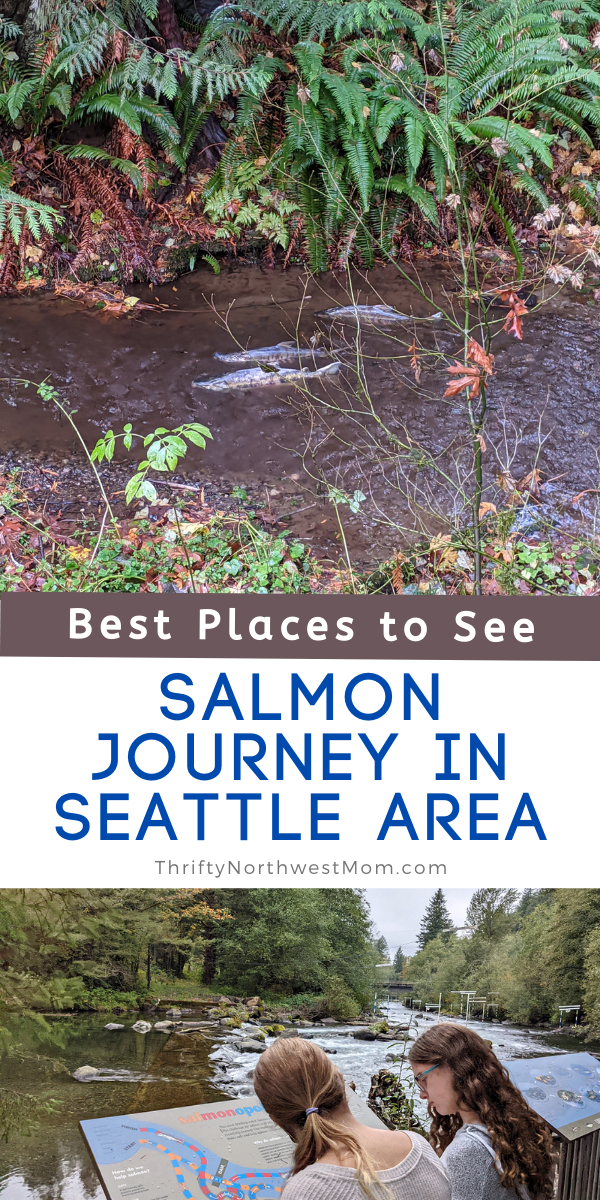
Imagine you’re looking through a window and huge fish are swimming right at eye level. Some are silvery and gleaming, others red as sunset. They swim with all their might against the current, and you can see every scale. It’s not an aquarium or a film—these are real wild salmon returning home. And it all happens because engineers, more than a century ago, solved a very difficult problem and accidentally created a place where people fall in love with fish.
In Seattle’s Ballard neighborhood there’s an unusual structure—the locks with a fish ladder. Every year, through the underwater windows of that ladder, more than a million people watch salmon swim upstream. Families come, bringing children and grandchildren, returning again and again. Some even name the fish. But the most surprising thing is that those windows were never intended for spectators. They appeared because engineers had to solve a problem that seemed nearly impossible.
A problem set by nature itself
In the early 1900s Seattle faced a problem. The city sits between the ocean (saltwater Puget Sound) and large freshwater lakes—Lake Washington and Lake Union. Boats needed to pass between them, but the lakes were 6–9 meters higher than the ocean. It’s like having to sail a boat uphill!
Engineers decided to build locks—special “elevators for ships.” A boat sails into a large chamber, the gates close, the water is raised or lowered, and the boat ends up at the required level. Brilliant! The locks opened in 1917, and they still operate today.
But there was one huge problem: salmon. Every year millions of salmon return from the ocean to the streams and creeks where they were born to lay eggs. This is called spawning. Salmon remember the scent of their home stream and find their way back across thousands of kilometers of ocean—one of nature’s most remarkable journeys. But now a massive concrete wall—the locks—stood in their way.
Engineer Hiram Chittenden (after whom the locks were later named) understood: if the salmon couldn’t pass, they couldn’t reproduce, and the entire population would disappear. A way had to be found to help fish climb 6 meters up.
A ladder for those without legs
The solution was called a “fish ladder,” but it’s nothing like an ordinary staircase. Imagine a long channel—21 steps, each about 30 centimeters high. Water flows from one step to the next, creating a current, but not too strong. A salmon can rest in each “pool” between steps, gather strength, and leap to the next level.
Engineers calculated everything precisely: flow speed, step height, pool size. If the current was too strong the fish couldn’t ascend. If it was too weak, they wouldn’t know where to swim (salmon use current as a cue). It was real mathematics of nature.
But how to know if the ladder worked? How to count how many fish passed? Engineers did what seemed purely practical: they built thick glass windows into the ladder’s walls. Through them, one could watch and count the fish.
No one expected what happened next.
When fish became stars
In the years after the opening people began coming to the windows. At first out of curiosity—to see the new engineering wonder. Then something strange happened: people couldn’t leave. They stood at the windows for hours, mesmerized.
It looked like magic. Behind the glass, in greenish water, huge fish swam by—some over a meter long. Chinook salmon (king salmon)—silvery giants. Sockeye—red-bodied with green heads, as if painted by a surrealist. Coho, pink, chum—each species with its own character, its own swimming style.
Families began to visit. Parents would tell children: “Look, this fish was born in a little mountain stream, swam thousands of kilometers in the ocean, grew there, and now returns home to give life to new fish.” It was a true adventure tale without words.
By the 1970s the viewing room had become one of Seattle’s most popular attractions. More than a million visitors a year! People came specifically to see the salmon migration. Volunteers appeared to help count fish and explain their journey to visitors.
Fish that changed people
But the most important impact wasn’t visitor numbers. Something deeper happened: people began to care about salmon.
When you see fish on a plate or in a store, it’s just food. But when you stand at a window and see a massive salmon fighting upstream, notice scars on its body from the ocean journey, and understand that this fish is returning home to give life to the next generation—it becomes a personality. It has a story.
Children named the fish. Families returned every year at the same season—it became a tradition, like a holiday. People started asking questions: “Why are there fewer fish this year?” “What can we do to help them?” “How do we protect the streams where they’re born?”
Historians say these windows at the Ballard Locks played a major role in the Pacific Northwest’s environmental movement. People who saw salmon up close became advocates for nature. They voted for river-protection laws, supported cleanup of polluted waters, and opposed dams that blocked fish passage.
One biologist said: “Those windows did more for salmon conservation than thousands of scientific papers. Science speaks to the brain, but those windows speak to the heart.”
A legacy that keeps swimming
Today, more than a century later, the Ballard Locks still operate. Every day hundreds of boats pass through them—from small yachts to large vessels. And every year, from July to November, thousands of salmon use the fish ladder.
Volunteers still count fish. It’s important scientific work: by the counts scientists assess population health, river cleanliness, and climate change impacts. But for many volunteers it’s also a way to be part of something larger—the great migration that has repeated for millions of years.
The idea of underwater windows for watching fish spread around the world. Now such windows exist in many places where fish ladders are built. But Ballard Locks remains special—because that’s where it all started, by accident, out of a purely practical need.
Engineers wanted to solve a technical problem: how to let ships pass without destroying the fish. They created a smart technical solution—locks for ships and a ladder for salmon. But by accident they created something more: a meeting place between people and nature, a window into a world usually hidden beneath the water.
Sometimes the most important inventions are not the ones we plan, but the ones that arise when we solve problems with intelligence and respect for nature. The Ballard Locks engineers wanted to help fish get past an obstacle. They didn’t know they were creating a place where millions would learn to see the fish not just as food, but as travelers, heroes, a wonder of nature.
And every autumn, when salmon return home, people—adults and children, locals and tourists—stand at the windows and watch in awe one of the oldest journeys on Earth. Thanks to the engineers who, over a century ago, solved a hard problem and accidentally gave us a chance to witness the miracle.