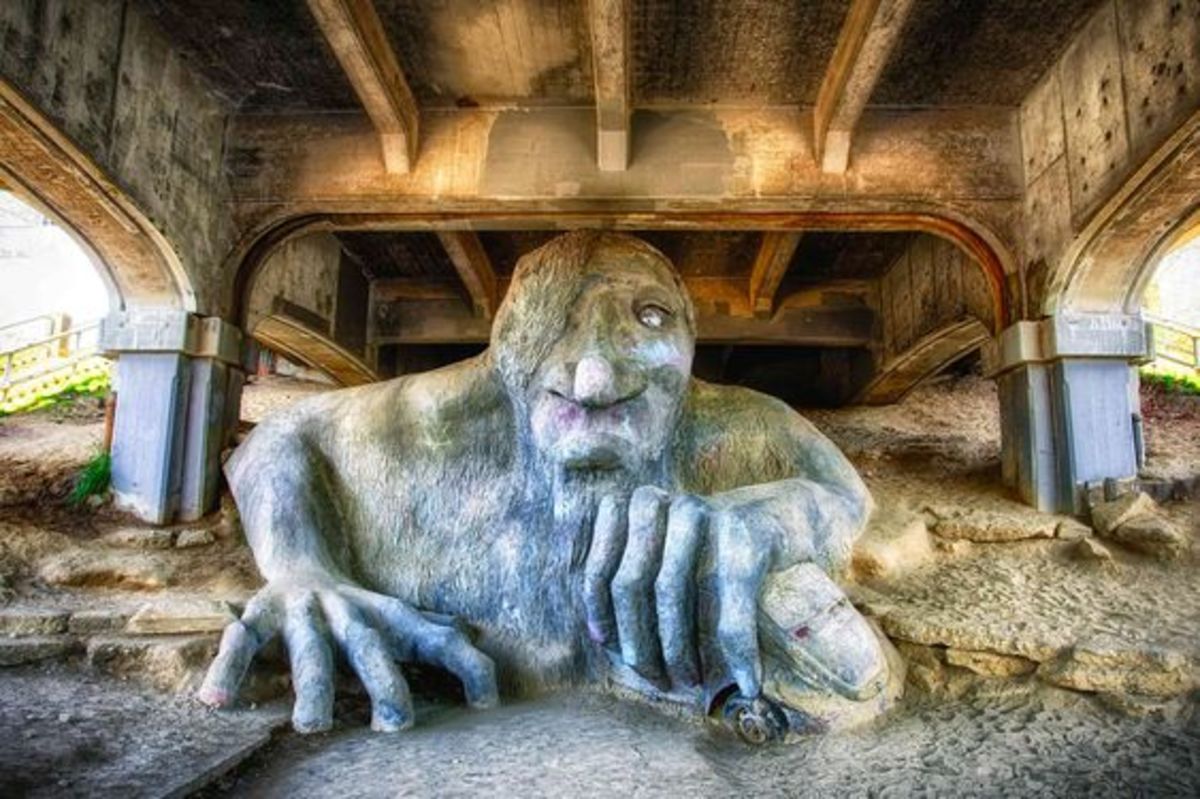
Imagine a dark place under a bridge that’s frightening even by day. Trash, broken glass, strange people hiding there. That’s what it was like under the Aurora Bridge in Seattle’s Fremont neighborhood. Parents forbade their children from going there, and adults walked around the place. But one day ordinary neighbors decided: enough being afraid! They came up with a way to turn the scariest spot in the neighborhood into something everyone would want to see. Their idea was so unusual that people around the world heard about it. They created a giant troll who “lives” under the bridge and has become a symbol of how art can transform an entire city.
A contest for the scariest spot
By 1989 Fremont residents had had enough. Their neighborhood was known as creative and a little weird, a place where artists and musicians felt at home. But the space under the Aurora Bridge spoiled everything. Trash accumulated there, unpleasant things happened, and nobody knew what to do.
So the local arts council announced an unusual contest. They asked artists to come up with a way to turn that awful place into something interesting. But there was one important condition: the art had to be so big and impressive that people would come specifically to see it. A small sculpture or pretty painting wouldn’t do — it had to be something that would make people say “Wow!”
Many ideas were submitted, but the boldest one won. Four artists — Steve Badanes, Will Martin, Donna Walter and Ross Whitehead — proposed creating a giant troll. Not a cute fairy-tale troll, but a real, somewhat scary one like in old Scandinavian legends. A troll who “lives” under the bridge, just like trolls in stories. And amazingly, this troll would hold a real car in its hand, crushed like a toy!
How to build a troll from two tons of concrete
When the artists won the contest, a real problem stood in front of them: how to build something so huge? The troll was to be as tall as a two-story house — about 5 meters! They couldn’t just sculpt it from clay or carve it from wood.
The artists decided to use materials normally employed for building bridges and buildings. They made a framework of steel rebar (those thick iron rods), then covered it with concrete — two tons of concrete! Imagine: like mixing a thousand sacks of cement right there under the bridge. Concrete was mixed in batches, like a giant cake batter, and applied layer by layer to the metal skeleton.
But the most interesting part was the troll’s eye. The artists decided he would have only one eye (like the cyclops of ancient Greek myth) and made it from a real car headlight! And in the troll’s hand they placed a real Volkswagen Beetle — an old car donated to the project. The troll “squeezes” it as if it were a ball.
The whole job took seven weeks. The artists worked out in the open, and neighborhood residents came to see the troll grow. Some helped, bringing coffee and food. It felt like the whole village had come together to build something important.
The troll becomes part of the family
When the troll was unveiled in October 1990, something unexpected happened. Instead of just looking at the sculpture and leaving, people began to… befriend it.
First someone brought the troll a hat for winter. Then for Halloween it was decorated with pumpkins. At Christmas it wore a holiday garland. When the local soccer team won, the troll received a scarf in the team’s colors. He became like a huge pet for the whole neighborhood!
But most importantly, the space under the bridge changed completely. What had once been scary and dirty became popular. Families with children came, tourists from around the world took photos with the troll. People who had previously loitered there and caused trouble left — because the place was now always busy.
Fremont residents learned an important lesson: when a place contains something people love and care for, it becomes safe. The troll became more than a sculpture — it became a guardian that protected the neighborhood. And it worked better than any security or fence.
Lessons from the troll for other cities
The story of the Fremont Troll taught people worldwide important lessons about improving cities.
First, it showed that ordinary residents can solve problems in their neighborhood. You don’t have to wait for government action. Fremont’s arts council raised only $20,000 for the contest — not a huge sum for a city. But that money launched a change that made the whole district better and more valuable.
Second, art proved to be a powerful tool against fear and decay. Many cities tried to address dangerous places with police, surveillance cameras, or fences. But Fremont showed a different path: make a place so interesting that people want to be there. When many people visit a place, it automatically becomes safer.
Third, the project demonstrated the power of an unusual approach. They could have put a beautiful fountain or a flower bed under the bridge. But the troll — scary, a little frightening, holding a crushed car — was much more effective. It made people talk about it, tell friends, bring guests. It became a memorable symbol.
After the success of the Fremont Troll, other Seattle neighborhoods and cities started creating their own public-art projects. A whole movement emerged called placemaking — creating places where people want to be. The idea is simple: instead of only building structures and roads, create places with character, history, and something special.
What makes art "of the people"
The Fremont Troll became an example of what’s called folk art or community art. It differs from traditional museum art in several important ways.
Usually, when a city wants to install a sculpture or monument, officials or wealthy donors decide and pay for it. They choose a famous artist who creates something “important” and “serious.” Often such monuments are barely noticed — they just stand in a square and people walk past.
With the troll it was different. The idea came from ordinary neighbors. The contest was open — any artist could enter, not just the famous. The four winners had never worked together before — they simply joined forces for this project. And most importantly, neighborhood residents immediately embraced the troll as theirs.
This happened because the troll reflected Fremont’s character. The neighborhood has always been a bit eccentric, creative, and humorous. Their slogan even was “Libertas Quirkas” (freedom to be weird). The troll fit that spirit perfectly — unusual, a little funny, a little scary, and very memorable.
When art is created with and for the community, people feel it’s their art. They take pride in it, care for it, and protect it. That’s why the troll remains in good condition more than 30 years later. People watch over it, and if someone tries to vandalize it, neighbors notice and intervene.
Little heroes of big changes
One of the most touching parts of the troll story is how children helped make it truly beloved. Adults created the sculpture, but children showed how to play with and befriend it.
Local schools began taking classes to visit the troll. Children drew it, wrote stories about it, invented where it came from and what it likes to eat (some decided it eats only cars and ice cream). Teachers used the troll in lessons: in math they calculated how much concrete such a large sculpture required, in literature they read Scandinavian tales about trolls, in history they studied how the neighborhood changed.
Each year the neighborhood holds “Trollfest” — a celebration in honor of the troll. Children dress as trolls, hold a parade, and play games. It has become a tradition that brings families together and strengthens the community.
Some kids who grew up playing near the troll later became artists or designers. They say the troll taught them an important lesson: art doesn’t have to be in a museum behind glass. It can be part of everyday life, something you can interact with every day.
When a problem becomes an opportunity
The most important lesson of the Fremont Troll is how it changed people’s approach to urban problems. Before the troll, when a neighborhood had an issue (a dangerous spot, an abandoned building, a dirty park), people generally complained and waited for the city to fix it. Or they simply avoided the problematic place.
The troll showed another way: you can turn a problem into an opportunity. The scary space under the bridge was a problem, but it also became an opportunity to create something unique. What made the place bad (darkness, concrete bridge supports, a cave-like feel) became what made the troll special. The troll couldn’t live in a sunny park — he’s a troll; he needed to live under a bridge!
That idea — finding opportunity in problems — spread to other projects in Fremont and beyond. An old advertising rocket was turned into a monument. An abandoned factory became an arts center. An ordinary statue of Lenin (yes, there is a statue of Lenin in Seattle — that’s another interesting story!) was turned into a tourist attraction.
The public-art movement that began with the troll taught cities an important lesson: you don’t have to make every place “beautiful” in the traditional sense. Sometimes odd, unusual, even a little scary works better. What matters is that it’s interesting, has a story, and people want to talk about it.
The troll today: a living legend
Now, more than 30 years after its creation, the Fremont Troll has become one of Seattle’s most photographed attractions. Each year hundreds of thousands of people from around the world visit it. It appears in films, books, and on postcards. But most importantly, it still performs its original function: making the space under the bridge safe and interesting.
The troll needs maintenance. Concrete sometimes cracks from rain and cold (Seattle gets a lot of rain). Its headlight eye is sometimes stolen and must be replaced. But the neighborhood raises funds for repairs because the troll is their pride.
Interestingly, the troll became so important to the neighborhood that when city officials proposed widening the bridge — which would have required removing the sculpture — residents strongly objected. They said, “The troll stays!” Engineers had to change bridge plans.
This shows how strongly art can become part of a place’s identity. Fremont without the troll is no longer the same Fremont. The troll became a symbol of what makes the neighborhood special: creativity, humor, and the courage to be different.
What we can learn from the troll
The story of the Fremont Troll teaches several important lessons useful not only for cities but for life in general.
First: don’t be afraid to be weird. The troll could have been a beautiful statue or a pleasant fountain. But it was the fact that he was unusual and a little scary that made him special. In life, the most interesting ideas are often those that seem strange at first.
Second: together you can do more. Four artists worked together, residents helped and supported them, the city gave permission and a little money. No one could have done it alone, but together they created something amazing.
Third: art isn’t only for museums. Beauty and creativity can be part of everyday life. You can see something interesting on the way to school, play next to art, and make it part of your routine.
Fourth: problems can be turned into opportunities. Where others saw only a scary spot, the artists saw the perfect home for a troll. Sometimes what seems bad can be the start of something good.
And finally, most importantly: when people care for a place, it becomes better. The troll works not because it’s made of concrete and steel, but because people love it, decorate it, protect it, and tell stories about it. Love and care make places special.
The Fremont Troll is more than just a big sculpture under a bridge. It’s proof that ordinary people can change their city, that art has the power to transform space, and that sometimes the boldest, most unusual choices are the best. And the story continues: each time someone comes to see the troll, every time children play beside him, every time residents decorate him for a holiday, they add a new chapter to this wonderful story of how art can change the world.