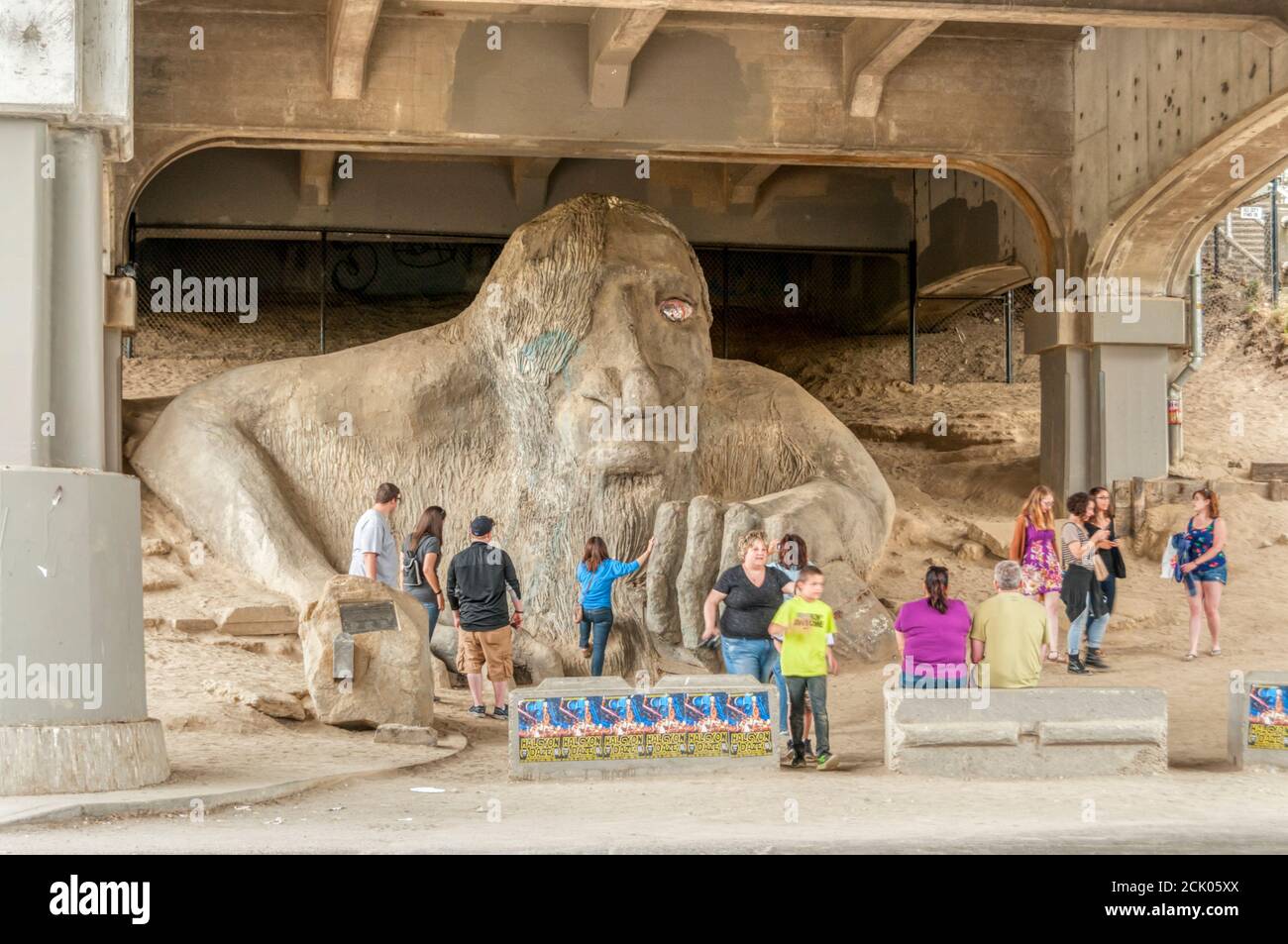
Imagine a dark, dirty place under a massive bridge—somewhere nobody wanted to go. It was scary, unpleasant, and dangerous. Now imagine that a giant troll lives there, and that every resident in the neighborhood absolutely adores him: they bring him gifts and take photos next to him, like he’s an old friend. That’s exactly what happened in Seattle, in the Fremont neighborhood, where the famous Troll under the Aurora Bridge appeared in 1990. And this story isn’t just about a sculpture. It’s a story about how one bold—and slightly crazy—idea can turn the scariest place into the most beloved.
Under the Bridge Where Nobody Wanted to Live
The Aurora Bridge is huge, noisy, and heavy. Under it there’s always darkness, even on sunny days. In the 1980s, the area under this bridge in the Fremont neighborhood was a real problem for the whole city. Trash piled up there, bad things happened, and ordinary residents simply tried to avoid the place.
Fremont, during those years, wasn’t exactly thriving either: artists and creative people lived there, but there was little money, many buildings were empty, and it seemed the neighborhood was slowly fading away.
But it was the residents of Fremont who came up with an unusual solution. Instead of simply fencing off the dark space under the bridge with a barrier or pouring it full of concrete, they held a contest. The idea was simple and at the same time surprising: let artists figure out what to place under the bridge—something that would make the place interesting, not frightening. This is called “revitalization of space through art”—smart-sounding words for a very straightforward idea: beauty and imagination can defeat neglect and fear.
Four Artists and One Car
There were many different proposals for the contest, but the winning team was four artists: Steve Badanes, Will Martin, Donna Walter, and Ross Whitehead. They proposed creating a giant troll—a creature from Scandinavian folklore said to live beneath bridges. The idea fit so well it seemed obvious: of course a troll should live under the bridge. Who else?
The sculpture was built from concrete, metal, and old car parts. The troll turned out to be enormous—about five meters tall. One of his arms is raised upward, and in the other he’s squeezing… a real Volkswagen Beetle! Yes, a real one—not a toy. They say that inside the car, the artists hid a time capsule containing keepsakes—letters, photographs, and other items from that era. It’s a little secret the troll has kept for more than thirty years.
When the troll was unveiled in November 1990, residents came to celebrate in full families. Kids weren’t afraid—they laughed and climbed all over the sculpture. Adults took photos. Someone brought flowers. From that day on, the dark, scary place under the bridge became one of Seattle’s most popular attractions.
One Troll—and an Entire Garden of Art
And this is where the most interesting part of the story begins. The troll turned out not to be just a sculpture—he became the seed from which an entire garden grew. After his appearance, the Fremont neighborhood seemed to wake up and decide: since we have a troll, let’s become the most unusual place in the city!
And wonders followed. A huge statue of Vladimir Lenin appeared in the neighborhood— it was brought from Slovakia after the dissolution of the USSR and installed right on the street. A real rocket was attached to the wall of one of the buildings. Every year the neighborhood holds the famous Solstice Parade, where participants dress in the most incredible costumes. Fremont declared itself the “Center of the Universe”—and it isn’t a joke. It’s the neighborhood’s official slogan, written on a sign at the entrance.
All of this was a direct result of what happened under the bridge in 1990. The troll showed that you can do strange, bold, unlike anything else things—and that this won’t destroy the neighborhood; it will make it better. Urban planners (scientists who study how cities work) call this effect an “anchor object”: one standout idea becomes a foundation around which everything else gathers.
“Fremont proved that art isn’t just decoration for the city—it’s the engine that drives it,” say architects studying the experience of this neighborhood.
The Troll as a Friend and Teacher
Every year, thousands of children come to meet the Troll under the Aurora Bridge. They aren’t afraid of him—they bring him gifts: coins, toys, and handmade postcards. On Halloween, there’s a celebration near the troll, and he becomes not a scary monster but the kind-hearted host of the party. It’s amazing: a sculpture that could have frightened people became a symbol of friendship and imagination.
But the most important thing is what the troll taught architects and designers around the world. His story has become an example in textbooks on how to “heal” problematic urban spaces using art. Today, similar projects are carried out in dozens of cities: artists turn abandoned areas under bridges, in dark alleyways, and in vacant lots into something alive and interesting. And every time that happens, somewhere they remember the Troll from Fremont—the pioneer who showed that it’s possible.
One Troll Changed Everything
The story of the Troll under the Aurora Bridge is the story of how the scariest and ugliest places can be turned into the most beloved. All you need is courage, imagination, and a bit of concrete. The four artists didn’t just create a sculpture—they changed an entire neighborhood, and through it influenced how cities around the world think about art in public spaces.
If you ever find yourself in Seattle, be sure to stop by under the Aurora Bridge. Pat the troll on his enormous nose (they say it brings good luck), look at the yellow car he’s gripping in his fist, and think: what if your city also has a dark, ugly place that’s waiting for its own troll?