Imagine that one day you buried your favorite toy in the garden, forgot about it, and then—sixty years later—someone dug up the earth and found it. Something like that happened in Seattle. Only instead of a toy, it was trams. And instead of a garden, it was the whole city.
A City Where Trams Sang
More than a hundred years ago, Seattle was a special kind of city. Trams glided along its streets—quiet, smooth, almost like boats. There were a lot of them: by 1910, more than two hundred miles of track ran through the city. That’s about the same as laying a road from Seattle to Portland and back.
But the most astonishing part was that these trams didn’t smoke or cough up exhaust from gasoline. They ran on electricity. And in Seattle, electricity was generated by rivers: water flowed down from the mountains, turned huge wheels at dams, and produced power. So the tram literally rode on the force of water. No smoke, no smell—just a gentle hum and sparks on the wires overhead.
Kids rode the tram to school. Families went to the shores of Lake Washington. Workers went to factories. The tram was like the city’s shared bicycle: get on, ride, get off. And the air in Seattle was so clean that you could see snowcapped peaks on distant mountains from the hills—far, far away.
How the Miracle Vanished
Then something strange happened. In the 1930s and 1940s, trams began disappearing across America. One after another. In Seattle, the last tram stopped in 1941. The tracks were rolled under asphalt, the overhead wires were removed, and the cars were sold or scrapped.
Why? Even now, it still feels a bit like a detective story. It turned out that companies selling cars and gasoline really wanted people to switch from trams to cars and buses. More cars meant more gasoline—more money. Trams got in the way of that plan. And little by little, they were eliminated.
The city moved on to cars. At first it seemed convenient—everyone had their own car, you could go wherever you wanted. But very soon the streets clogged with traffic. The air turned gray and heavy with exhaust fumes. Mountains outside the city started disappearing more and more into haze. Children with asthma were coughing. Fish in the bay suffered from the dirt washed off roads by rain and carried directly into the water. Seattle paid a very high price for the disappearance of trams—with its air, its water, and its health.
Tracks That Didn’t Die
But here’s what’s interesting: the tracks didn’t go anywhere.
When the trams were removed, the tracks were simply rolled under a fresh layer of asphalt. It was cheaper than digging them up. And they stayed there—quiet, in the dark, under people’s feet, people who didn’t even think about them.
Sometimes, when road crews repair streets in Seattle, they suddenly run into old tracks. Shiny bands of metal peek out from under the asphalt, as if to say: “We’re still here.” It’s a little like how paleontologists find dinosaur bones—except instead of dinosaurs, it was trams, and instead of millions of years, about eighty.
There’s another trace of old routes in Seattle too: the Interurban Trail to the north of the city. Long ago, an electric tram ran along this path, connecting different neighborhoods. Then it was taken out—but the corridor remained. Today, pedestrians and cyclists use it, walking and riding on the very ground where the vehicles glided a century ago. The earth remembers.
The City That Remembered
In the early 2000s, Seattle began to understand something.
Scientists said the air in the city was dirty. Traffic jams were huge. The climate was changing, and gasoline-powered cars were one of the causes. What to do? And then someone looked at old maps. They showed tram routes—thin lines threading through the entire city. And people thought: it was a good idea.
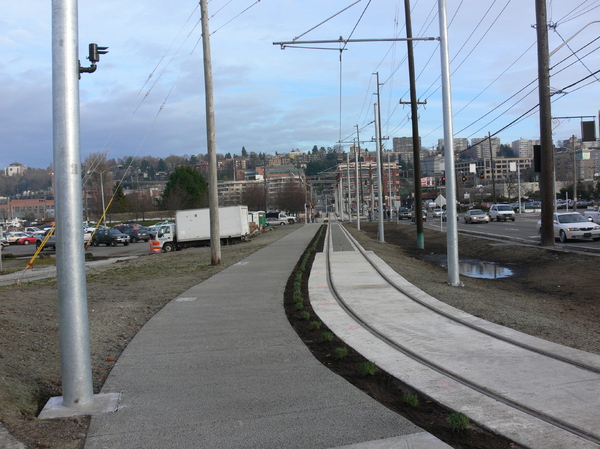
In 2007, a new tram opened in Seattle’s South Lake Union area. It runs almost exactly along the same path as the old cars did a hundred years ago. In 2016, another route appeared. And the Link Light Rail line runs through the Rainier Valley along a corridor where rail transport once also ran. It was as if the city reopened an old map and said, “Oh! So this is where we should go.”
The new trams and trains run on electricity again. That means—almost no smoke again. Quiet again. Clean again. Every person who switches from a car to a tram removes one car from the road. Multiply that by thousands of people, and the air starts getting a little better. On clear days, the mountains are visible from the city again.
The Earth Remembers
The story of Seattle’s trams is a story about an extremely expensive mistake. The city had something good, gave it up for the fashion of cars, paid for decades of dirty air and sick rivers—and then, slowly, step by step, it began returning to what it had started with.
The most surprising thing about this story is the tracks. They lay under asphalt all this time. As if they were waiting. As if the earth knew the city would remember one day. And when workers find them during road repairs, it’s a little like a message from the past: “We were right. Electricity. Water. Quiet cars. Clean air. You’ll come back.”
And Seattle came back. Not completely, not right away—but it came back. Sometimes the smartest step forward is remembering what was done right a long time ago.