Imagine a train of the future that travels just two kilometers in two minutes—and then stops. Sounds strange, right? Yet such a train became one of Seattle's most beloved symbols, even though it was originally supposed to lace the whole city with gleaming rails in the sky. The story of the Seattle Monorail is about how an unfinished dream became more important than a perfect plan, and how a city learned to value its imperfection.
The 1962 Dream: a City Floating Above the Ground
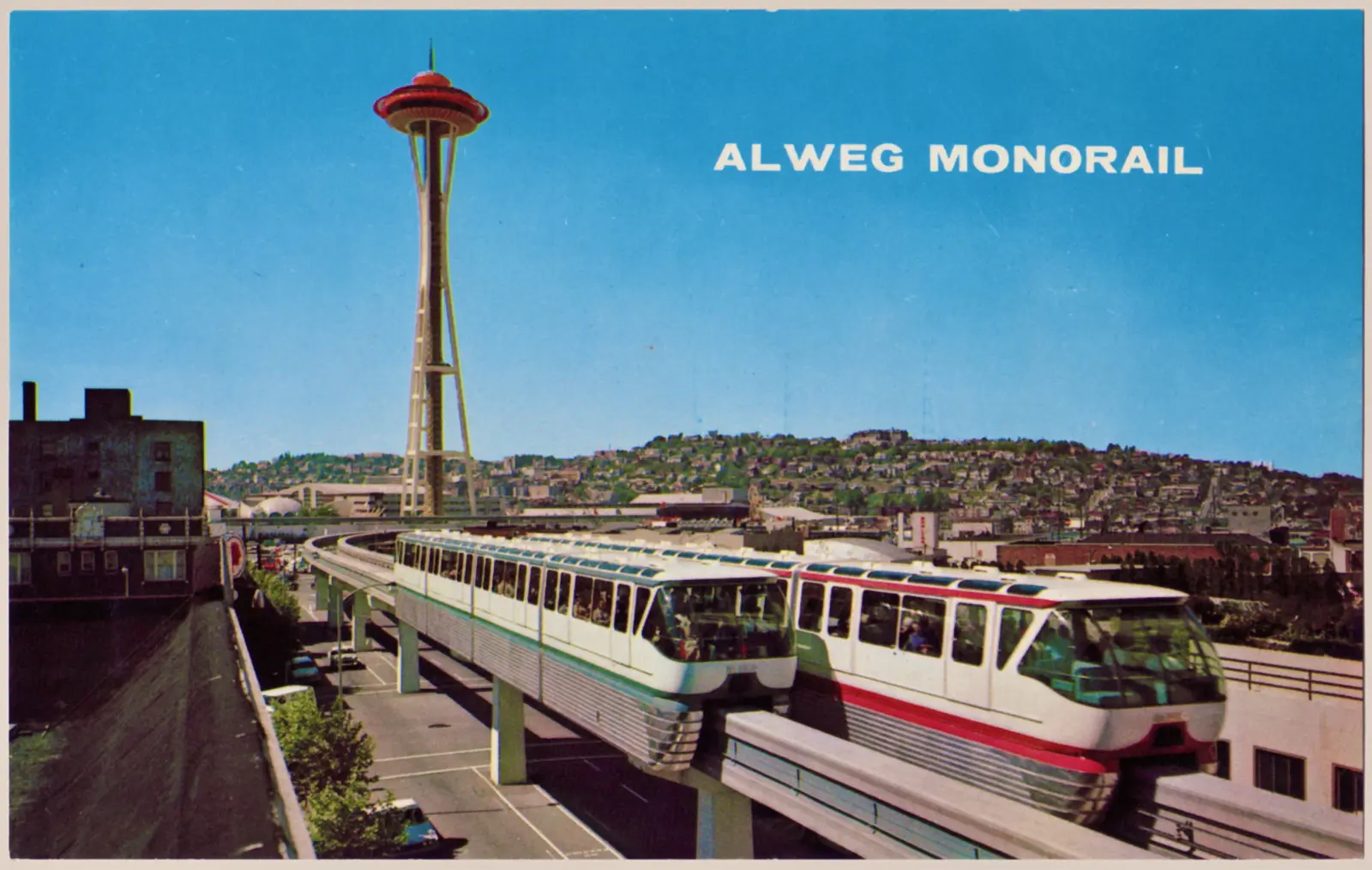
In 1962 Seattle hosted the World's Fair—a grand event that drew millions from around the world to see the "City of Tomorrow." Organizers built the Space Needle and a monorail: a futuristic train that glided above the streets on concrete columns like something out of a science-fiction film.
The monorail was designed by the Swedish company Alweg and built in just 10 months—an incredible pace even by modern standards. It connected the fairgrounds to the city's business district, and every day thousands of visitors rode it, admiring the view from above. The train ran on rubber tires along a concrete beam, operating quietly and smoothly, and it seemed like truly futuristic transit.
City planners dreamed big. They imagined that after the fair the monorail would become the backbone of a new Seattle transit system. In their plans, silver trains would stretch across the city—to the university, to the airport, into residential neighborhoods. Dozens of lines were shown on maps, crisscrossing Seattle in a web of elevated tracks. It looked as if the city were about to become the futuristic utopia showcased at the fair.
But it didn’t happen.
Why the City of the Future Stayed in the Past
After the World's Fair closed, enthusiasm began to fade. Expanding the monorail would require enormous funds—far more than the first line had cost. City leaders argued: some wanted to invest in car infrastructure (in the 1960s everyone believed the future belonged to private cars), others proposed expanding the bus network, and some pushed for a subway.
The monorail found itself in a strange position: it worked and people liked it, but no one could agree on how to extend it. Years passed, new plans emerged, votes were held, but something always went wrong. In 2005 Seattle residents voted down a large-scale expansion plan—deemed too expensive and complicated.
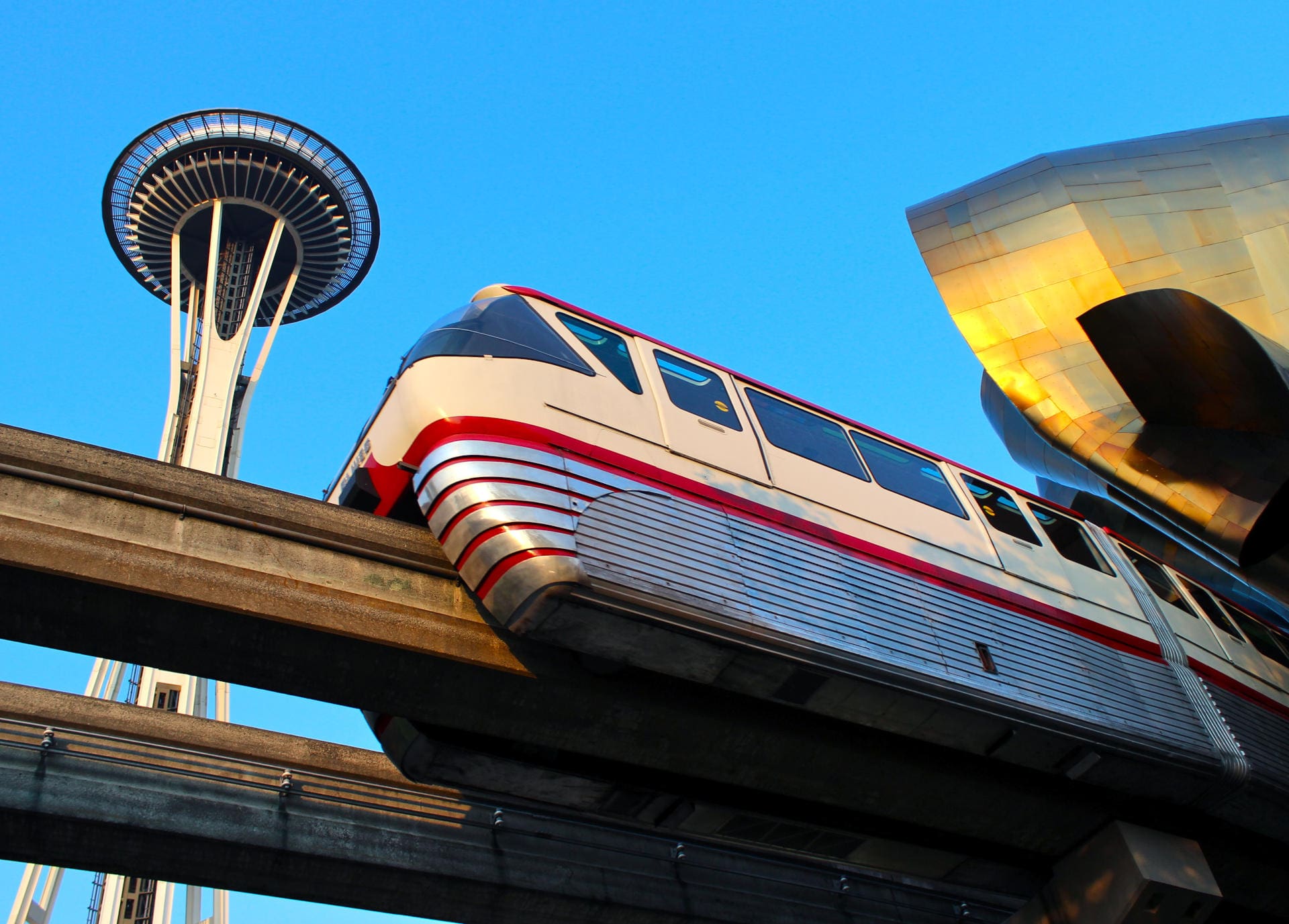
So the monorail remained as it had been in 1962: a short line of 1.6 kilometers connecting Seattle Center with the Westlake area. Many called it a failure. Journalists wrote of an "unfinished dream" and a "monument to unrealized ambitions." It seemed the city had missed its chance to truly become futuristic.
When the Unfinished Becomes Perfect
But something unexpected happened. Instead of becoming a symbol of failure, the monorail turned into something else—a reminder that not everything needs to be huge and all-encompassing to matter.
Locals began to treat the monorail with special fondness. Yes, it's short. Yes, it has limited practical use—most people can walk the same distance in about 15 minutes. But every day thousands of Seattleites and tourists board those retro 1960s cars for a two-minute ride. Why?
Because the monorail became a time machine. When you sit in a car with its vintage seats and hear the distinctive hum of the motor, you are transported to an era when people believed the future would be bright, clean, and full of technological wonders. It's not just a ride—it's an experience, a connection to the dreams of the past.
Moreover, the monorail's "unfinished" status began to shape how Seattle saw itself. The city learned an important lesson: grand plans don't have to be fully realized to create something valuable. Sometimes a small, imperfect, soulful solution is better than a perfect project that never comes to life.
How a Train to Nowhere Changed the City's Character
This philosophy—valuing the human and the imperfect—spread into other Seattle projects. The city became known for preferring small, experimental solutions over megaprojects.
For example, when Seattle built a new light rail system in the 2000s, it didn't try to cover the whole city at once. Instead, lines were added gradually, segment by segment, with the ability to adjust plans as they went. It was a lesson learned from the monorail: better to have a working part of a system than to wait decades for a perfect solution.
Or take the well-known project to transform the old Alaskan Way Viaduct into a waterfront with parks. Rather than creating a single massive park under a unified plan, the city allowed each section to develop on its own, reflecting the character of neighboring neighborhoods. The result wasn't perfectly symmetrical, but it felt very human.
Even Seattle’s famous bike culture evolved similarly: not by building a perfect network of bike lanes overnight, but through gradually adding individual routes, experimenting with different types of infrastructure, and listening to what people actually needed.
A Love of Imperfection
Today the monorail carries about 2 million passengers a year. That's not much compared to full metro systems in other cities. But ask any Seattle resident and they'll tell you the monorail is part of the city's soul.
Local teacher Margaret Chen says, "I take my students on the monorail every year when we go to Seattle Center. They always ask, 'Why is it so short?' And I answer, 'Because sometimes even small things can be special.' It's an important lesson—not everything needs to be huge to matter."
The monorail has survived a few incidents (including a small fire in 2004), many debates about its closure because of high maintenance costs, and proposals to replace it with buses. Each time, residents defended it. In 2018 the city funded an overhaul of the cars—not to modernize them, but to preserve their vintage 1960s look.
The Lesson of an Unfinished Dream
The story of the Seattle Monorail teaches us something important: sometimes what we don't finish shapes us more than what we complete. Had the monorail become a vast network crisscrossing the city, it might have become just another transit system—useful but ordinary.
Instead, it remained something special: a reminder of dreams, a symbol of an optimistic era, and, most importantly, a lesson that imperfection can be beautiful. Seattle learned not to chase ideal solutions, but to value what works—even if it doesn't match the original grand plan.
The next time you see something unfinished or imperfect, remember the train that goes nowhere yet carries millions to their dreams—albeit just two kilometers from their starting point. Sometimes the journey matters more than the destination, and an unfinished dream can teach us more than a perfectly executed plan.
The Seattle Monorail continues to glide above the city's streets, linking past with present, ambition with reality, and reminding us all: you don't have to be perfect to be beloved.