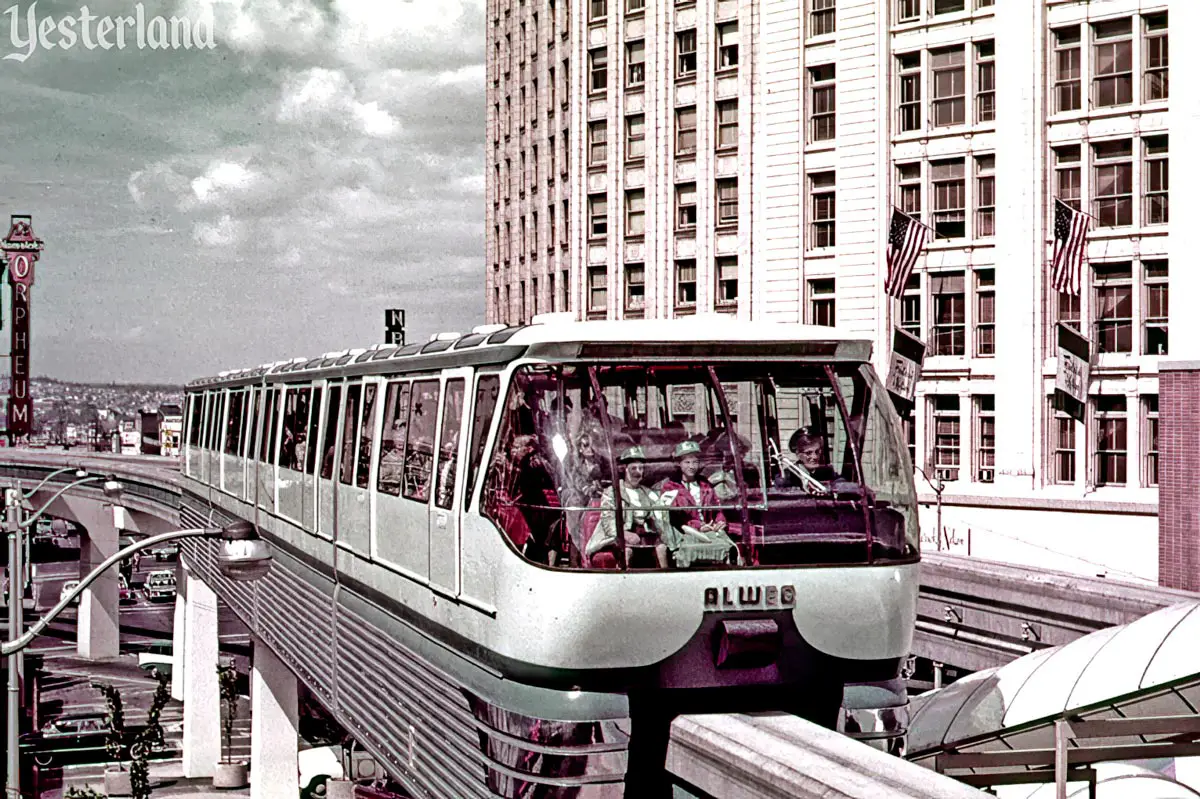
Imagine a train that doesn't run on tracks on the ground but floats in the air at the height of a third-floor window. That's the kind of train that appeared in Seattle in 1962, and its story is about how ordinary people saved a piece of the future when important adults wanted to throw it away.
The Swede Who Dreamed of Flying Trains
It all began with a man named Axel Lennart Wenner‑Gren. He was born in Sweden but dreamed of changing the world. Axel was a very wealthy inventor and businessman, and he had a strange idea: what if trains ran not on the ground, where they interfere with cars and people, but high above the streets?
Wenner‑Gren founded a company in Germany called Alweg. The name comes from the first letters of his name: Alxel Wegner‑Gren. In the 1950s, when most people couldn't even imagine such things, his engineers built the first monorail — a train that runs on a single rail (mono means "one") positioned high above the ground.
But here was the problem: no city wanted to build such a train. Everyone thought it was too expensive, too odd, too... futuristic. Until Seattle came along.
The World's Fair and the Train from the Future
In 1962, Seattle was preparing for a huge celebration — the World's Fair. People came from all over the world to see the most astonishing inventions and ideas. The fair organizers wanted to show something truly impressive, something that would make people say, "Wow! This is what the future looks like!"
That's when they remembered Wenner‑Gren's monorail. The German company Alweg agreed to build a monorail in Seattle. In just a year, workers erected concrete columns as tall as houses and laid track stretching one and a half kilometers — from downtown to the fairgrounds.
When the monorail opened, it was a genuine wonder. Snow‑white cars glided silently above the streets, and passengers could look down on the city like birds. The ride took just two minutes, but those two minutes felt like a trip into the future.
The Adults Who Wanted to Tear Everything Down
But when the World's Fair ended, something sad happened. Many important people in the city said, "Well, the celebration is over. Now let's remove this monorail. It takes up space, and we don't know what to do with it."
Imagine you have a favorite swing on a playground, and suddenly the adults decide to remove it because "the party is over." That's how Seattle residents felt. Many of them had grown to love the monorail. To them it was not just a train — it was a symbol that their city was special, modern, and looking toward the future.
And that's when the most interesting part of the story began.
Ordinary People Who Fought for the Train
A group of ordinary Seattle residents — teachers, shopkeepers, homemakers, students — decided they would not allow the monorail to be destroyed. They formed activist groups, collected signatures, attended city meetings, and persuaded politicians: "This train is needed in our city!"
It wasn't easy. Over and over, for decades, different mayors and city officials proposed tearing the monorail down. They said it was too expensive to maintain, that it carried too few people, that it was "obsolete." But each time the activists found new arguments.
They explained that the monorail is more than transportation. It is part of the city's history. It is a tourist attraction that draws visitors. It is a reminder that once Seattle dared to dream of the future.
One activist, an elderly woman named Mary (a fictitious name, but there were many like her), told reporters: "I rode this monorail when I was twenty, on my first date with my husband. Later I rode it with my children. Now I ride it with my grandchildren. This train is our family story. And the story of thousands of other families."
Why This Matters to All of Us
Today, more than 60 years after it opened, the monorail still operates. Every day it carries thousands of people — tourists, students, workers. It has become one of Seattle's symbols, as iconic as the Space Needle.
The story of Seattle's monorail teaches an important lesson: sometimes ordinary people understand the value of something better than those who make big decisions. The monorail technology came from Germany, the idea from a Swedish dreamer, but it survived thanks to American activists who simply loved their city and believed in the future.
This story shows that any of us can protect what we think is important. You don't need to be a mayor or a millionaire. You just need to believe in your idea, find like‑minded people, and not give up, even when it seems everyone is against you.
The Seattle monorail is not just a train. It is a monument to persistence, to dream, and to the power of ordinary people who taught their city to value the future.
![Monorail and MoPOP, Seattle Center, Washington [OC][6000x4000] : r/CityPorn](https://i.redd.it/01d7aacjjk811.jpg)