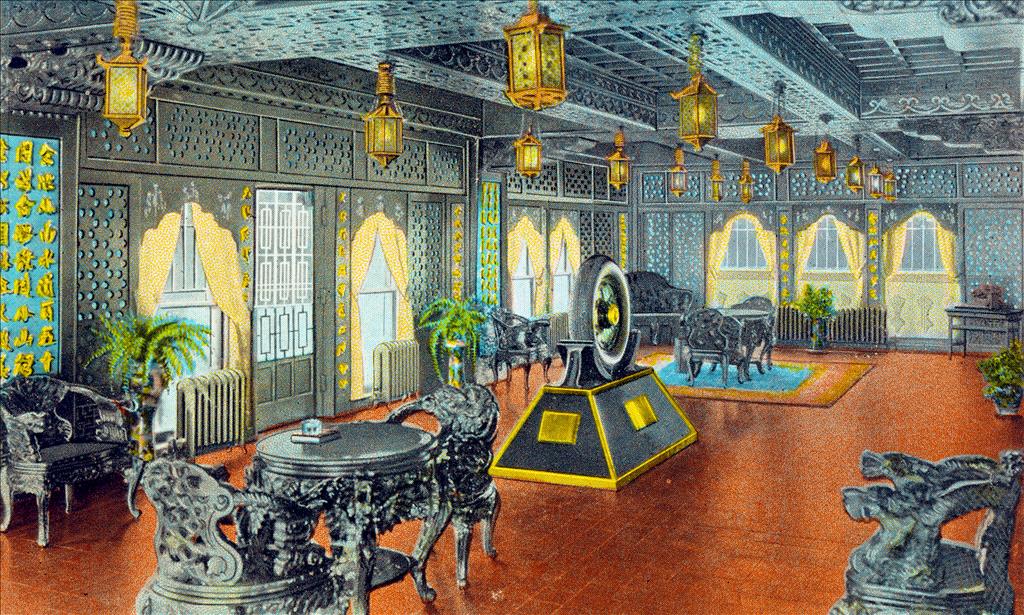
Imagine you live in a city where the tallest building is only three stories. Then someone suddenly builds a 42-story tower! That’s what happened in Seattle in 1914, when Smith Tower opened. But the most surprising thing wasn’t the exterior — it was at the very top: a hidden magical room, a gift from the Chinese empress, where for the first time in the city’s history everyone — rich and poor, men and women, Americans and newcomers — could sit together and watch the clouds. The tower was meant to prove that Seattle was a real city, but it accidentally taught it something more important.
The Typewriter Man Who Wanted to Touch the Sky
Lyman Smith was an inventor. He made typewriters — the very machines journalists used to pound out articles. His company was called Smith-Corona, and the typewriters were sold around the world. But Smith dreamed of something bigger than business. He wanted his native Seattle to stop being a “gold-rush town” and to become an important place like New York or Chicago.
At the time, a city’s height of buildings signaled its importance. New York already had skyscrapers of 50 stories, while in Seattle the tallest building barely reached ten. Smith decided, “I will build the tallest building west of the Mississippi!” Thus Smith Tower was born — 149 meters tall, with elevators that moved faster than people could get scared.
When the tower opened on July 4, 1914 (on Independence Day!), the whole city came to look. People lined up to ride the elevator to the 35th floor — the observation deck. Many saw their city from a bird’s-eye view for the first time. Houses looked like toys, ships in the harbor like matchboxes, and the distant mountains like painted scenery.
The Empress’s Gift That Changed the Rules
At the very top of the tower, on the 35th floor, there was a special room. It was called the Chinese Room, and it was unlike anything in America. The walls were covered with carved dark-wood panels, the ceiling patterned with dragons and clouds, and the furniture — tables, chairs, cabinets — was hand-carved by Chinese craftsmen. Each dragon, each flower on the wood told its own story.
This furniture was a gift from China’s last empress, Cixi. Why would the empress give a gift to an American businessman? Lyman Smith did a lot of business with China, selling his typewriters there, and he respected Chinese culture. The empress wanted to show friendship between the countries. The furniture sailed across the Pacific on a ship and was hauled up to the 35th floor in pieces — a real adventure!
But the most revolutionary thing wasn’t the room’s beauty; it was the rule that applied there: anyone could enter. In 1914 this was incredible! At that time, many restaurants, clubs, and even libraries wouldn’t admit women unless accompanied by a man. Chinese, Japanese, and other Asian residents were often barred from public places outside their own neighborhoods. The wealthy didn’t want to sit next to workers.
In Smith Tower’s Chinese Room a secretary could sit next to a bank director. A Chinese merchant could drink tea beside an Irish longshoreman. A woman could come alone, without a husband or father, and no one would give her a hard look. This was the city’s first truly communal room — a place where everyone was equal because everyone was equally amazed by the view from above.
The Tower That Was Forgotten, Then Remembered with Love
For many years Smith Tower reigned over Seattle. But in 1962 the Space Needle was built for the World’s Fair — and it became the new star. Then modern glass-and-steel skyscrapers appeared, taller and shinier. Smith Tower began to be forgotten. The Chinese Room closed. The elevators broke down. The building began to age and sigh.
By the 1980s many people wanted to tear the tower down and replace it with a parking lot or shopping center. “No one needs that old building,” they said. But neighborhood residents remembered the stories their grandparents told about the first time they rode the tower when they were young. They remembered the Chinese Room where their parents met for dates. They realized: this was not just a building — it was the city’s memory.
A major effort to save it began. People raised money, wrote letters, organized tours to show how beautiful the tower was inside. In 1999 someone bought the building and began restoring it. They repaired the elevators (now they even play vintage music!), cleaned the marble, and restored the Chinese Room. Every carved piece of furniture was cleaned with special brushes so as not to damage the craftsmen’s work from a century ago.
Today Smith Tower is open again. On the 35th floor there’s a bar with panoramic windows, and the Chinese Room welcomes visitors. You can sit in a chair that’s over a hundred years old, look at the city, and think about how much has changed — and how important it is that some things remain.
What the Tower Taught the City to Remember
The story of Smith Tower is not just the story of an old building. It’s a lesson that truly important places are those that open their doors to everyone. Lyman Smith wanted to build the tallest tower to prove: Seattle is a great city. But his tower became great for a different reason: it was among the first to say there is a place in the city for everyone.
When residents saved the tower from demolition, they weren’t saving bricks and elevators. They were saving an idea: beautiful, important places should belong to everyone, not just the wealthy. They were preserving the memory that once in their city there was a room where an imperial gift welcomed both the cleaning lady and the millionaire with equal warmth.
Now, when you see an old building someone wants to tear down, think: maybe inside there’s a room where people once learned to be equal. Sometimes a city’s most important lessons are hidden not in new skyscrapers but in towers that remember how it all began.