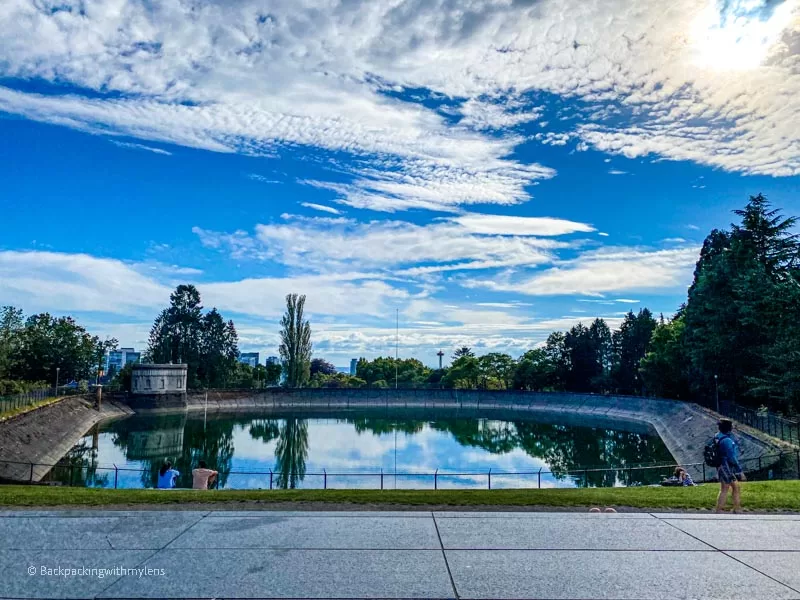
Imagine you’re growing very fast, and your mother buys you a new winter coat. But she buys it exactly your size, even though she knows you’ll grow in a month and it will become tight. Strange, right? But that’s exactly what Seattle’s builders did more than a century ago when they built a beautiful water tower in Volunteer Park. They built it too small — and they knew it from the start.
A city that grew faster than its plans
In the early 1900s, Seattle was growing at an astonishing rate. In 1900 the city had about 80,000 people. By 1910 it had more than 237,000! That’s like three new classes appearing in your school every month. The city urgently needed water for all those new residents.
City engineers understood the problem well. They sat at their drafting tables and did the math: how much water is needed today, how much will be needed tomorrow, how much in ten years. Their calculations showed that the new reservoir on Capitol Hill would have to be huge. But when it came time to build, they made a surprising decision.
Construction of the water tower and an underground reservoir began in 1906. The tower turned out to be truly beautiful — 23 meters tall, made of red brick, with a spiral staircase inside and an observation platform on top. It offered stunning views of the city, the mountains, and Puget Sound. Seattleites were proud of the tower. It became a symbol of their growing, modern city.
But there was one secret few people considered.
Beauty versus practicality: a choice that shaped the future
The reservoir beneath the tower was designed for about 60,000 people. That may sound like a lot. But remember: by the time construction finished in 1907, Seattle already had four times as many residents! It’s like bringing a birthday cake for six guests when 24 people showed up.
Why did the engineers and city officials make that choice? They had several reasons, and each tells us something important about how people sometimes think about the future.
First, they believed other, larger water sources would be built soon. The Volunteer Park reservoir was intended as a temporary solution, a beautiful addition to the water system. Second, Capitol Hill was a special place — one of the highest points in the city. Officials wanted something impressive there to adorn the city. Engineer R. H. Thomson, who led the project, dreamed of Seattle as a “city of beauty,” not just an assembly of practical buildings.
But there was a third, more quietly spoken reason: building a much larger reservoir would have cost far more. The city budget was limited, and officials decided it was better to build something beautiful but smaller than to postpone the project for years.
When the past catches up with the present
More than a century has passed, and that old tower still stands in Volunteer Park. People still climb its 107 steps to admire the city views. But the underground reservoir creates problems the 1906 engineers may not have anticipated.
Modern Seattle needs a very different water system. The city is home to more than 750,000 people, and the old reservoir long ago ceased to be a vital part of the water network. But it can’t simply be removed or ignored. The underground storage requires continuous maintenance and inspections. The water must remain clean, the walls sturdy, and the systems functioning.
Moreover, engineers have found that the old pipes leading to and from the reservoir have begun to age and fail. Some are more than 80 years old! When pipes break, water leaks into the ground, which is not only wasteful but also dangerous — it can damage roads and homes on the hill.
Today the city must spend money to maintain a system that was, from the start, too small. It’s like having to repair that tight coat every year instead of just buying a new one that fits.
The lesson from the hilltop tower
The story of the water tower in Volunteer Park teaches an important lesson: the decisions we make today affect the people of tomorrow. Sometimes we choose beauty over practicality, dreams over calculations. And you know what? That’s not always bad.
That lovely brick tower has brought joy to millions of people for more than a hundred years. Children have climbed its steps holding their parents’ hands. Lovers have met there to watch sunrises. Artists have painted its silhouette against the mountains. Maybe the engineers were right to build something beautiful, even if it wasn’t entirely practical.
But this story also reminds us: when we build “for growth,” we need to really think about how much growth to plan for. Seattle grew far more than the tower’s builders anticipated. Their beautiful choice created headaches for future generations.
Today, when city officials plan new parks, roads, or schools, they remember the lesson of Volunteer Park. They try to strike a balance: create something beautiful that will delight people, but also make it big and robust enough to serve the city for many years. It’s a difficult task, but an important one.
Next time you see an old, beautiful building in your city, consider: what choices did people make when they built it? What did they dream about? And how does their choice affect us today? Every building, every tower, is not just bricks and stone. It’s a story about hopes, dreams, and the choice between what’s beautiful and what’s practical. And sometimes, as Seattle’s water tower shows, you can have both — you just need to think carefully about the future.