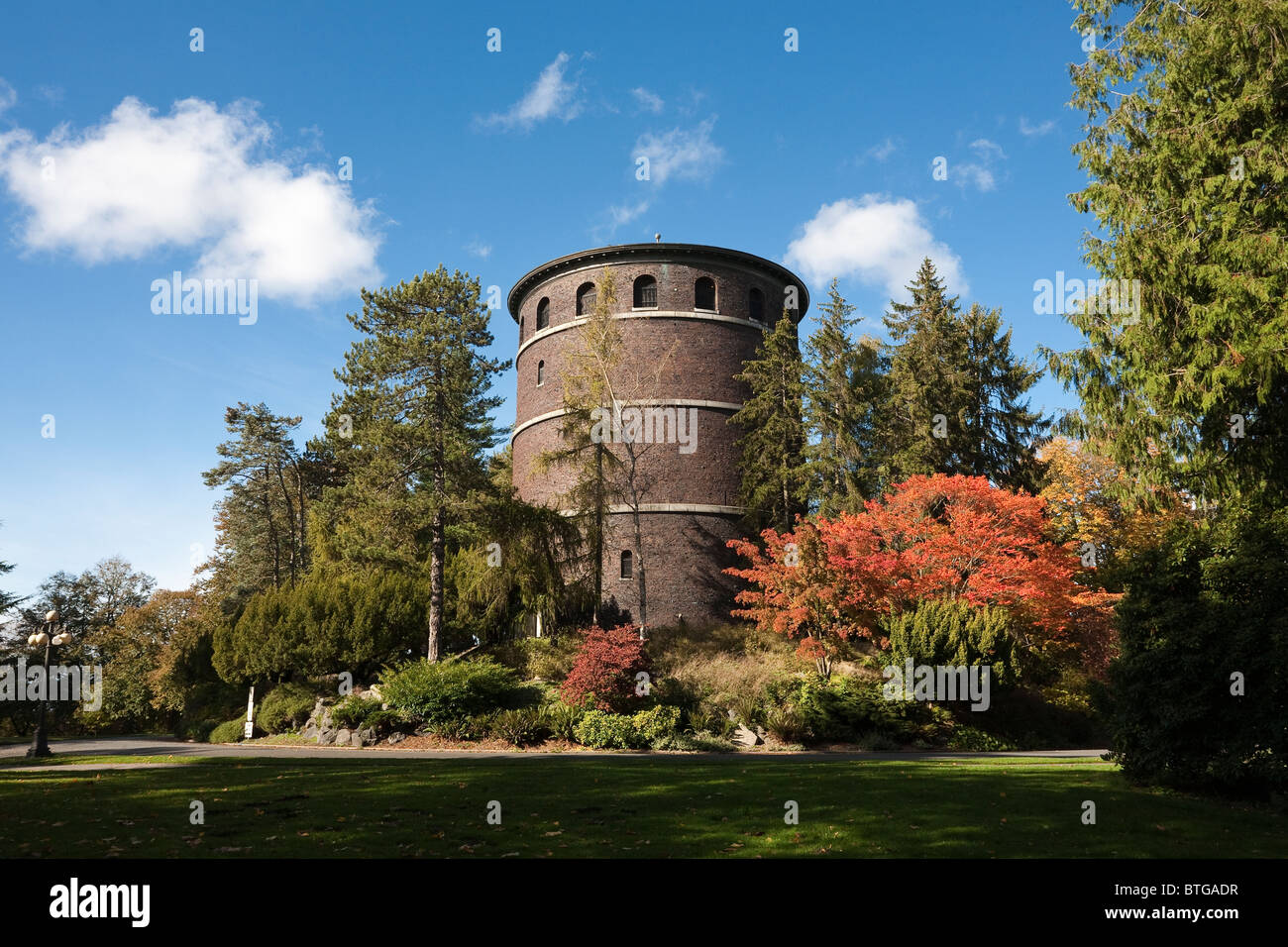
In Seattle’s prettiest park stands a tall brick tower. If you climb its spiral staircase — with 106 steps, no less — you can see the whole city at a glance: mountains, the bay, rooftops stretching as far as the eye can see. Tourists photograph it every day. But almost nobody knows exactly who built it — and what courage it took to do it.
The Park, the Tower, and a Great Thirst
In the early 1900s, Seattle was growing fast. Every month, thousands of new residents arrived in the city — people looking for work, newcomers, dreamers. And everyone needed water. Clean, fresh, and enough of it.
City officials decided to build a major reservoir — a huge underground tank for storing water — right in Volunteer Park, a beautiful hillside park. Next to it, they planned a water tower. The tower was needed so that water could flow through pipes to all the homes in the city under pressure. The higher the tower, the stronger the pressure. It’s simple — like physics in school.
Construction began around 1906. The work was hard: digging the ground, hauling bricks, mixing mortar in the rain — and in Seattle it rains very often. But who took on that labor?
People From the Far North
Most of the builders were immigrants from Scandinavia — from Sweden, Norway, and Denmark. They arrived by ship across the ocean in search of a better life. Many didn’t speak English. Many didn’t have American citizenship. Which meant they couldn’t vote in elections and officially influence the city’s decisions.
You might think: if you can’t vote, then who’s ever going to listen to you?
But these people came up with something smart. They organized. In Seattle, Scandinavian communities had their own mutual-aid clubs — something like large, close-knit families where everyone helped one another: lending money, helping people find jobs, teaching the language, and celebrating holidays together. And it was through these networks that the workers began talking to the city.
They would meet and discuss: was their pay fair? Was it safe to work on the construction site? Were contractors treating them properly? And then they selected representatives who went to city officials and spoke on behalf of everyone.
When You Can’t Vote, You Can Still Speak
This is called civic engagement. You don’t have to have the right to vote to fight for fairness. You can gather together, explain your position, write letters, attend meetings, and make problems known loudly and clearly.
Scandinavian workers won better working conditions on city construction projects — including the building of the tower and the reservoir in Volunteer Park. They demanded that the workday not be endless, that they be paid fairly, and that safety be upheld on the job site.
Imagine you don’t have a say in your class for students who moved to the school in the middle of the year. But those kids still get together, come up with shared arguments, and go to the principal — and the principal listens. That’s exactly how it works.
The city heard them. Not always immediately, not always completely — but it did hear them. Scandinavian communities became a noticeable force in Seattle’s life precisely during those years. Their voices — even if they were not electoral voices — were loud enough to be heard.
The Tower Still Stands
Today, the water tower in Volunteer Park is an architectural landmark. It’s no longer used to supply water: the city has more modern systems. But they kept it because it’s beautiful and important.
Important not only as an engineering structure. Important as a reminder of the people who built it. Of those who came from far away, didn’t know the language, didn’t have a vote — but still found a way to make their lives and the city’s life a little more fair.
When you climb those 106 steps and look at Seattle from above, remember: this view was opened for you by people who knew how to stand together. And that’s perhaps the most important thing you can build.