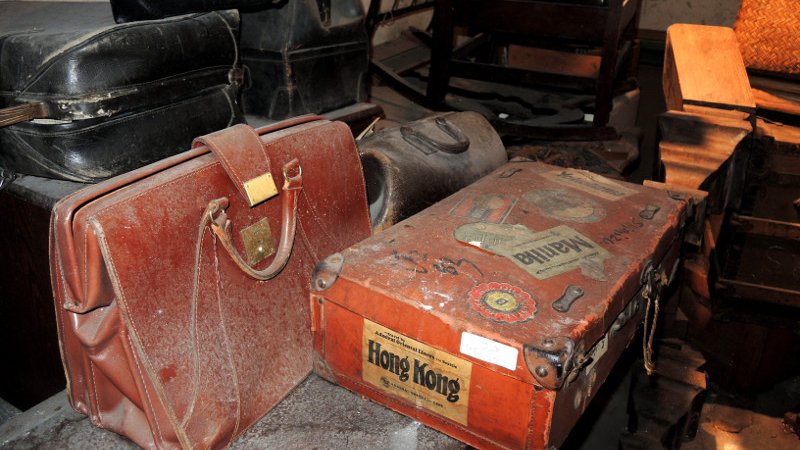
Imagine being told: “In a few days, you’ll have to leave home. Take only what you can carry in your hands.” What would you put in your suitcase? A favorite doll? Your mother’s jewelry box? That is how thousands of Japanese families in Seattle had to choose what to take in 1942. Many left behind whatever wouldn’t fit in the basement of an old hotel. Their belongings stayed there for decades, waiting for someone to remember them.
A Neighborhood Built by Immigrants
In the late 19th and early 20th centuries, many people came to Seattle from Japan. They were looking for work and wanted to raise their children somewhere safe. They opened small shops, laundries, restaurants, hotels, and bathhouses. The Nihonmachi neighborhood grew up around them; the name means “Japanese Town.” In 1910, an immigrant named Saburo Ozasa built the Panama Hotel there. It is a brick building with tall windows, designed by a Japanese architect.
Workers, sailors, and travelers stayed at the hotel. Its basement had a real Japanese bathhouse, called a sento. People came there not just to bathe, but to chat with their neighbors. For immigrants, places like this were a little piece of home.
Spring 1942
In 1941, war broke out between the United States and Japan. In February 1942, President Roosevelt signed Executive Order 9066. Under the order, people of Japanese ancestry on the West Coast began to be forced from their homes. Many of them were children born in America who considered themselves American.
Notices with instructions appeared on walls. Families had only a few days. They could take only what they could carry themselves. They had to abandon their homes, shops, and gardens, sell them for next to nothing, or leave them with neighbors. Families from Seattle were sent first to temporary camps, then to camps far from home, including one in Idaho. They lived there for years behind barbed wire.
A Basement with a Glass Floor
Some families took their belongings to the Panama Hotel basement. They hoped they would be back soon. Some left trunks; others, boxes and bundles. Inside were dishes, clothes, toys, and family photographs.
Many families were unable to return to Seattle. Their homes had already been occupied, and finding work was difficult. Some moved to other cities. The old life of Nihonmachi came to an end, and many shops and workshops never reopened.
In 1985, Jan Johnson bought the hotel. She went down to the basement and found belongings that had been there for more than 40 years. She didn’t throw them away; instead, she began looking for their owners. A tearoom later opened in the hotel, with a glass window set into the floor. Visitors sip tea and look down at the suitcases and trunks below.
The story inspired writer Jamie Ford. In 2009, he published Hotel on the Corner of Bitter and Sweet, a novel about a boy from a Japanese family who befriends a girl during a deeply unsettling time.
What Remained from Those Years
In 1988, the U.S. government formally apologized to the families sent to the camps and paid compensation to each survivor. In 2006, the Panama Hotel was designated a National Historic Landmark. The bathhouse is still preserved in the basement, though no one has bathed there in a long time.
Nihonmachi has changed, but its memory lives on. Seattle has museums and memorials, and descendants of the families still come to look for their grandparents’ belongings.
Why This Matters
I think this story is especially easy for children to understand. When you read about orders and wars, it’s hard to imagine that it really happened. But when you see a child’s doll in a basement, you understand that behind every date in a textbook were people who had homes, friends, and favorite things.
The belongings in the Panama basement don’t speak, but they tell us a lot: about the people who built their city, about fear and injustice, and about why it’s important not to forget the past, so that something like this never happens again.