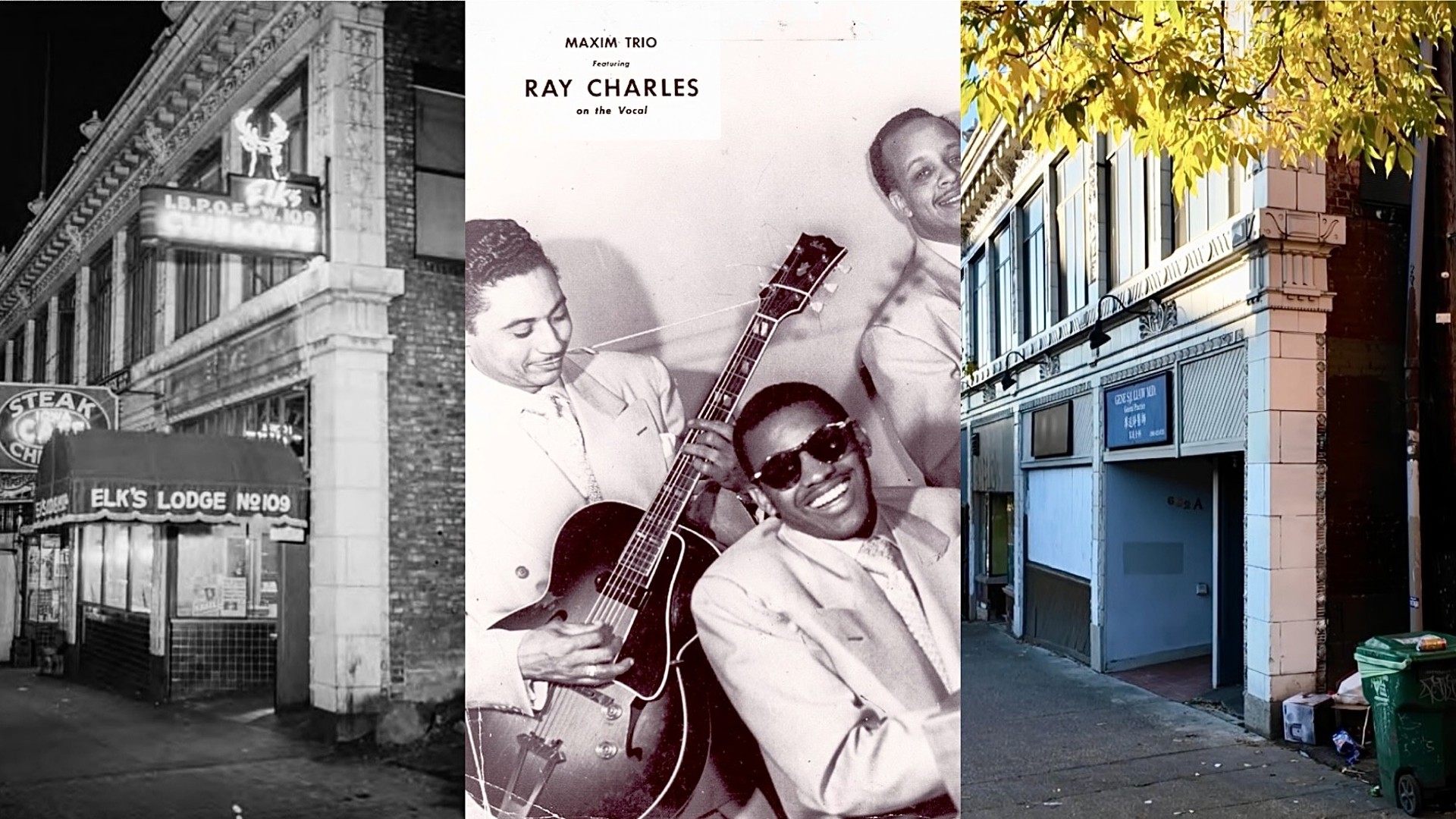
Imagine: You’re 17, you can’t see, and you decide to move to the other side of the country. Not because anyone is waiting for you there, but simply because that city is the farthest one from home on the map. That’s exactly what the future great musician Ray Charles did. He chose Seattle. There, in the Central District, on Jackson Street, he found his first real musical family.
The Street Where the Music Played Until Morning
In the late 1940s, Jackson Street was a special place. It had lots of small clubs where jazz was played. Many stayed open late, and some opened when ordinary cafés were already closing. After their evening jobs, musicians came here to “jam”—to play together without a plan, as if they were speaking the language of notes. Today, these gatherings are called jam sessions.
You could compare Jackson Street to a big communal kitchen in an apartment building. One person brings soup, another brings bread, and together they make a shared meal. It was the same here: one person brought a melody, another a rhythm, a third a new idea, and music grew out of it all.
Two Friends and One Secret
In Seattle, Ray Charles met a boy named Quincy Jones. Quincy was a little younger, played the trumpet, and attended Garfield High School in the Central District. Ray already knew how to write music for a full orchestra, and Quincy wanted to learn.
Ray became an older friend to him. It was like an older brother teaching a younger one to ride a bike: first he steadies the seat, then lets go. Ray explained how to distribute melodies among different instruments so they would sound good together. Quincy later grew up to become a composer and producer who worked with some of the world’s best-known artists. Ray became one of the leading voices in American music.
Other talented people sang in the neighborhood, too, including singer Ernestine Anderson. Garfield High School also produced other musicians, among them guitarist Jimi Hendrix, who attended the school but did not graduate.
Why It All Happened Here
This is an important and somewhat sad part of the story. In those days, many places in the United States were off-limits to Black people: it was difficult for them to live, study, or go to restaurants outside their own neighborhoods. As a result, many Black residents settled in the Central District. They built their own churches, shops, and clubs and supported one another.
The painful—and, at the same time, powerful—part of this story is that people were forced to gather in one place. But that brought talented musicians together, and they learned from one another. Later, as laws became fairer and people could go to any club, audiences began to spread out. And when major roads were built through the neighborhood and regulations for nightclubs changed, many of the old clubs disappeared.
What Remains and What Other Cities Can Learn
Many buildings have vanished, but the memories remain. Today, the neighborhood is home to the Northwest African American Museum, and the Garfield High School jazz band is known for winning major competitions. This shows that when adults carry on what those before them started, talent doesn’t fade.
Here’s what I think other cities can take from this story:
- Older generations should share what they know. Ray taught Quincy, and Quincy taught others. It’s a chain.
- We need places where things happen in person. A street, a club, a school with a band—somewhere you can go and simply play.
- Take care of what you have. We often recognize the value of a street only when it’s being redeveloped.
- Tell the story. A museum, a plaque, a school lesson. Otherwise, children won’t know that great music once lived right around the corner.
Not the End
I think it’s beautiful how these two teenagers met in this story. One couldn’t see, but he could hear how to put the pieces together into a whole; the other was too young to know everything, but eager to learn. Their street has changed a lot, but if one evening you hear a school band in Seattle, you’ll understand: Jackson Street is still playing.