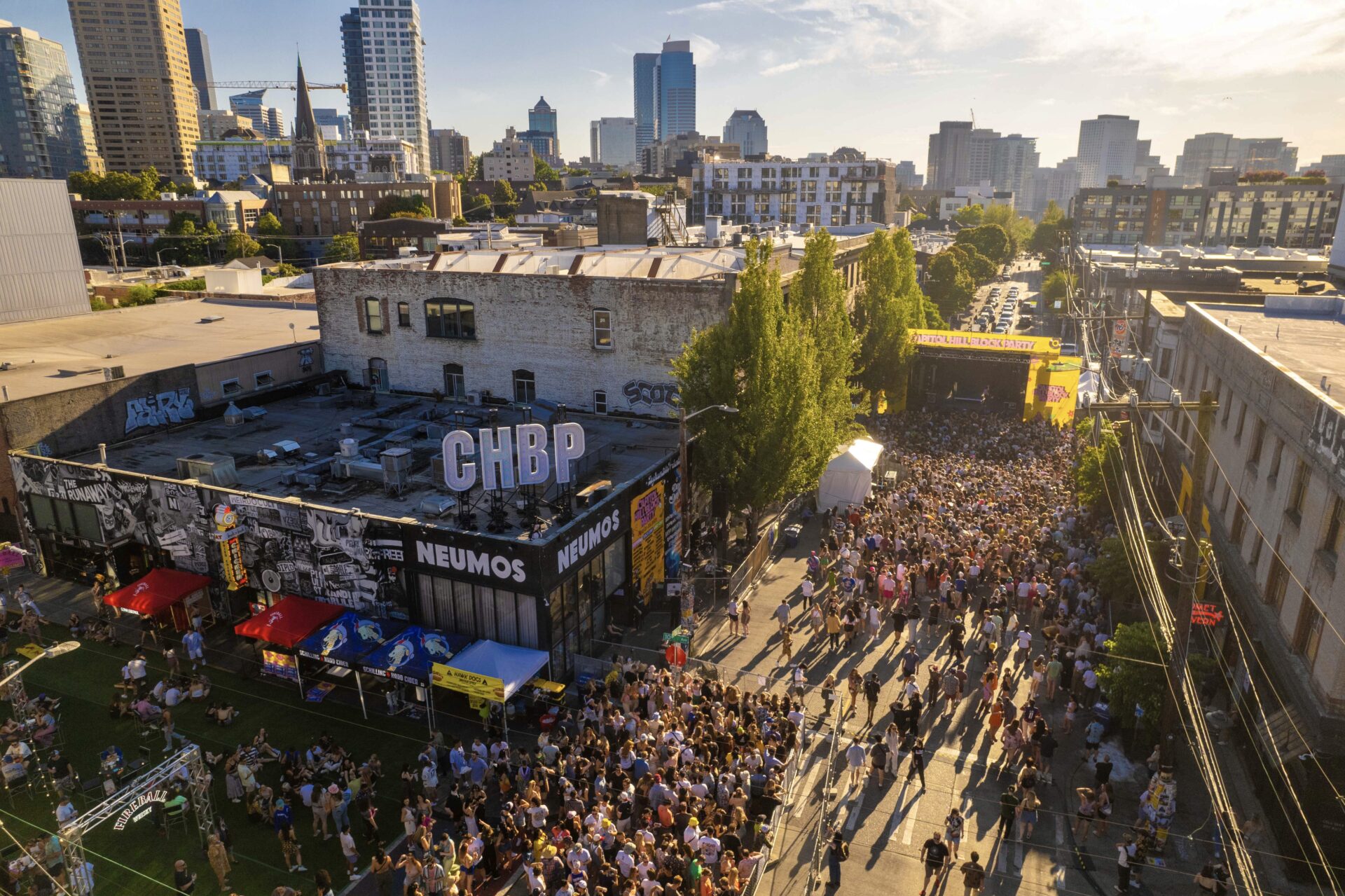
In one Seattle neighborhood people were arguing so much about noise that they decided to throw the loudest party in town. And it worked! Now every summer thousands of people come to Capitol Hill to listen to music right in the middle of the street. But few know that this huge festival was born from a very strange idea: to stop an argument about loud music, you have to make it even louder.
In the mid-1990s, Capitol Hill in Seattle became a place where everyone was constantly fighting. On one side were bar and club owners who played music late into the night. On the other side were residents who couldn’t sleep because of the noise and kept calling the police. Club guests’ cars took up all the parking spaces. Neighbors wrote angry letters. Business owners feared they would be shut down. It seemed the conflict would never end and the neighborhood would be permanently divided.
An idea that sounded like a joke
In spring 1997 a group of neighbors gathered to come up with a solution. Among them was a woman named Jim Layman, who worked at the local bookstore. Instead of proposing to make the music quieter or to introduce new rules, she said something unexpected: “What if we have one day when the music plays SO loud that everyone — club owners, residents, and the police — are forced to have fun together?”
At first everyone thought it was a joke. How could you solve a noise problem by adding more noise? But the more they thought about it, the smarter the idea seemed. It was like two brothers constantly fighting over toys and the parents saying: “Okay, let’s have one day when ALL the toys are shared and you MUST play together.” Sometimes the best way to stop a fight is to make people do together what they’re fighting about.
The group began planning. They decided to close an entire street — East Pike Street — to cars for a whole day. Stages would be set up on that street and musicians would play for free for everyone. Residents could step outside and listen to a concert right at their doorsteps. Club owners could show their music to the whole neighborhood. And guests wouldn’t be looking for parking because the street would become a pedestrian zone.
Engineering without blueprints: how to build a festival from nothing
But how do you turn an ordinary city street into a concert venue? That required real engineering work, even though none of the organizers were engineers. They had to solve many problems:
Problem of power: Where would they get electricity for amplifiers and microphones in the middle of the street? They struck deals with shop owners to let them run extension cords from their outlets. The result was a web of extension cords connecting the stages to dozens of different buildings.
Problem of safety: City officials worried the crowd could become dangerous. The organizers came up with a system: they asked local residents to become volunteer “street stewards.” These people knew the neighborhood and could spot problems earlier than the police. This was engineering of human relations — they built a safety system out of neighbors who cared for one another.
Problem of permits: To close the street they needed many documents from the city. That usually takes months. But the organizers used a trick: they called the event a “block party” — the American term for small neighborhood celebrations held right on the street. Rules are simpler for such parties. Of course, their “party” was much bigger than usual, but technically they weren’t lying.
The first Capitol Hill block party took place in summer 1997. About two thousand people came — a huge crowd for a small neighborhood event. Local bands played, many of which later became famous. People who had previously argued about noise now danced side by side. A club owner treated a neighbor to ice cream. A police officer nodded his head to the beat.
When volume becomes the solution
The most surprising thing happened after the party. Complaints about noise didn’t disappear entirely, but they dropped significantly. Why? Because people stopped being strangers. Now, when the music played too loudly at night, a neighbor didn’t call the police — they simply walked into the club and said, “Hi, Mike, remember when we danced together at the block party? Could you turn it down a bit? My daughter is trying to sleep.” And it worked, because Mike now knew that neighbor as a person, not just a complainer.
The organizers realized they had invented more than a party. They had invented a tool to mend broken relationships between people. It was social engineering — they built a bridge between two groups using music instead of concrete.
Each year the party grew. By 2000 attendance reached ten thousand. In the 2010s it topped thirty thousand. Sponsors appeared, professional stages and well-known musicians joined. But the main idea remained: one day a year the street belongs to everyone together, and the music must be so loud it can’t be ignored.
A lesson for other neighborhoods
The story of the Capitol Hill block party taught other Seattle neighborhoods and other cities an important principle: sometimes a problem can’t be solved by making something smaller or quieter. Sometimes you have to make it BIGGER and LOUDER — but in a controlled way, with everyone participating together.
After the success of this party, dozens of similar festivals sprang up in other parts of Seattle. Some cities across America copied the idea. They realized engineering is not only about bridges and buildings. Engineering is the skill of finding smart solutions to any problem, even problems between people.
Today the Capitol Hill block party is one of the largest music festivals in the Pacific Northwest. But for neighborhood residents it still remains what it always was: a reminder that neighbors are stronger when they’re together, and that sometimes the best way to deal with noise is to turn it into music everyone can hear.
This story shows that human ingenuity works not only with wires and machines. The cleverest inventions are sometimes those that help people stop arguing and start listening to one another — even if it means turning the music all the way up.