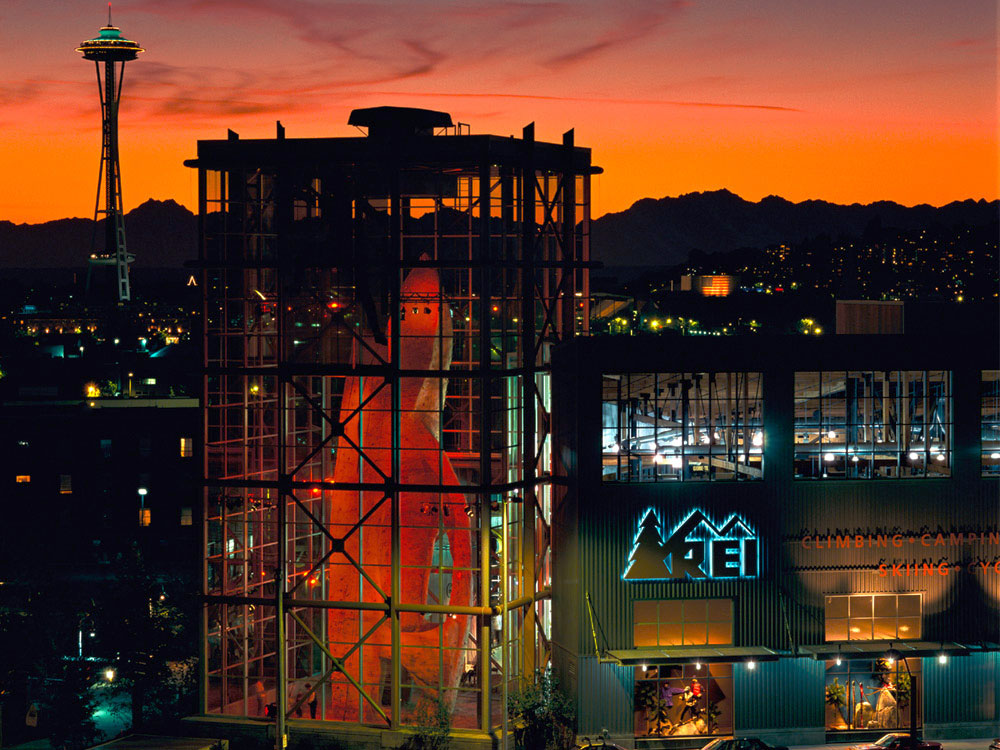
Imagine a store where you’re one of the owners. Not a CEO, not a millionaire—just you, and millions of people like you across the country. That’s how REI works: a huge outfitter for hiking and adventure, with its headquarters in Seattle. But what’s really interesting isn’t what they sell. What’s really interesting is the building itself—and the story of how it went from being an unwelcome guest to a beloved place for an entire neighborhood.
What a cooperative is—and why that’s cool
A typical store runs like this: there’s an owner, they earn the money, and customers simply come and go. But REI is set up differently. It’s a cooperative—almost like a big club. If you pay a small fee (once in your lifetime—about $30), you become a co-op member. And that means you’re a co-owner. Each year, part of the profits is returned to members, like a little thank-you for your loyalty.
REI was founded in 1938 in Seattle by a handful of friends who were climbers and mountaineers. They wanted to buy good gear for the mountains, but they couldn’t find what they needed at a fair price anywhere. So they decided: let’s band together and buy together! That’s how the cooperative began. Today, REI has more than 22 million members—as if the entire population of Australia had joined one club.
A building nobody wanted—and then everyone loved
In the 1990s, REI decided to build its main, biggest store in Seattle. They chose a location in the Capitol Hill neighborhood—a lively, creative, slightly bohemian part of town. And that’s when the fun really started.
Many local residents were against it. They said, “Why do we need a huge store? It will ruin the atmosphere of our neighborhood. Tourists will come in droves, and the small local shops will close.” The debate went on for a long time and got heated.
But the architects came up with something unusual. Instead of a glass box mall—like everywhere else—they designed a building that looks like an old industrial warehouse. Brick, metal, big windows—like something important was once made here by hand. Outside, there’s a real bike trail with ramps and obstacles, where you can test bikes right before buying. And inside—a climbing wall nearly 20 meters high, a real rock face in the middle of the store!
When the store opened in 1996, people came—and they stayed. Not only to buy a backpack. They came just to watch bold people climb an artificial rock. To sit by the fireplace inside. To ride their bikes on the test track.
The climbing wall that changed everything
The climbing wall at REI isn’t just an attraction. It’s a symbol of an idea: a store should be a place you want to visit even if you’re not buying anything. Kids came to watch the climbers like circus performers. Parents sipped coffee and watched. Teenagers dreamed of trying it themselves.
Over time, the neighborhood’s attitude changed. The very building people had protested against became a destination. The architects won awards. Journalists wrote about it as an example of how big business can respect the place where it lives.
One of the architects said something along these lines once: “We wanted the building to tell a story—the story of people who love the outdoors and want to get back into it.” It seems they did manage that.
Why it matters—even if you’ve never been to Seattle
REI’s story teaches an important lesson. When a business belongs to the people—not to a single rich uncle, but to millions of ordinary customers—it starts thinking differently. Not only “how to make more money,” but also “how to make sure people feel good around us.”
The REI building in Seattle isn’t just a beautiful structure. It’s proof that a store can be part of the life of the neighborhood, not just a place where money is taken. And that architecture isn’t only about whether it looks good or bad—it’s also about whether it’s honest or dishonest toward the people who live nearby.
And maybe the most surprising thing of all: the very residents of Capitol Hill who once marched with signs saying, “We don’t need this!”—today they’re proud of this building as their own. Because it really became theirs. For everyone.