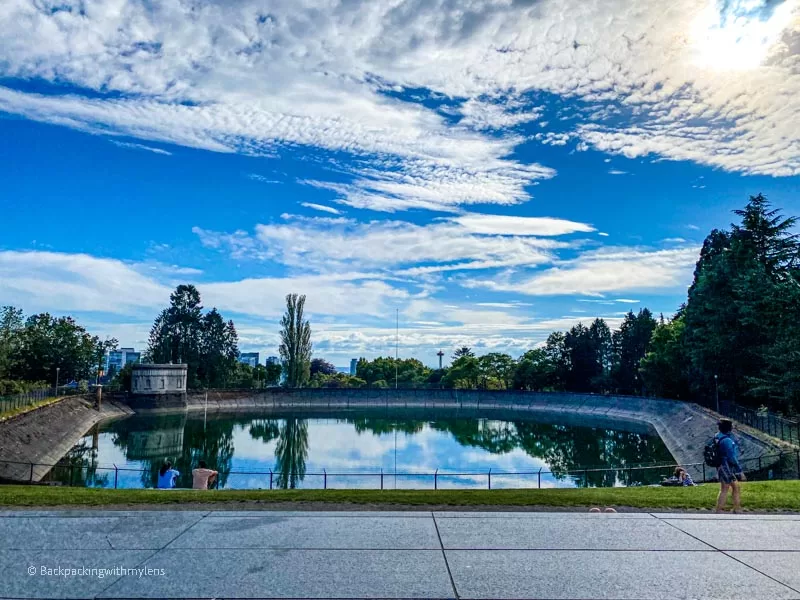
Imagine running across soft green grass in a park, lying down, and looking up at the sky. Now imagine that just a few meters beneath you, a real underground lake is hidden—a reservoir holding millions of liters of water that flows into the homes of thousands of people. That is how Volunteer Park in the American city of Seattle is designed. And almost no one who walks there even suspects this secret.
Why the City Needed a Giant “Invisible” Bowl
At the end of the 19th century, Seattle was growing very quickly. More and more people needed clean water—for drinking, cooking, and watering gardens. Engineers came up with a plan: build a huge reservoir, something like a giant concrete bowl, on the city’s highest hill. Water from Lake Union would be pumped uphill and then flow through pipes to people’s homes, because water always runs downhill. It was smart and economical: the city would not need to use much energy pumping water everywhere.
But there was one problem—the reservoir was not attractive at all. A bare concrete basin in the middle of the park would have ruined the entire experience. So the engineers decided to do something that seems almost magical today.
How to Hide a Lake Beneath a Hill
The builders did not simply leave the reservoir exposed. They covered it with soil, planted grass and trees, and transformed the engineering structure into an ordinary-looking green hill. Today, if you visit Volunteer Park, you will see a beautiful slope where people can go sledding in winter or have a picnic in summer. Almost no one would guess that a reservoir built in 1901—and still in use today—is hidden directly beneath their feet.
Here is what the same place looks like from two different perspectives:
| What an ordinary visitor sees | What is really hidden |
|---|---|
| A green, grassy hill | A concrete water reservoir |
| A place for picnics | Part of the city’s water-supply system |
| Simply a beautiful landscape | An engineering marvel from the early 20th century |
I think this is an incredibly touching idea: to build something highly useful without forgetting about beauty. The engineers could have simply left a concrete box in place, but they thought about the people who would come there to relax and gave them a beautiful hill instead of a dreary construction site.
The Tower That Offers a View of the Entire City
Next to the hidden reservoir stands a real brick tower. It can be seen from far away and makes no attempt to hide. The tower was built in 1906 and had a special purpose: helping regulate water pressure in the pipes. But the architects decided not to create a dull technical structure. Instead, they designed a beautiful building with narrow windows and a spiral staircase inside.
If you climb all 106 steps of the tower, you will find an amazing view at the top: the entire city of Seattle, the waters of Puget Sound, and, on a clear day, even the distant snow-covered peak of Mount Rainier. A seemingly boring “water” building was transformed into a genuine observation platform—a gift for anyone willing to make the climb.
As Seattle urban-planning historians have said, parks of that era were deliberately designed so that the “useful” and the “beautiful” would not compete with each other, but complement one another.
Why It Is Important to Remember This Today
This story teaches us something remarkable: sometimes the most important parts of our world are completely invisible. The water that flows from the tap at home and the light that comes on when you flip a switch all work thanks to invisible systems hidden underground or inside buildings. The people who built the reservoir and tower more than a century ago cared not only about ensuring that the city had water, but also about making the park a pleasant and beautiful place for residents.
So the next time you walk across a green hill in a park—any park—remember: there may be a small secret hidden right beneath your feet, designed by someone many years ago specifically to make your day a little brighter.