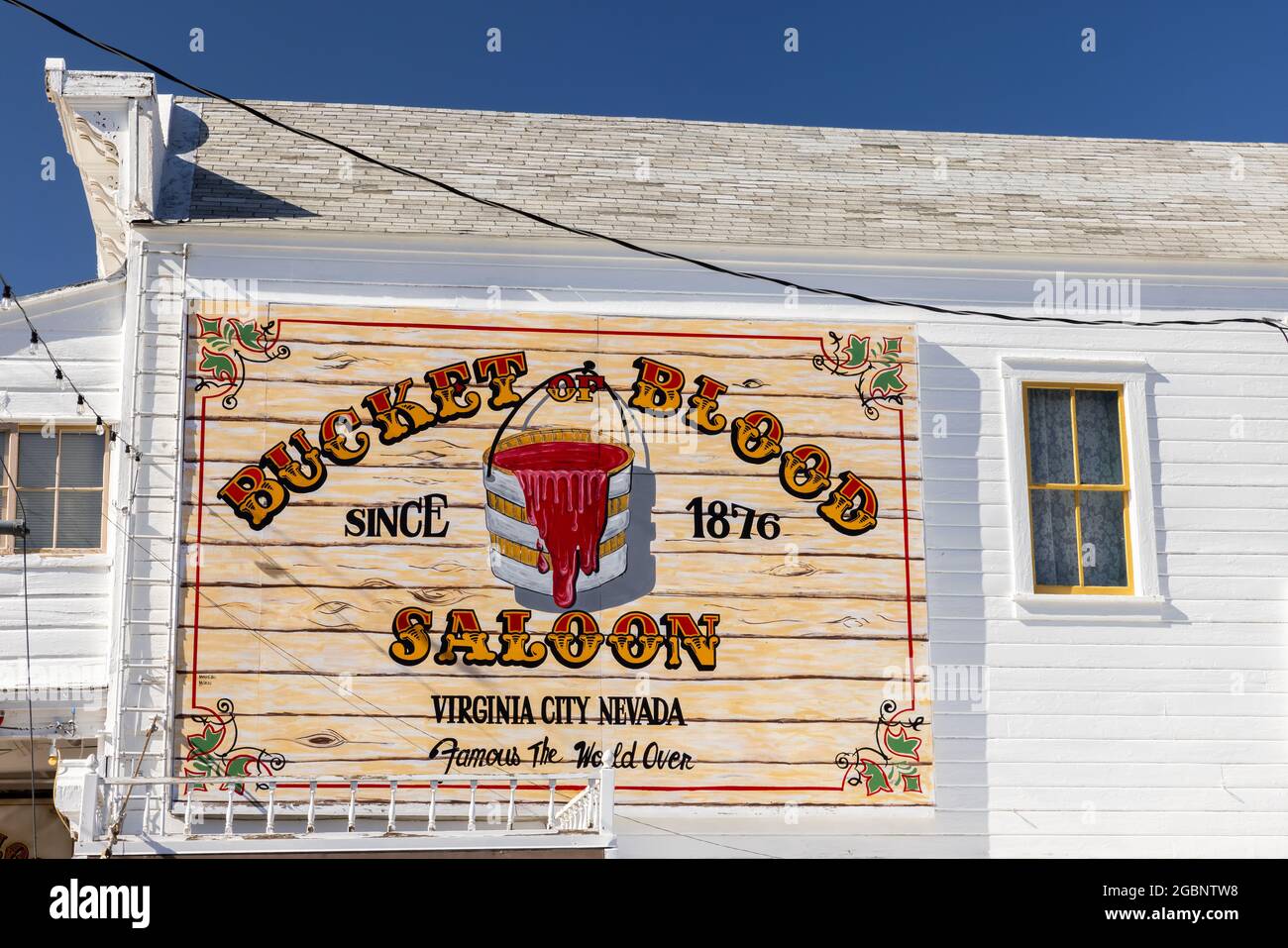
In the 1870s, in the American town of Virginia City, in the middle of the Nevada desert, there stood a saloon with a gruesome name — the "Bucket of Blood." The name came after a brawl when so much blood was left on the floor that they collected it by the bucket. But this story is not about fights. It is about how the owner of the roughest bar in town accidentally became an inventor because he desperately wanted to serve his customers cold beer in a place where summer temperatures rose to 40°C (104°F) and the nearest ice was hundreds of miles away in the mountains.
Imagine: you open a bar in the desert with no electricity, no refrigerators, and ice delivery costs a fortune. But your customers are miners who work underground all day in heat and dust, and all they dream about is a cold drink after their shift. What would you do? The owner of the Bucket of Blood did not give up. He looked at the mountains around the town, at the deep mine shafts underfoot, and devised a cooling system that worked without any machinery — using only water, stone, and clever planning.
An underground refrigerator of snow and stone
The saloon owner understood a simple thing: if it’s cooler underground than on the surface, you should use the earth itself as a refrigerator. He ordered workers to dig deep chambers under the saloon — real underground rooms where the temperature always stayed low, even when the sun baked above. But that alone wasn’t enough.
The main trick was water. High in the mountains surrounding Virginia City, snow remained even in summer. The saloon owner organized a system of wooden gutters and pipes that brought icy water from the mountain peaks straight into the basement of his establishment. This water flowed through special stone reservoirs, cooling them. And in those reservoirs stood barrels of beer and bottles of whiskey.
But that wasn’t all! To get the cold air from the basement up into the bar itself, he created a system of ventilation shafts — narrow passages in the walls through which cool air naturally rose (cold air is heavier and displaces warm air). It became a kind of natural air conditioner: cold water cooled the stones, the stones cooled the air, and the air rose into the room where the patrons sat.
One miner of the time wrote home in a letter: "Entering the 'Bucket of Blood' at noon is like plunging into a mountain lake. It's cool there when outside you can hardly breathe. And the beer is colder than anywhere else for hundreds of miles around."
Why this mattered for engineering
What the saloon owner did seems simple, but in fact he applied several serious engineering principles that were later used in real refrigerators and air-conditioning systems:
Principle of heat exchange: he understood that cold water can take heat from warm objects (beer barrels), cooling them down. This is the basis of any refrigerator.
Natural convection: warm air rises while cold air sinks. By creating the right openings and shafts, he made air move without any fans or motors.
Insulation: the underground chambers were lined with stone and clay, which are poor conductors of heat. This prevented the heat from the surface from penetrating downward and ruining the cool.
Of course, he was not a scientist and did not know all these terms. He simply experimented, tried different solutions, sometimes made mistakes, but eventually created a working system. That is real engineering: solving problems with what you have on hand and not being afraid to try new things.
How saloons became laboratories for inventors
The Bucket of Blood was not the only saloon where owners became inventors. Across the Wild West, in small towns amid deserts and mountains, bar owners faced the same problems: how to keep food fresh, how to cool drinks, how to make a room comfortable in unbearable heat or cold.
Some built icehouses — special buildings with thick walls where ice and snow were stored in winter and used for cooling in summer. Others invented water filtration systems because in mining towns the water was often dirty and unsafe to drink. Still others experimented with ventilation to remove smoke from cigars and kerosene lamps without losing precious cool air.
Interestingly, many of these solutions later attracted the attention of actual engineers. When mechanical refrigerators began to appear in the late 19th century, their creators studied the experience of saloons and restaurants of the Wild West. They looked at how people without formal education or technology solved cooling problems and used those ideas to build machines.
One pioneer of refrigeration, engineer John Gorrie, mentioned in his notes that he visited remote establishments and spoke with their owners to understand which methods worked best. He wrote: "These people do not know the laws of thermodynamics, but they know how to make ice not melt for three days in the heat. That knowledge is priceless."
Human ingenuity versus nature
What I like most about this story is that it shows: sometimes the most important inventions are made not by scientists in laboratories but by ordinary people who refuse to give in to difficulties. The owner of the Bucket of Blood could have said, "Well, in the desert you can't have cold beer; we'll have to make do with warm." But he didn’t say that. He thought, "How can I solve this problem?" — and set out to find an answer.
This is a very important lesson. When we face something that seems impossible, it's easy to give up. But the story of Wild West saloons teaches us that for almost any problem you can find a solution if you think carefully and are not afraid to experiment. You don't necessarily need expensive equipment or special training. Sometimes it’s enough to look closely at the world around you and figure out how to use what nature provides: mountain water, the coolness of the ground, air movement.
By the way, the Bucket of Blood operated until the early 20th century, when Virginia City finally got electricity and real refrigerators appeared. But by then the saloon had already become a legend — not only because of its frightening name and wild stories, but because you could always get the coldest beer in the area there, even when it seemed impossible.
What remains of saloon inventions today
Today, when we open the fridge or turn on the air conditioner, we rarely think about where these technologies came from. But tracing their history back to the beginning, we find that many ideas were born in the most unexpected places — for example, in rough saloons in the middle of the desert, where desperate bar owners fought the heat and devised clever ways to keep cool.
The principles they used — heat exchange, natural air circulation, insulation — are the foundation of modern refrigeration and climate control systems. The difference is that now we have electricity and complex mechanisms that do the work automatically. But the core idea remains the same: we remove heat from where it's not wanted and move it where it won't bother us.
And this story also reminds us that engineering is not only about big factories and scientific labs. It's about problem-solving, curiosity, and perseverance. It's about looking at the mountains around you and thinking, "What if we use that cold water?" Or looking underfoot and saying, "What if we dig deeper where it's cooler?"
The owner of the Bucket of Blood, whose name, unfortunately, has not survived in history, did not know he was doing something important for the future. He simply wanted his customers to be happy. But thanks to people like him, humanity learned to beat the heat, keep food fresh, and create comfort even in the harshest conditions. And that, if you think about it, is a far more important legacy than just the story of a bar with a frightening name.