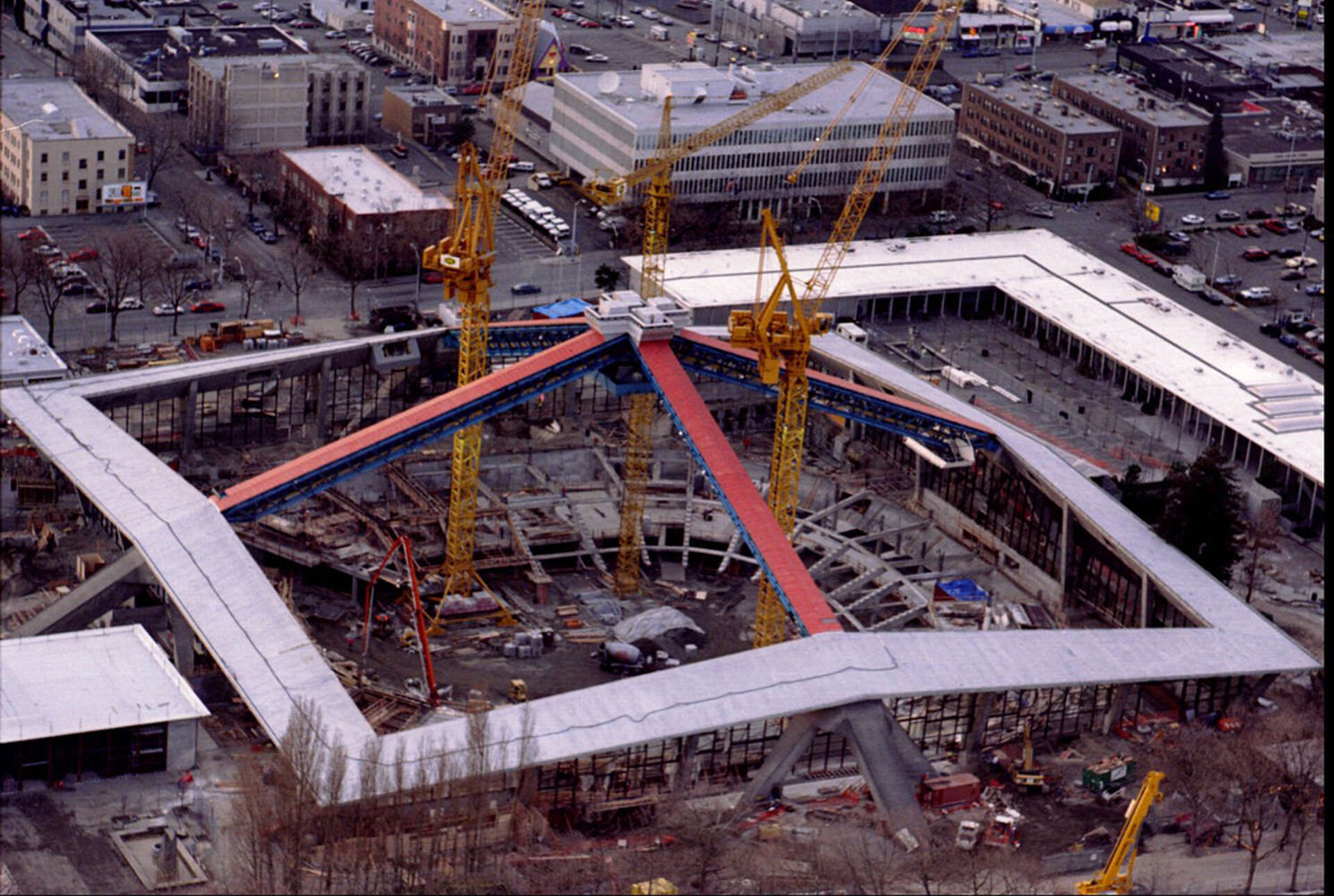
Imagine you need to clean up your room, but your mom says, “Don’t touch the ceiling — it’s special.” What do you do? Most people would be at a loss. But engineers in Seattle in that kind of situation… just lifted the ceiling into the air. Along with the entire roof. Weighing twenty thousand tons. That’s about the same as the weight of three thousand elephants. And this isn’t a fairy tale — it really happened, right in the middle of the city.
A Gift from the Past: What Remained After the Celebration
In 1962, something grand happened in Seattle. The city hosted the World’s Fair — a huge celebration that brought people from all over the world to see future technologies. That’s when the famous Space Needle appeared — a tower that still juts over the city like a pencil stuck into the sky. But the Space Needle wasn’t the only gift from that fair.
Next to it, they built a massive Coliseum — a sports arena with an unusual roof shaped like an inverted pyramid. The roof was beautiful, bold, and unlike anything people had built before. After the fair, the building didn’t just sit there: basketball teams played here, concerts happened, performers took the stage. Decades passed, the building aged, but the roof still hovered over the city — proud and untouched.
By the 2010s, it became clear the hall needed to be rebuilt. It was too small, too old, and completely unsuited for modern hockey. The city decided to give it a new life. But then came a problem that left everyone stumped except the bravest engineers.
A Problem That Had No Solution — Until One Was Found
The roof of the old Coliseum was designated a historic landmark. That meant: you can’t touch it, you can’t demolish it, you can’t change it. The city said firmly: the roof had to stay exactly as it was built in 1962. But inside, they needed to build an entirely new arena — spacious, modern, with seating for seventeen thousand spectators.
The usual approach — demolish the old and build a new one — wasn’t an option. Building around the roof without touching it also didn’t work: there wasn’t enough space. Engineers thought, argued, drew diagrams. And in the end, one of them proposed an idea that made the others gasp:
— What if we just… lift the roof?
That’s exactly what they did. In 2018, workers installed 72 special hydraulic jacks around the building — extremely powerful machines capable of lifting incredible loads slowly and precisely, millimeter by millimeter. The roof was carefully detached from the walls. And then they started lifting it.
It rose slowly — about at snail pace. Workers monitored every centimeter so the structure wouldn’t tilt. Once the roof was lifted high enough, work at the bottom went into full swing: builders dug into the ground several more meters, expanded the space, poured new foundations, and erected new walls. It was as if someone had taken a hat off their head, cut their hair, and put the hat back on — and the hat didn’t even notice.
An Arena That Drinks Rain
In 2021, the renovated arena opened. It was named the Climate Pledge Arena — “the arena that pledges to the climate.” And this isn’t just pretty words.
The builders decided to go further than simply preserving the old roof. They wanted an arena that wouldn’t harm the planet. And they pulled it off — so well that the arena became the first in the world to receive an official carbon-neutrality certification. That means it doesn’t add harmful gases to the atmosphere that warm the Earth.
But the most surprising part is the ice. Seattle is a rainy city, and the engineers decided to use that. The arena collects rainwater from the roof (that very historic one), purifies it, and freezes it right on the rink. So the Seattle Kraken hockey players skate on ice that literally “fell from the sky” just a few months ago. All the arena’s electricity comes from renewable sources — solar and wind. Even the food for spectators is chosen so that its production doesn’t damage nature.
If, back in 1962, the Coliseum builders had been told that their roof would one day collect rain for hockey ice and stand over the most eco-friendly arena in the world, they probably wouldn’t have believed it. But exactly that happened.
Why This Matters More Than It Seems
The arena’s story isn’t just a construction story. It’s a story about the fact that old and new don’t necessarily have to fight each other. Sometimes you can preserve the past and still step into the future — you just have to figure out how to do it.
The 1962 roof still hovers over the city. Beneath it is a completely new world: ice made from rain, stands for thousands of people, clean energy. The 1962 fair promised a future to the city. More than sixty years have passed, and this future has finally arrived — not by destroying the past, but by carefully lifting it into the air and making room for it underneath.
The next time you think a task has no solution, remember this roof. Sometimes the right answer is simply to lift what’s in the way and see what’s underneath.