In 2014, something happened in the American city of Seattle that would later spark debate among scholars, mayors, and ordinary ice cream vendors. The City Council decided to gradually raise the minimum wage to $15 an hour. No other major U.S. city had done this before. It became a huge urban experiment, and its main lesson was this: even a good idea needs to be tested, and every city can learn something from another.
What is the minimum wage, and why do we need it?
Imagine you’ve opened a lemonade stand in your backyard and hired a friend to help. You agree on how much you’ll pay her for each hour she works. Now imagine an entire city, where thousands of people work in cafés, shops, hotels, and kitchens. They all have different arrangements with their employers.
To make sure no one is paid too little, the country has a rule called the minimum wage. It is the smallest amount an employer is allowed to pay someone for an hour of work. They can’t pay less.
But the cost of living varies from city to city. In Seattle, rent, groceries, and transportation were expensive, and many people who worked full-time still struggled to make ends meet. That’s why people there began talking about raising the minimum wage much higher than usual.
How the idea became law
It all began in 2013. Kshama Sawant, a City Council candidate who had previously taught economics, ran for office on the slogan “$15 an hour.” At first, many people thought it was an overly ambitious dream. But residents liked the idea, and soon it was being discussed everywhere.
Then Mayor Ed Murray stepped in. He did something adults rarely manage to do when they disagree: he brought people with different views together around one table. Union representatives—unions are groups that workers form—and business owners, both large and small, took part. They spent a long time discussing how to raise people’s pay without forcing shops and cafés to close.
In the end, they reached a compromise, and in 2014 the Council voted for it unanimously—that is, not a single person voted against it.
A “staircase” instead of a leap
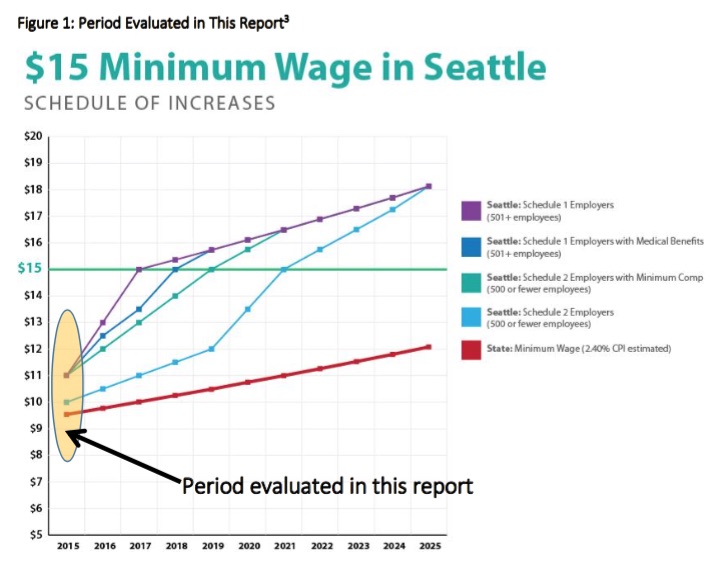
The cleverest part of Seattle’s decision was that the wage increase didn’t happen all at once. Imagine you want to climb over a tall fence. You can’t jump straight to the top, but if there are steps, it’s much easier to climb. That’s what they built here, too: a staircase.
Large companies with lots of money and many employees had less time to make the climb. Small businesses were given more steps and more years to prepare—for example, by adjusting prices or figuring out new ways of working. The law also took into account whether an employer provided workers with benefits such as health insurance. This was meant to make things easier for those who had the hardest time managing the change.
The climb took years, and the city watched carefully to see what happened at every step.
What researchers found
This is where the story gets really interesting. A group of researchers from the University of Washington set out to find out what had actually happened to workers and businesses. They studied the data over several years.
The results were surprising and mixed. Researchers found that many people’s hourly wages went up, which was good. But some workers saw their hours cut: to save money, employers gave them fewer shifts. As a result, some people’s total monthly earnings may not have increased—and in some cases may even have fallen.
Imagine a school fair. You’re suddenly promised more money for every pie you sell, but you’re only allowed to work at the stall for one hour instead of two. The benefit isn’t so obvious anymore. That was the kind of puzzle people faced in real life.
Other researchers studied the same events and reached somewhat different conclusions, so the debate continued. And that’s normal: the more complicated the question, the more different perspectives there are. Researchers are still discussing exactly how the results should be measured.
What I think about this story
What I like about Seattle’s story is that the city didn’t just pass a law and forget about it. It kept watch, collected data, and let researchers check whether things were going well. It’s like a cake recipe: instead of declaring it the best in the world right away, it’s better to bake it, taste it, and write down what turned out well and what needs changing.
It’s also important to remember the people on both sides of the counter. For a server working two jobs, a raise might mean finally having time to spend with family. Meanwhile, the owner of a small café might worry about whether they can afford to pay everyone without raising prices so much that customers stop coming. Both sides had a point: each had their own concerns.
What other cities can learn
There are a few simple lessons from Seattle’s experience that could apply to any city:
- Make changes gradually. A staircase is better than a leap: people and businesses have time to prepare.
- Listen to everyone. A decision worked out around one table with workers and employers is fairer.
- Check the results. Without monitoring what happens, it’s impossible to know whether a change helped.
- Don’t be afraid to make adjustments. If researchers find that some people are getting fewer shifts, that’s a reason to think about how to help those particular workers.
In Seattle, $15 an hour became more than just a number. It became a lesson in how a big city learns from experience. A city tries something, observes, draws conclusions—and other cities take those lessons for themselves. Perhaps the most useful idea in the whole story is this: good decisions don’t come from being sure we know everything, but from being willing to observe, think, and learn.