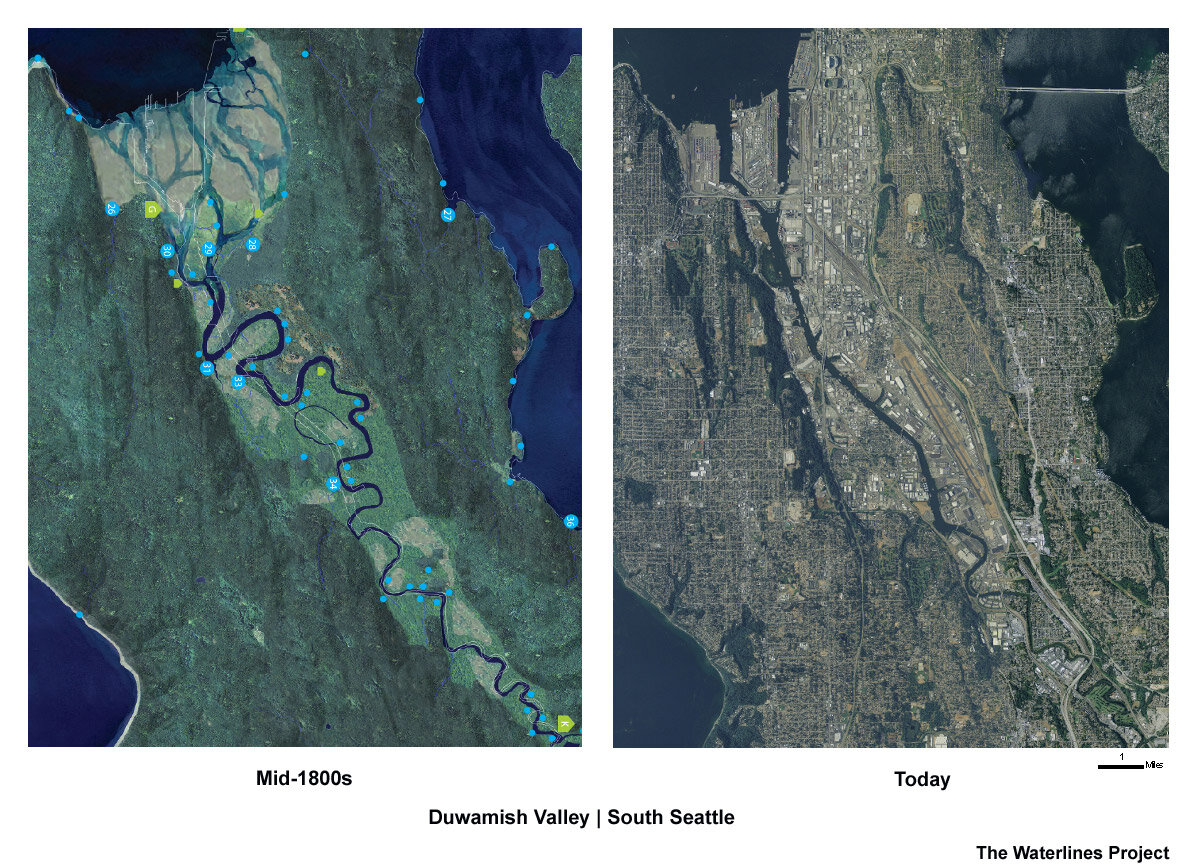
Imagine a shoelace lying in the grass in loops and curves. Someone decides it takes up too much space and pulls it into a perfectly straight line. That’s roughly what people did to Seattle’s Duwamish River. More than a hundred years ago, they “straightened” it to make room for factories and ships. Today, the city and people in nearby neighborhoods are still dealing with the consequences.
A River Full of Turns
The word “Duwamish” comes from the people who lived along these shores long before Seattle existed. It is often translated as “people of the inside.” The city is named after Chief Si’ahl, whom Europeans called Seattle. He was a leader of the Duwamish and their neighbors.
The river once wound through the lowlands, spreading into broad, shallow inlets. For salmon, these waters were like a “hotel.” Young fish that had just swum down from rivers rested and fed here, getting used to salt water before heading out to the ocean.
In the 1910s, engineers decided the river needed a different life. They cut off its bends and deepened its channel, and docks and factories sprang up along its banks. The river became easier to use. But experts estimate that most of those shallow waters and marshy banks disappeared. Fish had nowhere to rest. It was as if all the benches and shady spots in a park had been replaced with a smooth concrete corridor.
Mud That Never Forgets
In the straight, deep channel, currents and tides leave a lot behind on the riverbed. For decades, factories, shipyards, roads, and warehouses discharged various substances into the water and sewer pipes. Some were hazardous compounds, such as PCBs and arsenic. They didn’t simply disappear; they settled into the sediment, like grime at the bottom of a bathtub no one has cleaned.
You can’t just “wash away” river sediment. Small crustaceans feed on it; fish eat the crustaceans, and people and birds eat the fish. That’s why warning signs appeared along the river advising people which fish and crabs are best avoided. The signs were written in several languages because families from many countries live nearby. Many people are used to fishing in the river, and that, too, is part of their lives.
In 2001, the lower Duwamish River was added to the U.S. “Superfund” list. It includes the most polluted sites in the country, which must be cleaned up under a special program.
Neighbors Who Didn’t Give Up
Those hit hardest were the people living very close by, in the South Park and Georgetown neighborhoods. Many are immigrants and families with limited incomes. They joined forces and formed the Duwamish River Cleanup Coalition. Its members attended meetings, read complicated documents, asked for them to be translated into different languages, and questioned officials and companies. They didn’t want decisions about the river to be made without them again.
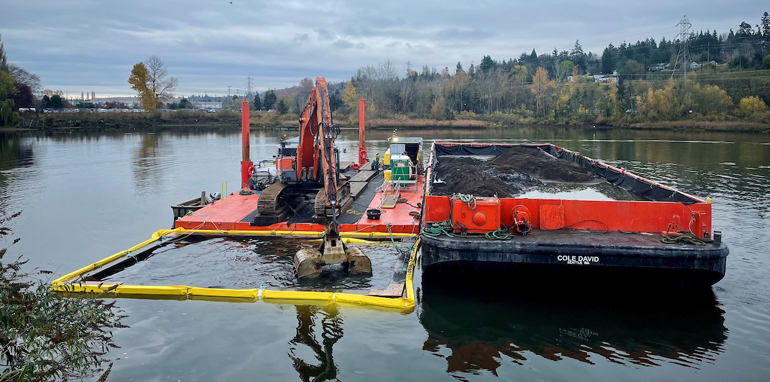
The results didn’t come overnight. In 2014, the U.S. Environmental Protection Agency approved a cleanup plan. Under the plan, some of the riverbed would be dredged, some covered with clean sand and gravel, and in places with less pollution, the river would be helped to clean itself. The work proceeded section by section, with the first “urgent” areas cleaned up ahead of the rest. Small parks and restored riverbanks were created alongside the cleanup. One of them, Herring’s House Park, is named in memory of a Duwamish longhouse that once stood nearby.
A New Mystery: Tires and Salmon
It might seem that everything is simple once the cleanup is done. But recently, scientists found a new problem. When rain washes dust from worn tires off the roads, a substance called 6PPD-quinone enters the water. It was identified in 2020 and is extremely toxic to coho salmon, a species that lives in Seattle’s streams. The fish surface and die, even though they look perfectly healthy.
It turns out the problem isn’t only the factories of the past. Today, the river is also harmed by ordinary cars and the roads built around it. In addition, sea levels are gradually rising, and the low-lying areas around the Duwamish are especially vulnerable. That’s why the city is building “green” storm drains: planted beds and ditches that hold water and filter it before it reaches the river.
What I Think
There’s one thing I like about this story: it shows that the river’s cleanup truly began after people spoke up and were heard. Engineers straightened the river in just a few years, but undoing the damage takes decades, millions of dollars, and the patience of many people.
When you walk past a stream or a river, look at how it curves. Those turns aren’t “extra.” Fish live in them, birds rest there, and clean water collects there. The Duwamish teaches us that it’s easier to damage a river than to heal it—and that we all need to look after it together.