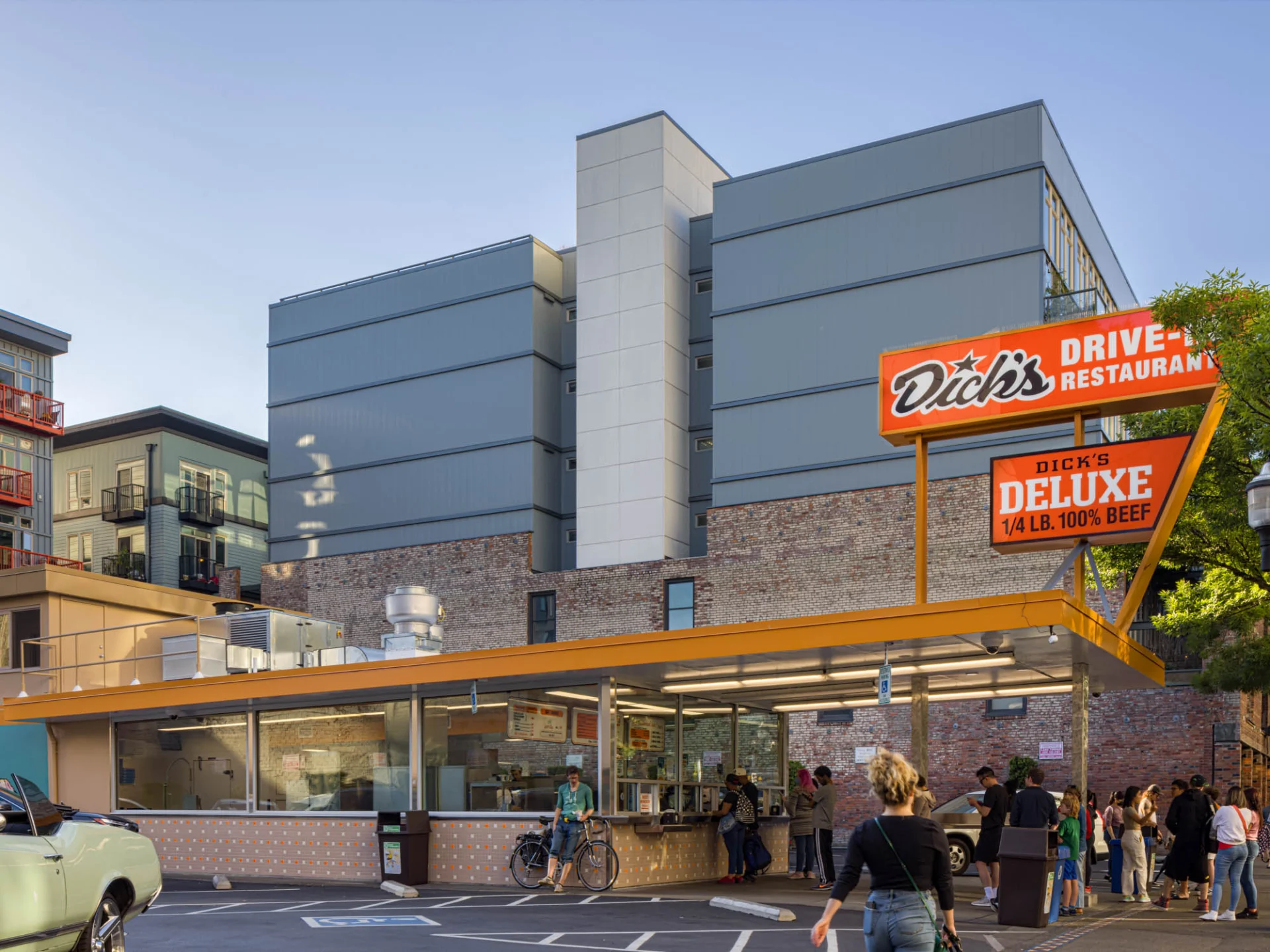
In Seattle there’s a fast-food restaurant where a hamburger costs less than at most other places, yet workers earn wages twice as high as in ordinary joints. Sounds like magic or a scam, right? But the secret of Dick's Drive-In is not magic or trickery — it’s smart engineering solutions and a belief that people work better when they’re respected. This story began in 1954 and continues today, proving that kindness can be very practical.
When Dick Spady opened his first little restaurant, he was an engineer by training. He approached burgers the same way other engineers approach bridges or airplanes: he measured everything, calculated and designed. But the most surprising thing — he decided that the main part of his “machine” was not the equipment, but the people. And if you make it good for people to work, the whole system will run perfectly.
The kitchen as a timepiece
Imagine you’re packing a backpack for school. If textbooks are in the right order, pencils in a separate pocket, and the sandwich packed so it won’t get squashed, you can get ready in two minutes. But if everything is in a heap, you’ll be looking for what you need for half an hour. Dick’s designed its kitchens on the same principle — only a thousand times more precisely.
In a typical fast-food restaurant the cook makes a lot of unnecessary movements: turning here and there, reaching for ingredients, waiting for something to finish cooking. Dick’s engineers measured every motion and redesigned the kitchen so that everything needed was within reach. The person who makes burgers stands in the center of a small “cocoon,” where buns, patties, sauces and vegetables are arranged at arm’s length. They don’t take a single extra step.
Moreover, the menu at Dick’s is very short — just a few kinds of burgers, fries, milkshakes and drinks. Not because they can’t make more. It’s a deliberate choice. When you do the same thing very well, you become fast and don’t waste ingredients. Dick’s cooks can make a burger in 30 seconds — not because they rush, but because every movement is honed like a dance.
This kind of work organization is called “efficiency.” It means: do more while spending less time, energy and money. But here’s the interesting part: most restaurants use efficiency to earn more for the owners. Dick’s uses it to pay workers more and keep prices low for customers.
Why happy workers are profitable
Now for the most unusual part. In most American fast-food restaurants workers receive minimum wage (the lowest amount the law allows). Often they don’t have health insurance, paid time off, or other benefits. Many work there only a few months and leave because conditions are hard and pay is low.
At Dick’s it’s the opposite. They pay well above minimum wage. Workers get health insurance, paid vacation, and — attention! — the company helps pay for college. If you’ve worked at Dick’s for six months and are studying, they give you money for tuition. Thousands of dollars. Every year.
Why do they do this? Wouldn’t it be more profitable to pay less and keep the money? Apparently not. Here’s why:
When people like their job, they stay longer. When they stay longer, they become experienced. Experienced workers cook faster, make fewer mistakes, waste less food. They know how to solve problems and help train newcomers. That means owners don’t have to constantly recruit and train new people — which is costly and time-consuming.
There’s another effect: happy workers are pleasant to customers. They smile not because it’s required, but because they genuinely feel good. And customers return not only for tasty burgers but for the atmosphere.
Dick’s turned kindness into arithmetic. They calculated: it’s better to pay one person well and keep them for five years than to pay five people poorly and replace them every six months.
Prices that don’t rise
Now imagine: you go to the store for your favorite ice cream. Last year it cost 50 rubles. This year — 65. Next year — probably 80. Prices keep rising; that’s called inflation. Usually wages also rise, but more slowly, so people feel everything is getting more expensive.
At Dick’s prices change very rarely and very slowly. There have been periods when the price of their signature “Deluxe” burger didn’t change for 10–15 years! How is that possible if groceries get more expensive, rents rise, and wages increase?
Again, engineering and smart planning. First, an efficient kitchen means less food wasted. If a typical restaurant throws away 10% of food (burned, spoiled, or made by mistake), at Dick’s that figure is much lower. Second, experienced workers prepare items precisely and quickly — so you can serve more customers in the same amount of time. Third, a short menu means you can buy ingredients in large batches at better prices.
But there’s also a philosophical reason. The owners of Dick’s (now the founder’s family and some long-time employees) decided they didn’t need to become billionaires. They were content to earn well, but not greedily. They could have raised prices and pocketed the difference — but they didn’t. They believe the restaurant should serve the city: feed people affordably and provide good jobs.
What it means for ordinary people
The story of Dick’s is not just about burgers. It’s proof that business can work differently.
For Seattle teens, a job at Dick’s is often the first experience that shows: labor can be respected and fairly paid. Many students were able to finish college thanks to the company’s help. Some of them became doctors, teachers, engineers — and they remember that once a restaurant believed in them.
For families, Dick’s is a place where you can feed children without spending half your paycheck. In a city where life is getting more expensive, that matters. Parents bring their children because they themselves came here as kids. It has become part of Seattle’s story.
And for other business owners it’s a challenge. Dick’s shows: you don’t have to exploit people to succeed. You can pay fairly, sell honestly, and still be successful. You just need to think not only about today’s profit but about long-term relationships with people.
A lesson from the engineer who loved people
Dick Spady died in 2013, but his ideas live on. His restaurant proved what many adults forget: kindness and smart choices work together. You can’t be kind but foolish — the business will collapse. You can’t be smart but greedy — people will turn away. But when you use your intelligence to create a system where everyone is well, something special happens.
Dick’s engineering approach teaches an important thing: any problem can be solved if you think it through. How to make people work quickly but not get exhausted? Eliminate unnecessary movements. How to pay more but not go bankrupt? Reduce waste. How to keep prices low? Don’t be stingy with profit.
Today there’s much debate about how much workers should earn, whether big corporations are fair, and whether business can be run honestly. Dick’s Drive-In doesn’t argue — it simply shows it’s possible. For almost 70 years.
And every time someone in Seattle bites into a reasonably priced burger made by a person who’s paid fairly, this small system keeps working. Quietly, efficiently, kindly. Just as the engineer intended — the one who believed machines should serve people, not the other way around.