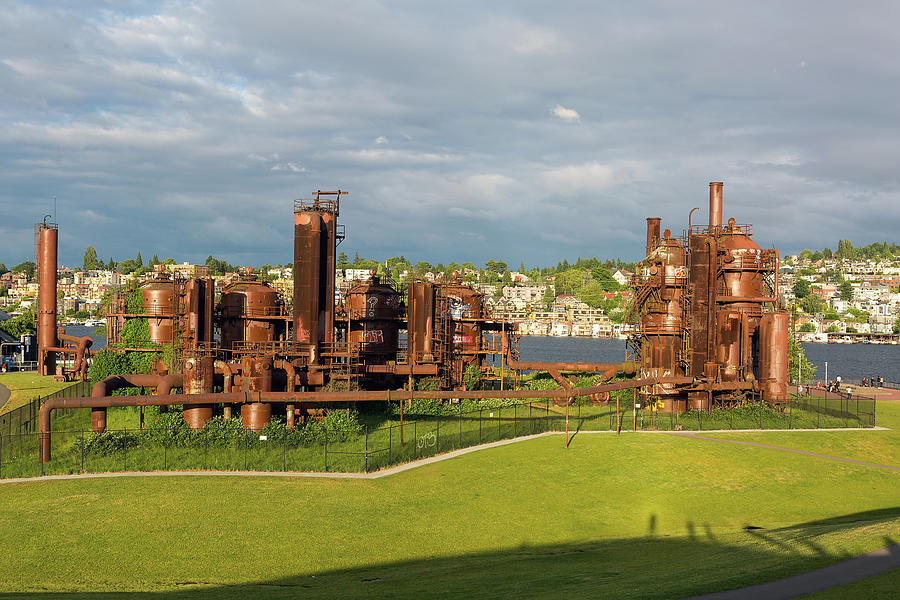
Imagine the grown-ups in your town decided to build a playground on the site of an old dump where dangerous chemicals had been buried. Everyone would shout, "You're crazy!" That's exactly what happened in Seattle in the 1970s, when a group of ordinary residents decided that a dirty, poisonous gas plant on the lakeshore should become... a park. Not just a park, but a park where rusty pipes and huge towers would remain standing as monuments! That seemingly mad idea became Gasworks Park — one of the city's most unusual and beloved places, and it changed how people around the world think about parks.
The plant that poisoned the lake
From 1906 to 1956 a gas plant operated on the north shore of Lake Union. It was a huge, noisy, filthy place where coal was processed into gas for lighting homes and cooking. Black smoke rose from tall chimneys, and dangerous substances with terrible names — benzene, toluene, cyanides, arsenic — leached into the soil and water. When the plant closed, the ground was so poisoned that nothing would grow there.
The city bought the land in 1962, and everyone assumed they would do what always had been done: bulldoze the buildings, haul away the contaminated soil, bring in clean fill, and plant ordinary trees and grass. Boring and predictable, right? But in the late 1960s, like in many American cities, Seattle began to think differently. People were tired of tearing down old buildings and replacing them with identical glass boxes. They wanted the city to remember its history — even if that history was dirty and ugly.
The architect with a wild dream and the people who believed him
In 1970 the city hired a landscape architect named Richard Haag to design a standard park on the factory site. But Haag was not ordinary. When he first came to the site and saw the huge rusting towers, miles of piping, and giant boilers, he didn’t think, “What a horror, all this must be demolished!” He thought, “How beautiful! These are like sculptures!”
Haag proposed the incredible: leave the industrial structures as part of the park, turn them into play structures and viewing platforms. But most importantly — he wasn’t alone. The neighborhood around the future park was home to artists, students, and young families who also saw not garbage but opportunity in the old factory. They formed a community group and began attending city meetings, writing letters, and holding neighborhood gatherings.
City officials and many residents thought these people had lost their minds. “You want children to play on poisoned ground among rusty metal? They’ll cut themselves! They’ll be poisoned! It’s dangerous and ugly!” opponents shouted. Safety experts shook their heads. Even some conservationists argued that everything should be torn down and a proper forest planted.
The fight for the right to be different
The next few years became a real battle. Supporters of the unconventional park — many of them women and homemakers who were often ignored at city meetings — organized ever more effectively. They brought their children to meetings. They invited journalists. They explained their idea again and again: the park could be honest; it could show the true history of the city instead of hiding it. Industry is part of who we are. Why should we be ashamed of that?
They reached a compromise on safety. The most contaminated soil was indeed removed and replaced with clean fill — but only in the areas where people would walk and sit on the grass. Contaminated soil remained under asphalt paths and beneath some structures, but it was isolated so toxins would not leach into the lake. Sharp metal edges were smoothed, hazardous chemicals were washed away, but the towers, pipes, and the huge boiler were left standing. The tallest structure — the gas purification tower — was turned into a viewing platform with views across the lake and the downtown skyline.
Activists also insisted on a large hill in the park — the highest point in that part of the city. The fill for the hill came from another city project building a freeway. It was perfect: the soil wasn’t wasted, and people got a spot to watch Fourth of July fireworks — a tradition that began there.
The park that changed the world
Gasworks Park opened in 1975, and... people loved it! It turned out children adored climbing on real industrial structures — far more exciting than ordinary swings. Artists came to paint the rusting towers against the sunset. Families picnicked on grass from which they could see both history (the old plant) and modernity (the downtown skyscrapers).
But the most important thing came afterward. Architects and urban planners from around the world began visiting Seattle to see this unusual park. Haag’s and the activists’ idea proved revolutionary: there is no need to erase traces of industrial past; they can be transformed into art and memory. After Gasworks Park, similar projects began appearing on former factories, mills, and railway sites in Germany, France, China, Russia — everywhere “post-industrial parks” emerged where old pipes sit alongside flowers and rusty cranes become sculptures.
Of course, not everything was perfect. Debates over safety continued for years. In the 1980s it became clear the soil still contained hazardous substances, and additional cleanup was carried out. In 2009 the park was closed for a year for another major remediation. But the park survived because people loved and defended it.
A lesson for every city
The story of Gasworks Park teaches several important lessons. First, ordinary people — moms, dads, students, artists — can change their city if they organize and don’t give up. City officials and experts aren’t always right; sometimes ordinary residents have better ideas.
Second, beauty comes in many forms. Not everything needs to be new, spotless, and uniform. Old, “ugly” things can tell important stories and become beautiful in their own way. The rusting towers of Gasworks Park at sunset really do look like giant sculptures.
Third, past mistakes should not be hidden — they should be learned from. The gas plant poisoned soil and water, and that’s true. But instead of erasing it from memory, the city turned it into a lesson: this is what happens when we ignore nature. And this is how we can fix it, without forgetting what happened.
Today Gasworks Park is one of the most photographed places in Seattle. Every July 4th tens of thousands come to watch the fireworks there. Children play where pipes once smoked. Lovers meet under rusting towers. And cities around the world continue to learn from that group of stubborn activists who, 50 years ago, refused to accept the “normal” solution and insisted on their “crazy” idea. Sometimes the best changes begin with people everyone thinks are a little mad.