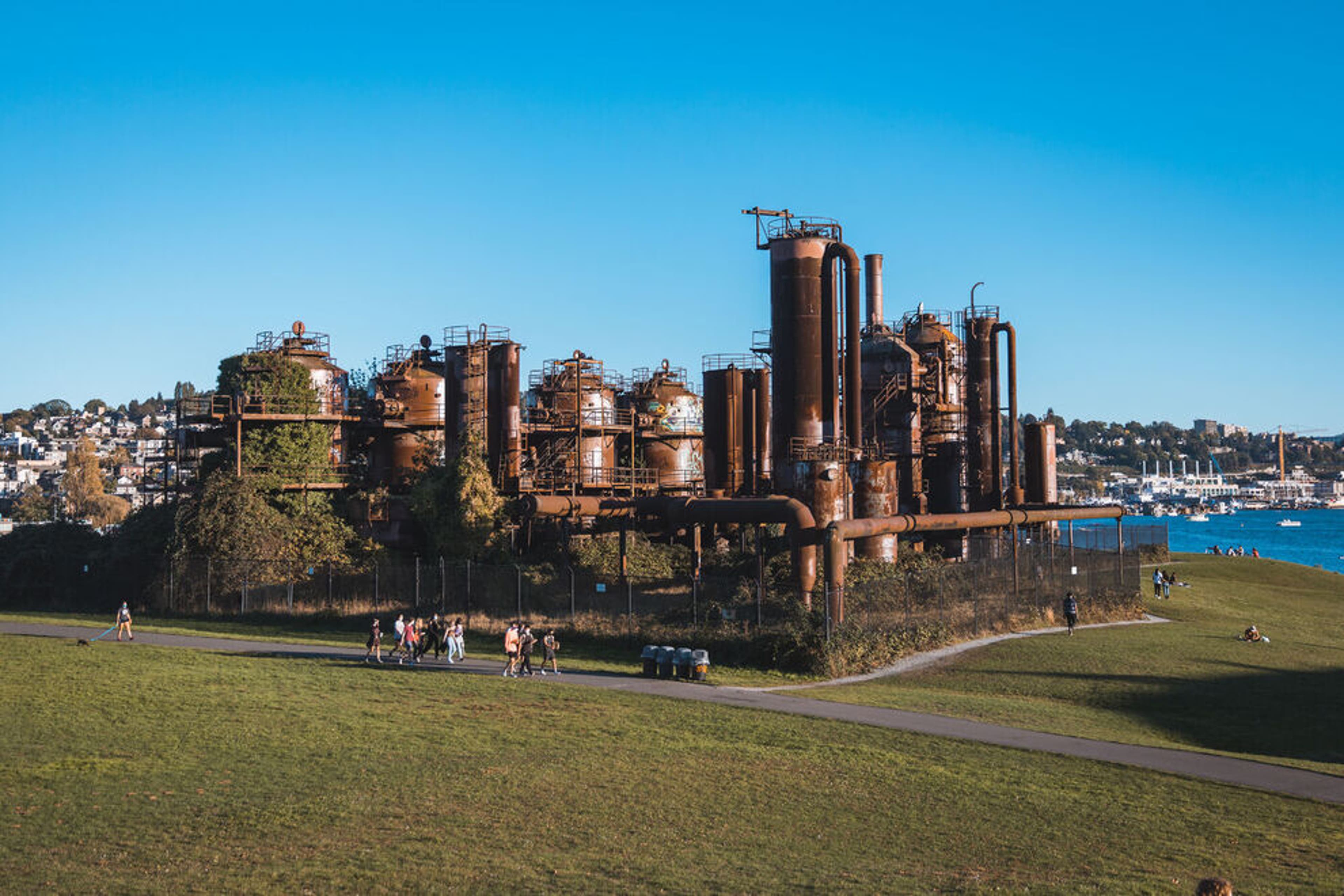
Imagine your town has an old factory with huge rusty pipes that once belched poisonous smoke. What would the adults do? Right — they'd tear everything down to the last bolt and plant neat rows of flowers. But in Seattle one stubborn landscape architect named Richard Haag said, "Let's leave these scary towers right in the middle of the park!" Everyone thought he was crazy. Now Gas Works Park is one of the city's most beloved spots for children, and hundreds of parks across America copy that "crazy" idea.
The factory that made light from coal and poisoned the ground
From 1906 to 1956 the Seattle Gas Light Company plant operated on the shore of Lake Union. Huge machines turned coal into gas that lit lamps in homes across Seattle. It seemed like magic, but very dirty magic. Black smoke poured from tall stacks, and terrible chemicals with names even adults struggle to pronounce seeped into the soil: benzene, toluene, cyanides.
When the plant closed, the ground was so contaminated that nothing would grow. Engineers said the soil needed to be removed to a depth of 10 meters — like digging a hole as tall as a three-story building! — and replaced with clean fill. And all those rusty towers, pipes, and massive boilers? Of course, send them to the scrap heap. That's how it had always been done.
The architect who saw sculptures instead of trash
But Richard Haag, the landscape architect hired in 1970, looked at those rusty structures and thought something entirely different. He didn't see trash; he saw giant sculptures that tell a story. "These towers are part of how Seattle grew," he said. "Why should we pretend they never existed?"
Imagine the reaction from city officials! Leave a poisonous plant in a children's park? Haag patiently explained: we'll remediate the soil and make everything safe, but preserve the structures as memory and as art. He showed how children could climb a hill with a view of the lake, how the rusted towers would look beautiful at sunset, how old boilers could become picnic shelters.
His plan was revolutionary. Instead of stripping away the contaminated soil, he proposed capping it with a layer of clean topsoil and planting special vegetation that would gradually extract the toxins. It was cheaper and smarter. Most importantly — it preserved history.
A park that at first scared kids
When Gas Works Park opened in 1975, many parents were afraid to bring their children. The rusting towers as tall as a ten-story building did look frightening. Some said it resembled a set from a horror movie. Children initially approached the huge machines cautiously, as if they might come to life.
But magic happened quickly. Kids discovered that some of the pipes could be climbed. That inside the big boilers there was a surprising echo. That from the mound, built with clean soil, you get the best view of the lake and the city. That you could play hide-and-seek among giant metal structures found in no other park in the world.
Parents noticed something important: their children were asking questions. "Mom, what are those towers?" "Dad, why are these pipes here?" The park became an outdoor history textbook. Kids learned how old factories worked, where the gas for lighting came from, how the city changed.
An idea that changed hundreds of parks
At first other cities laughed at Seattle. "They made a park out of a junkyard!" But a few years passed, and architects from across America began coming to see Gas Works. They saw how happily children ran among the rusted towers. How artists came to paint the unusual silhouettes at sunset. How hundreds gathered on the big hill to watch Fourth of July fireworks.
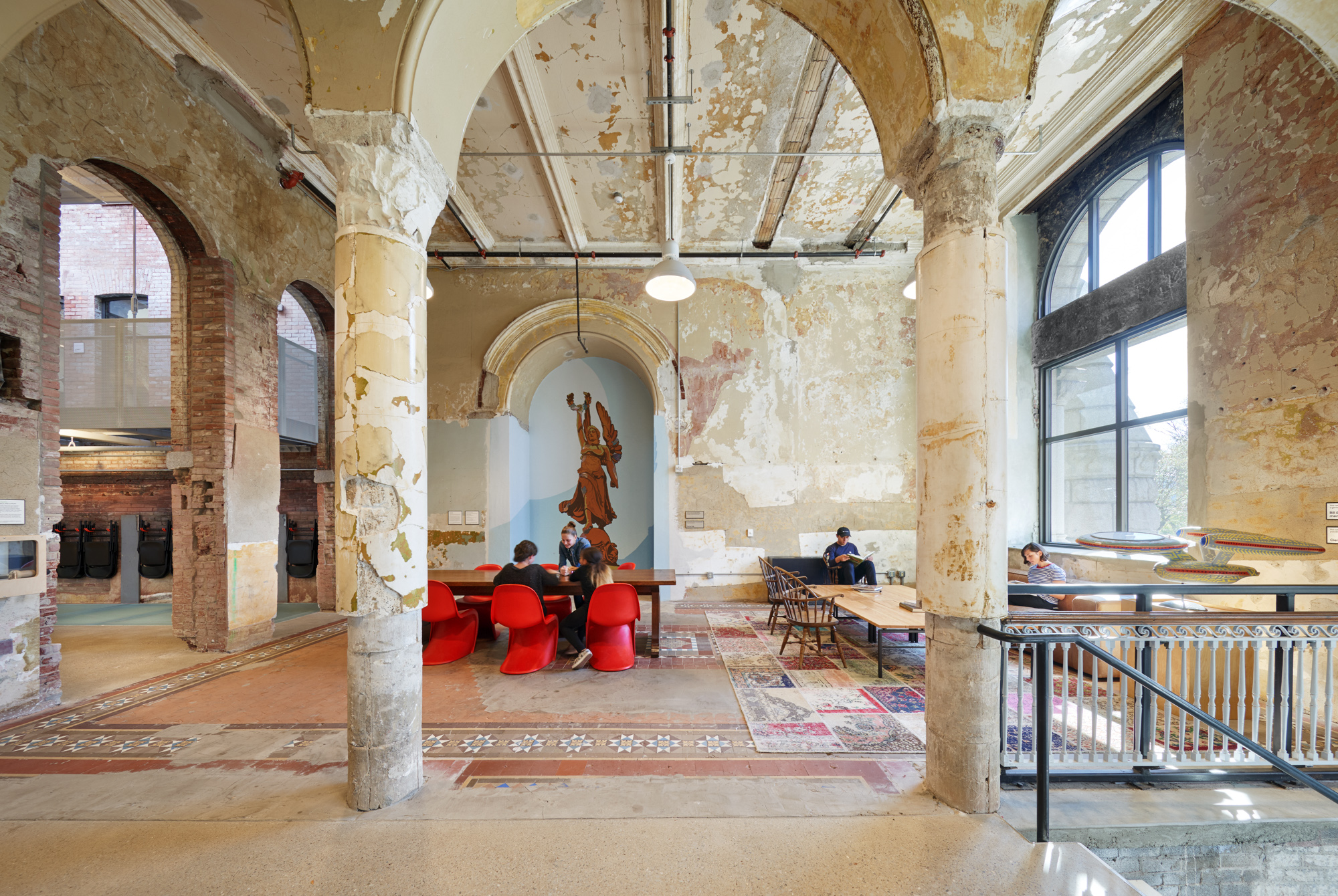
Gas Works Park proved an important point: it's not necessary to erase all the "ugly" parts of a city's history. Old factories, warehouses, and plants can be turned into parks, museums, and playgrounds. It's more honest — the city shows what it once was, even if that past wasn't always pretty.
Now architects across America and beyond use the "Gas Works method." In New York an old elevated railway became the High Line park, preserving the tracks. In Germany coal mines became museums. In London a power station was turned into the Tate Modern gallery. They all learned from the stubborn architect who refused to hide rusty towers.
What the park tells us today
Today Gas Works Park is one of the most photographed parks in Seattle. Each year thousands of children visit, scramble up the hill, explore the old machinery, and picnic in the shade of the rusted towers. The soil has long since been cleaned — the special plants Haag planted really did draw out the toxins. Now ordinary grasses and flowers grow there.
But most important — the park teaches not to fear the past. Yes, that plant polluted air and soil. Yes, we don't do that now. But those towers are a reminder of how the city learned, made mistakes, and became better. It's more honest than pretending the mistakes never happened.
Richard Haag, who would now be over 100, said: "Children are not afraid of rust and unusual forms. They see adventure where adults see a problem." He was right. Gas Works Park showed the world: sometimes the strangest ideas become the most beloved places. And a city's history — even its dirty, rusted parts — deserves to be remembered and turned into something beautiful.