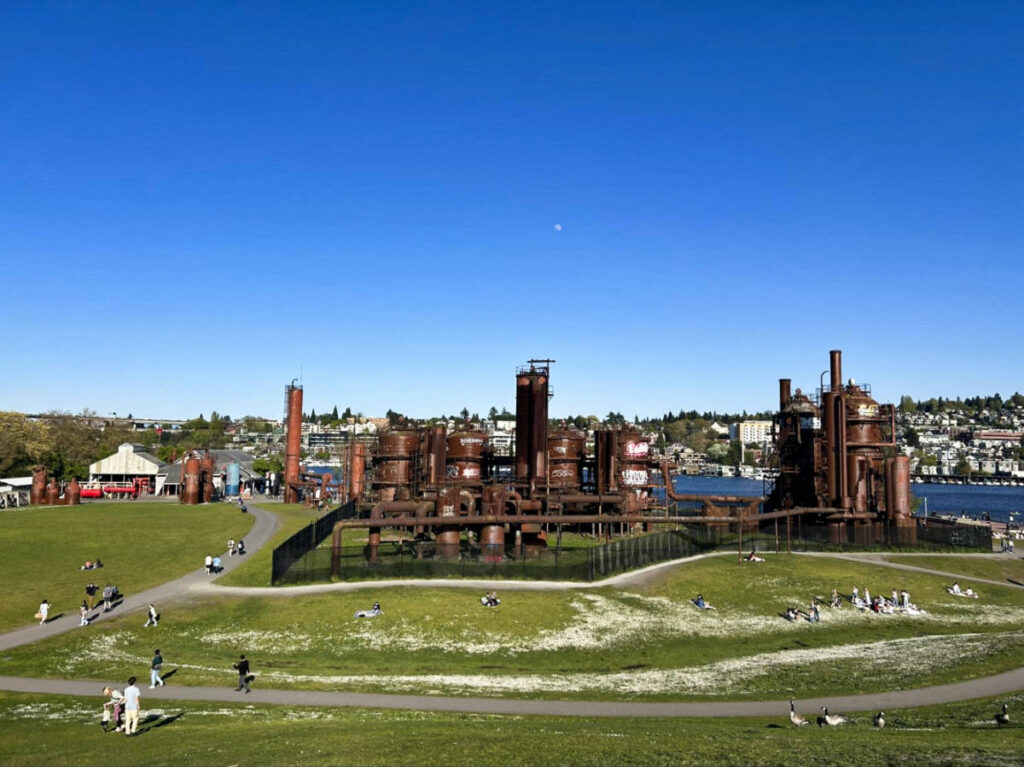
Imagine a big factory in your city closed down. The land around it is poisoned, huge rusty pipes jut into the sky, everything looks scary and filthy. What will adults do? Of course, they’ll tear it all down and build something new and clean! But in Seattle one architect said, "Wait! What if we leave those rusty towers and turn them into... a work of art?" Everyone thought he was crazy. Today that park with rusty pipes is one of the city's most beloved places, and his idea changed how cities around the world treat old plants and factories.
The factory that provided light for a whole city (and then became a problem)
In 1906 a huge plant was built on the shore of Lake Union in Seattle. It was called the Seattle Gas Light Company, and its work was very important: it turned coal into gas that lit all the street lamps in the city! Imagine: without that plant, Seattle would be plunged into darkness every evening.
The plant operated for almost 50 years. Every day huge furnaces heated coal to very high temperatures, gas came off it, and everything else — tars, chemicals, heavy metals — just remained in the ground. No one thought about the environment back then. By 1956, when electricity appeared in homes and gas was no longer needed, the plant was closed.
What was left? A huge site the size of eight football fields, covered in poisonous substances. There were so many toxic chemicals in the soil that nothing would grow there. Rusty towers as tall as a 10-story building jutted into the sky like the skeletons of giant monsters. Pipes, boilers, tanks — it all looked like the set for a horror movie. The city bought the land and wanted to turn it into an ordinary green park with grass and trees. To do that they would have to demolish all those frightening structures.
The architect who saw beauty in rust
In 1970 the city hired landscape architect Richard Haag to design the new park. Everyone expected him to say, "Tear down all that metal, bring in clean soil, plant flowers." But Haag was an unusual person. He came to the old plant site, walked among the rusty towers, touched the huge pipes and suddenly thought, "This is beautiful!"
He saw what others did not. These structures told a story. They showed how people worked, how the city got its energy, how technology changed. To Haag these rusty towers were like giant sculptures — artworks created by time and industry.
Haag proposed a crazy idea: let’s NOT demolish these structures. Let’s clean the soil of poison, but leave the towers, pipes and boilers. Let children climb on them, let people look at them and remember the history. Let it be a park unlike any other!
Can you imagine what happened? Many Seattle residents were horrified. "You want our children to play among rusty iron?!" "It's dangerous!" "It's ugly!" The arguments went on for years. But Haag didn’t give up. He explained that the industrial past is also part of the city’s history and shouldn’t be hidden. He said rust and metal can be as beautiful as flowers and trees.
How to clean the poison without removing the "toys"
The hardest task was cleaning the soil of toxic substances while preserving the structures. It was like having to wash a very dirty room but not being allowed to remove the furniture and toys — you’d have to clean around them!
Engineers devised a clever plan. They couldn’t remove ALL the contaminated soil — there was too much and removing it would destroy the structures. So they did this:
- They did remove the most contaminated soil and took it to a specially safe location.
- They left the less polluted soil, but covered it with a thick layer (more than a meter!) of clean soil.
- From that clean soil they made a large hill — the park’s highest point.
The result was that the poison remained deep underground, like in a sealed box, and on top was safe soil where people could play. This is called "contamination isolation." Imagine you have spoiled jam in a jar — you don’t throw away the whole jar, you just tightly close the lid and put it somewhere where no one will accidentally open it.
The park opened in 1975. People came and... gasped. It really was like nothing else! Huge rusty towers stood like sculptures. Children climbed on the metal structures (the safe parts, of course). From the hill made of cleaned soil there was a stunning view of the lake and the city. Grass and trees grew right next to the rusty metal — nature and industry together.
How one park changed the thinking of the whole world
At first Gasworks Park was just a strange place in Seattle. But gradually something surprising began to happen. Architects and city planners from other cities and countries started coming to see the park. They photographed the rusty towers, walked the hills, talked to people. Then they returned home with new ideas.
"What if we also don’t tear down an old factory, but turn it into something interesting?" they began to think. Similar projects started appearing around the world!
In London the old Bankside power station wasn’t demolished but was converted into the Tate Modern museum of contemporary art — now one of the most visited museums in the world. In Germany a huge coal plant in the Ruhr region became an amusement and cultural park. In New York an old elevated railway was transformed into the High Line, where people stroll among skyscrapers on a third-floor level.
All these projects happened because someone in Seattle was the first to say: "Old industrial buildings are not trash, they are history, and they can be beautiful."
Today there is an entire architectural approach called "adaptive reuse." It means: don’t destroy the old, find new uses for it. Old factories become museums, mills become housing, water towers become restaurants. And it all started with a park that kept its rusty pipes.
Why it’s important to see beauty in unexpected places
Gasworks Park teaches us an important lesson: sometimes what looks broken or ugly can actually be valuable and interesting. You just need to look at it differently.
Richard Haag wasn’t afraid to propose a strange idea, even when everyone else was saying "no." He believed the history of industry deserved respect just like the history of kings and castles. The workers who labored in that plant, the engineers who designed the machines — they were all part of the city’s story, and their labor shouldn’t simply disappear.
Today thousands of people visit Gasworks Park every week. Children fly kites from the big hill (the very one made of cleaned soil!). Artists paint the rusty towers at sunset. Families picnic on the grass among metal structures. And every time someone looks at those towers, they think about how the city changed, how technology evolved, how what was needed yesterday can become art today.
Maybe next time you see something old, rusty, or broken, you’ll think too: "What if this isn’t trash? What if it has its own story and its own beauty?" That’s how the best ideas are born — when we look at ordinary things with an unusual gaze.