Imagine: one morning in 1700, a wall of water sweeps into a small Japanese port, flooding homes and warehouses. But the ground hasn’t shaken, and no one knows where the wave came from. Officials simply record it in a chronicle. Nearly 300 years later, that old record helps explain why modern buildings in Seattle are designed to bend.
The mystery: a wave without an earthquake
Japanese chronicles contain several accounts of a wave that arrived in January 1700. Scientists call waves like these “orphans”: they have no “parents”—that is, no earthquake that caused them.
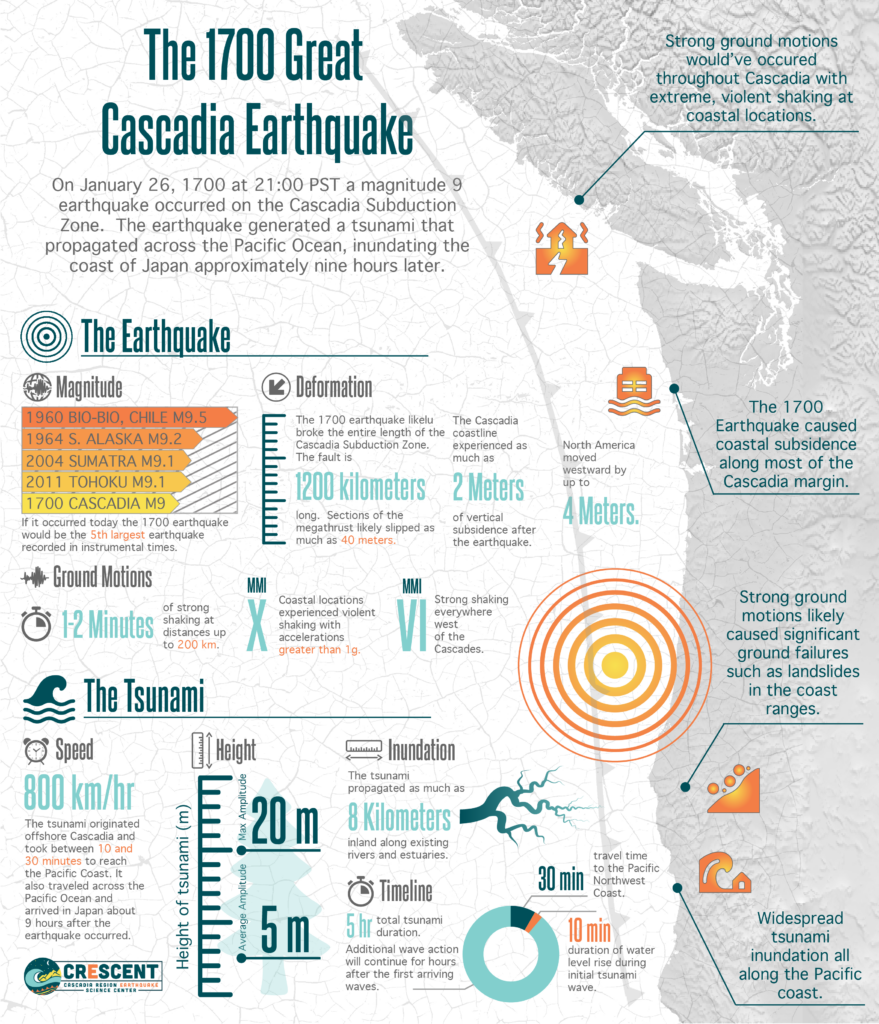
Japanese scientist Kenji Satake and his colleagues set out to find these “parents.” They calculated how long the wave would take to cross the ocean and realized it had come from roughly the other side of the Pacific. The distance was about 8,000 kilometers, and the journey took around 10 hours. Only one place fit: the coast of North America, where a tectonic plate slowly slips beneath the ocean floor. This area is called the Cascadia Subduction Zone.
In 1996, scientists published their conclusion: a massive earthquake had struck Cascadia on the evening of January 26, 1700. It would have had a magnitude of about 9—one of the strongest earthquakes possible.
Other clues: ghost forests and ancestral stories
The Japanese records weren’t the only clue. Back in the 1980s, scientist Brian Atwater was digging along the banks of rivers in Washington State. He found layers of old marsh soil buried under marine sand. This meant that the land had suddenly sunk at some point, and the ocean had rushed in.
There was other evidence, too:
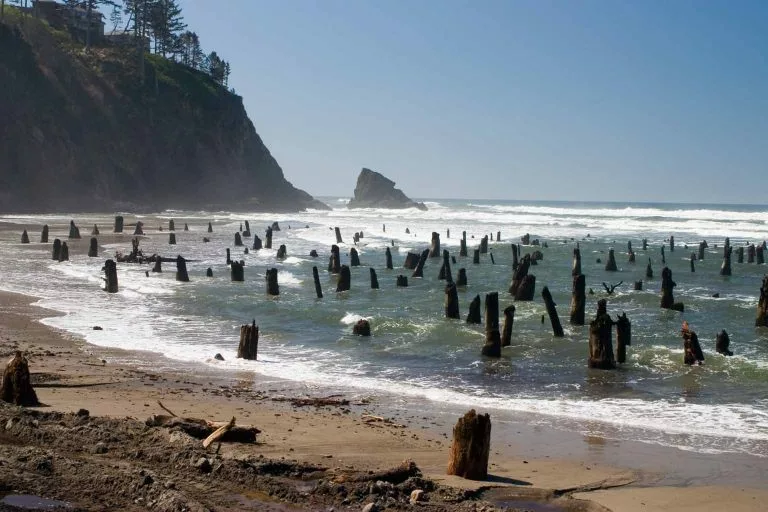
- Ghost forests. Dead, gray cedar trunks stand along the coast. The trees died when the land sank and salt water reached their roots. By studying the trees’ rings, scientists determined that they died in 1699–1700, matching the Japanese records.
- Stories of Indigenous peoples. For centuries, the peoples of the West Coast passed down stories of a night when the ground shook and the sea flooded villages. Scientists once dismissed these accounts as mere legends. Now it’s clear they preserved facts that were obvious to the people who experienced them. They are genuine eyewitness accounts, passed down from grandparents to grandchildren.
So three sources came together: documents from another country, tree rings, and oral histories. For a scientist, that’s an exceptionally rare stroke of luck.
Why Seattle needs special rules
Strong earthquakes also struck Seattle later on. In 1949, the shaking was so intense that brick chimneys and decorations fell from houses. The 1965 earthquake was similar. People died in both events, and the city learned a lesson.
But no one yet knew about Cascadia. When it became clear in the 1990s that an even stronger earthquake was possible, engineers began to think differently. Here’s a simple way to explain it.
A tree branch and a dry stick. If you bend a living branch, it gives and then springs back. A dry stick snaps right away. A building designed to withstand earthquakes should be like a living branch. It’s made from materials that can bend without collapsing. Walls are securely connected to floors, and steel frames let the building sway.
Jelly on a plate. Part of Seattle sits on soft ground that was once a bay floor or a riverbank. If you shake a plate, the jelly on it wobbles more than the plate itself. Soft soil amplifies shaking in the same way. That’s why building rules are stricter in these areas: foundations need to be deeper and buildings stronger.
After Cascadia was discovered, building codes began to account not only for earthquakes that had already happened, but also for the strongest one possible. Seattle’s building rules have been strengthened several times since then.
The test of strength
On February 28, 2001, the magnitude 6.8 Nisqually earthquake struck near Seattle. It was deep and not as destructive as it could have been. Newer buildings, built to modern codes, generally held up well. Older brick buildings suffered damage, especially in Pioneer Square: bricks and cornices fell from them.
This showed two things. The new rules work. But older, unreinforced brick buildings remain a weak point: there are about a thousand of them in Seattle, and they’re being strengthened gradually. That work is not yet finished.
What’s most amazing about this story
To me, the most astonishing thing is how closely connected people who never met can be. An 18th-century Japanese official recorded a strange wave simply because that was his duty. Grandparents on the coast told their grandchildren about a terrifying night. Then scientists pieced it all together, and an idea emerged that changed how an entire city builds.
So if you see a tall building in Seattle swaying a little in the wind, know that it’s nothing to worry about. It’s designed that way. It bends like a living branch, and its strength owes something to old Japanese records and to the stories of people who lived through that night in January 1700.