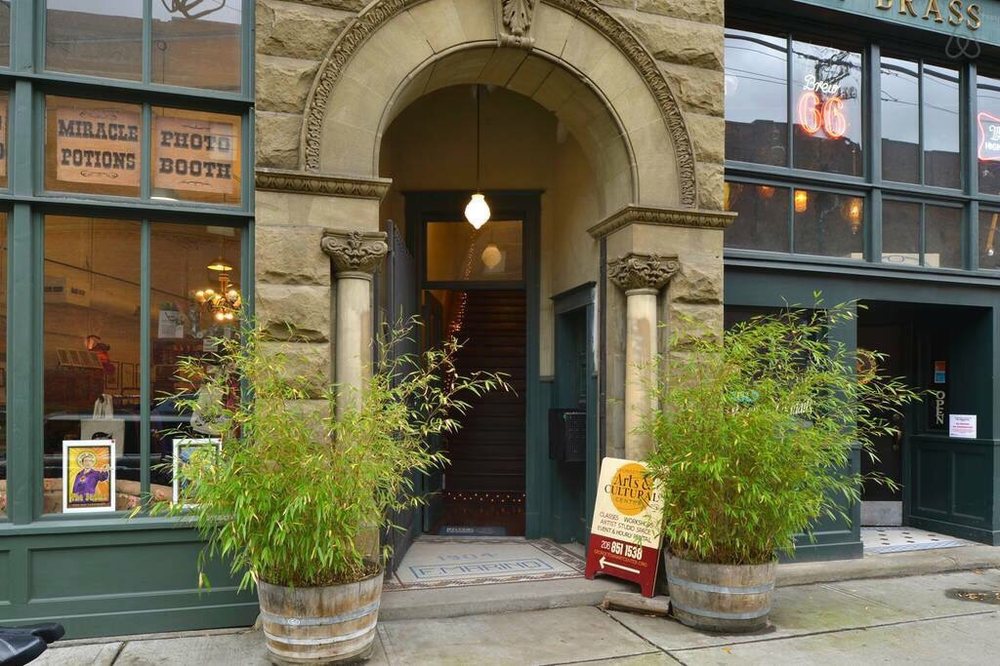
In 2004 something strange happened in Georgetown, a neighborhood of Seattle. Thousands of people wandered the dark streets between old factories, peering through huge rusty doors and climbing creaky staircases. They were looking for art where planes and beer had once been made. That one night changed an entire neighborhood and showed how vacant buildings can be turned into treasures.
This is the story of how a group of artists, who had run out of money to pay rent, came up with a bold plan. They didn’t know their idea would not only solve their problem but also breathe new life into a dying industrial area, creating an economic impact worth tens of millions of dollars.
When artists became too poor to afford their homes
In the early 2000s Seattle experienced a problem adults call "gentrification." That complicated word means something simple: when a neighborhood becomes fashionable, housing prices skyrocket, and the people who lived there can no longer afford the rent.
Seattle artists had always lived in the Capitol Hill area. There were small apartments that could be turned into studios, cafés where everyone knew each other, and a creative atmosphere. But from 1998 to 2003 rent in Capitol Hill tripled. An apartment that cost $400 a month suddenly cost $1,200. For artists selling paintings and sculptures, it was a disaster.
A young artist named Fiona McCull later recalled: "I remember sitting on the floor of my studio and crying. I got a notice that rent would go up another $300. I was selling paintings for $50–100. The math was brutal." Fiona and her friends began looking for a new place. They found it in the most unexpected spot — Georgetown.
Georgetown in those years was a sad place. Once it had been busy with Boeing factories, breweries, and metal shops. But by the 2000s most factories had closed or moved. Huge brick buildings stood empty. Windows were broken, doors boarded up. Building owners didn’t know what to do — who needs enormous spaces with concrete floors and ceilings as high as a three-story building?
But for artists those buildings were a dream. A huge space cost $200–300 a month — four times cheaper than a small Capitol Hill apartment. You could create large sculptures, hold exhibitions, invite friends. There was only one problem: no one came to Georgetown. The neighborhood was considered dangerous and boring.
A secret plan and one bold night
In the spring of 2004 a group of 15 artists who had already moved to Georgetown gathered in an old brewery building. They drank coffee from paper cups and discussed the problem. They had wonderful studios and were making interesting work, but no one saw it. Downtown galleries didn’t want to show artists "from the industrial zone." People were afraid to come to Georgetown at night.
"What if we throw one big night?" suggested sculptor John Fleming. "Open all our studios at once. Invite everyone we know. Show that something interesting is happening here."
They called it "Georgetown Art Attack." The plan was simple: on Saturday evening, April 10, 2004, twenty artists would open the doors of their studios from 6 to 10 p.m. Free. No invitations. Just come and look.
The artists made flyers on a home printer, put them up in Capitol Hill cafés, and emailed friends. They hoped 200 people would show up. Maybe 300 if they were lucky. They bought cheap wine and plastic cups, baked cookies.
When the first studio opened at 6 p.m., there was already a line outside. By 7 p.m. Georgetown’s streets were full of cars. People parked half a kilometer away and walked. They arrived in families — parents with children, grandparents with grandchildren. Students, teachers, doctors, construction workers came.
By the end of the night organizers counted more than 2,000 people. That was ten times what they expected. Fiona McCull later remembered: "I stood in my studio and there was a line of 50 people waiting to see my paintings. I couldn’t believe it. One woman bought a painting for $200 — that was my rent for a month. I cried right there in front of her."
How one night changed an entire neighborhood
After that night something changed in Georgetown. People who had come to the Art Attack told their friends. Journalists wrote articles. But most importantly — building owners realized something important.
Before, they thought empty factories were a problem. Who needs huge old buildings? Now they saw that artists are good tenants. They pay on time (even if a little), they improve buildings themselves, and they attract attention to the neighborhood.
The owner of a large building, Mr. Robert Chang, recalled: "Before 2004 my building sat empty for three years. I was losing money on taxes. After Art Attack five artists called me. I leased the whole building within six months. Then I realized I could do more — subdivide the big spaces into smaller studios, add heating. The artists helped me see the potential."
In 2005 a group of building owners and artists created the Georgetown Art & Cultural Center — an official organization. They began holding Art Attack every month, on the second Saturday. It became a tradition.
But the economic changes were even more interesting. Once artists began coming to Georgetown regularly, other businesses followed. A café opened because artists needed coffee. A framing shop opened. Then restaurants arrived — owners realized that every second Saturday thousands of people came to the neighborhood.
By 2008 Georgetown had more than 50 art studios and 12 galleries. Vacant buildings were nearly gone. Rents rose, but not as sharply as in other neighborhoods — owners understood artists couldn’t pay too much and tried to strike a balance.
When empty factories start making money
Economists like to tally money and impact. In 2010 the University of Washington conducted a study to understand the economic effect of Georgetown’s transformation. The results surprised even the researchers.
Here’s what they found. In 2003, before the first Art Attack, Georgetown brought the city about $2 million a year in business taxes. By 2010 that figure had grown to $15 million. Where did that money come from?
First, the artists themselves paid taxes. When you sell a painting you pay sales tax. When you have a studio you pay business taxes. Fifty studios equals fifty small businesses.
Second, restaurants and cafés. In 2003 Georgetown had 3 cafés. By 2010 there were 18. Each café pays taxes, hires employees (who also pay taxes), and buys supplies from vendors.
Third, tourism. People began coming to Georgetown on purpose. They bought gas, paid for parking, bought souvenirs. The study showed that each Art Attack visitor spent on average $45 per evening — on food, drinks, and buying art.
There were other, less obvious effects. Property values in Georgetown rose. A building worth $200,000 in 2003 (that no one wanted to buy) sold for $800,000 in 2010. That meant more property tax revenue for the city.
New jobs also appeared. In 2003 about 500 people worked in Georgetown (mostly at the remaining small factories). By 2010 there were more than 1,500 people working there: servers, baristas, gallery workers, teachers at art schools that opened in the neighborhood.
Here’s a simple table showing the transformation:
| Indicator | 2003 (before Art Attack) | 2010 (after transformation) |
|---|---|---|
| Art studios | 5 | 52 |
| Cafés and restaurants | 3 | 18 |
| Monthly visitors | ~500 | ~15,000 |
| Jobs | 500 | 1,500 |
| Tax revenue | $2M | $15M |
Why courage matters more than money
The story of Georgetown teaches an important lesson: sometimes the biggest changes start with small, brave ideas. The artists weren’t wealthy. They didn’t have big plans or investments. They had only their work and a desire for people to see it.
They didn’t know their one night would trigger a chain reaction that changed a whole neighborhood. They simply decided to try. And it worked because they solved a problem not only for themselves but for others — for building owners who didn’t know what to do with empty factories, for Seattle residents seeking new interesting places, for a city losing tax revenue from vacant buildings.
Today Georgetown is one of Seattle’s most interesting neighborhoods. Some factories still operate (now alongside galleries), the old brick buildings still stand (now with bright studio signs), and every second Saturday of the month thousands of people visit.
Fiona McCull, who cried on the floor of her studio in 2003, now owns a successful gallery in Georgetown. She says: "I still remember that first Art Attack night. We were so scared no one would come. Then everyone came. It taught me that people want to support good ideas. You just have to be brave enough to try."
This story shows that economic transformation isn’t always about big government plans or wealthy investors. Sometimes it’s just a group of people who open their doors and say, "Come in, see what we made." And sometimes that’s enough to change everything.