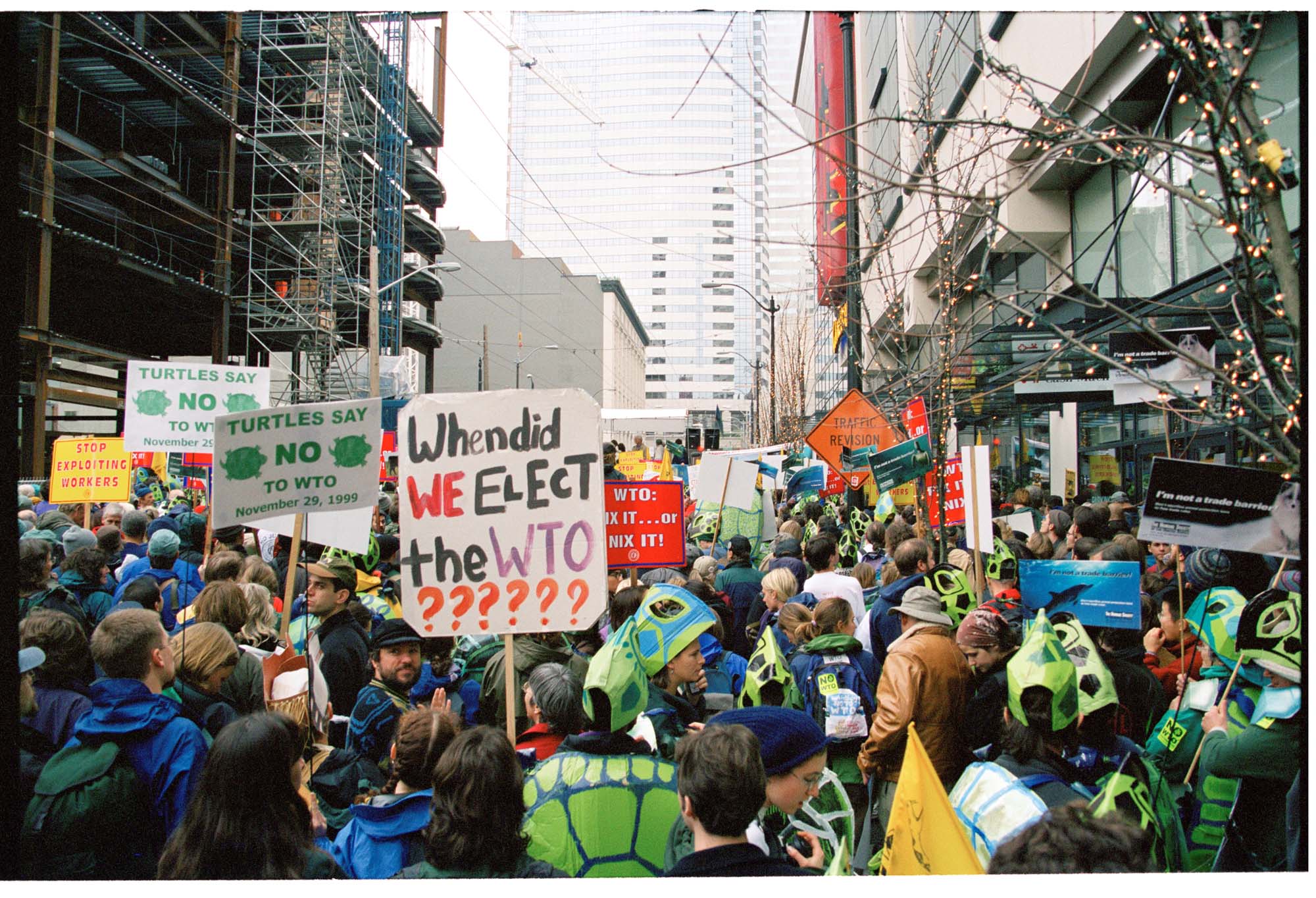
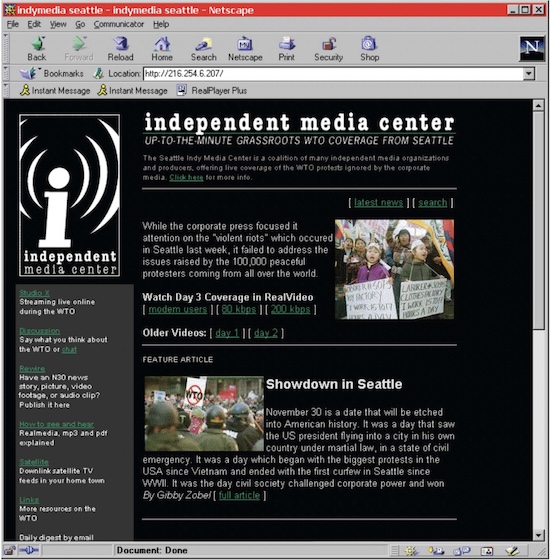
In late November 1999, representatives of more than a hundred countries gathered in Seattle. They had come for a conference of the World Trade Organization—the club of countries that negotiate the rules of trade. Tens of thousands of people took to the streets to make their views on those rules heard. Those days went down in history as the “Battle of Seattle.” But alongside the dramatic events, a quiet invention also took shape: people figured out how to report the news without waiting for someone else to do it.
What happened in Seattle
The World Trade Organization, or WTO, works to make sure countries trade with one another under clear rules. Imagine several school classes trading stickers: they need a shared agreement on who trades what, and on what terms. The WTO does something similar, except the things being traded are cars, clothes, food, and medicine.
Many people believed those rules paid too little attention to workers, the environment, and people in poorer countries. So on November 30, 1999, thousands of people came to Seattle: workers, students, environmentalists, and teachers. Some marched peacefully with signs. Others sat down at intersections and blocked roads to keep delegates from reaching the conference hall. The meeting did not start on time that day. The city declared a state of emergency, and police used tear gas. The negotiations ended without an agreement.
How people “talked” without a boss in charge
Here’s the most interesting part. The protesters did not have a single leader with a megaphone telling everyone where to go. Their organization was more like a swarm of bees or a flock of birds: small groups of about ten people made their own decisions while staying in touch with one another.
They used tools that were considered cutting-edge at the time:
- mobile phones, which in 1999 were far from commonplace;
- walkie-talkies, so groups could keep track of what was happening and where;
- email and websites, to invite people and explain what to do.
Researchers later called this way of acting “swarming.” It’s like a game in the schoolyard where everyone stays in touch, but there’s no one person in charge.
Imagine your class is playing cops and robbers, and each small team has a walkie-talkie. The teams decide for themselves where to run, but keep telling one another, “It’s clear here!” or “Don’t go this way!” That’s roughly how the protesters in Seattle operated, except the stakes were very real.
A newspaper where anyone could pin up a page
The most unusual creation of those days was called Indymedia. A few days before the protests, activists launched a website and opened an Independent Media Center downtown. It was an ordinary room with computers, where volunteers worked: photographers, sound engineers, camera operators, programmers, and simply people who wanted to share what they saw.
The main idea was called “open publishing.” Think of a school newspaper where any student could pin up a page, without a teacher having to check it first. That’s how the website worked: anyone could send in a story, photo, or recording, and it would appear for everyone to see. A special program written by activists in other countries made it possible.
The idea had a slogan coined by musician Jello Biafra: “Don't hate the media, become the media.” In the past, news was produced by a handful of big newsrooms. In Seattle, people showed in a striking way that anyone with a camera and internet access could report on events.
The idea caught on. In the years that followed, similar media centers appeared in cities and countries around the world.
What it has to do with our time
Reading about this now feels a little uncanny: so much of it seems familiar. Group chats where classmates arrange to meet are, in many ways, descendants of those walkie-talkies and phone “chains.” Livestreams, where someone films what’s happening on a phone and shows it to everyone, are descendants of the idea that you can “become the media.” And debates about trade between countries haven’t gone away; they still make the news.
But there’s another side, and it’s useful to know about it even now. If anyone can publish anything, then all sorts of things end up in the feed: truths, mistakes, and made-up stories. The people behind Indymedia realized this quickly: they had to debate how to tell verified information from questionable claims. We all face the same challenge every day.
A personal note: what I think matters most
Here’s what I like about this story. The people in Seattle didn’t wait for anyone to give them permission to report what they saw. They simply picked up new tools and did it themselves. But I think the other half of the lesson is just as important. It’s not enough to know how to report something; you also need to know how to check it: where the information came from, who wrote it, and whether they saw it with their own eyes. If you get a message that sounds like a huge deal, you can pause and ask yourself, “How do we know this?” That’s a habit you can learn, and it will come in very handy.
The takeaway
The “Battle of Seattle” is remembered as a dispute over trade, but it also holds a place in the history of technology as the moment when ordinary people with phones, walkie-talkies, and computers showed that news could come from more than just big newsrooms. That experiment began a conversation that continues to this day: how can we use our freedom to tell stories without losing the ability to distinguish truth from fiction? It matters to adults and to those just learning to write their first reports.