Imagine that right in the middle of your city there’s a huge hill. Not just a little mound in a park, but a real mountain—about the height of a ten-story building. Every day you walk to school and scramble up a steep slope. Trucks hauling goods can’t get through. Horses slip and fall. And everyone around you thinks the same thing: “Why is it even here?” That’s exactly how people in Seattle felt about Danny Hill. And then they decided to do something completely unbelievable: wash it away with water. Not in a day, not in a year—but over a full thirty years. And they managed it.
A Hill That Got in Everyone’s Way
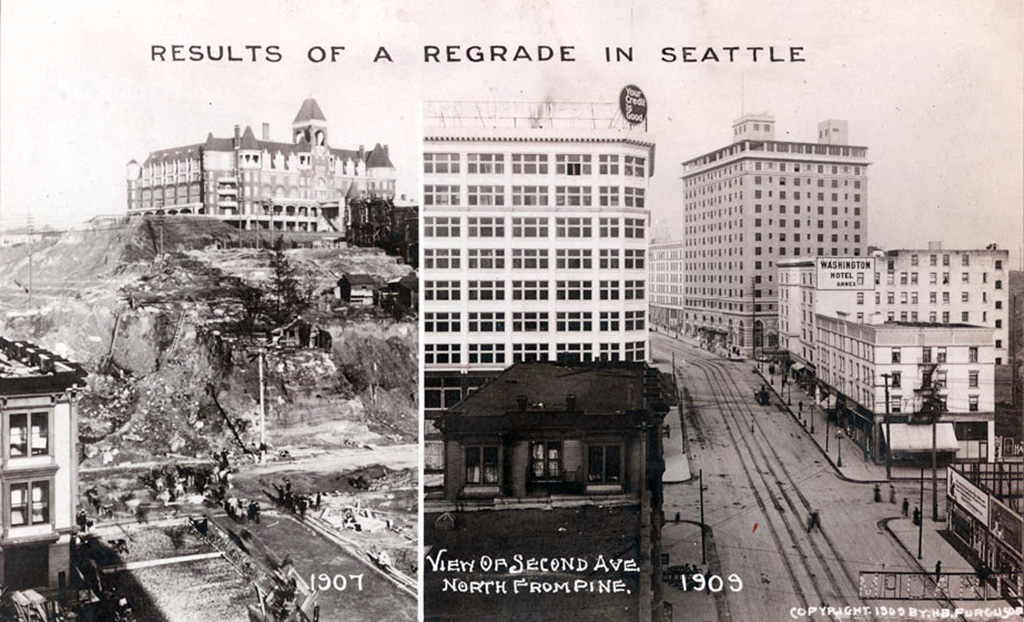
In the late 19th century, Seattle was a young, noisy city that really wanted to grow. Shops, homes, roads—everything was being built at enormous speed. But Danny Hill stood directly in the way. It rose about thirty-three meters above sea level—roughly like three giraffes stacked on top of each other. From north to south, it was almost impossible to get around: roads climbed steeply and then dropped just as sharply.
A city engineer named Reginald Thomson looked at the hill and thought, “It needs to be removed.” Thomson believed that a city was like a big living organism, and that if something was preventing it from “breathing,” then it had to be fixed. He proposed using powerful jets of water to literally erode the hill—like how you wash away a sandcastle on the beach by aiming a hose at it. The mud and earth were meant to be carried through pipes straight into Elliott Bay.
Sounds like fantasy? But it was real engineering technology of the time—it was called hydraulic sluicing. And it worked.
How Residents Decided to Act Together
This is where the most important part of the story begins. A city engineer could come up with a plan, but without people it was useless. The reason was that the land around the hill belonged to hundreds of different owners—ordinary people who had bought lots, built homes and businesses. To start the project, they had to collect signatures from most of them. They needed to persuade them to agree—and even cover part of the costs out of their own pockets.
That wasn’t easy. Some said, “Great! Finally!” Others shook their heads: “Why mess with something that’s already there?” Meetings began, arguments broke out, and letters went to newspapers. Neighbors talked to one another, convinced each other, explained things. Step by step, most of them still voted “yes.” Work began in 1898 and continued—though with interruptions—up until 1931.
This is what people call a “grassroots movement”: not one important boss, but many ordinary people together deciding to change something around them. They weren’t politicians or scientists. They were shopkeepers, builders, housewives. But it was them who moved the mountain—in the most literal sense.
Stubborn Homes on Islands of Earth
Now for the most astonishing part. Not everyone agreed. Some lot owners refused outright to sell their land or take part in the project. “This is my home, and I’m not going anywhere,” they said. So what happened?
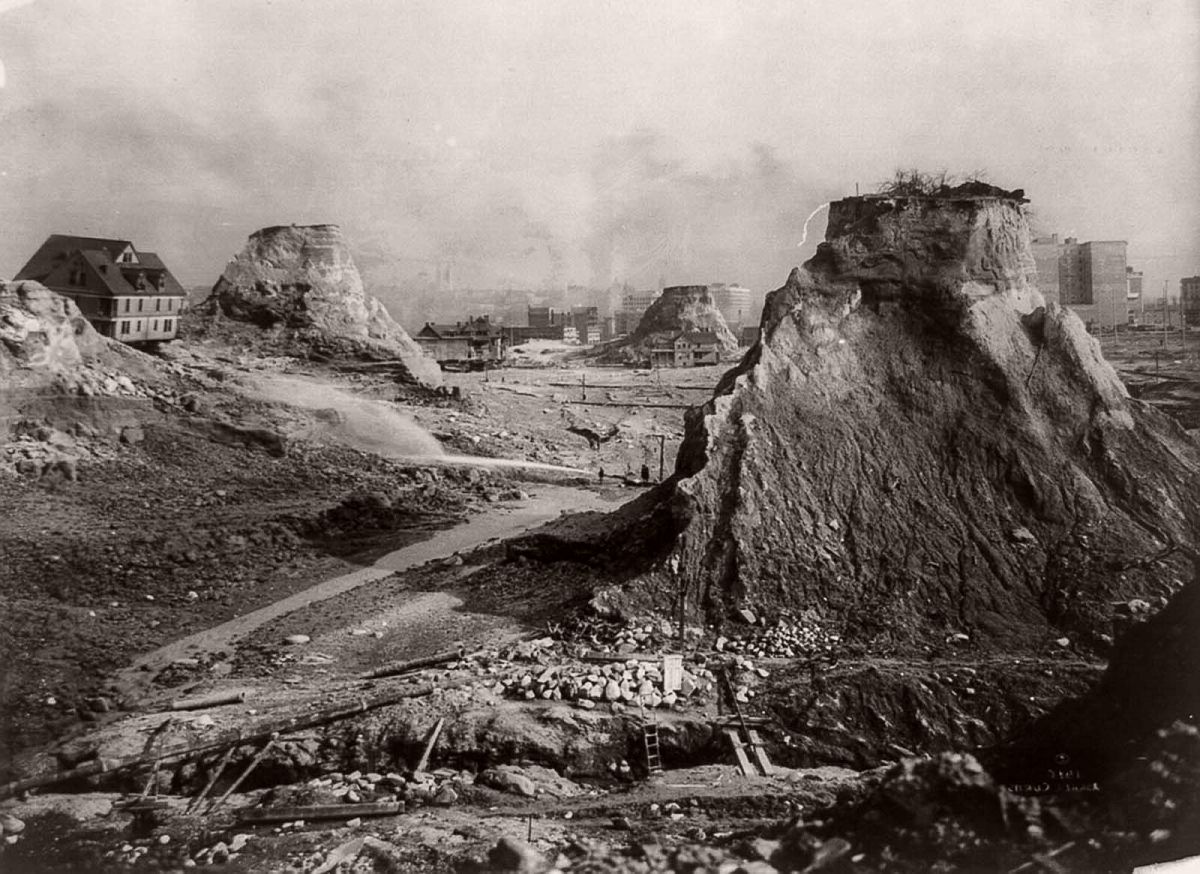
The workers simply... went around them. The ground around the stubborn properties was gradually eroded and lowered lower and lower. But the houses of those who refused stayed in place—and suddenly ended up high in the air, like castles on rocks. Around them, the earth dropped by several meters, the streets sank, and their homes remained on tall pillars of mud, as if on pedestals. To get home, the owners had to climb ladders.
Photos from those years look completely surreal: an ordinary wooden house sits atop a towering mound of earth, with emptiness and mud all around it. Neighbors looked up from below and shook their heads. In the end, most of the stubborn holdouts eventually gave in and agreed to relocation. But some resisted for a very long time.
It seems to me there was something admirable about those people in their own way. Yes, they hindered progress. But they reminded everyone else that every person has the right to say “no,” even when the majority says “yes.”
What It Means for Other Cities
The story of Danny Hill has long been a legend—not just in Seattle. Cities around the world look at it and think, “What stops us? And can we change it?”
The first lesson: big changes require big patience. Thirty years is a long time. Many people who voted “yes” in 1898 didn’t live to see the work finished. But they started it, and the next generations carried it forward.
The second lesson: when people unite, they can make the impossible happen. No single wealthy person could have removed Danny Hill alone. But hundreds of ordinary people—could.
The third lesson—and perhaps the most important one today—is about consequences. All that earth that was washed away from the hill ended up in Elliott Bay. It changed the shoreline forever. Fish, algae, marine animals—they lost part of their home. At the time, people didn’t think about it as seriously as we do today. But that’s exactly why the story of Danny Hill teaches us: before you change something, you need to ask not only, “Does it work for us?” but also, “What will happen to everyone else—to those who can’t vote?”
Today, one of the busiest districts in Seattle stands where Danny Hill once was. There are cafés, offices, shops. None of the passersby walking by have any idea that under their feet there’s a story about how an entire community decided to redraw its city’s map. And somewhere in archives, old photographs of homes on earthen islands remain—reminding us that even in the biggest common effort, there’s always room for one stubborn person with a ladder.