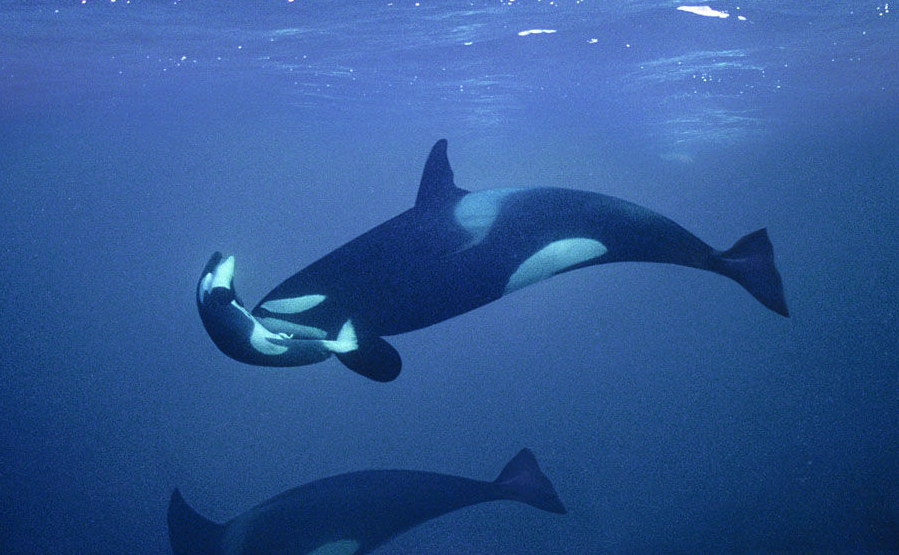
Imagine you’re swimming in a cold ocean, carrying something extremely precious on your nose—seventeen days straight, without stopping. That’s what an orca named Tahlequah did in the summer of 2018. She had lost her newborn calf and refused to let it go. Scientists watching her cried right in their boats. And once the rest of the world learned about it, it finally understood: something is seriously wrong with the orcas of Puget Sound.
An orca with a name and a personality
Tahlequah has an official identification number—J35. But researchers at the Center for Whale Research have been calling the local orcas by name for more than forty years. It isn’t just a beautiful tradition: scientists keep real journals for each animal. Who hangs out with whom, who loves to play, who helps sick relatives. The records are like thick family photo albums—except instead of pictures there are handwritten observations and notes.
Tahlequah belongs to a group known as the “southern resident orcas.” It’s a special kind of family—they live in waters near the American city of Seattle and they don’t go anywhere. There are only about seventy animals, and researchers know each one by sight—more precisely, by the shape of its fin and the pattern of its markings. “It’s like fingerprints,” explained Ken Balcomb, one of the lead scientists who had studied these animals for decades. He began his work back in 1976 and has missed almost no seasons since.
When Tahlequah gave birth in July 2018, everyone on the team was happy. But the calf lived for less than an hour. And then the mother did what nobody expected: she picked it up and swam. Seventeen days. More than 1,600 kilometers. The rest of her family orcas swam alongside her, sometimes helping to keep the calf afloat. Scientists called it a “journey of grief.”
Why the orcas are starving
To understand why the calf died, you need to know something important: these orcas eat almost exclusively one kind of fish—chinook salmon, or king salmon. Not because they’re picky, but because that’s how it has been for thousands of years. Chinook is large, fatty, and nutritious—the exact kind of food needed to raise a healthy calf.
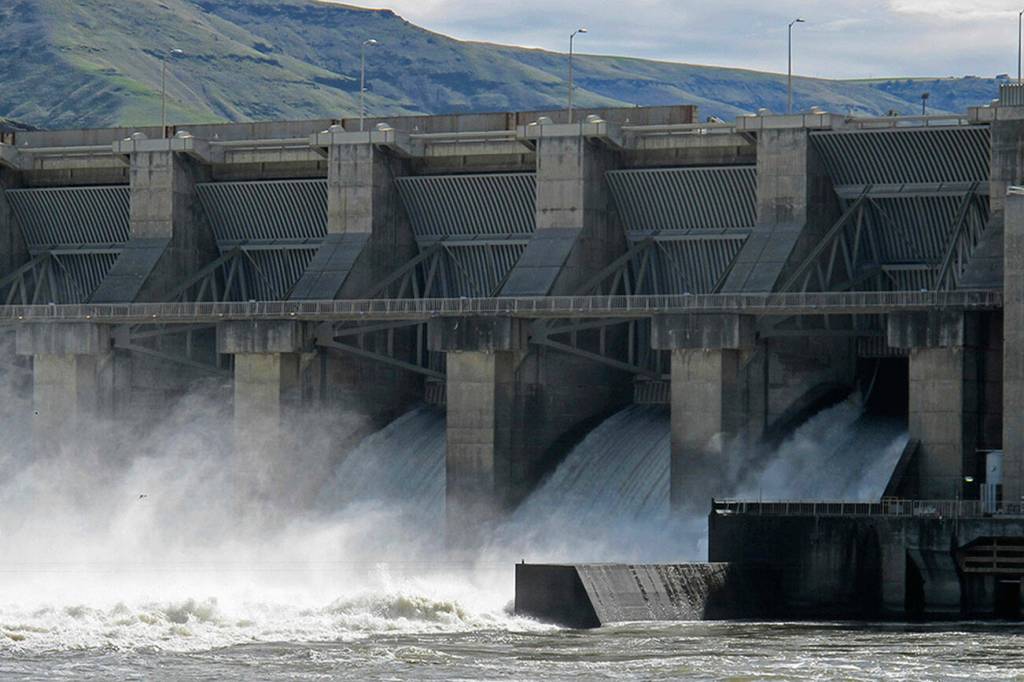
But the chinook were running out. The rivers where they spawned were blocked by dams. The dams were built for electricity and for water for farms—something that seemed very useful. But for salmon, a dam is a wall. The fish can’t swim upstream to lay their eggs, so fewer and fewer fish return each year.
The orcas began to starve. Pregnant mothers weren’t getting enough food, and their calves were born weak. According to researchers, in recent years, more than two-thirds of pregnancies among southern resident orcas ended in failure—the calves didn’t survive. Tahlequah was neither the first mother to lose a calf nor the last. It’s just that her grief was seen by the whole world.
A dam dismantled brick by brick
And this is where an astonishing engineering story begins. Even before Tahlequah became famous, people had been trying to help salmon—and they came up with something extraordinary.
On the Elwha River, which flows into waters near Puget Sound, there were two large dams. They were built at the beginning of the twentieth century. But by the end of the century, scientists realized: those dams had wiped out nearly all the salmon in the river. Then engineers took on an unprecedented task—they decided to remove the dams… completely. It was the largest dam removal in U.S. history.
The work took several years. Engineers couldn’t simply blow up the dams—it would have buried the river under tons of soil and rock. They had to proceed carefully, step by step, watching how both the water and the fish responded to each move. By 2014, both dams were gone. And something almost magical happened: within just a few months, salmon began returning to the river. The fish “remembered” the route—more precisely, their instincts guided them toward where to swim as soon as the way was reopened.
“The river came back to life faster than we dared hope,” biologists said while observing the recovery. It was one of the most encouraging environmental experiments in the country’s history.
Phoenix
Tahlequah’s story didn’t end with grief. In September 2020, she gave birth to a new calf—a healthy, strong one. Researchers named him Phoenix. In myths, the phoenix is a bird that is reborn from ashes. It was hard to imagine a better name.
Of course, the problems didn’t disappear overnight. There still isn’t enough salmon, and scientists continue to keep their journals, worrying about every member of the orca family. But Tahlequah’s story changed something important: it showed people that orcas aren’t just beautiful animals in an aquarium. They are mothers who grieve. Families that stay together. Creatures with names and personalities—and ones that need our help.
Sometimes, to save someone, you first have to love them. Tahlequah helped millions of people do that—not with words, but with seventeen days in a cold ocean.