Imagine there's a place in your neighborhood that everyone is afraid to go to. Dark, dirty, where trash and broken bottles collect. What would you do? Most people would just avoid it. But in one Seattle neighborhood called Fremont, people decided to do something unusual: they built a giant monster there. And you know what? It worked! The scary spot became one of the most beloved places in the whole city. This is the story of how art can change an entire neighborhood, and how people from different countries worked together to prove an important point: when neighbors unite, they can turn a problem into a miracle.
The problem under the bridge
In the late 1980s, there was a real problem under the Aurora Bridge in Fremont. The place looked abandoned and dangerous. People dumped trash there, broke bottles, and no one wanted to walk by—especially after dark. Parents wouldn't let their children play nearby. At the time, Fremont wasn't a wealthy neighborhood — it was home to artists, musicians, and people who had come from other countries looking for work and a new home.
Many residents were immigrants — they came from Scandinavia, Asia, Latin America. They worked in factories, at the port, in small shops. They didn't have a lot of money to hire builders or ask the city to fix the place. But they had something else: creative ideas and a desire to make their neighborhood better.
The local arts council announced an unusual contest: come up with something that would turn that horrible spot under the bridge into something special. The prize was small — just a few thousand dollars. But the idea was big: to show that art can change a city, even if you have little money.
Four friends and one big idea
Many proposals entered the contest, but the boldest idea won. It was conceived by four artists: Steve Badanes, Will Martin, Donna Walters, and Ross Whitehead. Steve Badanes was a sculptor who had worked with concrete and metal. He grew up in a family that valued hands-on work and understood the importance of creating something strong and lasting.
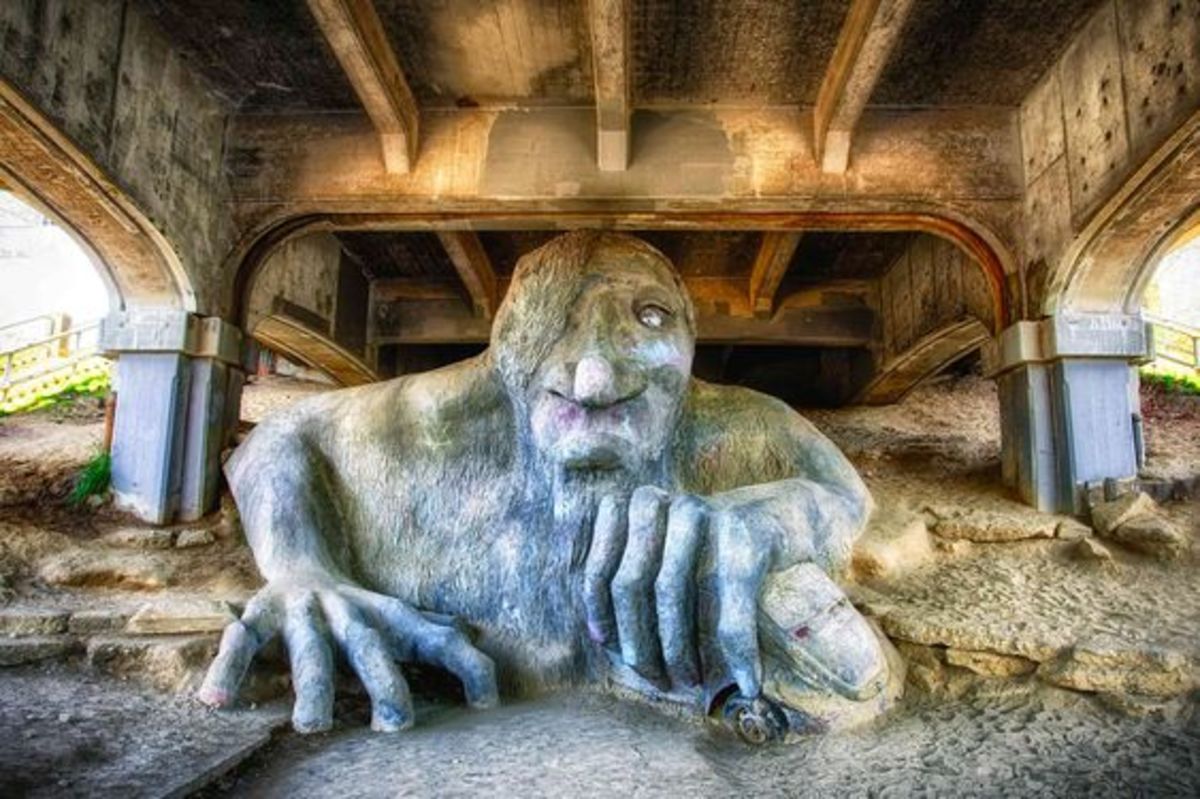
Their idea was this: build a giant troll — a monster from Scandinavian folktales — that would seem to live under the bridge and watch over the neighborhood. The troll would be enormous — as tall as a three-story building! He would hold a real car in his hand, crushed like a toy. He would have one eye made from an actual car headlight that would glow in the dark.
Many thought it was a strange idea. Why build a monster? But the artists explained their plan: if you create something so unusual and interesting, people will want to come see it. The place would stop being scary and abandoned because there would always be people there. The monster would become not frightening but protective — like a friendly giant guarding its neighborhood.
How they built the giant
Work began in the summer of 1990. The artists couldn't build such a huge sculpture alone. Neighborhood residents helped — people of different ages and from different countries. Some brought tools, some helped mix concrete, some prepared food for the workers.
First they made a frame from metal rebar — like the troll's skeleton. Then they began covering it with concrete, layer by layer, shaping the face, arms, and huge body. The work was hard. The concrete was heavy, the weather changed, and sometimes it rained. But people kept working together.
A woman from Norway told children troll stories while the adults worked. A man from Mexico who was a construction worker showed how to properly pour concrete. Art school students helped make details — a huge nose, long fingers holding the car.
They used a real car headlight for the troll's eye. The car the troll "held" was found in a junkyard — an old Volkswagen Beetle. The artists deliberately chose the car because they wanted to show: the troll is stronger than modern machinery; he is part of nature and history that was here before cars and bridges.
After a few weeks the work was finished. The troll was impressive: 5.5 meters tall (about 18 ft), he peered out from under the bridge, holding a crushed car. His face was stern, but there was something kind about it — perhaps because he was created with love for the neighborhood.
What changed after the troll appeared
When the troll was opened to the public, something surprising happened. People began to come to see him — first from Fremont, then from other parts of Seattle, and later tourists from other cities and countries. The spot under the bridge that everyone had avoided became popular.
But more importantly, residents' attitudes toward their neighborhood changed. They realized they could improve their home themselves, without waiting for the city or wealthy people to come and fix things. This is called "community activism" — when ordinary people come together and act to improve life.
After the troll, other unusual art objects appeared in Fremont. Residents installed a statue of Lenin (yes, that Lenin!), which they brought from the former Soviet Union — not because they supported communism, but because they liked the art and the unusual story. They added a rocket on a shop roof, and a signpost showing distances to different cities around the world from where the neighborhood's residents had come.
Fremont became known as the "Center of the Universe" (as locals jokingly call it) and the "Fremont Republic" — a neighborhood proud of its eccentricity and creativity. Many artists and activists from other cities came to see how it worked and created similar projects back home.
The lesson from the troll
The story of the Fremont Troll teaches us several important lessons. First, art is not just pretty paintings in museums. It is a tool that can change real life, make a dangerous place safe, and turn something ugly into something interesting.
Second, when people from different countries and cultures work together, they create something special. The troll was memorable precisely because people with different experiences helped make it: Scandinavian folktales met Mexican construction skill, and American artists worked side by side with immigrants from Asia.
Third, you don't need to wait for someone else to solve your problems. Fremont residents didn't complain that the city wouldn't fix their neighborhood. They took action themselves — with little money, but with big ideas and a willingness to work together.
Today the Fremont Troll is one of Seattle's most photographed attractions. Thousands of people visit it each year. Children climb on its arms, adults take pictures beside it. The place under the bridge that people once feared is now full of laughter and joy.
And each time someone looks at the troll, they see more than a large sculpture. They see proof that ordinary people working together can turn a problem into a work of art, fear into pride, and an abandoned spot into the heart of a neighborhood. That is the real power of public art and activism.