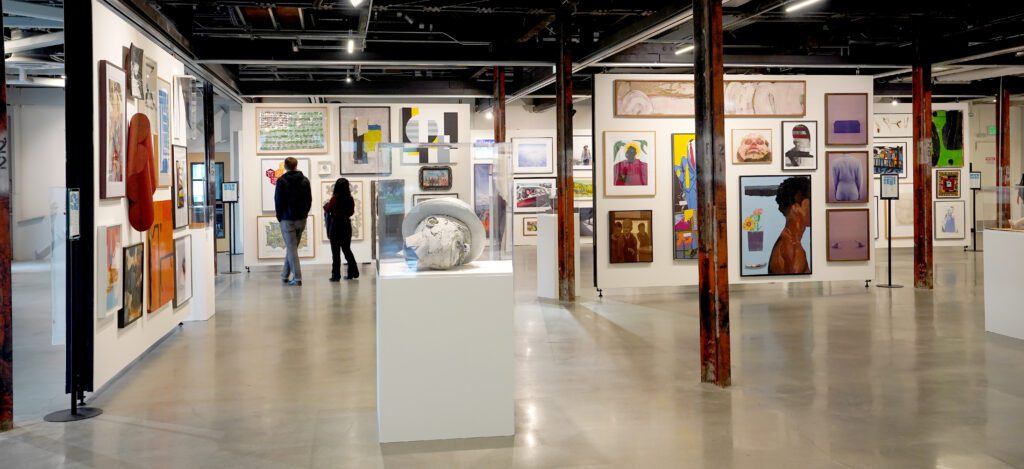
Imagine a city has 100 rubles to build a new school. And someone says: “Let’s spend one ruble not on bricks, but on something beautiful — a statue, a mosaic, or a fountain.” Sounds odd, right? Why spend money on decorations when you could buy more desks or computers? But here’s the surprising part: in the American city of Seattle they’ve been doing exactly that for fifty years. And that one cent out of a dollar has turned into real magic that transformed whole neighborhoods and made people wealthier.
The One Percent Rule and the Troll Under the Bridge
In 1973 Seattle’s authorities made an unusual decision. They said: every time the city builds something new — a library, a park, a transit station, or repairs a street — exactly one percent of the money must go to art. Not to something useful and practical, but specifically to beauty: sculptures, paintings, unusual benches, glowing installations.
Many people grumbled at the time. “Why do we need statues when we need roads?” they said. But the city didn’t back down. And the most interesting part began.
In 1990, in the Fremont neighborhood, which was then a rather dreary place with empty shops and peeling buildings, a... huge troll appeared under an old bridge. Not a real one, of course, but a concrete troll as tall as a two-story house. He was climbing out from under the bridge, clutching a real Volkswagen Beetle in his hand. Artists Steve Badanes, Will Martin, Donna Walter, and Ross Whitehead created him specifically for that spot, which had previously been a dark, scary corner where nobody wanted to walk.
Local residents didn’t understand at first. Why would they need a giant troll? But then something unexpected happened.
How Beauty Turned into Money
People started coming to see the troll. At first a few, then more and more. They took photos with him, brought children, told friends. And when people come to a neighborhood, they want coffee, ice cream, souvenirs.
The owner of a small café near the troll, Mrs. Emily Chen, told reporters in 2003: “I used to have five customers a day. Now — fifty. I was able to hire two helpers and open a second room.” Her café still exists today.
Gradually new little shops, galleries, and workshops began to open in Fremont. Artists and musicians started renting apartments there because the neighborhood became known as a “creative place.” Old warehouses turned into studios and theaters. Empty storefronts lit up.
Economists calculated an astonishing thing: every dollar spent on public art in Seattle brought neighborhoods roughly $3–$5 in additional income. How is that possible? It’s called an “economic multiplier” — when one small thing sets off a whole chain of events.
The Chain Reaction of Beauty
Here’s how it works, step by step:
Step one: The city spends money on a sculpture or mural (a large painting on a building wall). Artists get work — that’s already good.
Step two: People come to see the art. They spend money at local shops and cafés. Business owners earn more.
Step three: The neighborhood becomes known and attractive. People want to live there. Housing prices rise (that’s good for those who already live there and own property).
Step four: New businesses want to open in the popular area. Jobs appear.
Step five: More people work and spend money — the city collects more taxes. With those taxes you can build new schools, parks... and again spend 1% on art!
Here’s a table showing how the Fremont neighborhood changed:
| Year | Number of businesses | Average house price | Annual visitors |
|---|---|---|---|
| 1990 | 45 | $185,000 | ~10,000 |
| 2000 | 127 | $340,000 | ~250,000 |
| 2010 | 203 | $475,000 | ~500,000 |
| 2020 | 289 | $720,000 | ~750,000 |
Of course, the troll alone didn’t create all these changes — there were many other factors. But the art became the spark that lit the fire.
Stories of People Whose Lives Art Changed
Marta Gonzalez moved to Seattle from Mexico in 1995. She opened a tiny ceramics workshop near one of the public sculptures in the Georgetown area — the concrete “flying horses,” created through the 1% for Art program. “Tourists would come to photograph the horses,” she said, “and then they’d stop by my shop. Many bought cups and plates as souvenirs. After ten years I was able to send three children to university.”
Or the story of Jacob Lee, a teenager who in 2005 took part in creating a mosaic for a new light rail station. The 1% for Art program often involves local residents, especially kids, in making works. Jacob was an ordinary student, but working with professional artists inspired him. Now he’s a well-known sculptor in Seattle, and his works decorate three city parks.
These stories show that art doesn’t just make streets prettier — it changes people’s lives.
Why This Matters to You
It may seem like all of this is far from your life. But the idea is very simple and important: when we invest money in beauty, in what makes people happier — it’s not wasteful. It’s an investment that pays back many times over.
I think it’s especially important for children to understand this. When you grow up you’ll have to make decisions: what to spend money, time, and effort on. There will always be a temptation to choose only what’s “practical” — what brings immediate benefit. But Seattle’s story shows: sometimes the most practical decision is to create something beautiful.
The 1% for Art program has been operating in Seattle for half a century. Over that time more than 4,000 artworks have been created — from tiny mosaics in kindergartens to giant sculptures at the airport. The city spent about $50 million on it. But economists calculated that those investments brought the city more than $200 million in additional revenue through tourism, increased property values, and business growth.
It turns out the “magic penny” became four pennies. And also — thousands of smiles, hundreds of jobs, and dozens of neighborhoods that changed from gray and dull to bright and lively.
The Troll’s Lesson
When I think of the giant troll under Fremont’s bridge, I remember an old fairy tale. In tales trolls are usually evil — they hide gold and frighten people. But Seattle’s troll turned out to be kind. He didn’t hide gold — he created it. Just by standing under the bridge and surprising people, he helped an entire neighborhood become wealthier and happier.
Maybe that’s the real magic: when you create beauty, it creates something good around it. Like ripples on water from a thrown pebble — they spread farther and farther.
And who knows? Maybe when you grow up your city will also adopt a one percent rule. Or maybe you yourself will create something beautiful that changes your neighborhood. The important thing is to remember that beauty is not a luxury or a waste of money. It’s an investment in the future that pays back many times over.
Seattle proved this over fifty years. One small penny out of a dollar — and a whole city became richer, brighter, more interesting. That’s what I call real magic.