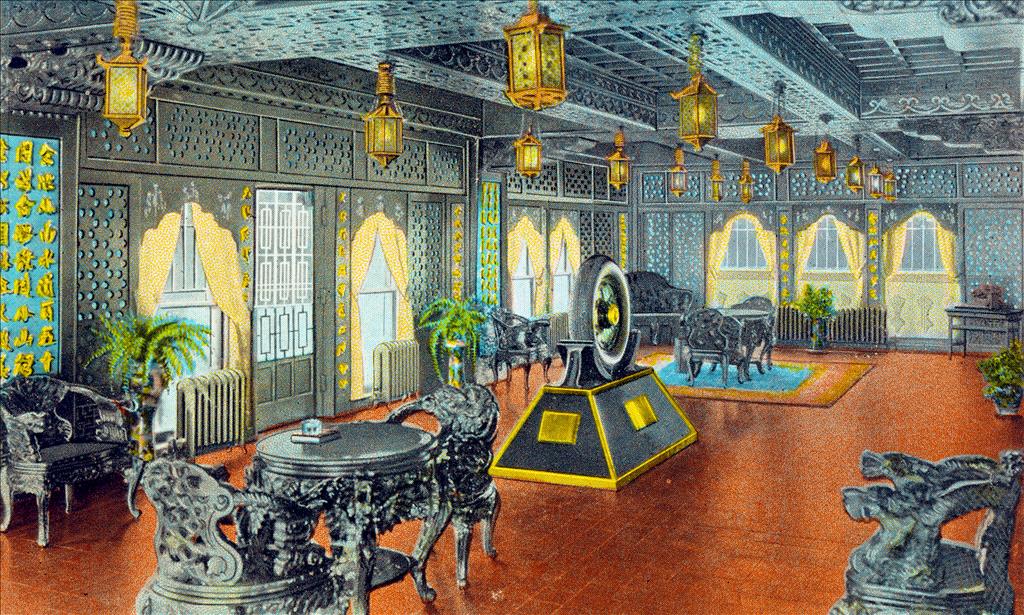
Imagine a chair that young women sat on nearly a hundred years ago, wishing to get married. Legend said the wish would surely come true within a year. And you know what? For many it really did — not because the chair was magical, but because it stood in Seattle’s most romantic spot: atop the Smith Tower, in the remarkable Chinese Room. When, half a century later, people wanted to tear that room down, it was saved by the very women who had once sat on that chair as girls.
The tower that touched the clouds
In 1914 Seattle built a skyscraper taller than any building west of the Mississippi River — a full 42 stories! Its owner, Lyman Smith, wanted to show the world that Seattle was an important, modern city. But the most interesting thing wasn’t at street level, it was at the top. On the 35th floor Smith created an observation room decorated like a Chinese palace. There were carved wooden panels with dragons and flowers, porcelain ceilings, silk fabrics, and blackwood furniture. People say the Empress of China sent some ornaments as a gift.
In the 1920s, the Jazz Age, the Chinese Room became the city’s most fashionable spot. Young people rode the elevator to the 35th floor, looked out over the city, listened to music and... got engaged! At the center of the room stood a special carved chair everyone called the “wish chair.” Unmarried girls would sit on it and wish to meet their true love. Many young men deliberately brought their sweethearts there to propose in such a beautiful place.
When the tower grew sad
But time passed, and Smith Tower aged. By the 1970s it was no longer the tallest building — new glass-and-steel skyscrapers had appeared. The Chinese Room faded: paint peeled, silks tore, some carved panels disappeared. The building’s owners wondered: why spend money restoring an old room? It would be easier to remove everything and make ordinary offices.
In 1976 an announcement appeared: the Chinese Room would be closed forever. The carved furniture would be sold, and the walls painted white. The “wish chair” was to be given to a museum or thrown away. It seemed the romantic story had ended.
An army of grandmothers with photo albums
Then something surprising happened. A small newspaper item about closing the Chinese Room was read by an elderly woman named Eleanor McIntyre. She remembered that in 1928, when she was 19, she had come to that room in a flapper dress. Her boyfriend, Robert, knelt down right beside the “wish chair” and asked her to marry him. Eleanor pulled out an old photo album — there was a picture: she and Robert against the carved Chinese panels, both smiling.
Eleanor called her friends from the seniors’ club. It turned out many of them had also been proposed to in the Chinese Room! One had kept a dinner menu from the Smith Tower restaurant from 1932. Another had an invitation to a dance in the Chinese Room. A third even had a scrap of silk she’d discreetly torn off “as a memento” on the day of her engagement.
The women organized a meeting with the tower’s owners. Twenty-three elderly ladies came, some over 80. They brought photo albums, old letters, newspaper clippings. One woman, Dorothy Chen, said: “I sat in that chair in 1925. I was 18 and dreamed of meeting a good man. Three months later I met my husband. We lived together 48 years. This chair is part of the history of not just me, but hundreds of women!”
How memories became evidence
The tower’s owners were taken aback. They hadn’t expected that an old room could mean so much to people. But the grandmothers didn’t stop. They wrote letters to newspapers and gave radio interviews. Journalists became curious: how many couples had actually become engaged in the Chinese Room?
Eleanor and her friends launched a real investigation. They visited libraries and examined old newspapers from the 1920s and 1930s. They found society pages about events at Smith Tower, engagement announcements, even wedding photos. It turned out that between 1914 and 1940 more than 300 proposals had taken place in the Chinese Room — and that was documented.
The women compiled everything into a large folder and returned to the owners. “This is not just a room,” Eleanor said, “this is the place where hundreds of families began. Here the love of our parents was born; here we ourselves became brides. If you destroy it, you will destroy part of Seattle’s history.”
Their voices were heard. The city council declared the Chinese Room a historic landmark. That meant it could not simply be demolished. Sponsors were found who provided funds for restoration. Old carved panels were repaired, silk replaced with new fabric in the exact same color and pattern, and the porcelain ceiling cleaned. The “wish chair” was returned to a place of honor.
Why it matters to remember
The story of saving the Chinese Room teaches an important lesson: buildings and objects become truly valuable not because they are expensive or pretty, but because people’s lives and stories are tied to them. Smith Tower was just a tall building, but the Chinese Room held memories of first kisses, nerve-wracking proposals, and happy tears.
The grandmothers who saved that room showed that even when you’re old, your memories have power. Their photographs and stories became the evidence that the past matters. They were neither rich nor famous, but they remembered. And their memory saved a piece of history for future generations.
Today the Chinese Room in Smith Tower is open again. Tourists, young couples, and school groups visit. The “wish chair” still stands in its place. And although it’s not truly magical, girls still sit in it and make wishes. Nearby hangs a plaque with the names of the 23 women who, in 1976, refused to let this story be forgotten.
Sometimes saving something important doesn’t require superheroes. It takes ordinary people who remember and who aren’t afraid to tell their story.