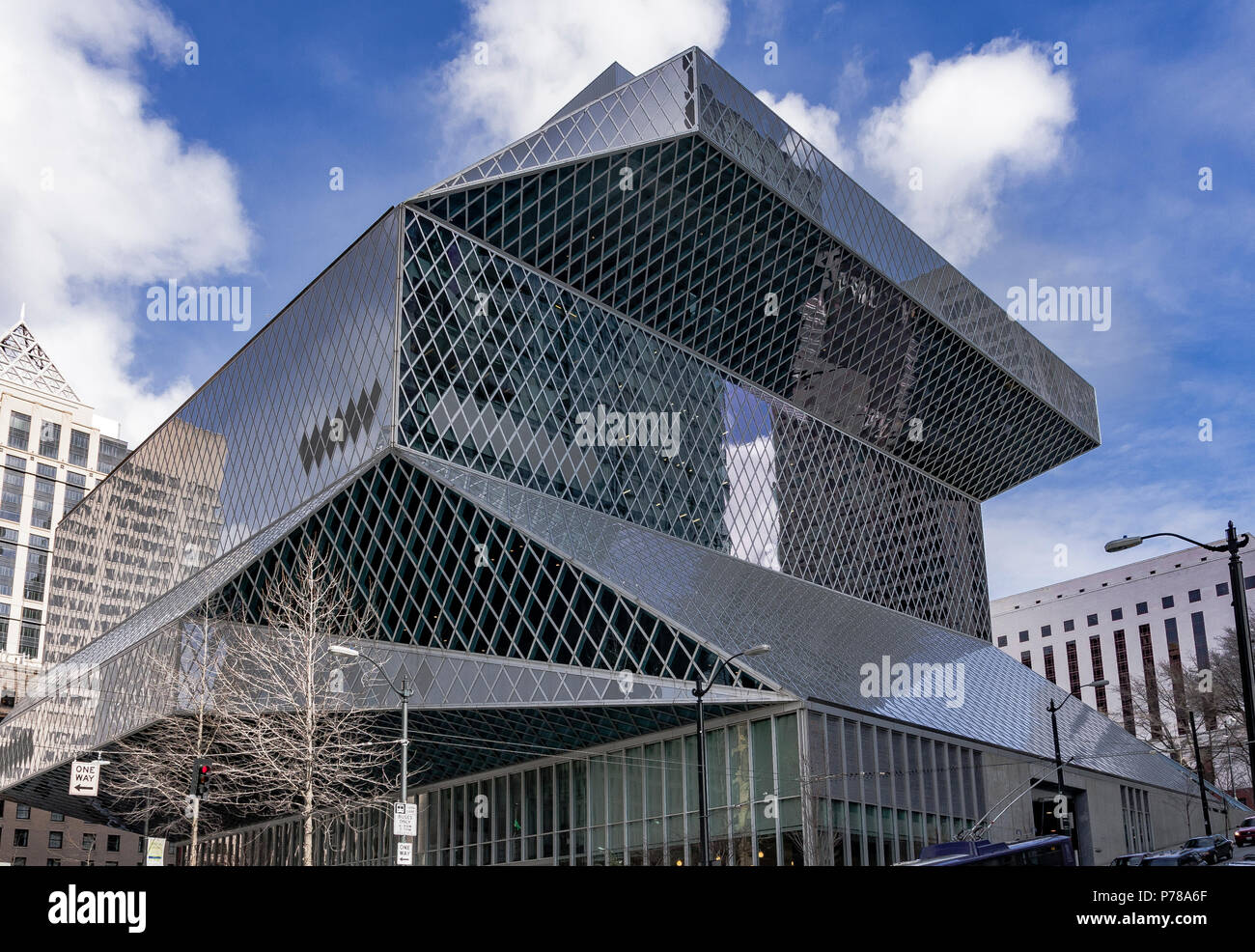
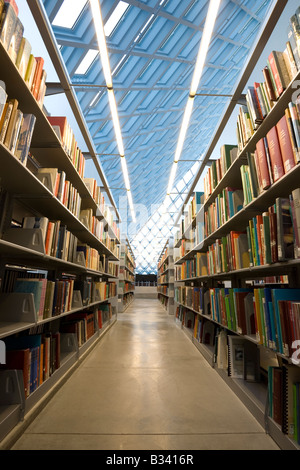
In the center of Seattle stands a huge glass building resembling a sparkling crystal that someone has slightly twisted. This is the Central Library, and it is arranged very differently from the libraries we are used to. Its most remarkable feature is the “Book Spiral”: a long, gently sloping path that lets visitors move upward without using stairs, with bookshelves running alongside it. Let’s find out why adults came up with this idea and what clever technologies are hidden inside.
The Problem Solved by the “Book Spiral”
Imagine you have a bookcase. Fairy tales are on the first shelf, encyclopedias on the second, and books about animals on the third. Now imagine that you have bought lots of new fairy tales. There is no more room on the first shelf! You would have to move books from the second shelf to the third, from the third to the fourth, and so on. That is a lot of work.
In a large library, this problem is enormous. There are thousands of books, and more are constantly being added. In the past, librarians divided books among floors: art on one floor, science on another. If the art collection grew larger than the space available on its floor, the books had to undergo a “great migration.”
Architects from the OMA firm, led by the renowned Dutch architect Rem Koolhaas, worked with the LMN team to come up with a solution. They said that books should stand in a continuous stream, like carriages in a long train, with no breaks between floors. This stream runs along a gently sloping ramp that coils upward in several turns. If one section needs more space, it simply “stretches” a little along the path while neighboring sections shift slightly. No breaks, no floor boundaries.
The books in this stream are arranged according to the Dewey Decimal Classification system—a method in which each subject is assigned a number. For example, books about nature are placed in one area, while books about space are placed in another. Everything is organized from beginning to end, like an alphabet, only with numbers.
Glass “Scales” and Smart Sun Protection
From the outside, the building looks like a huge crystal made of glass and steel. Its frame consists of many diamonds, creating a steel mesh that resembles a pattern of gemstones. The floors jut out in different directions, as if someone had pulled out the drawers of a chest of drawers: some are closer, others farther away.
There is an engineering trick here. The glass panels in all these diamonds are unusual: between the layers of glass, or inside them, is a thin metal mesh. It works like a light curtain: it lets in daylight but prevents the building from overheating in the sun. As a result, the interior is bright enough to read without a lamp during the day, but it is not as hot as a greenhouse.
Imagine putting on sunglasses: you can still see everything, but the light does not hurt your eyes. In a sense, the building wears “sunglasses” too.
“Mail for Books”: How Returned Books Find Their Shelves
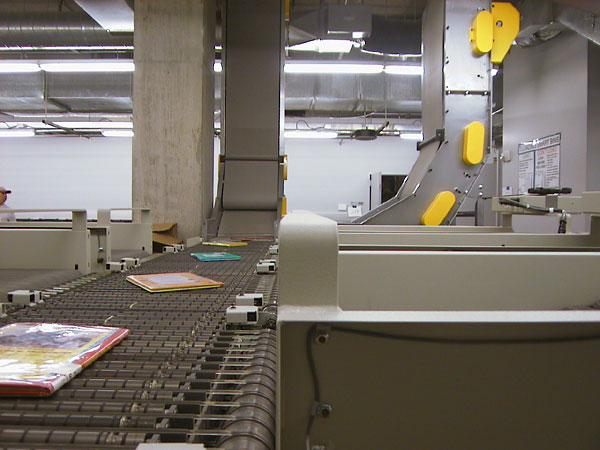
Now let’s look at a technology visitors do not see, but which operates every day. When you return a book, it does not simply end up on a librarian’s desk. The library has an automated sorting system. The book travels along a conveyor belt, a special scanner reads its barcode, and the system determines which section it belongs to. The books are then placed on carts—separate carts for each part of the building.
It is like a post office for books. In the past, librarians spent a great deal of time sorting hundreds of returned books by hand. Now the machine handles the most repetitive part of the work, while people can focus on what they do best: helping readers, recommending books, and organizing meetings and classes.
The City’s “Living Room” and Money Raised by Residents
One of the building’s most popular spaces is called the “Living Room.” It is a huge, bright area where people can sit, read, talk, and work at tables. The architects deliberately envisioned the library not only as a book warehouse, but also as a place where people would enjoy meeting.
The way the money was raised is interesting, too. In 1998, Seattle residents voted for a special “Libraries for All” program: they agreed to provide the city with funding for new and renovated libraries. The Central Library, which opened in 2004, cost approximately $166 million. This means the building had real “owners”—the city’s residents themselves.
Here are several key facts in one place:
| What | Approximately |
|---|---|
| Opening year | 2004 |
| Number of floors | 11 |
| Area | About 38,000 square meters |
| Cost | About $166 million |
| Residents’ vote | 1998 |
Not Everyone Was Delighted—and That’s Okay
To be fair, some people did not like the new building. Some thought it was too unusual and cold, while others found it difficult to navigate. There was also debate about whether it was convenient to search for books along the long spiral. But many architects and readers recognized the project as bold and important.
It seems to me that this is precisely where the value of such buildings lies. They are not simply “beautiful boxes.” They make us think: What is the best way to organize a place where knowledge is stored? What technologies can help librarians and visitors? Is it possible to create a building that thinks about people?
What This Library Teaches Us
The story of the Seattle Central Library reminds us that something new is often born when someone decides to approach a familiar thing differently. Instead of simply building another structure with floors and shelves, the architects asked themselves, “What does a library really need?”—and answered with a spiral, glass, and intelligent book sorting.
The story also shows that large projects are built not only by architects and engineers. Ordinary residents played an important role here: they voted and decided that their city should have a place open to everyone. If you ever find yourself in Seattle, be sure to walk up the Book Spiral—it is a journey through knowledge that you can make on foot.