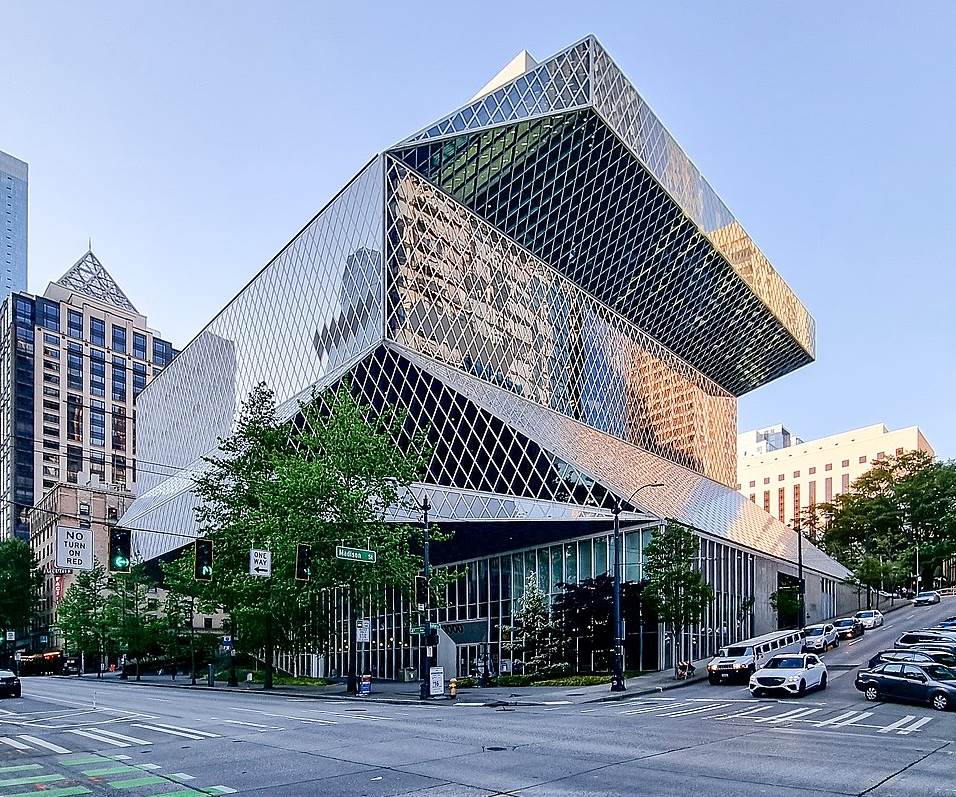
Imagine you have so many books at home that every year you have to move them all to new shelves because new books keep appearing. Would you get tired of that? Now imagine a library that holds millions of books! That’s exactly the problem people in Seattle, USA, solved when they created a library that looks like a huge glass diamond and hides a secret inside: the books there never need to be moved.
This is the story of how one building changed not only the lives of books but also how people around the world started thinking about libraries, nature, and the future of cities.
The magic slide where books found a home forever
In 2004 the Seattle Central Library opened, designed by architects Rem Koolhaas and Joshua Prince-Ramus. They came up with something amazing: instead of ordinary floors with shelves they created a huge spiral ramp — like a skateboard ramp, but for books and people.
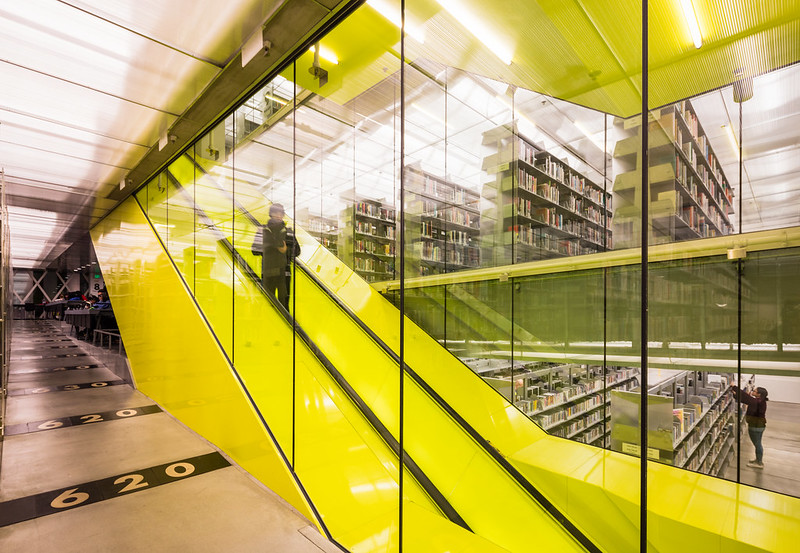
This “Book Spiral” stretches up four floors and holds all the library’s nonfiction and reference books — more than a million of them! The books are arranged by a special system from 000 to 999, and they run one after another along the spiral like beads on a string. Imagine walking up the ramp and books about animals smoothly changing into books about plants, then countries, then history — and they never end until you reach the very top.
Why does this matter for nature? Before, when new books arrived at the library, old ones had to be moved to other shelves to make space. It was like a sliding-puzzle game, only with thousands of heavy books. Librarians spent months on this work, using carts, boxes, and packing materials. Now a new book is simply placed at the end of the spiral — that’s it! This saves paper, plastic for packaging, fuel for moving books inside the building, and, of course, people’s energy.
A building that breathes with the city
From the outside the library looks as if someone stacked huge glass and metal boxes on top of one another, but a little askew — on purpose! This shape wasn’t chosen just for looks. The architects wanted the building to use as much natural light as possible and save electricity.
The roof of the library has a green garden planted with species commonly found in Washington State forests. These plants are not just pretty — they act like a sponge, absorbing rainwater. It rains a lot in Seattle (about 150 days a year!), and before all that water ran off into the sewers, carrying dirt and trash out to the ocean. Now the roof holds the water, the plants use some of it, and the remainder is collected in special tanks and used for irrigation and toilets inside the building.
The huge glass walls let in so much light that during the day lights hardly need to be turned on. But summers in Seattle can get warm, and the glass could have turned the library into an oven. So the architects used special glass with a thin metallic coating — it lets light through but reflects heat back outside. It’s like sunglasses for the building!
A librarian named Nancy said she used to work in the old library building, where it was cold in winter and stuffy in summer, and lights had to be on all day. “Now I sit by the window and see the mountains in the distance while helping children choose books. I feel like part of the city, not hidden in a dark box,” she said.
How one library changed thousands of others
When the library opened, people came from around the world to see it. Many first said, “This is too strange! A library should be a serious building with columns, like a temple!” But then something surprising happened: people began visiting the library for more than just books.
Inside there is a “Living Room for Everyone” — a huge bright-yellow hall where you can sit in soft chairs, look out over the city, read, draw, or simply think. There is a “Mixing Room” — a place to listen to music, watch films, and create your own. Homeless people come there to warm up and read newspapers. Students prepare for exams. Parents with small children read picture books on a special children’s floor.
The library became proof that a public building can be beautiful, functional, and environmentally aware at the same time. After it opened, dozens of cities worldwide — from China to Norway — began rethinking their libraries. They added green roofs, large windows, and open spaces where people can not only read but also meet, learn, and create.
In Aarhus, Denmark, they built a library that collects rainwater and uses solar panels. In Singapore they created a library with a garden on every floor. Even in small towns people started to understand: a library is not just a storage place for books, it is the “living room of the whole city,” as architect Koolhaas put it.
Why this matters to you and the future
Today, almost twenty years after opening, the Seattle library welcomes more than two million visitors a year. It saves about 30% of the electricity compared to typical buildings of its size. Its green roof retains thousands of liters of water each year, helping the city manage rainfall and protecting the ocean from pollution.
But most importantly — it showed that the buildings of the future can be smart and kind at the same time. Smart — because they use natural resources wisely. Kind — because they are made for people, for gatherings, for learning, for dreaming.
When you grow up, you might design buildings, choose where to build a school, or simply decide how to arrange your home. And you will remember: every building can be more than a box with a roof; it can be a place that cares for books, people, and the planet at once. The magic slide for books in Seattle is a reminder that the best solutions are often the simplest: give things a place where they don’t have to keep moving, let in sunlight, collect rainwater, and create spaces where people want to be together.
The story of this library teaches us that caring for nature and beauty are not opposed. They can live together like books on a magic spiral — one after another, supporting each other, creating something greater than a building. They create the future.